How We Run Our Amazon Business with AI Agents, and the Guardrails We Put Around Them
Published Updated

We build WisePPC, and we also sell on Amazon through our own brands. So the first people to ask “can an agent actually run this?” were us. This is an honest account of what our own AI agents do on WisePPC today, the guardrails we put around them, and what we are still testing.
The short version: the app now shows more reports and offers more actions than any one person can watch by hand. Ads and seller data, search terms, profit, inventory, bids, budgets, rules. Our answer was not another dashboard. It was to let our own agents work through WisePPC’s MCP server, with WisePPC providing the data and the permission model. One of the agents we use is Hermes Agent, an open-source agent from Nous Research. Another is Grok Bot, the always-on AI agents app from xAI. Both connect through WisePPC’s MCP server or REST API with a scoped key, like any other MCP client. WisePPC does not host or run the agent, and it is not affiliated with either. You bring yours.
Six jobs our agents do
1. “What changed overnight?”
Every morning an agent running in Hermes on Telegram reads our account health check and the change history, then sends a short message: which campaigns hit their budget early, which advertised product went out of stock, which target’s bid someone changed the evening before. It then proposes a handful of bid reductions and pauses.
The important part is what it does not do: it sends nothing straight to Amazon. The proposals wait in the WisePPC approval queue with the reasoning attached. We open the queue, read each one, and approve or decline.
2. “Why did my best product family drop 30%?”
This is the kind of question that eats an afternoon. The agent freezes the product family (the parent and every child SKU), compares the last two complete periods for units, sessions, conversion, Buy Box and price, and splits the result by child SKU so one stock-out is not mistaken for a family-wide problem. It then cross-checks Brand Analytics shares and the current ad coverage.
We gave it one hard rule: it does not name a cause on a single signal. If only one data source points at an explanation, the answer says “this is what the data shows, this is what we cannot tell yet”. And it only reports. It does not change anything while it investigates.
3. The quiet daily listing-health digest
We run this one on Grok Bot. A scheduled check reads listing content and listing issues across the catalog and compares them with the previous run. If nothing changed, it says nothing at all. If something changed, such as a new listing issue or an edited title, it tells us what and where. It only reads, and it asks before it changes anything. We deliberately made it quiet: a digest that always talks gets ignored.
To be precise about the word: this is a scheduled check that the agent runs on its own timer, not a push notification from WisePPC.
4. A+ content with three human gates
For A+ content, our Grok Bot agent reads the current A+ modules through MCP, builds the case for a change, and drafts a design plan. Then a person takes over, three times: we review the case, we approve the design plan, and we upload the content by hand in Seller Central. The agent does the reading and the drafting. Every decision that touches the live page stays with a human.
5. Search-term cleanup, approved in the queue
This one also runs on Grok Bot. The agent goes through our search terms and picks out the ones that keep getting clicks and spend but have produced no orders. For each one it proposes an exact-match negative on the ad group, and where the placement numbers call for it, a different placement adjustment on the campaign. Every proposal carries the numbers behind it: the clicks, the spend and the period it looked at.
Nothing goes to Amazon until we approve it. The proposals sit in the approval queue, we read them next to the search-term data, and we approve the ones that make sense. After Amazon accepts a change, the agent reads the campaign again to confirm it took effect.
6. Listing fixes, with a person at every gate
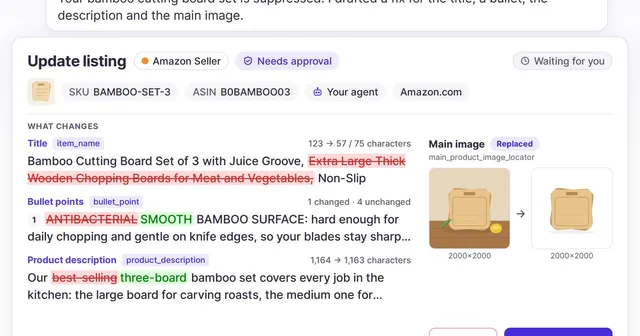
Our Grok Bot agents also fix listings. One agent reads the live listing and Amazon’s listing issues, drafts the corrected title, bullets, description or attributes, and shows us the draft. Nothing is submitted until we say go. Then the change is sent as a gated proposal, and it waits in the approval queue like any ad change.
After we approve it and Amazon accepts it, the agent reads the listing again to confirm the new content is really there, because “accepted” is not the same as “live”. Price, images and deleting a listing stay out of these copy fixes on purpose. Deleting a listing always needs a person’s approval in WisePPC, whatever the key is set to.
The guardrails that make this safe to try
An agent is only useful if you can trust the blast radius. These are the controls we rely on, and they are enforced by WisePPC, not by the agent’s good behavior:
- Off, Gated or Direct, per key. For each key we choose what it can read and, per marketplace and per operation, whether it can write: Off, Gated (a person approves) or Direct (applied automatically from the queue, without a separate approval). Write grants never inherit from the account above.
- The agent cannot choose its own mode. The key’s grant decides. A request that names a mode is refused.
- No self-approval. Only a signed-in person with access to the account can approve a gated change. A key cannot approve its own.
- Some operations always need a human, such as creating an Amazon Ads rule that Amazon cannot delete, or deleting a listing, even on a Direct key.
- Drift checks and verification. If the target changed after the proposal or after review, the change is refused or flagged. After a change is sent, WisePPC keeps verifying that Amazon applied it.
- An audit trail. Every change records which key proposed it and who approved it, and AI-originated changes are labelled in change history.
We also kept one honest limit in mind: there is no general rollback. Reversing a change means proposing a new one, and the review screen warns you when a change cannot be reversed. So our agents’ keys start gated.
What agents can change today
Today an agent can propose changes to Amazon Ads: campaigns, ad groups and ads, targets and negatives, bids, budgets, portfolios, Amazon Ads rules and creative assets, plus draft Brand Store ASIN edits. In Seller Central it can change a listing’s title, bullets, description, price, quantity and other attributes (including variations), create a listing, and delete one (which always needs your approval). It can also cancel a Multi-Channel Fulfillment order, which has no approval step: that permission is Off or Direct. Ad changes need Amazon Ads connected. Listing changes need Seller Central connected (seller accounts). Agents can also read profit, inventory, returns, Brand Analytics and more, in the same connection. The full list is on the AI integration page.
What we are testing next on our own accounts
None of this is available to customers yet. We say it here only so you know where we are heading, and we are giving no dates.
- Multi-Channel Fulfillment order creation and updates, behind the same permission model. Cancelling an order is already live, as described above.
- Events. WisePPC pushing important events to your agent, by webhook (agents like Hermes and Grok Bot) and as MCP events (Claude Code, Claude Desktop and ChatGPT next), so your agent no longer has to check on a schedule to catch changes. That saves runs and tokens. This is coming soon, not live: today our watchers are scheduled checks that run on their own timer.
Any of these may change shape, or not ship, depending on how the tests go. When something is ready for customers, it will show up in the product and in our release notes, not in a teaser.
Try the same setup
You do not need our setup to start. Connect Claude with a login and start asking questions, then add a key when you want an agent to propose changes. The step-by-step is in Connect Grok Bot, Claude and Hermes Agent to WisePPC. The same steps apply to Grok Bot and other MCP clients. If you want to see what the seller-side data looks like first, start with the seller analytics tools. Plans start at $45/month, with a free 30-day trial and no credit card. Start your trial below.