111222

How the Amazon Small Business Badge Can Help Your Brand Stand Out

If you’re a small business owner selling on Amazon, you may have heard of the Small Business badge – but what does it mean, and how can you earn it? This badge can do wonders for your product’s visibility, helping it stand out to customers who want to support smaller players in the marketplace. In this guide, we’ll explain what the badge is, how to get it, and how it can give your business a competitive edge.


What Is the Amazon Small Business Badge?

The Amazon Small Business badge is a special indicator that appears on product listings to highlight products from small businesses. This badge serves as a trust signal, helping your products stand out in Amazon’s vast marketplace, where it can be challenging for smaller brands to get noticed.

The badge is especially useful because it targets a growing consumer base that values supporting small businesses over large corporations. By displaying the badge, you’re showing your customers that your brand meets certain criteria set by Amazon, proving your small business status and setting you apart from larger sellers.
 

Why Is the Amazon Small Business Badge Important?

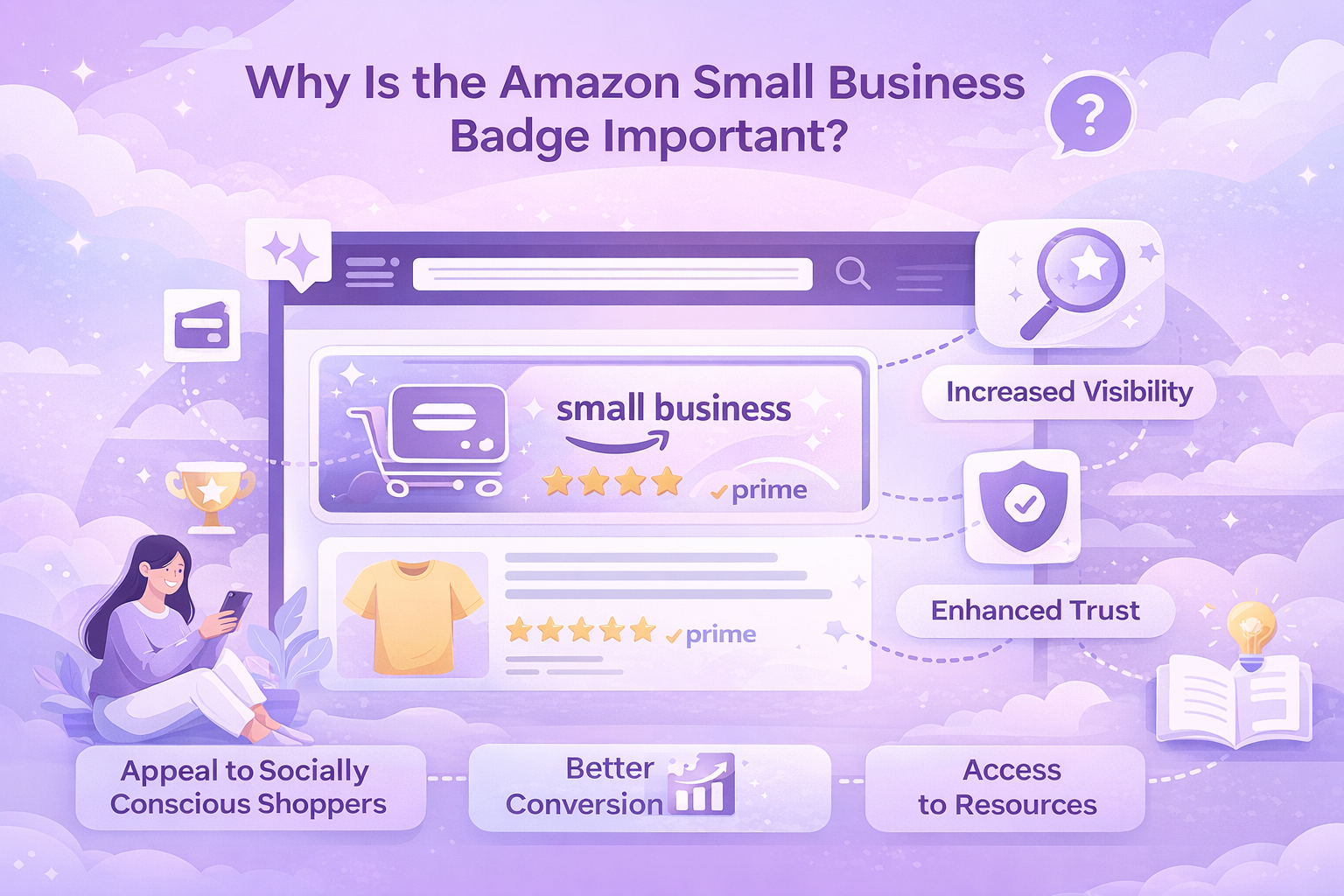
As a small business owner, competition on Amazon can feel overwhelming. With millions of sellers, it’s easy to get lost in the crowd. However, the Amazon Small Business badge can help elevate your brand in several important ways:

Increased Visibility

The badge makes your listings more noticeable, allowing potential customers to identify your business as a small one. For many buyers, this badge signals authenticity and a personal touch – traits that are often associated with small businesses.

Enhanced Trust

In an age where consumers are increasingly concerned about who they’re purchasing from, the badge acts as a seal of approval. It signals to shoppers that your business is legitimate and recognized by Amazon for meeting certain criteria.

Appeal to Socially Conscious Shoppers

Many consumers prefer supporting small businesses, particularly those that are minority-owned, woman-owned, or veteran-owned. The Small Business badge can help align your brand with these values, fostering customer loyalty and attracting those who care about who they’re buying from.

Better Conversion Rates

Studies have shown that products with badges like the Small Business badge are more likely to convert. Customers are more likely to purchase from sellers they trust, and having this badge can make a big difference in customer decision-making.

Access to Small Business Resources

Once you earn the badge, you may gain access to Amazon’s special programs and resources aimed at helping small businesses grow, including marketing support, educational content, and more.


How to Qualify for the Amazon Small Business Badge

To earn the Small Business badge, your business needs to meet certain criteria set by Amazon. While the process may seem simple, it’s important to ensure you meet the requirements before you apply. Here’s what you need:

1. Business Size Criteria

  • Your business should have fewer than 100 employees.
  • Your annual revenue must be under $50 million.

2. Enrollment in Amazon Brand Registry

To qualify for the Small Business badge, your business must be enrolled in Amazon’s Brand Registry or Amazon Handmade. These programs help protect your intellectual property, manage your brand, and provide access to Amazon’s marketing tools. They are essential steps for building your brand presence and gaining visibility on Amazon.

3. Amazon Business Enrollment

If you sell through Amazon Business, you can apply for the Small Business badge once you’re enrolled. However, you must also meet the other criteria, including being enrolled in Amazon Brand Registry or Amazon Handmade.

4. Application Process

Once your business meets these requirements, you’ll need to apply for the badge through your Seller Central account. Amazon will review your application and verify your business status. In some cases, you may need to provide additional information, like business registration documents.

5. Validating Your Eligibility

Amazon may ask for verification of your eligibility for the badge, and if everything checks out, the badge will be added to your product listings. You’ll also need to ensure your product listings comply with Amazon’s policies to maintain the badge.


Steps to Apply for the Amazon Small Business Badge

Once you’ve met the eligibility criteria, here’s how to apply for the Small Business badge:

  1. Sign up for a professional selling plan: You’ll need a professional selling account to qualify for the badge. If you haven’t already, sign up for a Professional Selling Plan on Amazon.
  2. Enroll in Amazon brand registry: If you haven’t enrolled in Amazon Brand Registry yet, this is the next step. Ensure your brand is properly registered to protect your intellectual property.
  3. Join the Amazon business program: If you sell in B2B (business-to-business) categories, you’ll need to enroll in Amazon Business. Once you’re enrolled, go to the B2B section in Seller Central to complete the certification process.
  4. Apply for the badge: After meeting all the criteria, apply for the Small Business badge through your Seller Central account. Navigate to the Certifications section in B2B to submit your request.
  5. Wait for verification: Amazon will review your application. If everything checks out, they will add the badge to your product listings. If any information is missing or unclear, Amazon may request additional documentation.


The Benefits of the Amazon Small Business Badge

While the process to earn the Amazon Small Business badge may seem straightforward, its benefits can significantly impact your business. Here’s why you should go for it:

  • Differentiation from larger competitors: The badge highlights your small business, appealing to customers who prefer personal brands over large corporations.
  • Improved marketing opportunities: The badge gives you access to Amazon’s marketing tools and campaigns to help boost your brand’s visibility.
  • More customer engagement: Shoppers are more likely to engage with your brand and make repeat purchases, knowing they’re supporting a small business.
  • Better positioning on Amazon search results: The badge enhances visibility through its trust signal, which can lead to more customer engagement.


How to Maximize the Impact of the Small Business Badge

Once you’ve earned the Amazon Small Business badge, you’ll want to make the most of it. Here are a few tips to maximize its impact:

1. Highlight Your Badge in Your Listings

Make sure to use the badge as a focal point in your product listings and product descriptions. Let customers know you’re a small business and emphasize the value of supporting independent sellers.

2. Leverage Amazon’s Marketing Programs

As a small business, you may be eligible for special marketing programs like Amazon Small Business Empowerment, which can provide valuable exposure. Take advantage of these opportunities to boost your sales and brand awareness.

3. Connect with Your Target Audience

Use social media and email marketing to target customers who are specifically looking to support small businesses. Highlight your badge in your marketing materials to build trust and encourage purchases.

4. Maintain High Customer Satisfaction

The Small Business badge can only help you if you continue to deliver excellent products and customer service. Always aim to keep your product quality high, minimize returns, and engage with your customers in a meaningful way.

5. Utilize Amazon’s Promotions

Offering time-limited discounts and flash sales can attract more buyers to your listings, especially when they see the Small Business badge. These promotions, combined with the badge, can increase urgency and boost your sales.


Challenges and Considerations

While the Small Business badge offers great advantages, it’s important to be aware of some challenges and considerations:

  • Eligibility requirements: The badge criteria may seem straightforward, but some small businesses may struggle to meet the employee count and revenue thresholds.
  • Ongoing compliance: After earning the badge, you must maintain eligibility. Ensure your business continues to meet the requirements and follows Amazon’s policies to avoid losing the badge.
  • Competition with larger sellers: Despite the badge, you’ll still face competition from larger brands. The badge helps with visibility, but focusing on strong product listings, customer service, and marketing is key to success.

 

Leveraging the Amazon Small Business Badge with WisePPC’s Advanced Tools

As a small business on Amazon, earning the Small Business badge can significantly enhance your product’s visibility and credibility. However, gaining recognition on Amazon is not just about having the badge – it’s about ensuring that your advertising and sales strategies are aligned with best practices. That’s where we come into play.

At WisePPC, we provide an advanced analytics platform designed to help small businesses grow and succeed in the marketplace. Whether you’re selling on Amazon, Shopify, or across multiple channels, our platform offers you the visibility and control needed to scale efficiently.
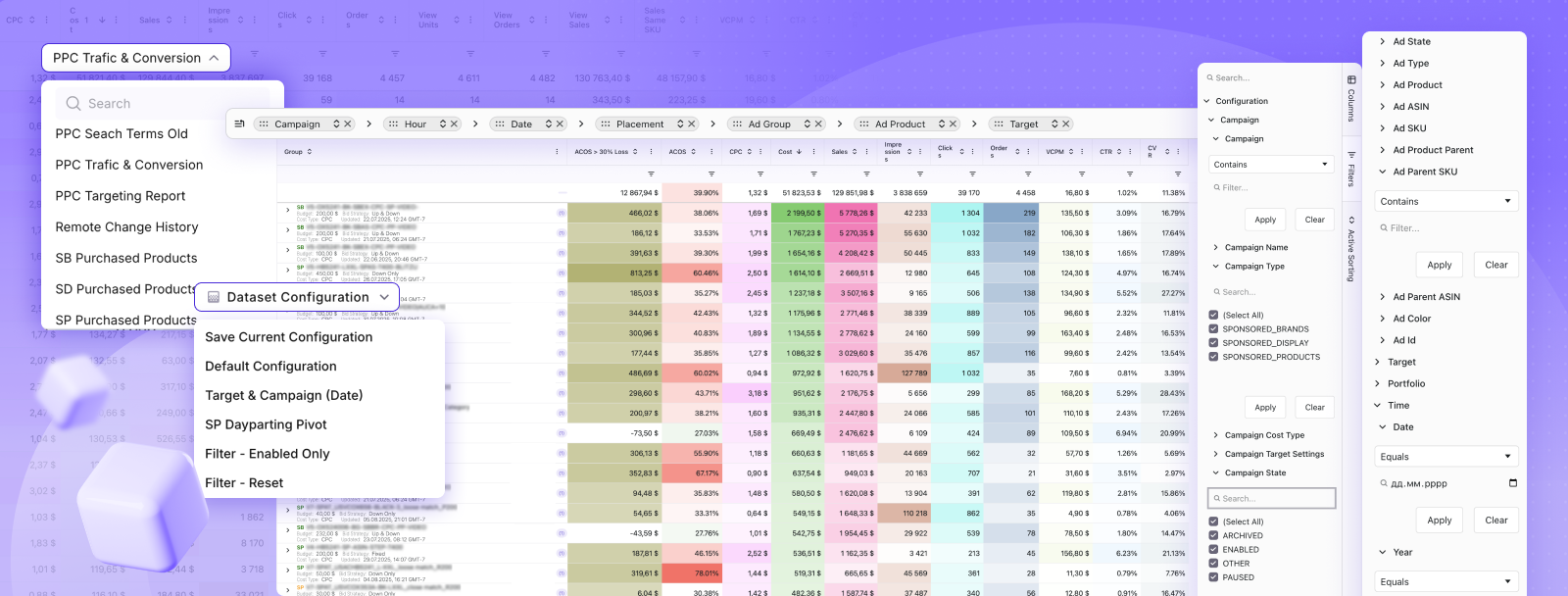
Our tools let you dive deep into performance data, optimize ad spend, track key metrics, and uncover what truly drives sales. With WisePPC, you can leverage the power of data to complement the trust and credibility that comes with the Amazon Small Business badge, making sure your business stands out in a crowded marketplace.


Conclusion

The Amazon Small Business badge can be a game-changer for your brand. It offers increased visibility, better customer engagement, and a unique edge in a crowded marketplace. Earning and leveraging this badge requires meeting specific criteria, but the benefits far outweigh the effort. Whether you’re just starting out or have been selling on Amazon for a while, getting the Small Business badge is a valuable step toward growing your business and attracting loyal customers.

Take the time to meet the requirements, apply for the badge, and make the most of its power to elevate your brand’s presence on Amazon. Your business and your customers will thank you.


FAQ

1. What exactly is the Amazon Small Business badge?

The Amazon Small Business badge is a special marker that appears on product listings to identify small businesses. If your business has fewer than 100 employees and makes under $50 million in annual revenue, you can qualify for this badge. It helps shoppers identify your brand as an independent small business, which can boost credibility and appeal to customers who want to support smaller companies.

2. How do I qualify for the Amazon Small Business badge?

To qualify for the Small Business badge, you need to meet Amazon’s criteria, which include being enrolled in Amazon Brand Registry, having fewer than 100 employees, and making less than $50 million in annual revenue. Once you meet these requirements, you can apply for the badge through your Seller Central account. Amazon will review your business details to ensure you meet all the necessary criteria.

3. Can the Amazon Small Business badge really help my sales?

Yes! The badge can increase your product’s visibility, which is key in a marketplace as large as Amazon. It also acts as a trust signal to customers who are looking to support smaller, independent businesses over larger corporations. By displaying the badge, you’re making it clear that your products come from a small business, which can resonate with certain customers, potentially leading to higher conversions.

4. Is the Amazon Small Business badge available to all sellers?

No, it’s only available to sellers that meet Amazon’s small business criteria, including having fewer than 100 employees and earning under $50 million annually. If your business qualifies, you can apply through Amazon’s certification process. If you’re not sure whether you qualify, it’s worth reviewing your business metrics and making sure you’re enrolled in Amazon Brand Registry.

5. Does the Small Business badge guarantee higher sales?

While the badge doesn’t guarantee a specific sales increase, it can certainly help you stand out in Amazon’s crowded marketplace. By showcasing your business as small and independent, the badge can help build trust with potential customers and make your listings more attractive, especially to those who prefer to buy from smaller businesses.

6. Do I need to do anything to keep my Amazon Small Business badge?

Once you’ve earned the badge, you need to maintain eligibility. This means your business must continue to meet the requirements, including having fewer than 100 employees and staying under the $50 million revenue threshold. Also, make sure to maintain your Amazon Brand Registry enrollment and adhere to Amazon’s policies to keep the badge active on your listings.

7. Can I use the Amazon Small Business badge in my marketing outside of Amazon?

While the badge itself is specifically for Amazon product listings, you can certainly leverage your small business status in your marketing outside the platform. Highlighting your Amazon Small Business badge in social media posts, email newsletters, and on your website can reinforce your brand’s commitment to being a trusted, independent business, helping you connect with like-minded customers. Just make sure to follow Amazon’s branding guidelines when using the badge in your materials.

How to Pack and Ship eCommerce Orders: A Step-by-Step Guide

When it comes to eCommerce, packing and shipping are more than just necessary steps – they’re crucial to ensuring your products arrive safely and your customers are satisfied. A well-packed order not only keeps your products in good shape but also strengthens your brand by showing you care about every detail. Whether you’re just starting or looking to improve your fulfillment process, this guide will walk you through the essentials of packing and shipping eCommerce orders like a pro. Let’s dive into the process that helps you deliver great service and keep your customers coming back.


Why Proper Packing and Shipping Matters

At first glance, packing and shipping might seem like simple tasks. However, they can have a significant impact on the customer experience. Think about it: your product is probably traveling hundreds (or even thousands) of miles before it reaches its final destination. If it’s not packed securely or shipped in the right way, it can arrive damaged, delayed, or simply not meet the customer’s expectations.

Effective shipping can also help you save money. By understanding packaging materials, shipping methods, and fulfillment strategies, you can reduce shipping costs without sacrificing quality. When your packing and shipping process is smooth, customers get their products in perfect condition, on time, and with minimal hassle.


How to Manage eCommerce Orders: Packing and Shipping Steps for Success

Packing and shipping are key steps in delivering great customer experiences, but doing them the right way can be a challenge. Here are the essential stages to follow.

Step 1: Choose the Right Packaging Materials

Choosing the right packaging is more than just about aesthetics – it’s about ensuring your products arrive safely. Below are the key packaging materials you’ll need for various items:

Boxes

Sturdy cardboard boxes are ideal for most products, especially fragile items. They protect the contents from impact during transport. Make sure the box is appropriately sized – too big, and your items may shift around, too small, and they could get damaged.

Padded Envelopes or Poly Mailers

For flat, non-breakable items like clothing, books, or small accessories, padded envelopes or poly mailers are often sufficient. They’re lightweight and cost-effective.

Bubble Wrap and Packing Peanuts

These fillers provide an extra layer of protection, especially for fragile items like electronics or glassware. Use bubble wrap to wrap your product securely, and fill any empty spaces in the box with packing peanuts, air pillows, or crumpled paper to prevent movement during transit.

Foam Sheets or Air Pillows

For items with delicate surfaces or electronics, foam sheets or inflatable air pillows offer great cushioning. These materials protect against scratches, dents, and other damage during transport.

Stretch Wrap or Packing Tape

To keep everything securely fastened, make sure to use high-quality stretch wrap or packing tape to seal your boxes. Ensure that all seams and flaps are properly taped to avoid accidental openings.

Step 2: Pack Your Items Carefully

Once you have your packaging materials ready, it’s time to pack your items. Proper packing ensures your products are well-protected and safe from damage. Here’s how to do it:

  1. Wrap fragile items first: If your product is fragile (like glass or electronics), wrap it tightly in bubble wrap or foam sheets.
  2. Secure small items: Place smaller items like accessories or books inside padded envelopes or poly mailers.
  3. Avoid overpacking: While it’s important to use protective fillers, overpacking can cause stress on the box, which could lead to tearing or breakage.
  4. Use custom inserts (optional): If you’re looking to add a personal touch or brand your packaging, consider using custom inserts with your logo, instructions, or care information.
  5. Test the packing: Before sealing the box, gently shake it to check if anything moves around inside.

Step 3: Label Your Packages Properly

Proper labeling is crucial for a smooth shipping process. Clear, accurate labels ensure that your packages reach the right destination without unnecessary delays. Here’s what you need to do:

  • Write the recipient’s address clearly and include the full name, street address, city, state or province, zip code, and country.
  • Include your return address in the upper left corner or on the back of the package.
  • Provide your customers with tracking information to add a layer of transparency and help avoid customer frustration.
  • Mark the fragile items with a “Fragile” or “Handle with Care” sticker.
  • Fill out a customs form detailing the contents and value of the package for international orders.

Step 4: Select the Right Shipping Method

Choosing the right shipping method depends on a variety of factors, including your budget, customer expectations, and the size and weight of the package. Here are some common options:

Standard Shipping

This is the most cost-effective option, typically taking 5-7 business days for delivery. It’s a good choice for non-urgent items or customers who don’t mind waiting a bit longer for their product.

Expedited Shipping

Faster than standard shipping, this method guarantees delivery within 2-3 business days. It’s ideal for customers who need their order quickly, but it comes at a higher cost.

Same-Day or Next-Day Shipping

Some businesses,especially those in high-demand sectors like groceries or electronics, offer same-day or next-day delivery. This requires efficient inventory management and a reliable delivery network.

Flat Rate Shipping

For predictable shipping costs, flat-rate shipping charges a set amount regardless of the weight or destination of the package. This method works well if you sell items that are fairly consistent in size and weight.

International Shipping

When shipping internationally, make sure to choose a carrier that offers reliable tracking and delivery times. International shipments can be more expensive, and customs fees may apply, so be transparent with customers about the cost.

Step 5: Choose a Reliable Shipping Carrier

The carrier you choose can impact both the delivery time and the cost. Here are a few popular options:

  • United States Postal Service (USPS): Ideal for small, lightweight items, USPS offers affordable shipping options like First-Class and Priority Mail.
  • FedEx: Known for fast, reliable service, FedEx is a great option for both domestic and international shipping, offering various delivery speeds.
  • United Parcel Service (UPS): UPS is known for its reliability, especially for ground shipping and international deliveries.
  • DHL: If you’re shipping internationally, DHL is a solid option for global coverage.
  • Local Couriers: For local deliveries, consider using a regional courier that can offer same-day or next-day delivery for local customers.

Step 6: Consider Shipping Insurance

For high-value items, shipping insurance can protect both you and your customers. In case of damage, loss, or theft, the insurance will cover the cost of the product, allowing you to replace it quickly without taking a financial hit. While not all shipments require insurance, it’s a good idea for expensive electronics, jewelry, or fragile goods.

Step 7: Managing Returns and Exchanges

Returns are an inevitable part of eCommerce, but a clear and efficient return process can help you manage them with ease. Here are some tips for handling returns:

  • Create a clear return policy: Be upfront with customers about how and when they can return items.
  • Provide return labels: Consider including a pre-paid return label inside the package or allowing customers to print one easily from your website.
  • Inspect returned products promptly: When a return is received, inspect the item for damage or signs of use.
  • Restock or dispose of returned items: If a returned item is in good condition, restock it. If it’s damaged or unsellable, consider disposing of it or offering it at a discount.

Step 8: Track Your Orders and Communicate with Customers

Keeping customers informed about the status of their orders is essential for maintaining trust. Provide tracking numbers as soon as the order ships and send email updates when there are any delays or issues with the shipment. If the product is delayed or damaged, communicating openly with the customer will help maintain a positive relationship.


Selling, Shipping, and Packaging on Amazon: A Quick Guide

When selling on Amazon, packing and shipping your products properly is essential for both customer satisfaction and meeting Amazon’s specific requirements.

Selling on Amazon: Key Considerations

Before you even start packing and shipping, it’s important to optimize your product listings on Amazon. Here’s how you can set yourself up:

  • Product listings: Ensure your product titles, descriptions, and images are clear, accurate, and follow Amazon’s guidelines.
  • Seller account: Choose between an Individual account (no monthly fee but higher per-item fees) or a Professional account (monthly fee with additional features and lower per-item fees).
  • Competitive pricing: Research the prices of similar products on Amazon to set competitive prices.
  • Branding: Even though you don’t have full control over the presentation of your products on Amazon, ensure your brand name, logo, and packaging are included to maintain consistency and visibility.

Amazon Packaging Requirements

When it comes to packaging, Amazon has specific requirements to ensure safe delivery and product integrity. Here’s what you need to keep in mind:

  • Box size and dimensions
  • Product condition
  • Barcoding requirements
  • Packaging materials
  • Sealing

FBA vs. FBM: Which Fulfillment Method Is Right for You?

Amazon offers two methods for fulfilling orders – Fulfillment by Amazon (FBA) and Fulfillment by Merchant (FBM). Here’s a breakdown of both:

Fulfillment by Amazon (FBA): You send inventory to Amazon’s fulfillment centers. Amazon takes care of packing, shipping, customer service, and returns. Your products become eligible for Amazon Prime, and customers benefit from fast, reliable shipping. FBA does have fees for storage and fulfillment, so managing inventory properly is key.

Fulfillment by Merchant (FBM): You handle everything – packing, shipping, and customer service. You have more control over the process but need to manage all aspects of shipping and returns. FBM is often preferred by sellers who have specialized products or want more control over the fulfillment process.

Shipping Methods for Amazon

Choosing the right shipping method depends on how you’re fulfilling orders – whether through FBA or FBM:

Shipping via FBA:

  • Amazon ships the product directly to customers, offering fast delivery and Prime eligibility.
  • With FBA, customers enjoy quick delivery through Amazon’s trusted logistics network.

Shipping via FBM:

  • Standard shipping: Affordable but slower, ideal for non-urgent items.
  • Expedited shipping: Faster delivery (typically 2-3 business days), suitable for customers willing to pay more for speed.
  • Same-day/next-day shipping: Great for urgent orders but comes with higher costs.

Whether using FBA or FBM, ensure your shipping rates are competitive. You can offer free shipping or charge based on the item’s weight, size, or destination.

Managing Returns and Exchanges on Amazon

Returns are an inevitable part of the eCommerce experience, and Amazon handles returns differently for FBA and FBM sellers:

  • FBA: Amazon handles returns for you. The customer sends the product back to Amazon’s fulfillment center, and Amazon processes the return according to your policy.
  • FBM: You’re responsible for processing returns. Make sure to have a clear, easy-to-understand return policy and inspect the returned items carefully.

Best Practices for Packaging and Shipping on Amazon

To ensure you’re meeting Amazon’s standards for shipping and packaging, follow these best practices:

  • Use proper packaging: Ensure that your products are packed securely. Avoid oversized boxes, and ensure that fragile items are well-protected with bubble wrap or foam.
  • Follow Amazon’s labeling guidelines: Each product should be properly labeled with the correct barcode. This is especially important for FBA shipments, as they require specific FBA barcodes.
  • Monitor inventory: Whether you use FBA or FBM, keep track of your inventory levels. Running out of stock can lead to missed sales and decreased visibility on Amazon.

Whether using FBA or FBM, make sure your products are shipped on time. Delays can lead to negative feedback and hurt your seller rating.


How WisePPC Can Help Improve Your Shipping and Packaging Efficiency

At WisePPC, we provide an advanced analytics toolkit specifically for marketplace businesses, including Amazon sellers. With our platform, you gain real-time insights into your ad campaigns, sales performance, and inventory management, allowing you to make smarter decisions that ultimately impact shipping and packaging.

For example, our bulk actions feature enables you to adjust multiple campaigns in just a few clicks, saving you time and reducing errors in ad management. This efficiency helps streamline overall operations, allowing you to focus more on timely order fulfillment.

Moreover, WisePPC helps track historical data, providing insights into how your products perform during different seasons and in various regions. This allows you to forecast demand accurately, ensuring that your packaging is always prepared for your inventory levels. Whether you’re fulfilling orders through FBA or FBM, our multi-account reporting and granular analytics tools ensure you can optimize inventory decisions based on real-time sales and ad trends.


Final Thoughts

Packing and shipping may not always be the most glamorous aspects of running an eCommerce business, but they’re critical for ensuring customer satisfaction and retention. By choosing the right packaging, shipping method, and carrier, you can improve your efficiency, save money, and deliver a better experience to your customers.

As your business grows, consider automating parts of the fulfillment process and using tools like inventory tracking or multi-channel fulfillment to scale effectively. When you get packing and shipping right, your customers will get their products quickly and safely, and your business will be one step closer to success.


FAQ

1. What’s the best way to pack fragile items for shipping?

Packing fragile items requires a bit more care and attention to detail. You’ll want to use bubble wrap or foam sheets to cushion the item and then place it in a sturdy box. For extra protection, consider double-boxing – place the item in one box and then in another with more padding in between.

2. Should I offer free shipping on my eCommerce store?

Free shipping can definitely attract more customers, but it’s important to calculate how it fits into your pricing strategy. While it can be a great selling point, you’ll want to ensure you’re not losing money. Some sellers build shipping costs into their product price, or you can offer free shipping for orders over a certain amount. Consider your profit margins, and always be transparent with customers about delivery timelines.

3. How do I choose the right shipping carrier for my business?

Choosing the right shipping carrier depends on several factors like cost, delivery time, and your customers’ location. USPS is great for smaller, lighter items, especially if you’re shipping domestically. For larger packages, UPS or FedEx might be a better fit, as they offer more reliable tracking and faster services. DHL is an excellent option for international shipments.

How to Grow Your Business: Key Strategies for Sustainable Success

Growing your business isn’t just about expanding your customer base – it’s about making smarter decisions, building strong relationships, and continuously adapting to new challenges. Whether you’re just starting out or looking to scale, there are several key steps you can take to ensure your business thrives in today’s competitive market.

In this article, we’ll explore practical strategies that can help you achieve sustainable growth, improve your efficiency, and keep customers coming back for more. Let’s dive into the fundamentals of growing your business the right way.


The Importance of Growing Your Business

Growing your business is not just about expanding your customer base or increasing profits – it’s about building a foundation that supports long-term success. In today’s competitive market, standing still is not an option. Whether you’re a startup looking to establish your presence or an established business aiming to scale, sustainable growth is crucial for staying relevant, maintaining your market position, and ensuring financial stability.

Business growth is essential because it opens doors to new opportunities, enhances your brand reputation, and helps you navigate challenges more effectively. When your business grows strategically, you’re not just increasing revenue; you’re also creating a resilient organization that can adapt to changes, attract and retain top talent, and foster innovation.

Key Strategies for Growing Your Business

In the following sections, we’ll break down practical and actionable strategies that can help you grow your business sustainably. These steps will guide you in making informed decisions, optimizing your processes, and positioning your company for ongoing success.

1. Strengthen Your Financial Foundation

A strong financial foundation is essential for any business looking to grow. Without a clear understanding of your financial health, it’s difficult to make informed decisions or plan for the future. To set your business up for long-term success, you need to focus on managing cash flow, tracking expenses, and understanding your financial statements.

Track and Manage Cash Flow

Regularly monitor your cash inflows and outflows. Cash flow management helps you anticipate shortages, plan for future expenses, and reinvest in your business for growth.

Monitor Expenses

Keeping a close eye on your business expenses helps you spot areas where you can cut costs and improve profitability. Regular reviews can also help you prepare for tax season.

Build Business Credit

Just as personal credit matters for individuals, business credit is vital for securing financing, getting better loan terms, and even reducing insurance premiums. Building and maintaining a strong business credit score gives you more financial flexibility.

Understand Financial Statements

Make sure you’re familiar with your balance sheet, income statement, and cash flow statement. These documents provide insights into your business’s financial health and guide your decision-making.

Building a solid financial foundation is key for any growing business. It ensures that you can weather any storms that come your way and gives you the financial freedom to make the moves necessary for growth.

2. Build Customer Loyalty

Attracting new customers is essential, but retaining them is even more critical for long-term success. Building customer loyalty means focusing on providing excellent customer service, understanding your clients’ needs, and rewarding repeat business. Loyal customers are often your best marketers, as they spread the word and keep coming back for more, that’s why:

  • Provide exceptional customer service: Respond promptly to inquiries, address concerns, and go the extra mile to meet customer needs.
  • Offer loyalty programs: Rewarding repeat customers can help you foster loyalty and encourage repeat business.
  • Engage with feedback: Respond to online reviews, both positive and negative, and take actionable steps to address any concerns. Engaging with customer feedback shows that you care and helps build trust.

Customer loyalty isn’t just about offering discounts – it’s about making your customers feel valued and appreciated. When customers feel like they’re part of your brand, they’re more likely to return and recommend your business to others.

3. Optimize Your Operations

Growth doesn’t always mean gaining new customers; sometimes it means optimizing what you already have. Efficient operations save time, reduce costs, and free up resources for innovation and scaling. Whether you’re dealing with inventory management, team coordination, or customer service, optimizing your internal processes can help you grow faster and more sustainably.

Automate Routine Tasks

Look for ways to automate repetitive tasks. This could be anything from automating social media posts to using customer relationship management (CRM) software to track leads. Automation allows your team to focus on higher-value activities while reducing human errors.

Delegate Effectively

As your business grows, you may find that you’re stretched thin. Don’t be afraid to delegate tasks to employees or outsource them to freelancers. This will free up your time for strategic decision-making and allow your team to grow with the business.

Use Data to Drive Decisions

Analytics tools can help you track key performance metrics (KPIs) like customer satisfaction, website traffic, and sales. Use these insights to make data-driven decisions that will improve efficiency and performance.

By optimizing your operations, you ensure that your business can handle more customers and grow without getting bogged down in inefficient processes. Efficiency is a key factor in scaling your business and increasing profitability.

4. Invest in Your Team

Your team is the backbone of your business. To grow, you need to invest in hiring, training, and retaining talented employees. Happy, skilled employees are more productive, which helps your business grow faster and more efficiently, so:

  • Provide training and development: Invest in your team’s growth by offering ongoing training and development opportunities. This could include workshops, online courses, or conferences.
  • Foster a positive work culture: Offer flexible working hours, promote work-life balance, and ensure that your team feels valued and heard.
  • Recognize achievements: Whether it’s through bonuses, public recognition, or even a simple thank-you, showing appreciation for their efforts boosts morale and encourages loyalty.

When you invest in your team, you’re investing in your business’s future. A motivated, skilled team will help your business thrive and contribute to long-term growth.

5. Form Strategic Partnerships

As your business grows, you don’t have to do it all alone. Forming strategic partnerships with other businesses can help you reach new audiences, share resources, and expand your market reach. A well-chosen partner can provide mutual benefits, helping both companies grow faster and more efficiently. Here what to do:

  • Identify the right partners: Look for businesses that share your values, target audience, and complementary goals. A successful partnership is built on mutual trust and clear communication.
  • Leverage each other’s strengths: For example, if you have great products but lack marketing expertise, partnering with a marketing agency can help you scale faster.
  • Be prepared for risks: Make sure you have clear agreements in place to prevent misunderstandings or disputes down the line. Consider how you’ll handle decision-making, profit-sharing, and responsibilities.

Forming the right partnerships can open doors that would otherwise be closed. Whether it’s collaborating on a marketing campaign or sharing industry insights, strategic alliances can help accelerate your growth and expand your reach.

6. Innovate and Adapt

In today’s rapidly changing business environment, staying stagnant is not an option. Businesses that innovate and adapt are more likely to stay competitive and succeed in the long run. Innovation doesn’t always mean developing new products – it can also mean finding smarter ways to do things or introducing a fresh approach to customer service.

Monitor Industry Trends

Stay up to date with what’s happening in your industry. Subscribe to industry blogs, attend conferences, and network with other business owners to stay informed about new trends, technologies, and opportunities.

Embrace New Technology

Technology is evolving fast, and businesses that fail to adopt new tools can fall behind. Embrace tools like artificial intelligence (AI), data analytics, and automation to improve processes and deliver better results for your customers.

Foster a Culture of Innovation

Encourage creativity within your team. Give employees the freedom to suggest new ideas, test them, and learn from failures. A culture of innovation leads to continuous improvement and helps your business stay relevant.

Innovation is crucial for staying ahead of the competition. By embracing change and adapting to new opportunities, you position your business for long-term success.

7. Use Effective Marketing Strategies

Marketing is one of the most powerful tools for growing your business. It’s how you reach new customers, retain existing ones, and build your brand. A well-executed marketing strategy can drive sales and generate awareness, while poor marketing efforts can waste resources and harm your reputation:

  • Define your target audience: Understand who your ideal customers are and what they need. Tailor your marketing efforts to meet their specific desires and pain points.
  • Leverage digital marketing: Use digital channels like SEO, content marketing, and social media to reach your audience. Focus on building an online presence that engages customers.
  • Measure your marketing efforts: Use analytics tools to measure key metrics like ROI, conversion rates, and customer acquisition costs to determine which strategies work best for your business.

Effective marketing helps you attract new customers and keep existing ones. With the right approach, you can boost brand awareness, increase sales, and ultimately drive growth.


Leveraging WisePPC for Smarter Business Growth

At WisePPC, we understand that growing your business in today’s competitive marketplace requires more than just basic tools – it requires intelligent insights and powerful optimization. That’s why we’ve developed a platform designed to help businesses like yours maximize their marketplace presence, whether you’re selling on Amazon, Shopify, or multiple channels simultaneously.

Our core strength lies in advanced analytics. With WisePPC, we allow you to dive deep into historical data, track real-time performance, and uncover what truly drives results. Whether it’s intelligent ad optimization, inventory tracking, or multi-account reporting, every feature we offer is built to simplify complexity. This enables your team to focus on what matters most: growth, efficiency, and strategic decision-making.

Our platform supports bulk actions that allow you to apply changes to multiple campaigns, ad groups, or targets with just a few clicks. As your business grows, so does our platform. Whether you’re managing a few products or thousands, WisePPC scales with you, offering deep insights and control as you expand.


Conclusion

Growing your business requires more than just increasing sales – it involves a strategic approach, ongoing optimization, and adaptability. By strengthening your financial foundation, building customer loyalty, optimizing operations, investing in your team, forming strategic partnerships, innovating, and implementing effective marketing strategies, you can set your business up for sustainable growth. Focus on what matters most, stay proactive, and keep evolving to ensure long-term success.

With the right mindset and these practical strategies, you can scale your business effectively, even in a competitive market. Start with these steps and watch your business grow smarter, not just bigger.


FAQ

1. How can I grow my business sustainably?

Sustainable growth starts with understanding your business’s foundation. Focus on strengthening your financial health, optimizing your operations, and nurturing customer loyalty. It’s important to stay adaptable, track key metrics, and continuously invest in both your team and the tools that can help you scale.

2. Why is customer loyalty important for growth?

Customer loyalty is one of the most cost-effective ways to grow your business. Retaining existing customers is generally easier than acquiring new ones. Loyal customers not only continue to buy from you – they also advocate for your brand, spread the word, and provide valuable feedback.

3. How can optimizing operations help my business grow?

Optimizing operations allows you to work smarter, not harder. By streamlining internal processes, reducing inefficiencies, and automating repetitive tasks, you free up valuable resources that can be used for strategic growth initiatives.

4. Why should I invest in my team as part of my growth strategy?

Your team is the backbone of your business. Investing in training, providing career development opportunities, and fostering a positive work culture helps retain top talent and boosts productivity. A motivated, skilled team is essential for scaling your business, and providing them with the tools and environment they need to succeed directly contributes to your long-term growth.

5. How do strategic partnerships impact business growth?

Strategic partnerships can help your business grow by giving you access to new markets, resources, and expertise. When you partner with other businesses that share your goals and values, you can leverage each other’s strengths to reach a broader audience and scale more efficiently.

6. What role does innovation play in growing a business?

Innovation is crucial for staying competitive and ensuring that your business evolves with market changes. Whether it’s adopting new technologies, improving your products or services, or finding smarter ways to serve your customers, innovation allows you to stay relevant and ahead of your competitors.

7. How can marketing strategies help me grow my business?

Effective marketing strategies help you reach new customers, build brand awareness, and retain your existing customer base. Whether it’s through digital channels like SEO, content marketing, and social media, or more traditional methods, marketing allows you to showcase your products and services to a wider audience. A well-defined marketing plan helps generate leads, increase conversions, and ultimately drive growth by positioning your business as a trusted brand in your industry.

How to Sell Handmade Products Online and Grow Your Business

Turning your passion for crafting into a business can be exciting, but figuring out how to sell your handmade products online can feel a bit overwhelming. Whether you’ve been selling at craft fairs or are just starting to explore the online world, this guide will help you navigate the essential steps.

From picking the right platform to mastering product photography and marketing strategies, we’ll walk you through everything you need to know to get your handmade business online and thriving. Ready to turn your hobby into a successful online store? Let’s dive in.


Why Sell Handmade Products Online?

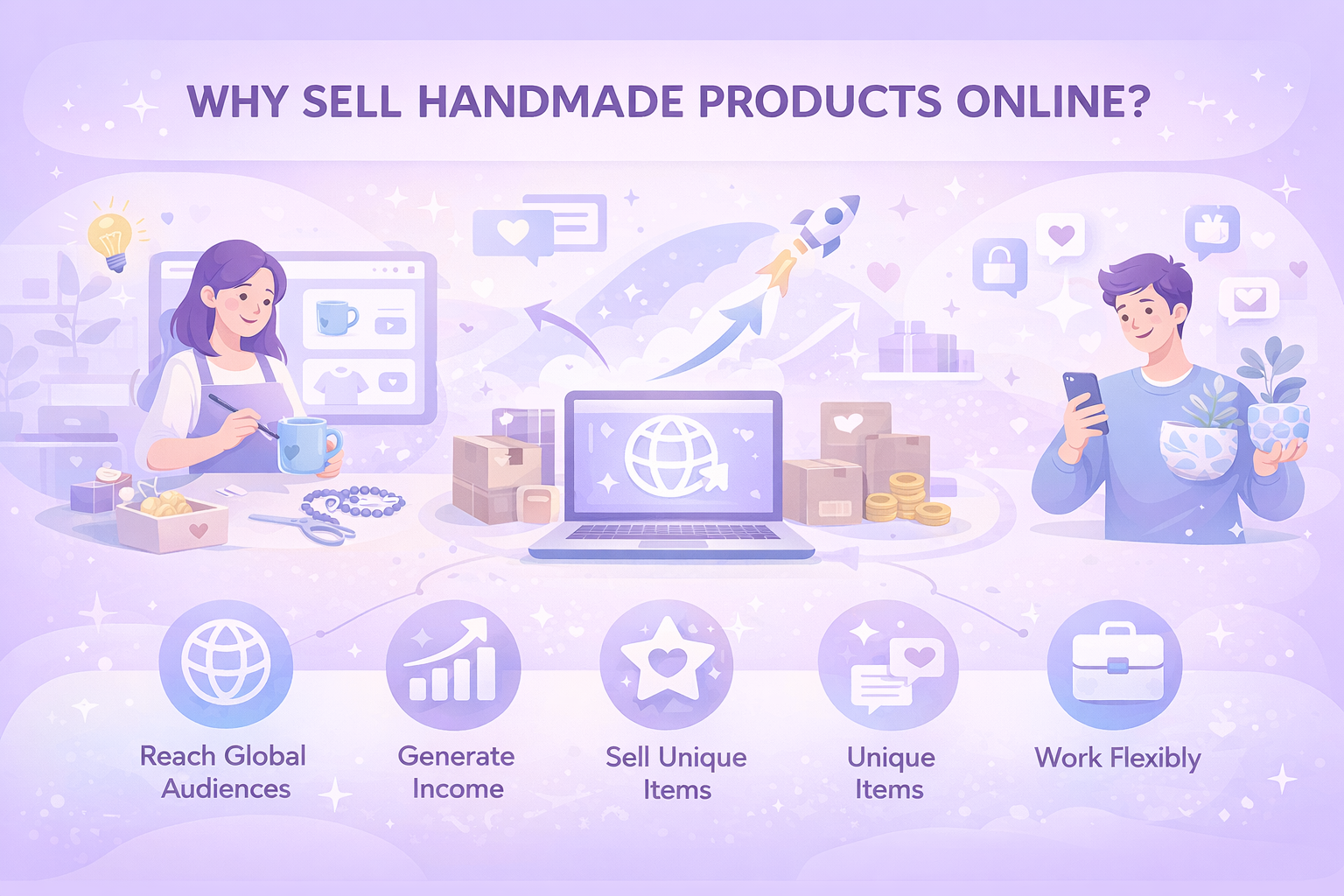
Selling handmade products online offers creators the opportunity to transform their passion into a profitable business. It allows you to share your unique creations with a global audience, turning your hobby into a sustainable income source. The online marketplace is growing rapidly, with consumers increasingly seeking out personalized, one-of-a-kind items that can’t be found in stores. Whether you’re looking to build a side hustle or turn your craft into a full-time business, the online space provides endless possibilities.


Benefits of Selling Handmade Products Online

Selling handmade products online comes with a variety of advantages that can help grow your business. Here are some key benefits:

  • Wider reach: Your online shop is accessible 24/7, allowing you to connect with a global audience and attract buyers who might never have found your work in person.
  • Lower overhead costs: Without the need for a physical storefront, you can save on rent and utilities.
  • Flexibility: Running your business online lets you work from anywhere, whether you’re at home, on the go, or traveling, offering you freedom and convenience.
  • Scalability: As your business grows, you can add more products, expand to new platforms, and invest in marketing with minimal effort.


How to Sell Handmade Products Online

Now that you understand the importance and benefits of selling handmade products online, let’s dive into the practical steps to get started. From choosing the right platform to optimizing your listings and marketing strategies, we’ll walk you through the process to help your handmade business thrive.

1. Choose the Right Platform to Sell Your Handmade Products

Choosing the right platform is essential for selling your handmade products online. The platform you pick will affect how you manage your business and interact with customers. Consider factors like ease of use, customization options, and the type of audience you want to reach. Whether you want to sell on a marketplace or create your own website, each option has its advantages depending on your goals.

2. Set Up Your Online Store

Once you’ve chosen your platform, it’s time to set up your online store. Here are some key considerations to keep in mind:

Create a Memorable Brand Name

Your brand name should reflect your style and be easy to remember. Consider using something personal, like your name or a nickname, or draw inspiration from your craft. Make sure the name is available as a domain and across social media platforms.

Buy Your Domain Name

Even if you’re selling on e-commerce platforms, it’s a good idea to secure your own domain name. This will help you maintain control of your brand identity and provide a more professional appearance. Use domain name tools to find one that matches your brand.

Design Your Storefront

Your storefront should reflect your brand’s personality. Ensure your shop is visually appealing and easy to navigate. High-quality images and a consistent color scheme can make a big difference.

Optimize Product Listings

Product listings are your chance to showcase your handmade items. Here’s what to include:

  • High-quality photos: Use well-lit, clear images that show your product from different angles. Include close-ups to highlight unique details and features.
  • Detailed descriptions: Write descriptions that tell a story about your product. Include details such as materials, size, color options, and the inspiration behind the piece.
  • Pricing: Make sure your pricing reflects both the cost of materials and your time. Research similar products to ensure your prices are competitive but fair.

3. Market Your Handmade Products

Marketing is essential to the success of your online business. Without customers, your products won’t sell, no matter how amazing they are. Here are some key marketing strategies to consider:

Utilize Social Media

Instagram is a visual platform, making it perfect for showcasing handmade products. Post regularly with high-quality photos of your products, behind-the-scenes content, and customer testimonials.

Pinterest is another great platform for promoting handmade products. Create visually appealing boards to showcase your products, and link back to your online store.

Create also a Facebook page for your business where you can engage with customers, post updates, and sell directly through Facebook Marketplace.

Leverage Email Marketing

Building an email list allows you to keep in touch with your customers, offer promotions, and announce new products. Offer incentives such as discounts or free shipping for people who sign up for your newsletter. Make sure to send out regular updates and personalized offers to keep your audience engaged.

Collaborate with Influencers

Consider partnering with influencers in your niche who can help promote your products to a wider audience. Look for influencers whose followers align with your target market and who have a genuine interest in handmade goods.

Optimize for SEO

Search engine optimization (SEO) is critical for getting found online. Make sure to use relevant keywords in your product titles, descriptions, and tags. This will help your listings appear in search results when potential customers are looking for products like yours. Additionally, consider writing blog posts or creating content related to your niche to drive organic traffic to your site.

4. Offer Exceptional Customer Service

To build strong relationships with your customers and encourage repeat business, excellent customer service is key. Here are a few ways to ensure your customers feel valued:

  • Respond promptly to inquiries: Make sure to address customer questions and concerns quickly, whether they’re asking about product details or shipping times. Handle issues professionally: Whether it’s a shipping delay or a product defect, always approach the issue calmly, professionally, and with a focus on resolution.
  • Offer clear shipping and return policies: Be upfront about shipping times, return policies, and exchanges. Providing transparency in these areas helps customers feel confident in their purchase and builds trust.

5. Manage Inventory and Orders Efficiently

As your business grows, it becomes increasingly important to manage your inventory and orders efficiently. Consider using inventory management software or tools provided by your platform to track stock levels and streamline the order fulfillment process.

Set Up an Efficient Shipping System

Decide whether you will ship domestically or internationally and choose the best carriers based on your needs. Make sure to factor in shipping costs when pricing your products, and offer tracking information to customers once their orders have shipped.

Automate Where Possible

To save time and reduce errors, consider automating aspects of your business. Many platforms offer tools to automate inventory updates, customer emails, and order fulfillment.

6. Use WisePPC to Optimize Your Sales Strategy

As a business selling handmade products online, leveraging the right tools can make all the difference, and that’s where we come in. We’re WisePPC, a powerful analytics platform designed to help businesses like yours maximize their marketplace presence, especially on Amazon and Shopify. Our suite of advanced features provides you with the insights you need to optimize your sales and advertising efforts in real-time.

Whether you’re selling on one platform or managing multiple sales channels, we give you the ability to track numerous key metrics, monitor performance, and adjust campaigns with ease. With features like bulk updates, advanced filtering, and historical data tracking, we help streamline your processes, spot trends, and make smarter, data-driven decisions. This way, you can focus on what truly matters – growing your business – while we handle the time-consuming tasks.

By integrating us into your strategy, you can ensure that your handmade products reach the right audience, at the right time, and with the right approach. Our tools will help you identify underperforming areas and provide actionable insights to improve your ads and sales tactics. With us, you can confidently scale your business, ensuring that your creative vision continues to drive results.


Conclusion

Selling handmade products online can be a fulfilling and profitable endeavor when approached strategically. By choosing the right platform, setting up an engaging store, implementing effective marketing strategies, and providing top-notch customer service, you can turn your creative hobby into a thriving business. Stay consistent, keep learning, and adapt to market trends as you grow, and your handmade business can flourish online.


FAQ

1. How do I choose the best platform to sell my handmade products online?

Choosing the right platform depends on your goals and the type of products you’re selling. Don’t be afraid to sell on multiple platforms to reach different audiences – just make sure you’re able to manage it all!

2. How do I photograph my handmade products to make them stand out?

Good product photography can really elevate your sales. Use natural light when possible, and consider investing in a lightbox for smaller items. Take photos from multiple angles to show off all the details, and include a shot that shows the product in use or in a lifestyle setting. The more clearly you can show your product, the better it’ll sell.

3. Can I sell handmade products on social media platforms?

Absolutely! You can post pictures of your creations, engage with your audience, and even facilitate sales. Social media allows you to showcase your creative process and connect with a loyal following.

4. How should I price my handmade products?

Pricing your products can be tricky, but it’s important to find a balance. Start by calculating the cost of materials and factoring in the time it takes to create each item. Then, research similar products to get an idea of what the market will bear. Don’t forget to include shipping costs and platform fees in your pricing to ensure you’re covering all expenses and making a profit.

5. What do I need to set up my handmade business legally?

Before you start selling, you’ll need to choose a business structure – whether it’s a sole proprietorship, partnership, or LLC – and register your business. You may also need an EIN (Employer Identification Number) for tax purposes, even if you’re working solo. Depending on your location, you might need specific licenses or permits, so it’s important to check with your local government to make sure you’re fully compliant.

6. How can I increase traffic to my online store?

To drive more traffic, you’ll want to use a combination of social media marketing, search engine optimization (SEO), and paid ads. Post regularly on platforms like Instagram, Pinterest, and Facebook to engage with your followers. Use SEO tactics, like including relevant keywords in your product descriptions and titles, to help people find your products through search engines. And consider running ads on social platforms or Google to target potential customers directly.

7. How do I manage customer service for my handmade business?

Good customer service is key to keeping customers happy and coming back. Be prompt in responding to inquiries and issues, and always aim for transparency in your communication – whether it’s about shipping times, product details, or returns. A simple, positive interaction can turn a one-time buyer into a loyal customer.

A Guide to Amazon FBA Seller Fees and How to Reduce Them

Selling on Amazon can be a great way to grow your business, but to do so effectively, you need to understand the costs involved, especially Amazon FBA seller fees. These fees can vary based on your product’s size, weight, and the services you use, and they play a crucial role in determining your profit margins.

In this guide, we’ll break down what FBA seller fees include, how they work, and share tips on how you can minimize these costs to improve your bottom line. Whether you’re new to Amazon FBA or looking for ways to optimize your expenses, we’ve got you covered.


What Are Amazon FBA Seller Fees?

Before diving into strategies to minimize costs, it’s essential to know exactly what Amazon FBA seller fees include. These fees can vary depending on factors like product size, weight, and the types of services you use.

Fulfillment Fees

This is the fee Amazon charges to pick, pack, and ship your products to customers. It also covers handling customer service, returns, and other services associated with fulfilling orders.

Storage Fees

These are monthly fees based on the space your products occupy in Amazon’s fulfillment centers. Storage fees are usually charged per cubic foot, and the rate can change seasonally, with higher fees during the holiday months when demand for storage is at its peak.

Other Fees

Depending on your business needs, there are additional fees like those for removals (when you want your inventory returned to you), long-term storage (for items sitting in Amazon’s warehouse for an extended period), and optional services like inbound shipments.


Breaking Down Amazon FBA Fulfillment Fees

Fulfillment fees are one of the most significant costs you’ll face as an FBA seller. These fees depend on the size and weight of your product. Here’s a breakdown:

Standard vs. Oversized Products

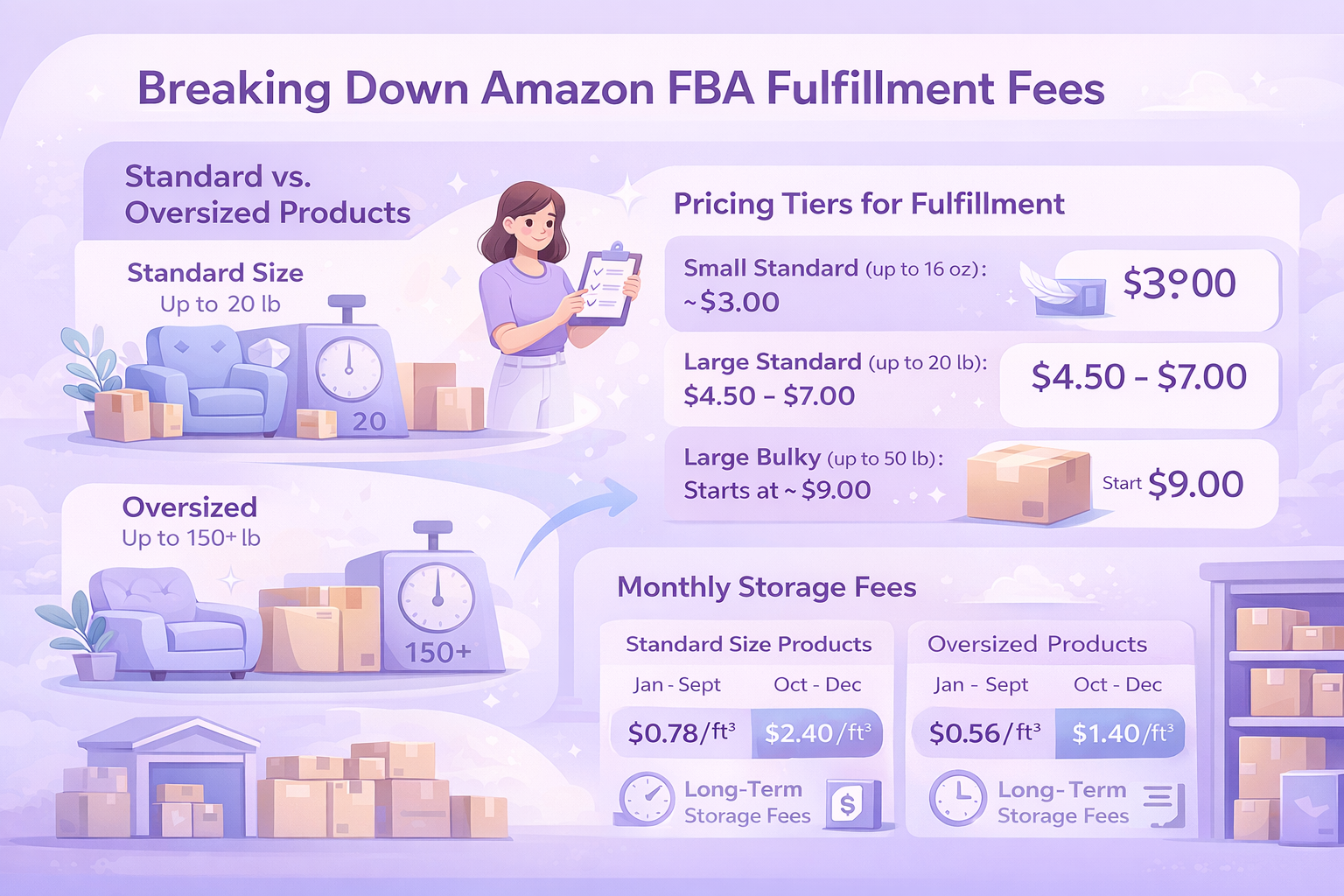
Amazon classifies products into two categories: standard-size and oversized products. The fees for standard-size products are typically lower, but they also depend on weight. For example:

  • Standard-size products range from small items under 2 oz to larger products up to 3+ lb to 20 lb (large standard).
  • Oversized products can be as large as 150 lb or more.

The cost increases as the product’s weight and size increase. While smaller items will cost less to ship, oversized products may incur higher fulfillment fees.

Pricing Tiers for Fulfillment

Here’s how the fulfillment fees typically break down based on product weight:

  • Small Standard (up to 16 oz): Around $3.00 per unit.
  • Large Standard (up to 20 lb): Between $4.50 and $7.00 per unit.
  • Large Bulky (up to 50 lb): Starts at nearly $9.00 per unit.

These numbers are approximate and vary based on factors like seasonal demand, product dimensions, and special handling requirements.

Understanding Amazon FBA Storage Fees

Storage fees are another key element of FBA costs. Amazon charges monthly storage fees based on the cubic feet of space your inventory occupies in their warehouses. These fees differ depending on the time of year.

Monthly Storage Fees

Standard-size products are typically $0.78 per cubic foot from January to September, and $2.40 per cubic foot from October to December.

Oversized products are charged at $0.56 per cubic foot from January to September, and $1.40 per cubic foot from October to December.

Long-Term Storage Fees

Products that sit in Amazon’s fulfillment centers for over 365 days can incur additional long-term storage fees. These fees are typically higher and charged on top of regular monthly storage fees.


Minimizing FBA Fees: Tips and Strategies

While you can’t entirely avoid Amazon’s FBA fees, there are ways to minimize them and keep your profit margins intact.

1. Optimize Your Inventory Management

One of the most significant costs with FBA is storage fees, especially for products that don’t sell quickly. Overstocking inventory can lead to high storage fees and long-term storage penalties. So:

  • Monitor sales trends regularly to avoid overstocking.
  • Use Amazon’s FBA Dashboard to keep track of your inventory performance, including metrics like the Inventory Performance Index (IPI), which shows you how quickly your products are moving.

2. Reduce Shipping Costs with Amazon Partnered Carrier

If you plan on shipping products to Amazon’s warehouses, consider using Amazon Partnered Carrier to save money on shipping costs. Amazon’s carrier partnerships offer discounted shipping rates, which can significantly reduce your inbound costs.

3. Choose the Right Products

Selecting the right products to sell can have a huge impact on your overall FBA fees. Opt for products that are:

  • Lightweight and small: These are cheaper to ship and store.
  • High-demand: Products that sell fast will minimize storage time and reduce storage fees.
  • Non-perishable: Non-perishable items avoid long-term storage fees and the risk of spoilage.

4. Watch Seasonal Storage Fees

Amazon’s storage fees may increase during peak months, particularly when the holiday shopping season hits. Plan ahead to ensure you’re not holding too much inventory during these months and:

  • Offer discounts or run promotions to clear out slow-moving inventory before the seasonal fees kick in.
  • Use Amazon Outlet for excess inventory, or choose removal services if you don’t want to store products over the long term.

5. Use Low-Price FBA Rates for Small Items

For products under $10, Amazon offers lower fulfillment fees through Low-Price FBA rates. This can be a great way to keep your fulfillment costs low while expanding your product offerings.


Other FBA Fees to Keep in Mind

In addition to fulfillment and storage fees, there are a few other costs associated with FBA that you should be aware of:

Removal Fees

If you want to retrieve products from Amazon’s fulfillment centers (for example, if they’re not selling), Amazon charges a removal fee per unit. This fee depends on the product’s size and weight. For standard-size items, the removal fee ranges from $1.04 to $2.89, while oversized or special handling items can cost significantly more.

Returns Processing Fees

If a customer returns an item, Amazon charges a return processing fee. This fee varies depending on the type of product and its price.

FBA Inbound Placement Fees

When you send inventory to multiple fulfillment centers, Amazon may charge you for using their FBA inbound placement service. The fee is based on the number of units and which fulfillment centers your products are placed in.


How to Estimate FBA Fees with the Revenue Calculator

To help you get a clear picture of your FBA costs, Amazon provides the FBA Revenue Calculator, which allows you to estimate fulfillment, storage, and other fees based on your product’s dimensions and weight. You can compare FBA costs with self-fulfillment costs to see which option is more cost-effective for your business.


How WisePPC Can Help You Navigate Amazon FBA Seller Fees

As you dive into the world of Amazon FBA, understanding the associated costs is essential to running a profitable business. At WisePPC, we understand the complexities of managing these fees. That’s why we’ve developed a powerful analytics platform that helps Amazon sellers gain visibility into their costs and optimize their advertising efforts to maximize returns.

Our WisePPC’s platform is designed to give you real-time performance tracking and insights into what’s really driving your sales. By integrating all your marketplace data, including Amazon ads, organic performance, and conversions, we help you get a comprehensive view of your business. This way, you can keep track of your FBA fees while making informed decisions on advertising spend, inventory management, and overall profitability.

What sets WisePPC apart is its ability to provide granular analytics. With our tool, you can track and compare key performance indicators across multiple marketplaces, including Amazon. This allows you to manage your Amazon FBA fees more effectively by optimizing your ad campaigns, targeting the right customers, and controlling costs. Whether you manage 10 or 100 products, our platform grows with you, offering actionable insights at every stage of your business.


Final Thoughts

Understanding Amazon FBA seller fees is essential for running a profitable Amazon business. While these fees can add up, FBA provides value in terms of convenience, access to Prime customers, and scalability. The key is to carefully track your expenses, optimize your inventory, and choose the right products to sell.

If you plan ahead, manage your inventory wisely, and use the tools Amazon provides, you can minimize your FBA fees and keep your business growing. It’s all about finding that balance between cost, convenience, and the services Amazon offers.

By implementing these strategies, you’ll be in a better position to scale your business while keeping costs under control.


FAQ

1. What are Amazon FBA seller fees?

Amazon FBA seller fees are charges that Amazon applies to cover the costs of storing, picking, packing, and shipping your products. These fees also include customer service and handling returns. They’re mainly broken down into fulfillment fees (based on product size and weight), storage fees (for holding your products in Amazon’s fulfillment centers), and additional costs for optional services like removal or disposal of inventory.

2. How are FBA fulfillment fees calculated?

Fulfillment fees are primarily determined by the size and weight of your products. For example, smaller items cost less to store and fulfill, while larger, heavier items incur higher fees. Amazon uses specific price tiers depending on whether your product is standard-size or oversized. These fees cover everything from picking your product in the warehouse to shipping it to customers.

3. Are FBA storage fees charged all year?

Yes, but they vary by season. Amazon’s standard storage fees are lower from January to September and increase during the peak holiday months of October to December. This seasonal shift is something to keep in mind when planning inventory, as storing products for extended periods during peak times can increase costs significantly.

4. How can I avoid long-term storage fees?

To avoid long-term storage fees, keep a close eye on your inventory. If products are sitting in Amazon’s warehouse for over 365 days, you’ll incur additional charges. Regularly review your sales data, use promotions or discounts to move slow-moving products, and consider using Amazon’s FBA Liquidations or Removal Services if you need to clear out old stock.

5. Can I reduce FBA fees with small and lightweight products?

Absolutely! Small and lightweight products not only cost less to fulfill but also incur lower storage fees. If you’re just starting out or expanding your product line, focusing on these kinds of products can help reduce your overhead costs while still providing good margins.

6. What are the hidden fees in FBA that I should be aware of?

While Amazon is transparent about most of its fees, some additional costs might catch sellers by surprise. These can include returns processing fees for customer returns, removal or disposal fees if you choose to remove unsold inventory, and fees for FBA inbound placement services if you send your stock to multiple fulfillment centers. It’s important to account for these extra charges in your overall cost structure.

7. How can I track and manage my FBA fees?

To keep track of your FBA fees, use Amazon’s Fee Preview and Revenue Calculator tools. These tools help you estimate your fees based on your product’s size, weight, and category. Additionally, you can monitor your costs and sales performance through the FBA Dashboard and Payments Dashboard on Seller Central to ensure you’re staying within budget.

Ecommerce Growth Strategies That Actually Scale Your Business

Growing an ecommerce business is rarely about one big move. Most of the time, growth comes from dozens of small decisions made consistently and backed by data.

Once your store is live and sales are coming in, the real question becomes what to improve next. More traffic? Better conversion? Faster fulfillment? New channels?

This guide breaks down practical ecommerce growth strategies you can actually apply, whether you’re running a small brand, a growing operation, or a complex multi-channel business. We’ll cover what works, where teams usually get stuck, and how platforms like Amazon and Shopify fit into long-term growth.


What an Ecommerce Growth Strategy Really Is

An ecommerce growth strategy is a structured plan for increasing revenue while keeping operations stable. It’s not just about getting more visitors. It’s about improving how your business acquires customers, converts them, fulfills orders, and keeps them coming back.

Good strategies balance short-term wins with long-term sustainability. They focus on systems, not hacks. And they evolve as the business grows.


Before You Scale: A Quick Reality Check

One of the most common mistakes in ecommerce is trying to scale too early.

If your store struggles with basic fulfillment, inconsistent customer support, or thin margins, adding more traffic will usually make things worse. Growth amplifies problems as much as it amplifies wins.

Before pushing harder on acquisition, make sure:

  • Your core products sell reliably
  • Returns and refunds are under control
  • Inventory planning is predictable
  • Customer feedback is mostly positive

Once those foundations are stable, growth efforts compound instead of collapse.


Core Growth Strategies That Work Across Most Ecommerce Businesses

1. Improve the Buying Experience First

Growth starts with making it easy for people to buy.

That means clear product pages, honest pricing, fast load times, and a checkout that doesn’t fight the customer. Small improvements here often outperform large ad budget increases.

Fast, reliable shipping matters too. Customers now expect speed and transparency, not excuses.

2. Expand Products With Intent

Adding more products can unlock growth, but only when it’s done thoughtfully.

Use sales data, customer questions, and return reasons to spot gaps. New variations, bundles, or complementary items often perform better than completely new categories.

Expansion should follow demand, not guesswork.

3. Keep Inventory in Balance

Inventory problems quietly kill growth.

Stockouts stall momentum. Overstock drains cash. The goal is accuracy, not perfection.

Demand forecasting, historical sales analysis, and seasonality tracking help keep inventory aligned with real demand, especially when selling across multiple channels.

4. Track Performance Relentlessly

Growth decisions should come from data, not instinct.

Track performance by channel, campaign, and product. Look at traffic sources, conversion rates, average order value, and repeat purchase behavior.

Then act on what the numbers tell you. Adjust pricing, refine messaging, and double down on what consistently works.

5. Invest in Retention, Not Just Acquisition

New customers matter, but repeat customers often drive profitability.

Retention strategies like follow-up emails, reorder reminders, subscriptions, and loyalty incentives increase lifetime value and stabilize revenue. They also reduce pressure on advertising budgets.

Growth becomes more predictable when a portion of sales comes from customers who already trust the brand.

6. Strengthen Fulfillment and Operations

As order volume increases, operational cracks widen.

Reliable fulfillment, accurate order processing, and responsive customer support are essential for sustaining growth. Delays, errors, and slow responses turn growth into churn.

Strong operations don’t always feel visible when they work well, but they quietly protect margins, customer satisfaction, and long-term scalability.


Growth Tactics Based on Business Type

For B2C Brands

B2C growth usually comes from a balance between bringing in new customers and giving existing ones a reason to return. Retention often has a bigger long-term impact than constant acquisition, especially as ad costs rise.

Loyalty programs, subscriptions, and personalized offers help increase customer lifetime value by turning one-time buyers into repeat customers. Even small touches, like tailored recommendations or reorder reminders, can make a noticeable difference.

Mobile optimization is no longer optional. A large share of purchases now happens on phones, and even minor friction on mobile can hurt conversion rates. Fast load times, simple navigation, and smooth checkout matter more than extra features.

Influencer partnerships can still drive growth when they feel genuine. Smaller creators with focused, engaged audiences often deliver better results than big names, especially when the content feels natural and aligned with the brand.

For B2B Ecommerce

B2B ecommerce growth is built on trust and reliability rather than impulse buying. Buyers want clarity, consistency, and confidence that the supplier understands their needs.

Clear pricing, bulk purchasing options, flexible payment terms, and dependable account support often matter more than design or branding polish. Buyers are looking for efficiency and predictability, not inspiration.

Content plays a key role here. Case studies, product documentation, certifications, and comparison guides help shorten buying cycles and support larger, repeat orders by reducing uncertainty.

Strong relationships drive repeat revenue in B2B ecommerce. Ongoing communication, reliable fulfillment, and responsive support are what keep customers coming back, not short-term promotions or discounts.


Growth Tactics Based on Business Size

Small Businesses

Focus usually wins early on. Trying to serve everyone often spreads resources too thin and makes it harder to stand out.

Niches tend to outperform broad catalogs in the early stages because they allow small businesses to speak directly to a specific audience. When customers feel understood, they’re more likely to buy and come back.

Partnerships with complementary brands can expand reach without heavy ad spend. Cross-promotions, bundles, or shared content introduce your products to new audiences in a natural way. Community building and direct communication, whether through email, social media, or customer support, often become real competitive advantages for smaller teams.

Midsize and Enterprise Businesses

At scale, coordination becomes just as important as creativity.

Multichannel fulfillment, unified marketing messaging, and automation across inventory, pricing, and reporting help prevent operational friction as volume grows. Without alignment, growth can quickly create inefficiencies instead of momentum.

International expansion opens new revenue opportunities, but it requires careful planning around logistics, compliance, taxes, and localization. Success depends on understanding each market, not just translating listings.

Customer data also takes on a different role at this stage. It becomes a strategic asset that informs pricing, product development, forecasting, and long-term growth decisions, rather than something used only for monthly reports.


How We Support Smarter Ecommerce Growth at WisePPC

At WisePPC, we help sellers turn growth strategies into clear, measurable actions.

We built WisePPC to give teams full visibility into what’s actually driving sales across advertising and organic performance. With centralized analytics, long-term historical data, and real-time tracking of key metrics like ACOS, TACOS, and profit, sellers can make decisions based on facts, not assumptions.

As an Amazon Ads Verified Partner, we use official integrations and follow Amazon’s best practices. Our bulk actions, advanced filtering, and on-spot campaign editing reduce manual work, while granular insights help uncover wasted spend and winning strategies faster.

WisePPC scales with your business, helping you grow efficiently, protect margins, and stay in control as complexity increases.


Common Growth Challenges and How to Avoid Them

  1. Scaling too fast. Rapid expansion without operational readiness often leads to late shipments, overwhelmed support teams, and shrinking margins. Growth should follow stability, not outrun it. Gradual rollouts, limited pilots, and clear performance checkpoints help reduce risk and reveal issues early.
  2. Over-automating too early. Automation can save time, but only when processes are already working. Poorly configured systems often create more problems than they solve. Start with tools that address clear bottlenecks, keep setups simple, and make sure teams understand how to use them before expanding automation further.
  3. Ignoring customer retention. New customers usually cost more than existing ones, especially as advertising becomes more competitive. Retention strategies like follow-up emails, reorder reminders, loyalty perks, and consistent post-purchase communication often deliver a higher return than acquisition alone and help stabilize long-term growth.


Ecommerce Trends Shaping Growth Today

Personalization Done Right

Customers now expect relevant experiences, not generic ones. Personalized recommendations, dynamic content, and targeted messaging improve conversion without feeling intrusive when done well.

Voice and Conversational Commerce

Voice assistants and chat-based shopping continue to grow. Customers use them to reorder essentials, ask product questions, and check order status. Chatbots reduce support load and improve response times.

Augmented Reality and Visualization

AR helps bridge the gap between online and in-store shopping. Seeing products in real environments reduces hesitation and lowers return rates, especially for furniture, fashion, and home goods.

Sustainability as a Growth Signal

Eco-friendly practices are no longer niche. Transparent packaging, responsible sourcing, and carbon reduction efforts influence purchasing decisions, especially for younger audiences.


Scaling Without Burning Cash

Sustainable growth protects margins, not just revenue. Chasing top-line numbers without understanding costs usually creates pressure instead of progress.

That means closely monitoring advertising efficiency, knowing your contribution margins by channel, and being honest about which campaigns actually make money. Not every sale is a good sale, especially when discounts, returns, and fulfillment costs are factored in.

It also means knowing when to pause or pull back. Growth driven by permanent discounts or consistently unprofitable ads may look good on dashboards but eventually stalls when cash flow tightens.

Healthy ecommerce businesses scale at a pace their cash flow can support. They invest more when results are proven, slow down when signals turn negative, and treat profitability as a requirement, not an afterthought.


Final Thoughts

Ecommerce growth isn’t about copying tactics from bigger brands. It’s about building systems that match your stage, your customers, and your resources.

Focus on fundamentals first. Let data guide decisions. Expand carefully. And choose platforms that remove friction instead of adding it.

When growth is intentional, it compounds.


Frequently Asked Questions

What is an ecommerce growth strategy?

An ecommerce growth strategy is a structured approach to increasing online sales while keeping operations, margins, and customer experience under control. It focuses on acquisition, conversion, fulfillment, and retention working together, not in isolation.

Why is an ecommerce growth strategy important?

Without a strategy, growth becomes reactive. A clear plan helps businesses prioritize the right improvements, avoid costly mistakes, and scale in a way that’s sustainable rather than chaotic.

What should I focus on first when trying to grow an ecommerce business?

Start with fundamentals. Make sure the buying experience is smooth, fulfillment is reliable, and margins are understood. Growth efforts work best when the core business is already stable.

Is it better to focus on acquisition or retention?

Both matter, but retention often delivers a higher return over time. Repeat customers reduce pressure on advertising budgets and create more predictable revenue, especially as acquisition costs rise.

How do I know if my growth efforts are actually working?

Track performance consistently. Look at metrics like conversion rate, average order value, repeat purchases, advertising efficiency, and contribution margins by channel. Growth should improve profitability, not just revenue.

Amazon Seller Policies That Help Keep Your Account and Sales on Track

Selling on Amazon gives businesses instant access to a massive audience and built-in customer trust. That advantage comes with rules. Amazon expects sellers to follow clear policies designed to protect customers and keep the marketplace reliable.

Understanding these policies early helps you avoid account issues, protect your revenue, and build a business that lasts. Sellers who treat policies as an afterthought often learn the hard way, usually when something gets suspended or funds are put on hold.

This guide walks through the most important policy areas every seller should understand, without legal jargon or unnecessary fluff.


What Amazon Seller Policies Are, in Plain Terms

Amazon seller policies are the basic rules that govern how selling works on the platform. They set expectations for how products should be listed, how sellers communicate with customers, how orders are shipped, and how advertising is handled. The goal is simple: create a shopping experience that feels reliable and consistent for customers, no matter who the seller is.

These rules touch nearly every part of daily operations. They cover things like product descriptions, pricing accuracy, delivery timelines, and customer service standards. Some policies are easy to spot and follow. Others are buried in documentation and often only get attention when something goes wrong.


Why Following the Rules Actually Matters

Amazon is very customer-focused, and its systems are built to detect issues fast. When a seller breaks policy, even unintentionally, the consequences can be serious.

Common outcomes include:

  • Listing removals
  • Loss of Featured Offer eligibility
  • Funds being temporarily withheld
  • Account restrictions or deactivation

Most of these problems are preventable. Sellers who understand the rules tend to fix issues before they escalate.


Product Compliance and Safety: Where Many Sellers Slip Up

Product compliance is about making sure what you sell is legal, safe, and accurately represented.

Restricted and Approval-Required Products

Some products cannot be sold at all. Others require approval before listing. These rules vary by category and sometimes by region. Always check restrictions before sourcing inventory.

Product Condition and Accuracy

Listings must match the real condition of the item. Mislabeling a used or refurbished product as new is a common reason for complaints and policy warnings.

Intellectual Property Basics

Sellers are responsible for avoiding trademark and copyright violations. Using brand names incorrectly, copying images, or listing counterfeit items can lead to immediate takedowns.

Reviews Must Stay Clean

Amazon strictly controls customer reviews. Any attempt to influence, manipulate, or fake reviews puts your account at risk. Reviews must reflect genuine customer experiences.


Account Health: The Metrics Amazon Watches Closely

Amazon keeps a close eye on seller performance through a small set of core metrics. These numbers play a major role in how your account is evaluated and how much flexibility you have as a seller. Even small changes can affect visibility or trigger warnings if they go unchecked.

Account Health Rating

This score shows how close your account is to potential restrictions. It’s influenced by policy violations, unresolved issues, and overall performance history. When problems are addressed quickly, the impact is usually limited. When they sit unresolved, the score drops and recovery becomes harder.

Order Defect Rate (ODR)

ODR reflects how well you meet customer expectations. It includes negative feedback, A-to-z Guarantee claims, and chargebacks. In most cases, keeping ODR below 1% helps protect your selling privileges and reduces the risk of enforcement actions.

Checking these metrics regularly makes a difference. Catching issues early gives you more options and less pressure than trying to fix things after restrictions are already in place.


Shipping and Fulfillment Rules That Affect Your Account

Shipping performance plays a big role in how Amazon evaluates your account. Whether you handle fulfillment yourself or rely on Amazon’s network, delivery-related issues are closely monitored and can quickly impact account health if they become consistent.

Seller-Fulfilled Orders

When you fulfill orders on your own, Amazon expects reliable execution on every shipment. That means shipping on time, confirming orders promptly, and providing accurate tracking so customers know where their package is.

Key areas to watch include:

  • Late Shipment Rate should stay below 4%
  • Cancellation Rate should stay under 2.5%
  • Valid tracking and on-time delivery remain essential

Many cancellations trace back to inventory problems rather than shipping mistakes. Running out of stock or overselling products often leads to last-minute cancellations, which is one of the fastest ways to hurt performance metrics. Keeping inventory levels accurate and up to date helps prevent these issues before they start.


Fulfillment by Amazon (FBA): Less Work, Still Rules

Using Fulfillment by Amazon can simplify day-to-day operations, but it doesn’t remove a seller’s responsibility to follow the rules. Amazon takes care of storage, packing, shipping, and customer returns, yet sellers remain accountable for what they send into the fulfillment network.

To avoid problems, sellers need to:

  • Follow product and category restrictions before listing
  • Meet packaging, labeling, and preparation requirements
  • Make sure inventory is compliant before it arrives at the fulfillment center

FBA also comes with its own safeguards. If inventory is lost or damaged while under Amazon’s control, sellers may qualify for reimbursement in certain situations. Knowing how these cases are evaluated and when to file a claim can make a real difference to margins, especially at higher volumes.


Advertising and Brand Content Guidelines

Advertising on Amazon is tightly regulated, and the rules apply whether you’re running simple sponsored ads or building out a full brand presence. Ads must follow Amazon’s content standards and targeting guidelines, and any claims you make need to be accurate and supported. Even ads that perform well elsewhere can be rejected if they don’t meet Amazon’s requirements.

Brand content follows similar principles. Storefronts, A+ Content, and brand profiles should reflect the business honestly. Misleading visuals, exaggerated benefits, or unclear messaging often lead to rejected submissions or warnings on the account. Keeping content straightforward and accurate usually leads to fewer delays and fewer revisions.


A Section Many Sellers Overlook: Ongoing Policy Changes

Amazon updates its policies regularly, sometimes in small ways that are easy to miss. A listing or process that was acceptable a year ago may no longer meet current standards.

Successful sellers make it a habit to:

  • Review policy updates in Seller Central
  • Pay attention to account health notifications
  • Adjust listings and workflows before issues appear

Ignoring updates is one of the most common reasons long-standing accounts run into sudden problems. Staying informed helps avoid surprises and gives sellers time to adapt without pressure.


Selling on Amazon Without Constant Stress

Amazon’s policies are not designed to trap sellers. They are designed to standardize quality at scale. Sellers who understand this tend to do better long term.

When policies are treated as part of operations, not obstacles, running an Amazon business becomes more predictable. Fewer surprises. Fewer interruptions. More focus on growth.

Following the rules is not just about staying active. It’s about building a business Amazon trusts and customers feel comfortable buying from.


WisePPC: How We Help Sellers Stay in Control

Running an Amazon business is easier when you can clearly see what’s happening across ads, sales, and account performance. That’s why we built WisePPC. We give sellers a single place to track key metrics, understand performance, and make decisions based on real data instead of guesswork.

As an Amazon Ads Verified Partner, we use official integrations and follow Amazon’s best practices. Sellers can monitor more than 30 metrics, access years of historical data that Amazon doesn’t keep, and spot trends before they turn into account or budget issues.

WisePPC is built to save time. Bulk actions, advanced filtering, and visual performance indicators help sellers quickly identify what needs attention. With clear reporting and tools designed for scale, we help sellers stay organized, reduce wasted ad spend, and grow with more confidence.


Wrapping It Up

Amazon seller policies can feel overwhelming at first, especially when you’re focused on sourcing products, managing inventory, and growing sales. But in practice, most issues come down to a small set of rules that affect listings, shipping, account health, and customer experience.

Sellers who understand these policies tend to run into fewer surprises. They catch problems earlier, fix them faster, and spend less time dealing with suspensions or appeals. Over time, that stability matters just as much as traffic or conversion rates.

Selling on Amazon works best when policies are treated as part of daily operations, not something to review only after something goes wrong. Staying informed, checking performance metrics regularly, and adapting to policy updates helps keep your business running smoothly and gives you more room to focus on growth.


Frequently Asked Questions

Can sellers create their own return policies on Amazon?

Sellers must follow Amazon’s return requirements. In some cases, sellers can choose whether to accept returns outside the standard return window, but Amazon policies always take priority over seller-specific rules.

Can Amazon seller policies be changed or customized?

No. Amazon’s seller policies apply to all sellers and cannot be changed. What sellers can control is their own account settings, shipping options, and store information within Seller Central.

What is considered a seller code of conduct violation?

Violations include actions like listing counterfeit products, manipulating reviews, providing inaccurate information, or misusing Amazon systems. These issues can lead to listing removals, account restrictions, or full deactivation.

Can a seller refuse a return request?

For most products, returns requested within Amazon’s standard return window must be accepted. Refusing valid return requests or ignoring them can result in automatic refunds and potential account penalties.

How often do Amazon seller policies change?

Policies are updated regularly. Some changes are minor, while others can affect entire categories or fulfillment methods. Reviewing Seller Central notifications and policy updates helps sellers stay compliant.

What’s the best way to avoid policy-related account issues?

Regularly checking account health metrics, keeping listings accurate, managing inventory carefully, and staying aware of policy updates are the most effective ways to avoid problems.

How to Report an IP Violation to Amazon: A Short Guide

Protecting your intellectual property is not something most sellers think about on day one. It usually becomes important when something goes wrong. A copied image. A suspicious seller. A product that looks a little too familiar.

On Amazon, those problems can escalate quickly. Counterfeit listings and unauthorized content don’t just hurt your brand. They confuse customers, damage trust, and can lead to account-level issues if left unchecked.

The good news is that Amazon has clear processes for reporting intellectual property violations. Once you understand how they work, taking action is usually straightforward.

This guide explains what counts as IP, what qualifies as a violation, and how to report problems the right way so Amazon can act on them.


What Counts as Intellectual Property?

Intellectual property, often shortened to IP, refers to things you create that have business value even though they aren’t physical objects.

For ecommerce sellers, this usually includes:

  • Product names and brand names
  • Logos and packaging designs
  • Product images and written descriptions
  • Original designs, inventions, or functional features

Think of IP the same way you think about owning a physical asset. You may not be able to touch it, but it still belongs to you, and you control how it’s used. That ownership is what allows you to protect your work and prevent others from profiting from it without permission.

IP is typically protected through trademarks, copyrights, or patents, depending on what you’re protecting.


What Does IP Infringement Look Like on Amazon?

IP infringement happens when someone uses your protected material without your approval. On Amazon, this can show up in several common ways.

Some typical examples include:

  • A seller using your product photos or copy on their own listing
  • A listing that uses branding or packaging designed to look like yours
  • A product that copies a patented design or feature
  • Counterfeit items sold under your brand name

In most cases, the intent doesn’t matter. If your protected IP is being used without authorization, it may still qualify as infringement.


The Three Types of IP Amazon Enforces

Amazon’s enforcement system is built around three main categories. Understanding which one applies to your situation makes reporting much easier.

Copyright

Copyright protects original creative work. This includes photos, written content, graphics, and designs. If someone copies your images or text and uses them to sell a product, that is usually a copyright issue.

Trademark

Trademarks protect brand identifiers such as names, logos, and slogans. If another seller uses branding that could confuse customers or make them think their product is yours, that may be a trademark violation. Counterfeiting also falls under this category.

Patent

Patents protect inventions and functional designs. If someone manufactures or sells a product that uses your patented invention without permission, that may be a patent infringement.

Amazon focuses on these three areas when reviewing IP complaints.


Who Can Report an IP Violation?

Amazon allows IP rights owners and authorized agents to submit infringement reports.

There are two main ways to do this:

  • Public Notice Form. Available to any rights owner or agent. This option is open even if you’re not enrolled in Brand Registry.
  • Report a Violation tool. Available only to brands enrolled in Amazon Brand Registry. To use it, your account must be assigned the Rights Owner or Registered Agent role.

If your trademark is still pending, you won’t be able to use the Report a Violation tool yet. However, you can still access other Brand Registry benefits and use the Public Notice Form in the meantime.


How Brand Registry Changes the Process

Amazon Brand Registry gives registered brands more control over how their intellectual property is protected across the marketplace. Instead of reacting to problems after they appear, Brand Registry shifts part of the work to prevention.

Once a brand is enrolled, Amazon applies automated protections that use data patterns and machine learning to identify and block many suspected violations before they ever reach customers. This includes stopping inaccurate product information, counterfeit listings, and other common forms of abuse early in the process.

Brand Registry also gives brands stronger tools for enforcement. Sellers can search Amazon’s catalog more effectively, identify potential infringements faster, and submit reports through a dedicated system designed specifically for IP issues. Compared to public reporting, the process is more direct and typically moves faster.

In day-to-day use, this means fewer surprises and less manual cleanup. Many problems are resolved before a brand even becomes aware of them, and when something does slip through, Brand Registry makes it easier to take action quickly and keep listings under control.


How to Report an IP Violation Using Report a Violation

If your brand is enrolled in Brand Registry, reporting a violation is fairly direct.

After logging in:

  1. Open Brand Registry and select Report a Violation
  2. Search using ASINs, product URLs, keywords, images, or order numbers
  3. Identify the listing and select the type of violation
  4. Provide clear details explaining why it infringes your IP
  5. Submit the report for review

You can report individual listings or upload up to 50 ASINs at once if the issue affects multiple products.

Accuracy matters here. Be specific about what’s being violated and which IP right applies. Clear reports are reviewed faster and are more likely to lead to action.


Reporting Patent Issues the Faster Way

Patent disputes can be slow and expensive when handled through traditional legal channels. To address this, Amazon offers a program called Patent Evaluation Express for certain utility patent claims.

Instead of sending sellers straight into court, the program relies on a neutral third-party evaluator with experience in patent analysis. The evaluator reviews the patent and the accused listing to determine whether infringement is likely. This creates a clearer, faster path to resolution without requiring a full legal proceeding.

Patent Evaluation Express is designed to move quickly compared to standard litigation, which can drag on for months or years. It also keeps costs under control. The program is free for the party the evaluator determines is correct, making it a practical option for rights owners who want to enforce their patents without committing to a lengthy and expensive legal fight.

For sellers dealing with patent-related issues on Amazon, this approach often provides a more efficient way to protect their rights and resolve disputes with less disruption to their business.


Tracking and Managing Your Reports

After submitting a report, you’re not left in the dark. Amazon provides visibility into what’s happening so you can follow each case without constant back-and-forth.

Inside Brand Registry, you can:

  • View all submitted complaints in one place
  • Check the current status of each case as it’s reviewed
  • Open detailed reports to see what information was submitted
  • Retract a complaint if it was filed in error or the issue has been resolved

Having access to this history is especially helpful if you manage more than one brand or deal with repeat infringement issues. It also gives you clear documentation over time, which can be useful when tracking patterns, responding to disputes, or working with advisors on ongoing brand protection.


Why Acting Early Matters

IP violations rarely resolve on their own. In most cases, ignoring them only gives bad actors more time to copy, list, and sell without consequences. What starts as a single issue can quickly turn into multiple listings, confused customers, and ongoing damage to your brand.

Reporting problems early helps protect customers from misleading information and counterfeit products. It also preserves your brand’s credibility by showing consistent ownership and control over how your products appear in the marketplace. Left unaddressed, small issues can grow into larger listing conflicts or even account-level complications.

The sooner Amazon receives clear and accurate information, the sooner they can review the issue and take action. Early reporting keeps problems contained and allows you to stay focused on growing your business instead of constantly putting out fires.


How We Help Sellers Stay in Control With WisePPC

At WisePPC, we work with Amazon sellers who want clarity, not guesswork. Protecting a brand on Amazon goes beyond reporting violations. It also means understanding what’s happening across your listings, ads, and sales data before small issues turn into bigger problems. That’s exactly where our platform fits in.

We built WisePPC to give sellers full visibility into their marketplace performance. With advanced analytics, long-term historical data, and real-time insights, we help teams spot unusual activity, performance drops, or changes in sales behavior that may signal deeper issues. When you can see trends clearly, it’s easier to react quickly and make informed decisions, whether that’s adjusting campaigns, reviewing listings, or addressing potential abuse.

As an Amazon Ads Verified Partner, we use official integrations and follow Amazon’s best practices. Our tools are designed to simplify complex workflows, from bulk campaign updates and granular performance tracking to advanced filtering and segmentation across campaigns, keywords, and placements. Instead of juggling spreadsheets or short-term reports, sellers get a centralized system built for scale and long-term growth.

By combining clear analytics, automated insights, and flexible reporting, we help sellers focus on what matters most: improving efficiency, and growing with confidence in a competitive marketplace.


Final Thoughts

Protecting your intellectual property on Amazon doesn’t have to be complicated. Once you understand what qualifies as a violation and which tools to use, the process becomes manageable.

Whether you’re handling it yourself or working with professionals who understand ecommerce compliance, the key is staying proactive. Your brand is one of your most valuable assets. Treat it that way.

If you need guidance with IP issues, brand protection, or the financial side of running an ecommerce business, working with specialists who understand marketplace rules can save time and prevent costly mistakes.


Frequently Asked Questions

What counts as an IP violation on Amazon?

An IP violation usually involves someone using your protected work without permission. This can include copied product images or descriptions, branding that looks confusingly similar to yours, counterfeit products, or the unauthorized use of a patented invention. Amazon focuses on copyright, trademark, and patent violations when reviewing reports.

Do I need to be enrolled in Brand Registry to report an IP violation?

No. Any IP rights owner or authorized agent can report suspected violations using Amazon’s Public Notice Form. However, brands enrolled in Amazon Brand Registry get access to stronger tools, including faster reporting through Report a Violation and additional proactive protections.

Can I report an IP violation if my trademark is still pending?

If your trademark is pending, you won’t be able to use the Report a Violation tool yet. That tool becomes available once the trademark is fully registered. While you’re waiting, you can still use the Public Notice Form and take advantage of other Brand Registry benefits.

How long does Amazon take to review an IP complaint?

There’s no fixed timeline. Some cases are reviewed quickly, while others take longer depending on the type of violation and the details provided. Clear, accurate reports with supporting information usually move faster than vague or incomplete submissions.

Can I report more than one listing at a time?

Yes. If you’re using Report a Violation through Brand Registry, you can submit multiple ASINs in a single search. This is helpful when the same issue affects several listings or sellers.

How to Use Product Opportunity Explorer to Find Great Products on Amazon

Finding what to sell on Amazon doesn’t have to be guesswork anymore. With Product Opportunity Explorer, you can use real Amazon data to see what customers are searching for, what they buy most often, and where there might be room for something new. It’s like having a window into customer behavior and demand trends, all in one place. In this guide, we’ll break down how the tool works, why it matters, and how you can use it to find products that are more likely to succeed.


What Product Opportunity Explorer Really Does

Product Opportunity Explorer is a research tool inside Seller Central that analyzes customer demand using aggregated marketplace data from Amazon.

At its core, it answers four practical questions:

  • What are customers actively searching for?
  • Which products attract the most clicks and purchases?
  • Where is demand growing faster than supply?
  • What problems cause returns or negative reviews?

Instead of starting with products, the tool starts with customer needs. That difference matters more than it sounds.

Most sellers think in terms of items. Customers think in terms of problems, uses, and outcomes. Product Opportunity Explorer bridges that gap by organizing demand into niches built from real search behavior and purchase patterns.


Understanding Niches Before You Touch Any Data

Everything in Product Opportunity Explorer revolves around niches, so it is worth slowing down here.

A niche is not a category and it is not a keyword. It is a group of related search terms and products that reflect a specific customer need.

For example, “dog bed” is not just a keyword. It represents a broader intent that includes size preferences, materials, durability, washing needs, and price sensitivity. The niche groups all of that behavior together.

A single product can belong to multiple niches. A single search term can appear in more than one niche. That overlap is intentional and mirrors how real customers browse and compare.

Niche data in Product Opportunity Explorer is updated monthly. Each metric reflects the last 30, 90, or 360 days of aggregated data, but the refresh cycle itself occurs on a monthly basis. This keeps the insights current without being noisy.


Getting Started Inside Seller Central

To access Product Opportunity Explorer:

  1. Log in to Seller Central.
  2. Open the main menu.
  3. Go to Growth.
  4. Select Product Opportunity Explorer.

If this is your first time inside the tool, start by watching the short overview videos. They help orient you without locking you into any specific strategy.

Once inside, you can explore in three main ways:

  • Browse example niches
  • Search by keyword
  • Search by ASIN

Each approach serves a different research goal.


When to Search by Niche and When to Search by ASIN

Searching by Niches

Niche search is best when:

  • You want to discover new product ideas
  • You are open to entering a new category
  • You want a high-level view of demand and competition

Start broad. Type a general keyword that reflects a customer problem, not a specific product model. Let the tool show you how that demand breaks down across niches.

From there, click into individual niche pages to explore deeper.

Searching by ASINs

ASIN search is best when:

  • You already sell a product
  • You want to improve or extend an existing listing
  • You want to see which niches your competitors dominate

When you search by ASIN, Product Opportunity Explorer shows which niches that product appears in, along with its relative performance. This is useful for identifying adjacent opportunities or weaknesses in existing offers.


Reading Niche Pages Without Jumping to Conclusions

Every niche page in Product Opportunity Explorer is built to tell a complete story, not to hand you a single yes-or-no answer. Each tab exists for a reason. One shows demand, another shows competition, another shows customer satisfaction, and another exposes risk. Looking at only one of them almost always leads to a distorted view.

A common mistake sellers make is anchoring on a single number, usually search volume or average price. High demand can look attractive, but without context it means very little. A niche can have strong search volume and still be a poor opportunity if most clicks go to a handful of established brands or if return rates are consistently high. The opposite can also be true. A niche with moderate demand may quietly perform well because competition is fragmented and customer needs are not fully met.

The real insight appears when you connect signals across tabs. Product data shows how crowded the space is. Search terms reveal how customers describe their needs. Insights help you judge whether entry is realistic. Reviews and returns explain where products succeed or fail in real use. When these pieces align, confidence increases. When they conflict, it is a warning to slow down and investigate further.

Instead of asking “Is this niche big enough?”, a better question is “Does this niche make sense when all the data is viewed together?”. That mindset shift alone helps avoid many costly product decisions.


The Products Tab: What Is Actually Selling

The Products tab shows ASIN-level data for the most-clicked products in the niche.

Key things to pay attention to:

  • Number of products receiving the majority of clicks
  • Review counts and average ratings
  • Average selling prices
  • Brand concentration
  • Product age and launch timing

If a niche has many products with similar click share and review counts, competition may be balanced. If a small number of products dominate clicks, entry will be harder unless you have a clear angle.

Avoid assuming that high price equals high opportunity. Price only matters when viewed alongside click share and conversion signals.


The Search Terms Tab: How Customers Express Demand

This tab shows how customers phrase their intent.

You will see:

  • Search terms
  • Search volume
  • Search volume growth
  • Click share
  • Conversion rate
  • Top clicked products per term

This is where you learn how customers think, not how sellers label products.

Look for:

  • Search terms with rising volume
  • Terms with strong conversion rates
  • Language customers use that is missing from existing listings

These insights influence not only product selection but also listing structure, titles, bullet points, and advertising.


The Insights Tab: Viability at a Glance

The Insights tab summarizes whether a niche is realistically worth entering.

Key metrics include:

  • Number of products in the niche
  • Percentage of products using Sponsored Products ads
  • Percentage of Prime offers
  • Average number of reviews
  • Brand concentration
  • Selling partner count
  • Out-of-stock rates

This tab helps you answer one critical question:

Is this niche competitive in a way I can realistically compete with?

High demand alone does not make a good opportunity. A niche with moderate demand and manageable competition often performs better for new or growing sellers.


Using Customer Review Insights to Improve Products Before Launch

Customer Review Insights aggregates positive and negative review themes across a niche or group of products and turns them into something you can actually work with. Instead of reading through hundreds of individual reviews, the tool highlights recurring complaints, recurring praise, and shows how each theme influences overall star ratings.

This perspective is especially valuable during product planning and refinement. When you are designing a new product, it helps reveal which features customers consistently care about and which issues cause frustration. When you already sell in a niche, it becomes a fast way to identify what could be improved without guessing or relying on isolated feedback.

The real opportunity appears when the same negative themes show up again and again across top products and remain unresolved. That usually points to unmet demand rather than poor execution. On the other hand, if complaints are scattered, minor, or inconsistent, making changes may not meaningfully improve performance.


Using Returns Data to Avoid Costly Mistakes

Returns data is easy to ignore, but it is one of the most practical signals Product Opportunity Explorer provides. The Returns tab summarizes why customers send products back, how often specific issues appear, and whether those problems are becoming more or less common over time.

Looking at this data helps surface issues that are not always obvious from listings or reviews alone. Some returns point to clear product flaws. Others reveal design mismatches or usage expectations customers did not anticipate. In some cases, the data highlights entire niches where dissatisfaction is common, regardless of brand.

A niche can still be worth entering even if return rates are high, but only when the causes are clear and fixable. If returns stem from structural limitations of the product type itself, it is usually a sign to pause and reconsider. Walking away early is often cheaper than learning that lesson after launch.


Evaluating Competition Without Overthinking It

Competition analysis inside Product Opportunity Explorer is less about counting sellers and more about understanding dominance.

Pay attention to:

  • Click share distribution
  • Brand concentration in the top products
  • Review gaps between leaders and challengers

A niche dominated by a few brands with massive click share and review advantages requires differentiation. A niche with fragmented attention allows room for entry.

Do not avoid competition entirely. Avoid imbalanced competition.


Spotting Seasonal Demand Early

Product Opportunity Explorer allows you to view trends over different timeframes.

Use this to:

  • Identify seasonal spikes
  • Avoid one-off trends
  • Plan inventory cycles realistically

Products that sell well year-round behave very differently from those driven by holidays or weather. The tool helps you see that before committing capital.


Turning Product Research Into Sales With WisePPC

Finding a strong product idea is only half the job. Turning that idea into consistent sales is where most sellers struggle. That’s exactly why we built WisePPC.

Once Product Opportunity Explorer shows you where demand exists, we help you act on it faster and smarter. Our platform brings advertising and sales data into one clear view, so you can see what actually drives revenue and what quietly wastes budget. No spreadsheets. No guessing.

We store years of historical data, not just the last 60 to 90 days, which means you can spot trends, seasonality, and real performance shifts early. Bulk actions, advanced filters, and visual highlights make it easy to scale campaigns, adjust bids, and cut inefficiencies in minutes instead of hours.

The goal is simple. Better decisions. Lower wasted spend. Faster growth once your product is live.


Common Mistakes Sellers Make With Product Opportunity Explorer

Even the most useful tools can lead to poor decisions when they are used in isolation or rushed through. Product Opportunity Explorer is no exception. Most mistakes happen not because the data is wrong, but because it is interpreted too narrowly or taken at face value.

Common mistakes include:

  • Focusing only on search volume. High demand looks attractive, but it does not tell the full story. Without considering competition, pricing pressure, and customer satisfaction, search volume alone can be misleading.
  • Ignoring review and returns data. Reviews and returns often explain why products struggle or succeed. Skipping these tabs removes critical context about real customer experience.
  • Entering niches dominated by entrenched brands. Some niches are controlled by a small number of sellers with strong brand recognition and deep review history. Breaking into these spaces usually requires more time, capital, and patience than many sellers expect.
  • Treating niche data as static. Demand, competition, and customer expectations change. Relying on a single snapshot instead of tracking trends over time can lead to outdated decisions.
  • Copying existing products instead of improving them. Replicating what already exists rarely creates an advantage. The real value comes from identifying gaps, not cloning top listings.

Product Opportunity Explorer reflects what is actually happening in the marketplace. It offers clarity, not shortcuts.


Final Thoughts

Product Opportunity Explorer removes much of the guesswork from Amazon product research, but it does not remove responsibility.

It shows what customers want, how they behave, and where friction exists. What you do with that information determines outcomes.

Sellers who treat the tool as a thinking aid, not a shortcut, tend to make better decisions. Fewer surprises. Fewer costly lessons. More intentional launches.

Used properly, Product Opportunity Explorer is less about chasing trends and more about understanding demand deeply enough to meet it well.

And that, in the end, is what good product selection has always been about.


FAQ

What is Product Opportunity Explorer used for?

Product Opportunity Explorer is used to research customer demand on Amazon. It helps sellers understand what shoppers are searching for, which products attract clicks and purchases, and where unmet demand may exist.

Who should use Product Opportunity Explorer?

The tool is useful for both new and experienced sellers. New sellers can use it to avoid entering overly competitive niches, while established sellers can use it to expand product lines or improve existing listings.

Do I need an active Amazon selling account to access it?

Yes. Product Opportunity Explorer is available inside Seller Central and requires an active Amazon seller account. Access may depend on account type and region.

How often is the data updated?

Niche data in Product Opportunity Explorer is updated monthly. Each metric reflects the last 30, 90, or 360 days of aggregated data, but the refresh cycle itself occurs on a monthly basis. This allows sellers to track changes in demand and competition without relying on outdated data.

Can Product Opportunity Explorer guarantee a successful product launch?

No tool can guarantee success. Product Opportunity Explorer provides data and insights, but outcomes still depend on product quality, pricing, positioning, and execution.

Ecommerce Strategies for Growing Sales at Every Stage

Ecommerce is easier to start than it was a few years ago. At the same time, it’s much harder to grow without a clear plan. New tools appear constantly, competition keeps rising, and customers expect things to work instantly.

That’s why successful ecommerce brands don’t rely on tactics alone. They build a strategy that connects products, customers, marketing, sales channels, and operations into one system. Not something rigid, but something that evolves as the business grows.

This article breaks down how that system works, and how your approach should change depending on where your business is today.


What an Ecommerce Strategy Actually Is

An ecommerce strategy is not a launch checklist or a collection of growth hacks. It’s a set of decisions that explains how your business makes money online in a repeatable way.

It defines what you sell, who you sell to, how customers discover you, where purchases happen, and how orders are delivered. Most importantly, it keeps all of those pieces aligned. When one part changes, the others adjust instead of breaking.

Without a strategy, growth often feels reactive. With one, decisions become clearer, even when the business gets more complex.


Why Strategy Matters More Than Ever

Most ecommerce brands don’t fail because their product is bad. They struggle because different parts of the business pull in different directions.

Marketing brings traffic that doesn’t convert. Operations can’t keep up with demand. Discounts increase sales but quietly destroy margins. These problems usually point to a missing or unclear strategy.

A well-defined ecommerce strategy helps you focus on what actually moves the business forward. It keeps spending under control, improves customer experience, and makes growth more predictable over time. Just as importantly, it helps you decide what not to do.


The Core Parts of a Strong Ecommerce Strategy

Every ecommerce strategy is built on a few connected pillars. Ignoring one of them almost always creates problems later.

1. Product Strategy: What You Sell and Why

Product strategy starts with understanding why your product exists in the first place. It’s not just about features, but about relevance.

Strong product decisions come from understanding customer needs, market demand, and long-term viability. This includes thinking about how your product will evolve, whether it has seasonal demand, and how easily it can be expanded with variations or related items.

Product strategy also needs flexibility. Customer feedback, trends, and supply chain changes should inform ongoing improvements instead of forcing reactive fixes.

2. Customer Strategy: Who You’re Really Selling To

Knowing your customer goes beyond basic demographics. It’s about understanding how people discover your product, what hesitations they have, and what makes them come back.

Mapping the customer journey helps here. From the first interaction to repeat purchases, every step reveals friction points and opportunities. Brands that invest in retention early often outperform those that focus only on acquisition.

Customer insights should shape everything from messaging and pricing to support policies and content.

3. Sales Channels: Where Transactions Happen

Where you sell affects how you grow. Some brands focus on direct-to-consumer stores. Others lean on marketplaces. Many do both.

Each channel plays a different role. Marketplaces can offer fast access to demand and built-in trust. Direct stores offer control, better margins, and customer data. The goal isn’t to be everywhere, but to use each channel intentionally.

As a business grows, channel decisions should be revisited. What worked at launch may not be optimal at scale.

4. Marketing Strategy: Turning Attention Into Demand

Marketing connects your product to the right audience. Effective ecommerce marketing balances organic and paid channels while staying grounded in data.

Search visibility, email, social media, advertising, and partnerships work best when they support each other rather than compete. Clear goals and consistent measurement help teams understand what’s driving results and what’s wasting budget.

Marketing strategies should evolve continuously. Customer behavior changes, platforms shift, and what worked last year may not work today.

5. Fulfillment and Operations: Delivering on the Promise

Fulfillment often gets less attention early on, but it becomes critical as volume increases. Shipping speed, inventory accuracy, returns handling, and customer support all shape the buying experience.

Operational decisions also affect pricing and margins. Offering fast shipping or free returns only works if the business can absorb the cost. Strategy helps set realistic expectations and avoid overpromising.


How These Pieces Fit Together

None of these areas exist in isolation. Decisions in one part of the business almost always affect the others.

  • Product choices influence who your customers are and what they expect.
  • Customer behavior shapes which sales channels make sense.
  • Sales channels determine how you approach marketing and promotion.
  • Marketing performance impacts inventory planning and fulfillment speed.
  • Fulfillment capabilities set clear limits on delivery promises and pricing.

Strong ecommerce brands regularly step back and look at how these parts interact. Small misalignments often go unnoticed at first, but over time they compound and slow growth if they aren’t corrected early.


Turning Ecommerce Strategies Into Clear Decisions With WisePPC

At WisePPC, we see the same issue across growing ecommerce brands: strategy exists, but the data needed to manage it is scattered. Advertising performance, sales results, and historical insights live in different tools, making it harder to see how decisions in one area affect the rest of the business.

We built WisePPC to bring those pieces together. Our platform connects advertising and sales data into a single, clear view, helping teams understand how product choices, customer behavior, and marketing performance influence growth. Long-term data storage makes it possible to analyze seasonality and past performance that would otherwise be lost.

WisePPC is designed for action, not just reporting. Bulk updates, inline campaign editing, and real-time metrics allow teams to respond quickly, while visual highlights help surface issues and opportunities without digging through spreadsheets.

By clearly separating ad-driven sales from organic performance, we help brands make smarter decisions around budgets, pricing, and inventory planning. As an Amazon Ads Verified Partner, we work within Amazon’s best practices while giving sellers deeper visibility into what actually drives profitable growth.


Strategy for Ecommerce Brands at Different Stages

Early-Stage Ecommerce Brands

Early-stage ecommerce is about learning quickly without overcommitting. At this point, the goal isn’t scale, it’s clarity.

Before launch, the focus should stay on fundamentals. Products need to solve a real problem. The buying process should feel simple and predictable. Product pages should be clear, honest, and easy to navigate. Even basic inventory tracking and customer support systems matter, as long as they work reliably.

Once the store goes live, early traction usually comes from a mix of personal networks, small paid campaigns, influencer partnerships, and search-friendly content. Email list building should start immediately, even before traffic grows, because those early subscribers often become your most valuable customers.

At this stage, testing matters more than polish. Every click, purchase, and question provides insight. The goal is to learn what resonates and adjust quickly, rather than chasing perfection.

Growing and Established Ecommerce Brands

Once sales become consistent, priorities shift from experimentation to optimization.

Customer experience becomes critical because friction scales with volume. Checkout speed, payment options, delivery reliability, and support response times all start to affect conversion and retention in a much bigger way.

Product expansion should be guided by data, not intuition. Sales history, customer feedback, and demand trends help determine which variations or new products are worth introducing. Limited runs and small tests reduce risk while still allowing growth.

Operational efficiency also takes center stage. Inventory planning, forecasting, and fulfillment processes need to keep up with demand without tying up unnecessary capital. At this stage, smooth operations often matter as much as marketing in sustaining growth.


Advanced Approaches to Sustainable Growth

Multichannel Selling Without Chaos

Selling across multiple channels can increase reach, but only if managed carefully. Centralized inventory, consistent branding, and unified support systems help prevent confusion.

Performance should be tracked by channel, and strategies adjusted accordingly. Not every channel needs to be optimized the same way.

Using Data to Guide Decisions

At scale, intuition stops working. Brands need visibility into contribution margins, acquisition costs, customer lifetime value, inventory turnover, and return impact.

These numbers guide smarter decisions about pricing, promotions, and growth investments. Without them, it’s easy to grow revenue while profitability quietly erodes.

Automation That Supports, Not Hides, Problems

Automation works best when processes are already understood. Inventory reordering, review collection, email segmentation, and returns workflows are common areas where automation saves time.

The goal is to reduce manual effort while keeping control. Automation should highlight issues early, not bury them.


Common Mistakes That Hold Brands Back

Many ecommerce growth problems don’t come from a single bad decision. They build over time, often quietly, as small misalignments compound.

  1. Expanding product lines or channels too quickly without enough data to support the decision.
  2. Relying heavily on discounts to drive sales, while margins shrink in the background.
  3. Treating each sales channel as a separate business instead of part of one system.
  4. Scaling paid traffic before fixing conversion and checkout friction.
  5. Ignoring customer retention and focusing only on acquiring new buyers.
  6. Underestimating fulfillment complexity, especially as order volume increases.
  7. Letting inventory decisions lag behind marketing and demand changes.
  8. Making strategy decisions based on short-term spikes rather than long-term performance.

These issues rarely show up overnight. They tend to grow slowly, which is why regular strategy reviews and honest performance analysis matter as the business scales.


Conclusion

Ecommerce growth is rarely about one big breakthrough. It’s usually the result of many connected decisions made over time, and adjusted as the business changes. What works at launch won’t work forever, and what works at scale can easily break a younger brand.

The strongest ecommerce strategies evolve. They connect products, customers, marketing, sales channels, and operations into a system that makes sense together. When those pieces stay aligned, growth becomes easier to manage and easier to repeat.

Whether you’re testing your first product or optimizing a mature business, the goal stays the same: make decisions based on real data, review your strategy often, and fix small misalignments before they turn into big problems.


FAQ

What is an ecommerce strategy?

An ecommerce strategy is a plan for how an online business sells products, reaches customers, fulfills orders, and grows over time. It connects product decisions, marketing, sales channels, and operations into one system.

Why do ecommerce strategies need to change as a business grows?

Customer behavior, costs, and operational complexity change as a business scales. A strategy that works for early traction often breaks at higher volume, which is why regular adjustments are necessary.

What is the biggest mistake ecommerce brands make when scaling?

One of the most common mistakes is scaling too fast without enough data. This includes expanding products, increasing ad spend, or adding channels before fixing conversion, retention, or fulfillment issues.

How important is customer retention in ecommerce growth?

Customer retention is critical. It’s usually more cost-effective to sell again to an existing customer than to acquire a new one. Strong retention improves margins and stabilizes growth.

Should ecommerce brands sell on multiple channels?

Multiple channels can help reach more customers, but only if they’re managed together. Without centralized data and inventory, multichannel selling can create confusion and inefficiency.

When should a brand focus on operational efficiency?

Operational efficiency becomes especially important once sales are consistent. At that stage, inventory planning, fulfillment speed, and cost control directly impact profitability.

success icon

Thank you for submitting request.

We will get back to you ASAP.