What Is a Good ACOS on Amazon? (And How to Find Yours)
Published Updated
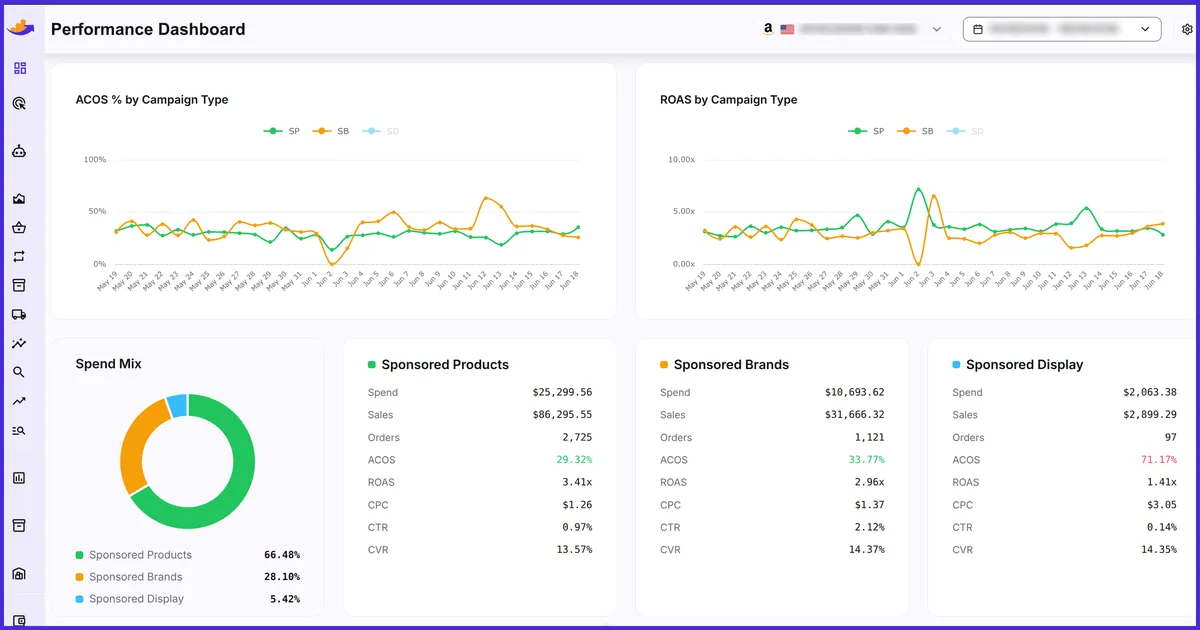
There is no single “good” ACOS on Amazon. A good ACOS is one that sits comfortably below your break-even point — and where that point is depends entirely on your profit margin and what you want a campaign to achieve. A 40% ACOS can be excellent for one product and ruinous for another.
That’s the honest answer, and it’s more useful than a magic number. This guide shows you how to find your good ACOS: what break-even ACOS is, how to calculate it, the general benchmarks to keep in mind, and how your goals and product lifecycle change the target.
The short answer
A good ACOS is any ACOS low enough to leave you the profit you want after Amazon’s fees and your product costs — for the goal you’re chasing right now. For a mature, profit-focused product that usually means an ACOS well under your break-even. For a brand-new launch, a “good” ACOS might temporarily sit at or even above break-even, because you’re buying rank and reviews, not immediate profit. Same metric, completely different target.
To turn that into numbers, you need two things: a quick refresher on what ACOS measures, and your own break-even ACOS.
A quick refresher: what ACOS measures
ACOS (Advertising Cost of Sales) is the share of your ad-generated revenue that you spent on ads, as a percentage:
ACOS = (ad spend ÷ ad revenue) × 100
Spend $25 to make $100 in ad sales and your ACOS is 25%. Lower means you’re keeping more of each ad-driven dollar. (New to the metric set? Our guide to what Amazon PPC is covers ACOS, ROAS, CPC and the rest in plain English.)
The number itself tells you nothing about whether you’re profitable, though. For that, you have to compare it to your break-even ACOS.
Why there’s no universal “good” ACOS
Imagine two sellers, both running at a 35% ACOS:
- Seller A sells a premium product with a 60% profit margin. At 35% ACOS they’re still pocketing healthy profit on every ad sale. For them, 35% is great.
- Seller B sells a low-margin commodity with a 25% margin. At 35% ACOS they’re losing 10 cents on every dollar of ad sales. For them, 35% is a slow bleed.
Identical ACOS, opposite outcomes. The variable that decides “good” versus “bad” is margin — which is exactly what break-even ACOS captures.
Your real benchmark: break-even ACOS
Your break-even ACOS is equal to your profit margin before ad spend — the percentage of the sale price left after product cost, Amazon referral fees, and FBA/fulfillment costs. At that ACOS, your advertising eats your entire margin and you make exactly zero profit on the ad sale. Below it you profit; above it you lose money on each ad-attributed sale. (Skip the arithmetic: our break-even ACOS and bid calculator works it out from your price and cost — and turns it into a target bid.)
Because break-even ACOS just equals your margin, it scales directly with it:
| Profit margin (before ad spend) | Break-even ACOS | What a “good” target might look like |
|---|---|---|
| 20% | 20% | Aim well under 20% to keep real profit |
| 35% | 35% | Mid-20s leaves a comfortable cushion |
| 50% | 50% | You can run 30–40% and still profit nicely |
This is your north star. Forget generic targets you see in forums until you know your own break-even — it reframes every other benchmark below.
General ACOS benchmarks (read in context)
With break-even in mind, the commonly cited ACOS ranges become useful as rough context rather than gospel. Here’s the spectrum most Amazon advertisers work within:
| ACOS range | What it usually means |
|---|---|
| Over 100% | You’re spending more on ads than they return — bleeding money. Needs immediate attention. |
| 50–100% | Marginally unprofitable for most products; sometimes acceptable during a launch. |
| 25–50% | Moderately profitable — the typical zone for a healthy, established product. |
| 10–25% | Strong profitability; efficient campaigns with good targeting and listings. |
| Under 10% | Exceptional — but very low ACOS can mean you’re under-spending and leaving sales on the table. |
One caveat that surprises people: an extremely low ACOS isn’t automatically the goal. If your ACOS is far below break-even, you may be bidding too conservatively and missing profitable volume. A slightly higher ACOS that still clears your margin, but drives far more sales, is usually the better business outcome.
“Good” depends on your goal and the product’s stage
The same product should run a different target ACOS at different points in its life:
- Launch phase. The goal is rank, velocity, and reviews — not profit. A good ACOS here can sit at or above break-even for a defined window, treated as a marketing investment. The mistake is leaving it there forever.
- Growth phase. Aim around break-even and reinvest the efficiency you gain into more volume. You’re balancing profit with market share.
- Mature / harvest phase. Now profit is the priority. Push your target ACOS well below break-even and let efficient, proven keywords carry the load.
So the right question isn’t “what’s a good ACOS?” but “what’s a good ACOS for this product, at this stage, for this goal?”
Don’t judge ACOS in isolation
ACOS only sees ad-attributed sales. Two other metrics complete the picture:
- TACOS (Total ACOS) measures ad spend against your total revenue — ads plus organic — so it shows whether your advertising is lifting the whole business, not just attributed sales. See what Amazon TACOS is and why it matters.
- ROAS is simply ACOS flipped around — return on ad spend instead of cost of sales. If you’re unsure which to track day to day, read ACOS vs ROAS: which metric should you track.
How to actually hit your target ACOS
Knowing your number is half the battle; moving toward it is the craft. The levers are bid management, tighter keyword and negative-keyword discipline, better campaign structure, placement and dayparting tuning, and — often the biggest one — improving the listing so more clicks convert. We walk through all of them in our complete playbook on how to reduce ACOS and improve ROAS, with the bidding side covered in depth in Amazon PPC bid management strategies.
Tracking your good ACOS with software
Your break-even and target ACOS aren’t static — margins shift with fees, costs, and price changes, and the right target moves with each product’s stage. Keeping that straight across dozens of products and thousands of keywords is where spreadsheets break down.
WisePPC is built for exactly this. Its ACOS>30% Loss metric shows, in dollars, how far each campaign or keyword sits over a 30% line — and because it’s a dollar figure, not a ratio, it ties efficiency to volume: a bad ACOS on tiny spend is a small number, a moderately-high ACOS on real volume is a big one, so you see exactly where the dollar bleed is and what to fix first. It tracks ACOS, ROAS and TACOS together with up to 24 months of history — well beyond Amazon’s window — so you judge a number against its trend, not one snapshot, alongside metrics Amazon’s console rarely shows like average sale price and cost per order. Color-shaded cells across the grid and chart make high-ACOS outliers jump out at a glance. As an Amazon Ads Verified Partner it reads straight from Amazon’s official advertising API, and its AI integration lets you connect your own assistant — Claude, ChatGPT, or any MCP-compatible agent — to flag campaigns drifting above break-even; it proposes, and you approve every change inside WisePPC.
Explore the WisePPC tools, see the AI integration, or compare plans and pricing and start a free 30-day trial.
Keep learning
- ACOS vs ROAS — which metric to track, and when.
- What is Amazon TACOS? — the whole-business view of ad efficiency.
- How to reduce ACOS and improve ROAS — the tactical playbook.
- What is Amazon PPC? — the metrics and mechanics from the ground up.
- Amazon PPC bid management strategies — bidding to control ACOS.
The bottom line
A good ACOS is not a number you can copy from someone else — it’s the gap between your ACOS and your break-even, sized to your current goal. Calculate your break-even ACOS from your margin, decide whether you’re launching, growing, or harvesting, and set your target from there. Do that and “what’s a good ACOS?” stops being a guessing game and becomes a deliberate decision.
See how WisePPC tracks ACOS against your break-even, see the AI integration, or compare plans and start your free trial today.