ACOS vs ROAS: Which Metric Should You Track?
Published Updated
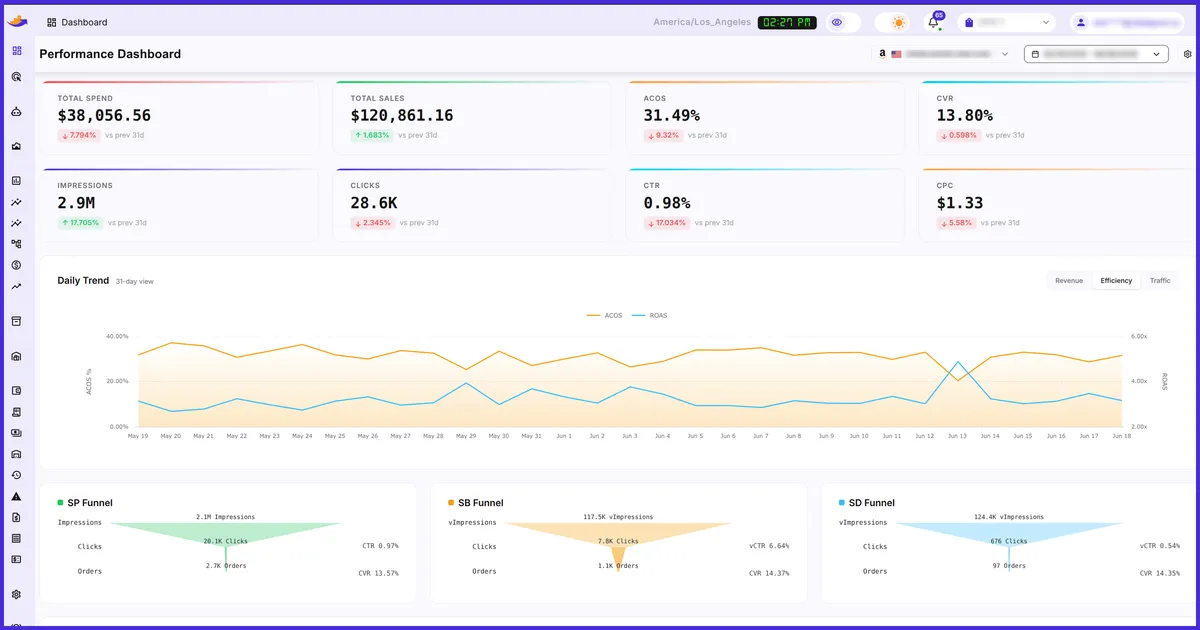
ACOS and ROAS measure exactly the same thing — how efficiently your Amazon ads turn spend into sales — just from opposite directions. They’re mathematically inverse, so neither is “more accurate” than the other. The real question isn’t which is right; it’s which one you should reach for to make a given decision.
This guide answers that. We’ll cover the formulas quickly, then spend most of the time on the part that actually matters: when ACOS is the better lens, when ROAS is, and how to use both together.
The 10-second version
- ACOS (Advertising Cost of Sales) = the percentage of ad revenue you spent on ads. Lower is better.
- ROAS (Return on Ad Spend) = the revenue you earned per dollar of ad spend. Higher is better.
They are two views of one number. If you know one, you know the other: ROAS = 100 ÷ ACOS%.
The formulas, side by side
Both use the same two inputs — ad spend and ad revenue — just flipped:
- ACOS = (ad spend ÷ ad revenue) × 100
- ROAS = ad revenue ÷ ad spend
So a campaign that spends $20 to generate $100 in sales has a 20% ACOS and a 5.0 ROAS. Here’s how the two line up across the range:
| ACOS | ROAS | Reading |
|---|---|---|
| 100% | 1.0 | You make back exactly what you spend |
| 50% | 2.0 | $2 of sales per $1 of ad spend |
| 33% | 3.0 | $3 per $1 |
| 25% | 4.0 | $4 per $1 |
| 20% | 5.0 | $5 per $1 |
| 10% | 10.0 | $10 per $1 |
Notice the inverse relationship: as ACOS falls, ROAS rises. They never disagree — they just point in opposite directions.
So why have both?
If they carry identical information, why does the industry use both? Because each frames that information for a different way of thinking — and matching the metric to the decision makes you faster and less error-prone.
Track ACOS when you’re thinking about cost and profitability
ACOS speaks the language of margin. Your break-even ACOS equals your profit margin, so when you see an ACOS you can instantly judge profitability: an ACOS under your margin means profit, over it means loss. That makes ACOS the natural lens for:
- Profitability checks — “are we making money on this campaign?” is a one-glance comparison to break-even.
- Day-to-day Amazon management — Amazon’s advertising console reports ACOS natively, so it’s the default unit inside the platform.
- Setting targets from margin — because the math ties straight to your costs. (To turn that into a target, see what a good ACOS is and how to find yours.)
Track ROAS when you’re thinking about return and scaling
ROAS is the return-on-investment lens — a revenue multiple, the same shape as ROI metrics used everywhere else in marketing. That makes it the natural choice for:
- Scaling decisions — “this campaign returns 6x, let’s put more behind it” is an intuitive way to think about where the next ad dollar goes.
- Cross-channel and blended reporting — Google and Meta report in ROAS, so if you advertise beyond Amazon, ROAS gives you one comparable number across platforms.
- Executive and client reporting — “we returned $5 for every $1 spent” lands more clearly with stakeholders than a cost percentage.
The smart move: use both together
This isn’t an either/or. The metrics complement each other, and most experienced advertisers keep both in view:
- Use ACOS as your day-to-day profitability gauge, always read against your break-even.
- Use ROAS for the higher-level scaling and portfolio view, and whenever you’re comparing Amazon to other ad channels.
The trap to avoid is optimizing one to an extreme. Chasing the lowest possible ACOS can starve campaigns of profitable volume; chasing the highest ROAS can do the same. Watch them alongside actual sales and profit, not in a vacuum.
Where TACOS completes the picture
Both ACOS and ROAS share a blind spot: they only count ad-attributed sales. Neither tells you how your advertising affects your organic sales or the business as a whole. That’s the job of TACOS (Total ACOS), which measures ad spend against your total revenue. A falling TACOS over time is a great sign — it means ads are increasingly lifting organic rank rather than just buying sales. We cover it in what Amazon TACOS is and why it matters.
What counts as a good number?
Whichever metric you favor, “good” is relative to your break-even — which is set by your profit margin, not by an industry average. A 4.0 ROAS (25% ACOS) is excellent for a high-margin product, but an outright loss for a low-margin one whose costs leave it under a 25% margin. We break the benchmarks down in what is a good ACOS on Amazon.
Improving whichever you track
Because they’re the same number flipped, anything that lowers your ACOS raises your ROAS. The levers are the same: sharper bids, disciplined negative keywords, cleaner campaign structure, and higher-converting listings. Our complete guide to reducing ACOS and improving ROAS walks through each one.
Tracking both with software
You shouldn’t have to pick a single lens, and software is what keeps both in view. WisePPC plots ACOS and ROAS side by side on one chart (with TACOS, CPC, CVR and more — up to six at a time), so you switch the cost lens for the ROI lens on the same data, color-graded so outliers stand out. With up to 24 months of history — well beyond Amazon’s ~60-to-90-day window — you read the trend in both, not one snapshot. As an Amazon Ads Verified Partner it reads straight from Amazon’s official advertising API, and its AI integration lets you connect your own assistant — Claude, ChatGPT, or any MCP-compatible agent — and ask in plain English; it proposes, you approve every change inside WisePPC.
Explore the WisePPC tools, see the AI integration, or compare plans and pricing and start a free 30-day trial.
Keep learning
- What is a good ACOS on Amazon? — set a target from your break-even.
- What is Amazon TACOS? — the whole-business efficiency metric.
- How to reduce ACOS and improve ROAS — the tactical playbook.
- What is Amazon PPC? — every key metric, explained.
- Amazon PPC bid management strategies — the biggest lever on both metrics.
The bottom line
ACOS and ROAS are the same efficiency story told two ways: ACOS in the language of cost and margin, ROAS in the language of return and scale. Use ACOS to guard profitability day to day, ROAS to guide scaling and cross-channel comparisons, and TACOS to see the whole business. Pick the lens that fits the decision in front of you — and let the other one keep you honest.
See ACOS, ROAS and TACOS together in WisePPC, see the AI integration, or compare plans and start your free trial today.