Amazon FBA in 2026: What It Costs and When It Beats Self-Fulfillment
Published Updated
Amazon FBA (Fulfillment by Amazon) is Amazon’s logistics service: you ship inventory into Amazon’s fulfillment centers, and Amazon stores it, then picks, packs, ships, and handles customer service and returns for every order you sell — in exchange for a per-unit fulfillment fee. But the question most sellers really have is not what FBA is; it is whether letting Amazon ship is cheaper than shipping orders yourself. Here is the shortcut nobody spells out: because Amazon’s referral fee is the same whether Amazon fulfills the order or you do, it cancels out of the comparison — collapsing the entire FBA-versus-FBM decision to a single number, your FBA fulfillment fee against your own per-unit cost to pack and ship.
The calculator below runs exactly that comparison on your product. Enter your price, cost, category, and size tier, add what self-fulfillment costs you per unit, and it returns your profit and margin each way, the monthly dollar difference, and the break-even self-fulfillment cost where the two channels tie. Start there, then read on for what FBA actually costs in 2026 and when it is worth paying for.
Amazon FBA vs FBM break-even calculator
Enter your product's numbers. The per-unit cost comparison updates as you type.
What you pay per unit: manufacturing + inbound shipping to Amazon. Everything except Amazon's fees, fulfilment, and ad spend.
Amazon's commission on each sale. It's the same for FBA and FBM, so it cancels out of the comparison, but it still sets each channel's profit.
2026 $10–$50 base rate. The calculator applies the Low-Price FBA discount under $10 and the higher rate over $50, then adds the 3.5% fuel surcharge.
Your own pick, pack, mailer/box, and outbound shipping per unit.
Units you sell per month. Scales the per-unit gap into a monthly dollar difference.
Verdict
—
What you keep per unit
FBA profit / unit
—
—
FBM profit / unit
—
—
Break-even self-fulfillment cost
—
Below this, your own fulfilment is cheaper on cost. Above it, FBA wins on cost alone, before any Prime / Buy Box lift.
Monthly difference
—
2026 US base rates. The FBA fulfillment fee includes the 3.5% fuel and logistics surcharge Amazon applies to every unit since April 17, 2026; it excludes monthly storage and optional fees. FBM cost is your own estimate. Amazon's Seller Central fee schedule is authoritative: confirm your product's exact fees there.
What is Amazon FBA, and how does it work?
With Amazon FBA, you send your products to an Amazon warehouse and Amazon takes over the physical side of selling: storage, picking, packing, shipping, customer service, and returns. To the buyer it looks like they are ordering from Amazon directly, even though the item belongs to a third-party seller — and the listing earns the Prime badge, with the fast, free delivery shoppers filter for. That trust and speed are why the large majority of third-party sellers use FBA for at least part of their catalog.
In practice the flow is five steps:
- Prep and label. Your units have to meet Amazon’s packaging and barcode requirements before they go in.
- Create a shipping plan in Seller Central — what you are sending, how many units, and which fulfillment centers receive them.
- Ship it in using your own carrier or Amazon’s discounted partnered carriers.
- Amazon checks in and stores the inventory until a customer buys.
- Amazon fulfills — picking, packing, delivery, customer service, and returns all run without you touching the order.
Once inventory is received and active, your listing becomes Prime-eligible automatically, which typically lifts visibility and conversion in competitive categories.
How much does Amazon FBA cost in 2026?
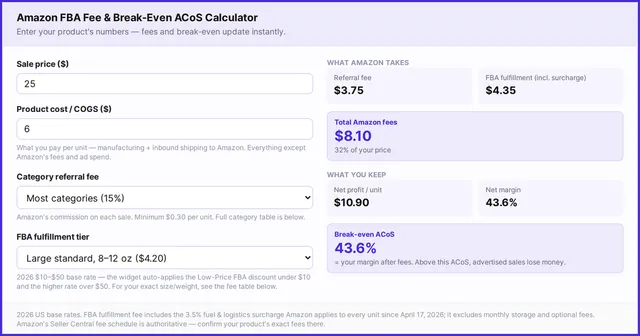
For a typical standard-size product, Amazon’s fees add up to roughly a third of the sale price before you pay for the product itself — a referral fee (usually 15%) plus an FBA fulfillment fee of about $3 to $7 per unit, with monthly storage on top. On a $25 item that is around $8 to Amazon before storage, returns, and advertising. FBA is convenient, but it is not cheap, and this fee math is what decides whether a product funds your growth or quietly loses money on every order.
Three 2026 changes matter for the numbers as of July 2026:
- Fulfillment fees rose about $0.08 per unit on average, effective January 15, 2026.
- A 3.5% fuel and logistics surcharge now applies to every fulfilled unit, as of April 17, 2026 — so a $4.20 base fee is really about $4.35.
- Low-Price FBA discounts fulfillment by roughly $0.86 per unit on products priced under $10, applied automatically with no enrollment.
Storage is billed per cubic foot and spikes in Q4: standard-size inventory runs $0.78 per cubic foot from January to September and $2.40 during the October–December peak. We keep the full referral-fee schedule, the complete fulfillment-fee tables by size and weight, and every situational charge current in our companion guide, Amazon FBA fees in 2026 — this post focuses on the decision the fees drive rather than reprinting the tables.
FBA vs FBM: which is actually cheaper for your product?
The decision comes down to one comparison: your FBA fulfillment fee versus your own per-unit cost to pick, pack, and ship. The referral fee is identical for FBA and self-fulfillment (FBM, short for Fulfilled by Merchant), so it cancels out — whatever Amazon’s commission is, you pay it either way. That leaves fulfillment cost as the only variable that changes between the two channels, which is why the break-even point is simply the FBA fee itself. If you can ship a unit yourself for less than the FBA fee, FBM is cheaper on cost; if your own cost is higher, FBA wins on cost alone.
The calculator above makes this concrete. It takes your sale price, product cost, referral category, FBA size tier, and your own per-unit fulfillment cost, then shows profit and margin for each channel side by side, the break-even self-fulfillment cost where they tie, and — if you enter monthly volume — the dollar difference across a month. Using its worked defaults (a $25 item, $6 cost, 15% category, the $4.20 large-standard tier, and $5.00 self-fulfillment), FBA keeps $10.90 per unit at a 43.6% margin versus $10.25 at 41.0% for FBM: FBA nets $0.65 more per unit, or about $195 a month at 300 units, and the break-even self-fulfillment cost is $4.35 — the FBA fee with the surcharge. Beat $4.35 a unit shipping it yourself and the math flips.
| Amazon FBA | Self-fulfillment (FBM) | |
|---|---|---|
| Who ships and supports | Amazon | You |
| Prime badge | Automatic | Only via Seller-Fulfilled Prime |
| Fulfillment cost | Fixed FBA fee per unit (+3.5% surcharge) | Your own pick, pack, and ship cost |
| Storage | Amazon’s monthly per-cubic-foot fee | Your own warehouse or space |
| Referral fee | Yes — same rate | Yes — same rate |
| Best for | Small, light, fast-moving units | Heavy, bulky, slow, custom, or high-margin |
One caveat the pure cost comparison cannot capture: FBA also buys the automatic Prime badge, which usually raises your Buy-Box win rate and conversion. FBA often wins on total profit even when its per-unit fee is the higher of the two, so treat the break-even as the floor of the decision, not the whole of it.
When does Amazon FBA beat self-fulfillment?
FBA tends to win when products are small, light, and fast-moving, when your margin can absorb the fulfillment fee, and when the Prime badge matters for winning the Buy Box in a competitive category — in short, whenever your own per-unit shipping cost would be higher than the FBA fee, or the Prime lift is worth a small premium. It also wins simply by removing daily warehouse work, which has real value if fulfillment is not your strength.
Self-fulfillment tends to win for heavy or bulky items, where FBA’s size- and weight-based fees climb fast; for slow-moving inventory that would rack up storage and aged-inventory surcharges; for products with custom packaging, inserts, or bundles Amazon’s line cannot replicate; and for high-margin goods where you would rather keep the shipping margin and full control. Many sellers run a hybrid — FBA for the small, high-velocity SKUs and FBM for the oversized or slow ones — and shift items between the two as their numbers change. Run your real figures through the calculator before committing either way; a change of a few ounces or one size tier can move the break-even enough to flip the answer.
How do you start selling with Amazon FBA?
Once your Amazon seller account is active, enrolling in FBA is a straightforward, no-code process inside Seller Central. You select the products to send, create an inbound shipping plan with quantities, prep and label the units to Amazon’s spec, ship them in on Amazon’s partnered carriers or your own, and wait for check-in. When the shipment is received, your listings go Prime-eligible and live automatically — no further setup.
The one thing worth doing before you send a single box is the math. Take your price, subtract the referral fee, the FBA fulfillment fee with its surcharge, an estimate of monthly storage, and your landed product cost, and confirm there is a real margin left. Many sellers start with a small test shipment, review the actual fees Amazon charges, and only then scale — exactly the discipline the calculator above is built to enforce.
How can WisePPC help you sell profitably on FBA?
Your FBA fees do more than trim your margin — they set the ceiling on what you can afford to spend on ads. Whatever net margin is left after Amazon’s referral, fulfillment, and storage fees is your break-even ACoS: the advertising cost of sales at which an ad-driven order makes exactly zero profit. In the $25 example above, the calculator leaves a roughly 43% margin before storage; subtract the small monthly storage fee and your break-even ACoS is still about 43%. Advertise below it and every sale profits; advertise above it and you are paying to lose money. Our Amazon PPC bid calculator turns that margin into a max bid, and what counts as a good ACoS puts the number in context.
WisePPC is an Amazon Ads management and analytics platform — and an Amazon Ads Verified Partner — built to keep your advertising inside that margin. It brings your Sponsored Products, Brands, and Display data into one place with 30+ metrics, a Unified Report, Search Terms and Targeting reports, an Excel-like analytics grid with CSV export, and a bulk-edit Management page for campaigns and negatives. Connect your Amazon Ads account and you get 24 months of daily history backfilled, so you can see how fees, ad spend, and pricing have actually moved your profit over time. Prefer to bring your own AI? Connect a Claude or ChatGPT agent over MCP to your WisePPC data — it proposes bid, budget, and negation changes and you approve them inside WisePPC. Explore the WisePPC tools, compare plans, or start free: sign up for a 30-day trial with no credit card required.
Frequently Asked Questions
What does Amazon FBA stand for, and how does it work?
Amazon FBA stands for Fulfillment by Amazon. You ship inventory to Amazon’s fulfillment centers, and Amazon stores, picks, packs, ships, and handles customer service and returns for each order. You pay a per-unit fulfillment fee plus monthly storage, and your listings become Prime-eligible automatically once inventory is checked in.
How much does Amazon FBA cost in 2026?
For a typical standard-size item, expect Amazon to take roughly a third of the sale price: a referral fee (usually 15%) plus an FBA fulfillment fee of about $3 to $7 per unit, before storage and advertising. Fulfillment fees rose about $0.08 per unit on January 15, 2026, and a 3.5% fuel and logistics surcharge applies to every unit as of April 17, 2026. Products under $10 get a discount under Low-Price FBA.
Is Amazon FBA cheaper than fulfilling orders myself?
It comes down to one number. Because the referral fee is the same either way, the comparison is just the FBA fulfillment fee versus your own per-unit cost to pack and ship. If you can ship a unit for less than the FBA fee, self-fulfillment (FBM) is cheaper on cost; if not, FBA wins — and FBA also adds the Prime badge, which often lifts conversion. Use the calculator above to find your exact break-even.
Can I use FBA and FBM at the same time?
Yes. Many sellers run a hybrid model — FBA for small, light, fast-moving SKUs where Amazon’s fee beats their own shipping cost, and FBM for heavy, bulky, slow-moving, or custom items where self-fulfillment is cheaper. You can move individual products between the two channels as their economics change.
Does using FBA guarantee the Prime badge?
Most FBA listings become Prime-eligible automatically once inventory is checked in, but the listing must still meet Amazon’s performance and compliance requirements. Prime eligibility is one of the main reasons sellers accept FBA fees, since the badge tends to raise Buy-Box win rate and conversion.
Fee figures are current as of July 2026 and reflect Amazon’s 2026 US rate card. Amazon updates fees annually and sometimes mid-year, and the fee schedule in Seller Central is always authoritative — confirm your product’s exact fees there before pricing. WisePPC is an Amazon Ads management and analytics platform serving the US, UK, DE, and JP marketplaces.