Amazon FBA Fees Explained (2026): What It Really Costs to Sell
Published Updated
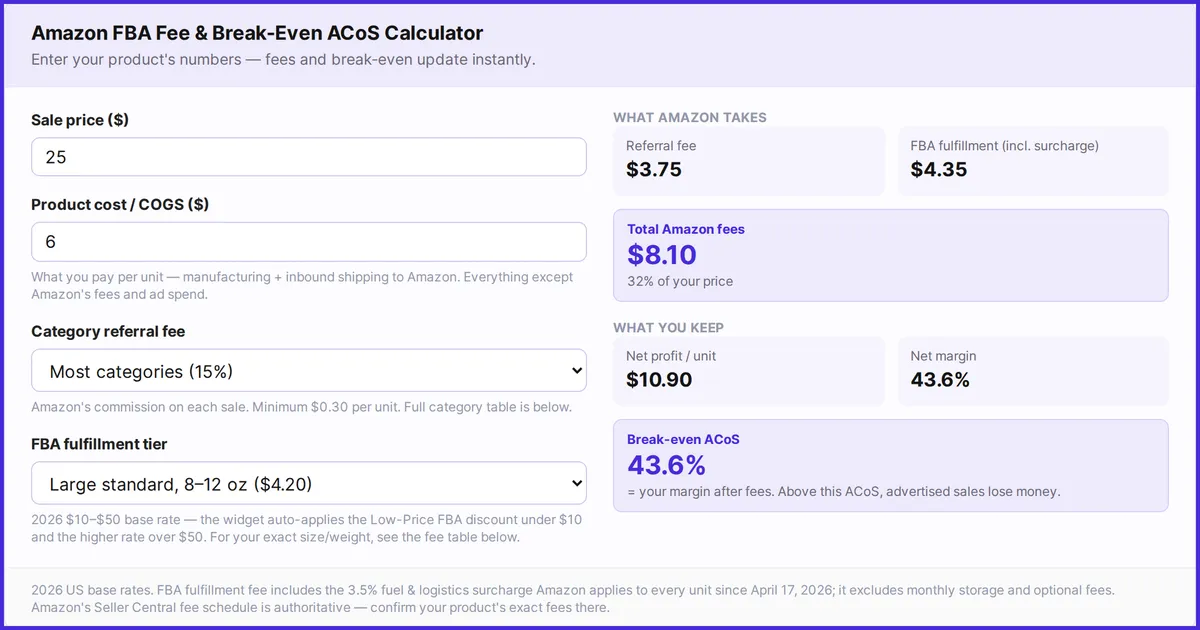
For a typical standard-size product, Amazon takes roughly a third of the sale price before you pay for the product itself. On a $25 item that means about $3.75 in referral fee plus roughly $4.35 in FBA fulfillment — around $8.10, or 32%, to Amazon — and that is before storage, returns, and advertising. Knowing the exact numbers is the difference between a product that funds your growth and one that quietly loses money on every order.
This guide breaks down every Amazon FBA fee with current 2026 figures — referral fees by category, the fulfillment-fee tables, storage, and the new 3.5% fuel surcharge — and the calculator below turns your own price, cost, and size into your real net margin and break-even ACoS. Start there, then read on to see where each number comes from.
Amazon FBA fee and break-even ACoS calculator
Enter your product's numbers. Fees and break-even update as you type.
What you pay per unit: manufacturing + inbound shipping to Amazon. Everything except Amazon's fees and ad spend.
Amazon's commission on each sale. Minimum $0.30 per unit. Pick the closest category; Amazon's Seller Central fee schedule has the full list.
2026 $10–$50 base rate. The calculator applies the Low-Price FBA discount under $10 and the higher rate over $50. For your exact size and weight, check the fee schedule in Seller Central.
What Amazon takes
Referral fee
—
FBA fulfillment (incl. surcharge)
—
Total Amazon fees
—
—
What you keep
Net profit / unit
—
Net margin
—
Break-even ACoS
—
= your margin after fees. Above this ACoS, advertised sales lose money.
2026 US base rates. The FBA fulfillment fee includes the 3.5% fuel and logistics surcharge Amazon applies to every unit since April 17, 2026; it excludes monthly storage and optional fees. Amazon's Seller Central fee schedule is authoritative: confirm your product's exact fees there.
What fees does every Amazon seller pay?
Every seller pays two things no matter how they fulfill orders: a selling-plan subscription and a referral fee on each sale. Choosing FBA adds fulfillment and storage fees on top. Everything else — inbound placement, removals, returns processing — is situational. Here are the two unavoidable ones.
Individual vs Professional selling plan
The Individual plan costs $0.99 per item sold with no monthly fee; the Professional plan costs $39.99 per month flat, with no per-item charge. The math is simple: once you sell more than about 40 units a month ($39.99 ÷ $0.99), Professional is cheaper — and it is required to run Amazon Ads, win the Buy Box, or use bulk tools. Below ~40 units a month, Individual keeps costs down while you validate a product.
Referral fees by category (2026)
The referral fee is Amazon’s commission on every sale — a percentage of the total price (item + shipping). Most categories are 15%, the overall range runs from 5% to 45%, and there is a $0.30 minimum per item. Amazon froze referral percentages across 2024, 2025, and 2026, so the rates below are current. Referral fees apply to FBA and FBM sellers alike.
| Category | Referral fee |
|---|---|
| Amazon Device Accessories | 45% |
| Full-size Appliances | 8% |
| Compact Appliances | 15% up to $300, 8% above |
| Automotive & Powersports | 12% |
| Baby Products | 8% (≤ $10), 15% (> $10) |
| Beauty, Health & Personal Care | 8% (≤ $10), 15% (> $10) |
| Clothing & Accessories | 5% (≤ $15), 10% ($15–$20), 17% (> $20) |
| Computers & Consumer Electronics | 8% |
| Electronics Accessories | 15% (≤ $100), 8% above |
| Home & Kitchen | 15% |
| Jewelry | 20% (≤ $250), 5% above |
| Pet Supplies | 15% |
| Sports & Outdoors, Toys & Games | 15% |
| Everything else | 15% |
Source: Amazon’s published referral fee schedule. Some categories tier by price — always check your specific category and price point.
How much are Amazon FBA fulfillment fees in 2026?
The FBA fulfillment fee is a flat per-unit charge to pick, pack, and ship your order, set by the product’s size tier and weight. For most standard-size items it runs $3 to $7 per unit. In 2026 Amazon raised fulfillment fees by an average of $0.08 per unit (effective January 15) and, separately, added a 3.5% fuel and logistics surcharge on every unit as of April 17, 2026. The table below shows representative 2026 base rates for the common $10–$50 price band.
| Size tier (2026 base, $10–$50 band) | Fulfillment fee / unit |
|---|---|
| Small standard (≤ 16 oz) | ~$3.30 – $3.95 |
| Large standard, ≤ 12 oz | $3.95 – $4.20 |
| Large standard, 1 – 1.5 lb | $5.04 – $5.42 |
| Large standard, 1.75 – 3 lb | $5.82 – $6.67 |
| Large standard, 3 – 20 lb | $6.97 + $0.08 per 4 oz over 3 lb |
| Large bulky (≤ ~50 lb) | $9.35 + $0.38 / lb |
| Extra-large | from $26.33 + $0.38 / lb |
Rates are the January 15 – October 14, 2026 base period and exclude the 3.5% surcharge. Items over $50 pay roughly $0.26 more per tier; items under $10 pay less under Low-Price FBA (below). Amazon’s Seller Central fee schedule is authoritative — confirm your product’s exact tier there.
Low-Price FBA for items under $10
Products priced under $10 qualify for Low-Price FBA, which discounts fulfillment by roughly $0.86 per unit versus standard rates. It applies automatically — you do not enroll — and it is what keeps cheap, light items viable on FBA despite their thin absolute margins.
What are Amazon’s FBA storage fees?
Storage fees are monthly rent for the warehouse space your inventory occupies, charged per cubic foot and much higher in Q4. For standard-size items it is $0.78 per cubic foot from January to September, jumping to $2.40 during the October–December peak. These are easy to underestimate because they scale with how long stock sits, not how fast it sells.
| Storage (per cubic foot / month) | Jan–Sep | Oct–Dec |
|---|---|---|
| Standard-size | $0.78 | $2.40 |
| Oversize | $0.56 | $1.40 |
Two surcharges catch sellers off guard: an aged-inventory surcharge on units stored longer than 181 days (steeper past 365), and a low-inventory-level fee on standard items you keep too thin relative to sales. The fix for both is the same — hold roughly four to six weeks of cover, not two and not twelve.
What other Amazon fees catch sellers out?
Beyond the core three, watch for these situational charges:
- Inbound placement service fee — a per-unit charge (waivable) for letting Amazon split your shipment across fulfillment centers instead of spreading it yourself.
- Returns processing fee — applies in high-return categories (e.g. apparel, shoes) on units returned to you.
- Refund administration fee — when you refund a customer, Amazon returns the referral fee minus the lesser of $5.00 or 20% of the referral fee.
- Removal and disposal fees — per-unit charges to pull or dispose of stranded inventory.
- Closing fee — a flat $1.80 on each media item sold (books, DVDs, video games).
What does it really cost to sell a $25 product?
Here is the full stack on a standard-size, $25 item in a 15% category, with a $6 landed product cost — the kind of unit economics most sellers actually run:
| Line item | Amount |
|---|---|
| Sale price | $25.00 |
| Referral fee (15%) | − $3.75 |
| FBA fulfillment ($4.20 + 3.5% surcharge) | − $4.35 |
| Estimated storage (per unit) | − $0.15 |
| Product cost (COGS) | − $6.00 |
| Net profit / unit | $10.75 |
| Net margin | 43% |
Amazon’s cut here is about $8.25, or 33% of the sale price. The seller keeps 43% before advertising — and that last number is the one that decides how you should bid.
Why your FBA fees decide your break-even ACoS
Here is the connection most fee guides never make: your net margin after all Amazon fees is your break-even ACoS — the advertising cost of sales at which an ad-driven order makes exactly zero profit. In the example above, a 43% margin means a 43% break-even ACoS. Run ads below that and every advertised sale is profitable; run above it and you are paying to lose money.
This is why fees are not just an accounting detail — they set the ceiling on what you can afford to bid. As an Amazon Ads Verified Partner team, it is the first calculation we run on any product, because a great campaign on a thin-margin product still loses money. Once you know your break-even ACoS, you can turn it into an actual max bid: our Amazon PPC bid calculator takes your margin and conversion rate and returns the most you should pay per click, and our primer on what counts as a good ACoS puts that number in context. If you would rather not police it by hand, WisePPC keeps bids under your break-even automatically.
FBA vs FBM: when do the fees favor doing it yourself?
FBA usually wins for small, light, fast-moving products; FBM (Fulfillment by Merchant) often wins for heavy, bulky, slow-moving, or high-margin items where Amazon’s per-unit fulfillment and storage fees outweigh the convenience. FBM also gives you the shipping margin and full control — at the cost of the automatic Prime badge and Amazon’s customer-service coverage.
| FBA | FBM | |
|---|---|---|
| Who ships | Amazon | You |
| Prime badge | Automatic | Only via Seller-Fulfilled Prime |
| Main costs | Fulfillment + storage fees | Your own shipping + labor |
| Referral fee | Yes | Yes |
| Best for | Small, light, high-velocity | Heavy, bulky, slow, custom |
How to lower your Amazon FBA fees
- Right-size your packaging. Fulfillment tiers turn on ounces and inches; trimming a product from one weight band or size tier to the next can cut the per-unit fee outright. Amazon bills on dimensional weight, so a smaller box can matter more than a lighter product.
- Keep inventory balanced. Four to six weeks of cover dodges both the aged-inventory surcharge (from overstocking) and the low-inventory-level fee (from understocking).
- Use SIPP. Products eligible for Ships in Product Packaging save $0.04 to $1.32 per unit and ship in your own branded box.
- Review Fee Preview and your IPI monthly. Catch mis-measured dimensions and storage creep before they compound.
- Advertise efficiently. Ad spend is the largest controllable cost on most listings — hold ACoS under your break-even, cut wasted keywords, and treat it like the margin line it is.
Frequently Asked Questions
How much are Amazon FBA fees in 2026?
For a typical standard-size product, expect Amazon to take about a third of the sale price: a referral fee (usually 15%) plus an FBA fulfillment fee of roughly $3–$7 per unit, before storage and advertising. On a $25 item that is around $8 to Amazon. Professional sellers also pay $39.99/month, and a 3.5% fuel surcharge applies to fulfillment fees as of April 17, 2026.
Did Amazon raise FBA fees in 2026?
Yes, modestly. FBA fulfillment fees rose by an average of $0.08 per unit effective January 15, 2026, and Amazon added a 3.5% fuel and logistics surcharge on every fulfilled unit as of April 17, 2026. Referral fee percentages, however, were frozen and are unchanged from 2024.
What is Amazon’s referral fee?
The referral fee is Amazon’s commission on each sale — a percentage of the total price. Most categories are 15%, the range is 5% to 45%, and the minimum is $0.30 per item. It applies to both FBA and FBM sellers.
What is the difference between FBA and FBM?
With FBA, Amazon stores, packs, ships, and handles customer service — you pay fulfillment and storage fees but get the automatic Prime badge. With FBM, you handle fulfillment yourself: more control and no FBA fees, but no automatic Prime. FBA tends to win for small, light, fast-moving items; FBM for heavy, bulky, or slow-moving ones.
How do I calculate my Amazon FBA fees before listing?
Use the calculator at the top of this page to turn your price, cost, category, and size into your net margin and break-even ACoS, or use Amazon’s own FBA Revenue Calculator for a fee estimate on a specific ASIN. Always run the numbers before you commit to a product — a small change in weight or category can flip a product from profitable to underwater.
Fee figures are current as of July 2026 and reflect Amazon’s 2026 US rate card. Amazon updates fees annually and occasionally mid-year — the fee schedule in Seller Central is always authoritative, so confirm your product’s exact fees there before pricing.