Amazon Seller Account Deactivated in 2026: How to Diagnose It, Fix It, and Get Reinstated
Published Updated

Getting reinstated on Amazon comes down to one thing: correctly identifying the exact reason your seller account was deactivated, then giving Amazon precisely what that reason requires — which is usually a Plan of Action (POA), and sometimes just a document. Generic “write a sincere appeal” advice fails because Amazon does not reinstate sincerity; it reinstates evidence that the specific problem is fixed and will not recur. This guide gives you a reason-by-reason diagnosis, the account-health metrics behind deactivations, a POA template, and what to do about your held funds.
Quick clarification first: this article is about seller accounts (Seller Central), where a deactivation freezes your business and your payouts. If you are a shopper whose buyer account was blocked from placing orders, that is a different process handled through regular Amazon customer service — most of the playbook below will not apply to you.
Is it “suspended” or “deactivated” — and what does that mean for a seller?
Amazon’s own term today is deactivated — the button in your account is “Reactivate your account” — though most sellers still say “suspended.” Either way, it means your ability to sell is switched off: your listings go inactive, orders stop, and under Section 3 of the Business Solutions Agreement Amazon can hold your disbursements while the issue is open. A deactivation is not always permanent, but it is always urgent, because every day offline is lost sales plus held cash. The single biggest predictor of getting back on is not how apologetic your appeal sounds — it is how precisely it addresses the actual reason Amazon cited.
Why does Amazon deactivate seller accounts in 2026?
Deactivations fall into a handful of buckets, and each one wants a different response. In 2026 the most commonly reported triggers are authenticity and intellectual-property complaints, identity/verification failures, prohibited business practices, and account-health metric breaches. Knowing which bucket you are in is the whole game — the table below maps each to what Amazon is actually asking for.
| Deactivation reason | What Amazon actually wants | POA needed? |
|---|---|---|
| Inauthentic / counterfeit complaint (the most common type) | Valid supply-chain proof: invoices from a verifiable supplier covering the quantities sold | Yes — plus documents |
| Intellectual-property complaint (trademark, copyright, patent) | A retraction from the rights owner, or proof of authorization / that the complaint is invalid | Yes |
| Identity or INFORM verification failure | The exact documents requested (ID, bank statement, utility bill) matching your registered details | Often no — just correct documents |
| Dropshipping / prohibited sourcing (third-party packing slips) | Evidence you are the seller of record and control fulfillment; end the prohibited practice | Yes |
| Related-account linkage | Explanation of the relationship, or proof the accounts are genuinely separate | Yes |
| Account-health metric breach (ODR, late shipment, etc.) | Fix the metric and show the operational change that will keep it fixed | Usually yes |
| Restricted-product violation | Remove the listings; explain how you will prevent restricted listings going forward | Yes |
Notice how different the “inauthentic” response (supplier invoices) is from the “verification” response (a matching bank statement). Sending a heartfelt POA when Amazon just wanted a document — or sending a document when Amazon wanted a full POA — is the most common reason appeals stall.
Which account-health metrics trigger a deactivation?
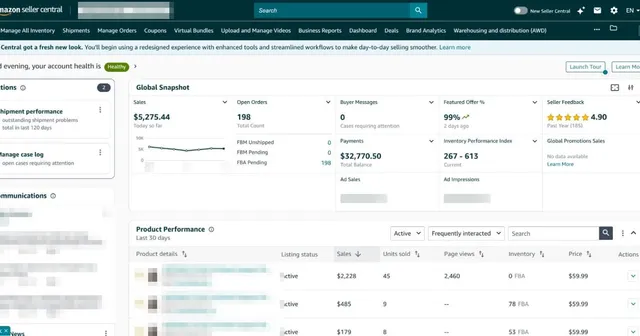
Amazon scores your account with an Account Health Rating (AHR) and a set of performance targets; cross the wrong line and deactivation follows. The AHR runs on a 0–1000 scale, and it is widely reported that 200 and above is “Healthy,” 100–199 is “At Risk,” and below 100 puts the account at risk of deactivation (new sellers start at 200). Underneath the score sit the performance thresholds Amazon expects you to hold:
- Order Defect Rate (ODR): under 1% — the big one; it combines negative feedback, A-to-Z Guarantee claims, and chargebacks.
- Late Shipment Rate: under 4% (seller-fulfilled orders).
- Pre-fulfillment Cancel Rate: under 2.5%.
- Valid Tracking Rate: over 95% — and since January 2025 this covers all carriers, not just Amazon-integrated ones.
- On-Time Delivery Rate: 90% target — and as of February 28, 2026, enforcement moved to the listing level, so chronic-late listings can be deactivated individually rather than the whole account.
One program worth knowing about before trouble hits: Account Health Assurance (AHA), still active in 2026, means that for eligible sellers (typically Professional plan, active at least a year, AHR 200+, with an emergency phone number on file) Amazon commits to contact you and give you time to fix an issue before deactivating. It is free and automatic if you qualify — which is a strong reason to keep your AHR above 200 and your contact details current.
How do you write a Plan of Action that Amazon accepts?
When a POA is required, Amazon expects a specific three-part structure, and it rewards specifics over apology. The three parts are: (1) the root cause — the real, honest reason the problem happened; (2) the corrective actions you have already taken to fix it right now; and (3) the preventive measures — the systemic change that stops it recurring. Lead with root cause, keep it factual and blame-free, and attach the evidence the reason requires (invoices, a retraction, corrected documents). Below is a template you can adapt — it is an illustrative example, not a real case, so replace every bracket with your true details:
- Root cause: “The complaint arose because [specific factual reason — e.g. we could not immediately provide supplier invoices covering the units sold for ASIN X]. On review, the underlying cause was [e.g. we sourced this ASIN from a supplier without retaining complete invoices].”
- Corrective actions (already done): “We have [e.g. removed the affected listings / obtained complete invoices from an authorized distributor, attached / corrected the mismatched registration detail]. Evidence is attached: [list documents].”
- Preventive measures (going forward): “To prevent recurrence we have [e.g. moved sourcing to an authorized distributor, implemented an invoice-retention process for every inbound shipment, added a weekly Account Health review].”
Keep it concise and evidence-led; do not pad it, do not argue, and never fabricate an invoice or document — supplying falsified paperwork is itself grounds for a permanent ban. If your case is complex (an IP dispute, a large fund hold, or a second-level rejection), this is the point where sellers often bring in a specialist reinstatement service or an e-commerce attorney; it is worth saying plainly that we are an advertising platform, not a reinstatement firm, so for a high-stakes appeal, professional help can be money well spent.
How do you actually submit the appeal, and what about your money?
Submit through Seller Central → Account Health, using the “Reactivate your account” button next to the specific violation — not through generic support, which routes it wrong. Amazon’s response time varies by case: metric-driven issues can turn around in days, while authenticity and IP cases often take one to several weeks. Two practical points sellers overlook:
- Your funds. During a Section 3 deactivation Amazon typically holds disbursements for about 90 days. After that window, if there is no active A-to-Z claim or fraud allegation, you can request release (sellers commonly email disbursement-appeals@amazon.com); Amazon may require an identity verification step first.
- Escalation. If you are eligible, use “Call Me Now” on the Account Health dashboard to reach an Account Health Support specialist by phone — a live human who can explain what the appeal is missing is often faster than another written round. For urgent cases where you have exhausted the normal path, the executive-escalation route (the well-known jeff@amazon.com address, now handled by a dedicated team) is still reported to work.
How do you avoid a deactivation in the first place?
Prevention is almost entirely about two habits: keeping your metrics green and keeping your paperwork ready. Check the Account Health dashboard weekly, act on any policy warning the same day, and keep supplier invoices and your registered identity/bank details accurate and current (remember the 2026 INFORM re-certification prompts come with a 10-day window). Source only from verifiable suppliers so you can always prove authenticity, stay out of prohibited practices like packing-slip dropshipping, and never operate a second account that could be linked to your first. The sellers who rarely get deactivated are not lucky — they simply treat account health as a weekly operating task, not an emergency.
How does WisePPC fit in?
Let us be straight about scope: WisePPC is an Amazon Ads management and analytics platform and an Amazon Ads Verified Partner — we do not file reinstatement appeals or handle Account Health cases. Where we are relevant is on the two sides account health touches that we do own. First, advertising policy is part of staying compliant, and a deactivation freezes your campaigns and ad spend along with everything else — so a healthy account protects your ad program too. Second, when an account comes back from a deactivation, the job is rebuilding the sales velocity and ranking it lost, and that is exactly the launch-style advertising problem WisePPC is built for: your Sponsored Products, Brands, and Display data in one place with 30+ metrics, a Unified Report, Search Terms and Targeting reports, an analytics grid with CSV export, and 24 months of daily history that survives the downtime so you can see your pre-deactivation baseline. Explore the WisePPC tools, compare plans, or start free: sign up for a 30-day trial with no credit card required.
Frequently Asked Questions
What is the fastest way to reinstate a deactivated Amazon seller account?
Identify the exact reason Amazon cited, then respond with precisely what that reason requires. For an inauthentic complaint that means valid supplier invoices; for a verification failure it means the correct matching documents; for a policy or metric issue it means a Plan of Action with root cause, corrective actions, and preventive measures. Submit through the “Reactivate your account” button in Account Health, not generic support.
What is a Plan of Action (POA) and what should it include?
A POA is the structured appeal Amazon requires for most policy-based deactivations. It must have three parts: the root cause (the honest reason it happened), the corrective actions you have already taken, and the preventive measures that stop it recurring. Lead with root cause, keep it factual and free of blame or apology-padding, and attach the evidence the specific violation calls for.
How long does Amazon hold your money after a deactivation?
During a Section 3 deactivation Amazon typically holds disbursements for about 90 days. After that period, if there is no open A-to-Z claim or fraud allegation, you can request release of the funds, and Amazon may require an identity verification step first. Getting reinstated also releases the account to disburse normally again.
What Account Health Rating puts a seller at risk?
The Account Health Rating runs 0–1000. It is widely reported that 200 and above is Healthy, 100–199 is At Risk, and below 100 makes the account eligible for deactivation; new sellers start at 200. Staying above 200 also helps you qualify for Account Health Assurance, under which Amazon contacts eligible sellers before deactivating instead of switching the account off first.
Should I hire a reinstatement service or appeal myself?
Straightforward cases — a metric breach or a verification-document request — are usually appealable yourself by following the reason-specific steps above. For high-stakes situations such as an intellectual-property dispute, a large held balance, or a second-level rejection, a specialist reinstatement service or an e-commerce attorney can be worth the cost. WisePPC is an advertising platform and does not handle reinstatements, so we would point you to a dedicated specialist for those.
Policies, thresholds, and processes described here are current as of July 2026 for Amazon’s US marketplace and are drawn from Amazon Seller Central guidance and reputable 2026 seller sources; some figures (such as the Account Health Rating bands) are widely reported rather than officially published, and Amazon can change them. Seller Central and your specific deactivation notice are always the authoritative source. Nothing here is legal advice. WisePPC is an Amazon Ads management and analytics platform and does not provide account-reinstatement services.