
 EN
EN  ES
ES  FR
FR  DE
DE  IT
IT  KO
KO  JA
JA  ZH
ZH  AR
AR  PT
PT  TR
TR PL
PL
Advertising on Amazon can be a game-changer for your business, but without a well-optimized strategy, it can quickly eat into your profits. One of the key metrics to monitor is Advertising Cost of Sale (ACoS), which helps measure the efficiency of your campaigns.
In this article, we’ll dive into practical tactics to improve your Amazon ACoS strategy, ensuring that your advertising spend transforms into higher sales and improved profitability. Whether you’re just starting or looking to refine your approach, these tips will help you make the most of your Amazon PPC campaigns.

What Is Amazon ACoS?
ACoS (Advertising Cost of Sale) is a metric used in Amazon advertising to measure how much you spend on ads relative to the sales those ads generate. It is calculated by dividing your ad spend by the revenue generated from the ad campaign and multiplying by 100 to express it as a percentage.
The formula is:
ACoS=(Ad SpendAd Revenue)×100ACoS = \left( \frac{\text{Ad Spend}}{\text{Ad Revenue}} \right) \times 100ACoS=(Ad RevenueAd Spend)×100
For example, if you spend $60 on an ad campaign and make $200 in sales, your ACoS would be:
60200×100=30%\frac{60}{200} \times 100 = 30\%20060×100=30%
This means you spent 30% of your revenue on advertising.
Why Is ACoS Important?
ACoS helps sellers understand how efficiently they are spending on advertising relative to the revenue it generates. A low ACoS indicates that the campaign is cost-effective, with advertising spending relatively little for the revenue it brings in. A high ACoS, on the other hand, means that the advertising cost is eating into profits, which could indicate inefficiencies in your campaign strategy.
ACoS is crucial because it directly impacts your profitability. When you’re selling products on Amazon, you want to ensure that your advertising campaigns not only increase visibility and sales but also provide a good return on investment (ROI). Understanding ACOS vs ROAS makes it easier to read that return from both an efficiency and a revenue angle. If your ACoS is too high, you may be spending more on ads than you’re making from the sales, leading to poor profitability.
A Brief Introduction into Amazon ACoS Strategy
An Amazon ACoS Strategy refers to the structured approach that Amazon sellers use to manage and optimize their Advertising Cost of Sale (ACoS), with the aim of maximizing profitability while minimizing wasted ad spend. Essentially, it is the set of tactics and methods employed by sellers to lower their ACoS while improving ad campaign performance.
ACoS is a key performance indicator (KPI) in Amazon advertising, and managing it well is essential for ensuring that the money spent on ads is effectively driving sales without eating into profits. An ACoS strategy helps sellers balance their advertising budget and sales performance by setting clear goals for their ACoS and adjusting campaigns accordingly.
A well-planned ACoS strategy is not just about minimizing ACoS but aligning it with the seller’s goals. For example, a seller looking to launch a new product may accept a higher ACoS in the short term to increase visibility and drive initial sales. Conversely, sellers with established products may aim for a lower ACoS to maximize profitability.

Creating a Strong Amazon ACoS Strategy for Better Managing Budget and Profitability
To create a successful Amazon ACoS strategy, you must take a systematic approach to managing your ad spend and measuring the effectiveness of your campaigns. The goal is to lower ACoS while maintaining or increasing sales.
Here are the steps to follow to create a strong and effective Amazon ACoS strategy:
Step 1: Understand Your Profit Margin and Break-Even ACoS
Before you can optimize your ACoS, you need to understand the basics of your product’s profitability. Calculate your profit margin by considering the following:
- Cost of goods sold (COGS)
- Amazon fees
- Shipping costs
For example, if a product sells for $100, the production cost is $30, Amazon’s referral fee is $10, and shipping costs $5, your total costs would be $45. So, your profit margin is:
Profit Margin=(Selling Price−Total CostSelling Price)×100\text{Profit Margin} = \left( \frac{\text{Selling Price} – \text{Total Cost}}{\text{Selling Price}} \right) \times 100Profit Margin=(Selling PriceSelling Price−Total Cost)×100 Profit Margin=(100−45100)×100=55%\text{Profit Margin} = \left( \frac{100 – 45}{100} \right) \times 100 = 55\%Profit Margin=(100100−45)×100=55%
Now, calculate your break-even ACoS. This is the point at which the cost of advertising equals the profit margin. If your profit margin is 55%, then your break-even ACoS is 55%.
Understanding this will help you set a realistic ACoS target that ensures your advertising efforts are profitable.
Step 2: Set Your Target ACoS
After understanding your break-even ACoS, it’s time to set your target ACoS. ACoS varies based on your goals, such as maximizing profitability or visibility, and it helps to compare your number against the benchmarks for target ACoS in your category.
- For profitability, your target ACoS should be lower than your profit margin. For example, if your profit margin is 55%, setting a target ACoS of 30% would allow you to remain profitable after accounting for ad costs.
- For new product launches, you may accept a higher ACoS temporarily to build visibility and boost sales, aiming for a longer-term strategy.
- For brand awareness, a higher ACoS may be acceptable as you’re investing in long-term growth.
Your target ACoS is a personal decision based on your profit margin, campaign goals, and product category.
Step 3: Conduct Thorough Keyword Research
Keywords are the foundation of any Amazon PPC campaign. Choosing the right keywords ensures that you reach the most relevant audience and increase your chances of making a sale. Here’s how to optimize your keyword strategy:
- Use keyword research tools: different tools can help identify the most relevant keywords for your product.
- Focus on long-tail keywords: these are more specific and often less competitive, which means you can target customers who are closer to making a purchase decision.
- Regularly refine your keywords: continuously track the performance of your keywords and remove those that aren’t converting well. Focus your budget on high-performing keywords to maximize sales and minimize ad spend.
Step 4: Optimize Your Product Listings
An optimized product listing is essential to converting ad clicks into actual sales. If your listings are not optimized for conversion, you may have a low conversion rate (CVR), which will directly impact your ACoS. Follow these tips to improve your listings:
- Title optimization: ensure that your product titles are clear and include relevant keywords within the first 80 characters.
- High-quality images: use high-resolution images that show your product from various angles.
- Bullet points and descriptions: highlight key features, benefits, and differentiators in your bullet points and product descriptions. This helps convince customers to buy from you rather than a competitor.
Step 5: Adjust Your Bidding Strategy
Amazon offers several bidding strategies, and choosing the right one is key to managing your ACoS effectively:
- Dynamic bidding: Amazon adjusts bids based on the likelihood of a sale. Opting for dynamic bidding can help you spend less when conversions are unlikely and more when they are.
- Bid caps: set a maximum bid for your keywords to avoid overspending. Adjust your bid caps based on performance data to find the sweet spot between competitiveness and cost-efficiency.
- Dayparting: adjust your bids based on the time of day or days of the week. If certain hours or days have higher conversion rates, allocate more budget to those times.
Step 6: Monitor and Optimize Campaign Performance
Regularly reviewing your campaigns is essential to maintaining a profitable ACoS. Here’s how to monitor and optimize your campaigns effectively:
- Track ACoS regularly: keep an eye on your ACoS to determine whether your campaigns are performing as expected. If your ACoS exceeds your target, make adjustments.
- Pause underperforming ads: if certain ads are not converting or are consistently resulting in a high ACoS, consider pausing them.
- Adjust budgets: if a campaign is performing well and generating sales, consider increasing its budget to capitalize on successful performance.
- A/B testing: experiment with different ad creatives, product images, and copy to find what works best. Testing allows you to optimize for higher conversion rates and better ACoS.
Step 7: Leverage Amazon’s Advanced Tools
Amazon provides several advanced tools that can help you manage and optimize your campaigns:
- Amazon Campaign Manager: this tool allows you to analyze performance, adjust bids, and track ACoS over time.
- Amazon’s Bid+: Bid+ allows you to increase bids for ad placements in top-of-search or product pages to boost visibility
- Negative keywords: use negative keywords to prevent your ads from showing up for irrelevant searches, which will help you reduce wasted ad spend.
Step 8: Scale Your Campaigns Strategically
Once you have successfully optimized your campaigns and brought your ACoS under control, it’s time to scale. Here’s how to scale effectively:
- Increase budgets for high-performing campaigns: if certain campaigns are generating profitable sales, allocate more budget to them to maximize returns.
- Expand keyword targeting: as you refine your keyword strategy, expand your reach to new relevant keywords that have the potential to drive sales.
- Diversify ad formats: experiment with different ad types, such as Sponsored Brands or Sponsored Display Ads, to find what works best for your goals.
Optimizing Amazon ACoS is an ongoing process that requires continuous monitoring and strategic adjustments. By understanding your profit margins, setting clear ACoS targets, and regularly refining your keyword and bidding strategies, you can create an effective Amazon ACoS strategy that maximizes profitability.
WisePPC: Optimizing Your Amazon ACoS Strategy
At WisePPC, we are committed to helping businesses maximize the efficiency of their marketplace advertising, especially on Amazon. Our powerful analytics platform provides in-depth insights into sales, ads, and overall performance, enabling sellers to optimize their Amazon Advertising Cost of Sale (ACoS) strategy with precision and ease. With our advanced analytics, real-time data, and smart optimization tools, we make it simpler to adjust bids, refine keywords, and track key performance metrics, ultimately driving profitability while controlling ad spend.
As an Amazon Ads Verified Partner, we adhere to Amazon’s best practices and leverage official integrations to provide seamless access to key performance insights. With WisePPC, businesses gain full visibility into what’s driving their ad performance and revenue, allowing them to make informed decisions that align with their growth goals.
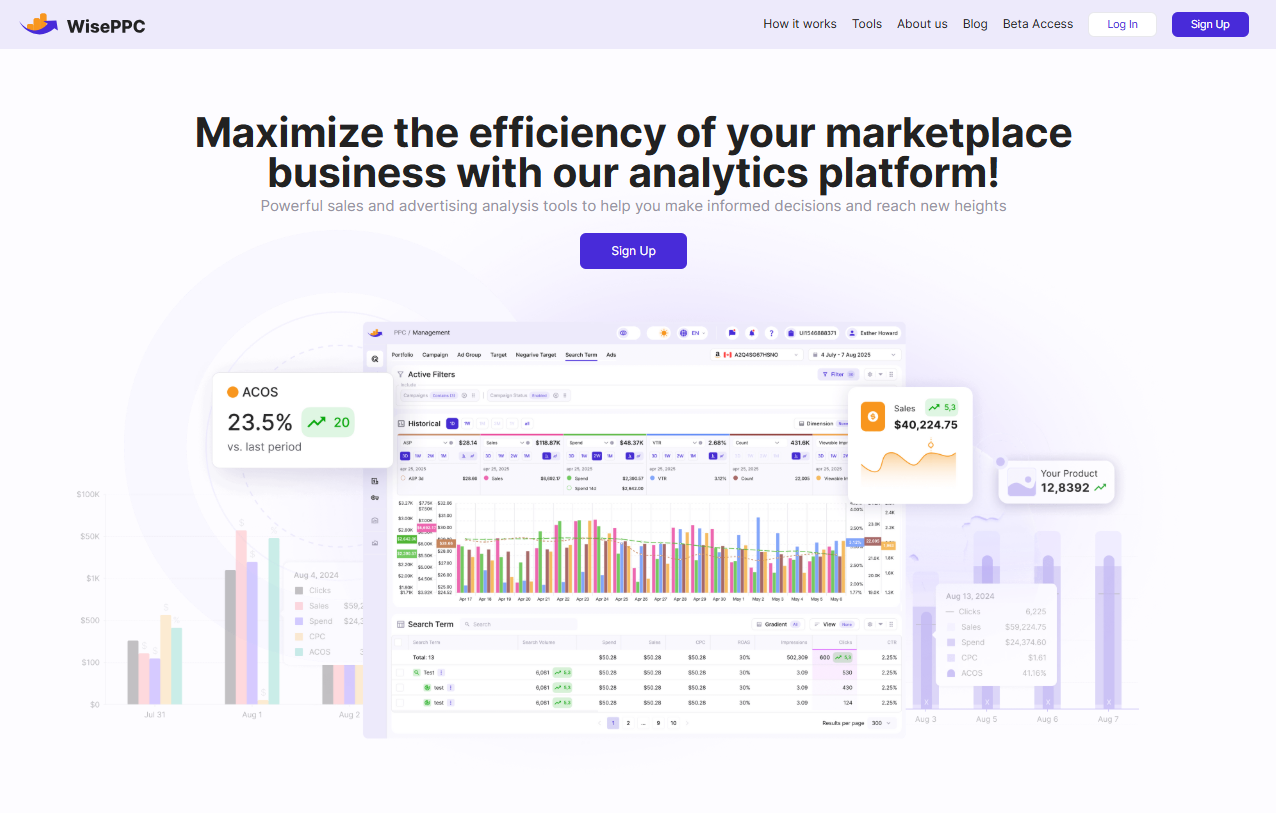
Comprehensive WisePPC Set of Features to Help Amazon Sellers
Bulk Actions
We simplify the process of making changes to multiple campaigns, keywords, or targets at once. This feature saves hours of manual work and ensures faster, data-driven decisions.
Advanced Analytics and Historical Metrics
With our granular insights into each ad, campaign, and keyword’s performance, we help sellers track performance over time and optimize for improved ACoS.
Campaign Performance Analysis
We provide detailed analysis of each campaign’s performance, including keyword and placement-level insights, to identify profitable areas and underperforming segments.
Real-Time Data and Automated Recommendations
We track key metrics in real time and provide actionable insights, such as recommended bid adjustments or keyword changes, helping sellers optimize their ACoS strategy continuously.
Custom Views and Multi-Account Reporting
We allow sellers to manage and compare multiple marketplace accounts from one platform, giving them a comprehensive view of all their advertising efforts and enabling them to adjust strategies accordingly.
By utilizing our suite of tools, Amazon sellers can streamline their advertising management, reduce wasted ad spend, and continuously refine their ACoS strategy to drive more profitable results. Whether you’re aiming for better profitability or scaling your ad efforts, we at WisePPC equip you with the insights and features necessary to succeed on Amazon.
Conclusion
Optimizing your Amazon ACoS strategy is essential for achieving a balanced and profitable advertising campaign on the platform. By understanding your profit margins, setting realistic ACoS targets, and implementing efficient bidding, keyword optimization, and product listing strategies, you can significantly reduce wasted ad spend and improve overall profitability.
It’s not just about lowering ACoS; it’s about aligning your advertising efforts with your business goals, whether that’s maximizing visibility, supporting new product launches, or boosting brand awareness. With continuous monitoring, regular campaign optimizations, and leveraging advanced tools like WisePPC, you can refine your ACoS strategy to drive sustainable growth and success on Amazon.
A successful Amazon ACoS strategy requires both patience and precision. Keep testing, analyzing data, and making informed adjustments to improve your campaigns, and over time, you’ll see the impact on your bottom line. Effective management of your ACoS is a key driver of profitability, ensuring that every advertising dollar spent delivers the best possible return.
FAQ
1. What is ACoS in Amazon advertising?
ACoS (Advertising Cost of Sale) is a key metric that helps measure the efficiency of your advertising campaigns on Amazon. It is calculated by dividing your ad spend by the revenue generated from your ads. A lower ACoS indicates a more cost-effective campaign, while a higher ACoS suggests that you may be spending too much on ads relative to the sales they generate.
2. How do I calculate my target ACoS?
To calculate your target ACoS, you need to know your product’s profit margin. From there, you can set a target that allows you to remain profitable. If your profit margin is 50%, setting a target ACoS of 30% would help ensure that your advertising costs don’t eat into your profits. The target ACoS should always be aligned with your business goals and profitability objectives.
3. Why is ACoS important for my Amazon campaigns?
ACoS helps you track the effectiveness of your Amazon advertising spend. It enables you to see if your campaigns are delivering profitable results or if you need to adjust your strategy. By keeping ACoS in check, you can optimize your advertising efforts and ensure that you are not overspending while still driving sales.
4. What tactics can I use to reduce my ACoS?
To reduce your ACoS, focus on keyword optimization, improving your product listings, using dynamic bidding strategies, and regularly monitoring your campaigns. Additionally, using tools like WisePPC can help identify underperforming ads, optimize keywords, and adjust bids based on real-time data to ensure you get the best return on investment.
5. How often should I review my ACoS strategy?
It is crucial to regularly monitor and adjust your ACoS strategy. Weekly or bi-weekly reviews can help you track your campaign performance, identify areas that need improvement, and make necessary changes. The more often you refine your campaigns based on current data, the more effectively you can control ACoS and drive better results.
6. Can ACoS be a good thing for new product launches?
Yes, ACoS can be higher during new product launches as you focus on building visibility and generating initial sales. While you may accept a higher ACoS in the early stages, your goal should still be to refine your strategy over time to lower ACoS as the product matures, and you begin to see organic growth and more cost-effective conversions.
7. What role do keywords play in ACoS optimization?
Keywords are crucial to ACoS optimization. By selecting the right keywords that attract relevant traffic and generate high conversion rates, you can reduce your ACoS. Regularly reviewing and refining your keyword list ensures that you are targeting the most effective search terms, driving profitable traffic, and avoiding wasted spend on irrelevant clicks.
 No credit card required