EN
EN  ES
ES  FR
FR  DE
DE  IT
IT  KO
KO  JA
JA  ZH
ZH  AR
AR  PT
PT  TR
TR  PL
PL  ID
ID  VI
VI The Amazon Metrics Your Reporting Tool Can’t See — And Why They Explain Your 2026 ROAS Drop

If you manage Amazon DSP or vCPM-billed Sponsored Brands / Sponsored Display campaigns — for your own brand or for clients — something strange happened in early 2026. Attributed purchases fell, ROAS slid, and nothing about the campaigns themselves had changed. Same budgets, same creatives, same targeting. Lower numbers.
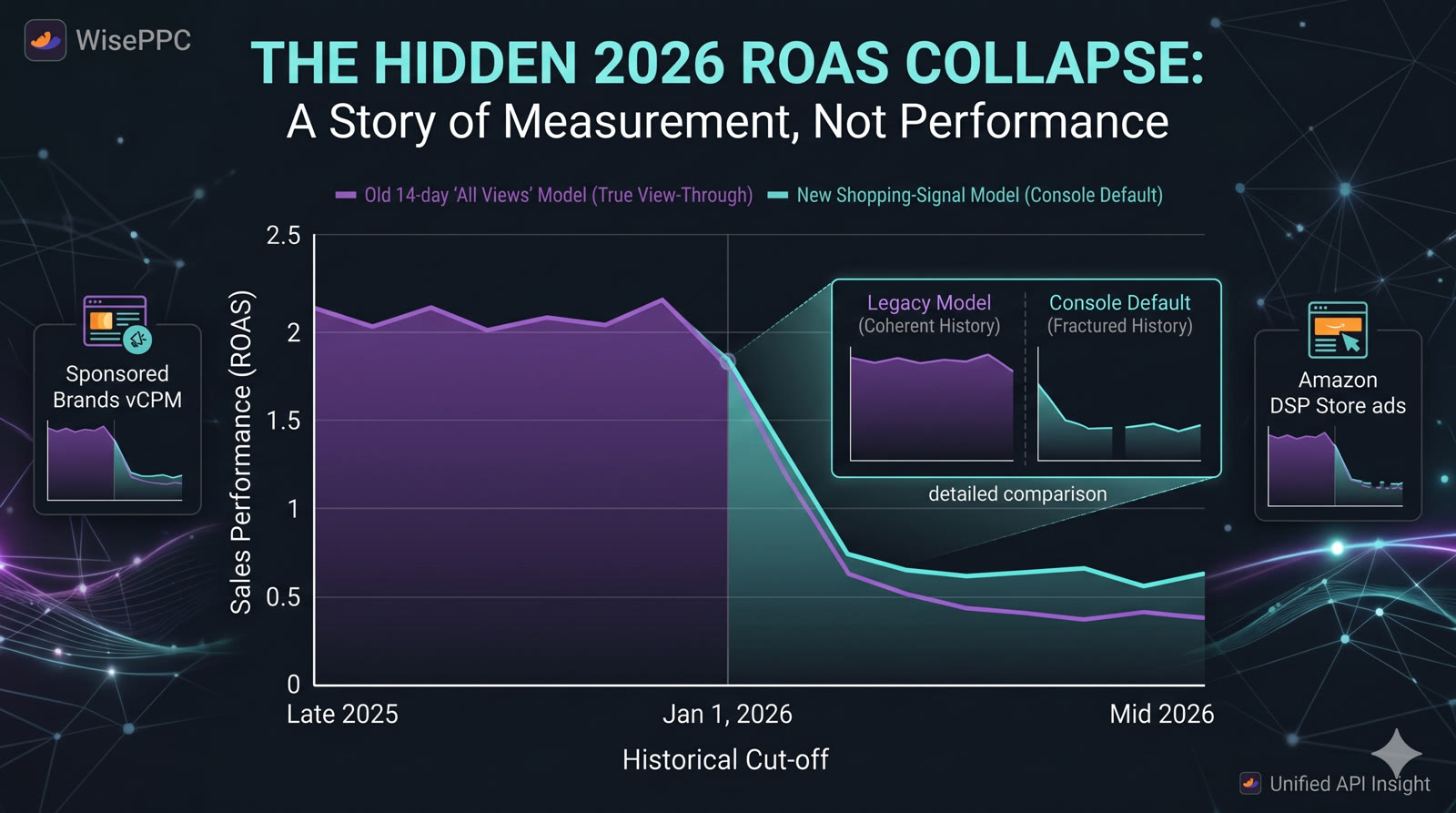
Nothing broke. On January 1, 2026, Amazon quietly rolled out a new attribution model for view-through conversions on its Store ads. And in the same quiet rollout, Amazon introduced 54 new “all views” metrics that preserve the old measurement methodology — but parked them in a new unified reporting API. The Amazon console exposes this API only through a beta “Reporting” tab that works as a manual report builder (click through metrics and dimensions, submit a request, wait, download a CSV), and most third-party reporting platforms still don’t ingest the unified API at all.
The practical effect: most advertisers and agencies are looking at the new-model numbers only. They see the ROAS drop, they can’t see the before-and-after comparison in their day-to-day dashboards, and they have no easy way to explain it to their clients or stakeholders — unless they’re willing to generate and reconcile one-off CSV exports for every account, every reporting cycle. The data exists. It just isn’t wired into anything useful for most of the industry.
WisePPC is one of the platforms that did open it. This article is about what you can see with those metrics in hand — and why you should have them in hand.
Key Points at a Glance
- On January 1, 2026, Amazon replaced its 14-day view-through attribution model with a new shopping-signal model for vCPM-billed campaigns (Amazon DSP Store ads, vCPM Sponsored Brands, vCPM Sponsored Display).
- Sponsored Products, CPC-billed campaigns, Sponsored TV, and click-based attribution everywhere are not affected.
- The old methodology is preserved in 54 “all views” metrics — but only through Amazon’s new unified Reporting API (v1). The Amazon console’s beta “Reporting” tab is a manual report builder on top of that API (click-through metrics selection, request, generate, download CSV) — useful for ad-hoc exports, not a live dashboard surface.
- Most third-party platforms have not integrated the unified v1 API. Their users cannot see these metrics in normal reporting at all — they see only the lower, new-model numbers with no historical context.
- WisePPC is built on the unified v1 API. “All views” metrics show up in client reports automatically, side-by-side with the new standard metrics.
- This is why year-over-year performance reviews spanning the 2026 cutoff are coherent on WisePPC, and confusing almost everywhere else.
What Actually Changed on January 1, 2026
Before 2026, view-through attribution on Amazon Store ads worked like this: if a shopper saw your ad — no click required — and then bought the product on Amazon within 14 days, that purchase could be credited to the ad. Every viewable impression in the 14-day window was eligible to claim the sale.
Generous, and often directionally useful for upper-funnel brand measurement. Also generous enough that a lot of view-through credit went to impressions with no plausible influence on the purchase.
In January 2026, Amazon replaced that with a “shopping-signal enhanced last-touch” model, scoped to vCPM-billed campaigns only:
- Shorter view-through window. Amazon hasn’t published the exact new number, but it’s materially tighter than 14 days.
- Views have to earn the credit. Instead of crediting every viewable impression in the window, the new model uses shopping signals — searches, product page visits, cart activity, category browsing — to judge whether a given view was actually part of the journey to purchase. Views with no signal are filtered out.
Who was affected:
- Amazon DSP campaigns serving ads in the Amazon Store.
- Sponsored Brands campaigns billed on vCPM (including branded keyword campaigns).
- Sponsored Display campaigns billed on vCPM.
Who wasn’t:
- Sponsored Products (click-billed, always click-attributed).
- CPC-billed Sponsored Brands and Sponsored Display.
- Sponsored TV.
- Off-Amazon conversions through Amazon Attribution.
- Click-based attribution everywhere — Amazon’s own wording: “Click-based attribution remains unchanged.”
The net effect for everyone with a DSP or vCPM Sponsored Ads program: reported view-through conversions are down, and reported ROAS is down with them. Campaign performance didn’t change. Measurement did.
The Metrics Amazon Preserved — and Where They Live
Amazon didn’t delete the old methodology. It relabeled it. In Amazon’s new unified reporting layer, you’ll find a second family of metrics tagged “(all views)” alongside every standard conversion metric:
| Standard metric (new model) | “All views” counterpart (old 14-day model) |
|---|---|
| Purchases | Purchases (all views) |
| Sales | Sales (all views) |
| Units sold | Units sold (all views) |
| ROAS | ROAS (all views) |
| Cost per purchase | Cost per purchase (all views) |
There are 54 of these “all views” variants in total, covering every purchase, sales, and efficiency metric Amazon reports.
Here’s the catch, and it’s the reason you likely haven’t seen these metrics in any useful form:
- They live in Amazon’s new unified Reporting API (v1) — a recently-released, API-first reporting surface that’s genuinely different from the Sponsored Ads APIs (v2 and v3) that most third-party platforms have integrated.
- They do not appear in the standard campaign performance dashboards.
- They do not appear in the default CSV exports advertisers and agencies export every day.
- They are not exposed by the v2 or v3 Sponsored Ads reporting APIs that most BI connectors, dashboards, and agency-facing reporting tools still run on.
- They are technically available through the “Reporting (beta)” tab in the Amazon Ads console — but that tab is essentially a manual web interface on top of the unified v1 API. You click through hundreds of available metrics and dimensions to assemble a custom report, submit the request, wait for Amazon to generate it, and then download a CSV. It’s a one-shot report builder, not a live analytics surface. You can’t build a recurring client-facing dashboard on top of it, you can’t pivot freely, and you can’t join the output with the rest of your marketing data without a lot of manual plumbing on your end.

Translation: even motivated advertisers who know the data is there spend real time every week assembling one-off CSV exports — or simply stop bothering and work off the numbers their main reporting tool shows them. And if your agency or brand is using a platform that hasn’t migrated to Amazon’s unified v1 reporting, your recurring dashboards literally cannot show you the comparison between the old and new attribution models. The data exists. You just don’t have a continuous pipe to it.
Why This Is a Competitive Advantage, Not a Footnote
Every WisePPC customer running DSP or vCPM SB / SD campaigns got three things on January 1, 2026, without changing anything:
- The new standard metrics, matching exactly what Amazon now uses to measure view-through performance.
- The “all views” metrics, preserving the pre-2026 methodology for direct comparison.
- Both of them in the same reports, at the same grain, with the same dimensions — so a year-over-year chart that spans the methodology change is actually possible.
That third point is where most of the industry got stuck. Agencies running client books on older reporting stacks entered Q1 2026 with:
- A ROAS number that dropped and no way to show why.
- Year-over-year decks that looked catastrophic without context.
- “Did our campaigns get worse?” conversations with no clean data answer.
Agencies running WisePPC had the full picture from day one — in their existing dashboards, on the schedule they already reported on, without anyone having to open Amazon’s beta report builder, click through a metrics menu the length of a phone book, submit a report request, wait for generation, and reconcile a CSV by hand. The conversation with clients was “here’s the new number, here’s the old-methodology number for apples-to-apples comparison, here’s why they’re different, here’s what Amazon recommends you optimize against.” That’s a thirty-minute alignment instead of a month of explaining.
What “Serving” the Unified Report Actually Looks Like
The difference between an API and a product is the difference between data being technically available and data being usable. To make the contrast concrete, here’s what a WisePPC user sees when they open the Unified Report on a client account — every element below is on a single page, live, no request-and-wait cycle:

- A library of saved table configurations at the top — pre-built layouts like “Product Targeting,” “Product / Campaign Type / Target,” “Filter — Reset,” with one-click switching and the ability to save and share new ones. An agency builds the report once and every account inherits the template; clients don’t need a new ad-hoc CSV each week.
- Configurable KPI tiles with sparklines and 3D / 1W / 2W / 1M trend toggles for the metrics that matter most to that account: ACOS, CPC, Cost, Sales, Impressions, ACOS-loss thresholds, and so on. Any metric in the unified API can sit in any tile.
- A multi-series time-series chart beneath the KPIs, segmentable by any additional dimension (campaign type, placement, marketplace…), so the trend story is visible without leaving the page.
- A pivot table that lets users group by any available dimension, in any order — Ad Product Parent, Ad Product, Campaign Type, Campaign, Placement, Target, Date, Search Term, Match Type, Marketplace, and the rest of the unified-API dimension set. Drag chips into any sequence, swap them around mid-analysis, drop one and add another. Per-column inline filters, color-coded performance heatmaps, group totals, and Pivot Mode are all live, no rebuild. The same report becomes “performance by ASIN broken down by campaign type” and “performance by search term broken down by placement” in two drag movements — without leaving the page or generating a new CSV.
- A searchable column picker exposing the full unified-API metric catalog, including the “all views” family side-by-side with the new standard metrics, so a year-over-year comparison is a checkbox, not a project.
- Multi-account and multi-marketplace context at the top, so an agency can flip between client books in a click — without re-authenticating, re-exporting, or re-stitching CSVs.
- A live Export for when a CSV is genuinely the deliverable — but as the output of the report you’ve already shaped, not as the only way to see the data.
Now contrast that with Amazon’s beta Reporting tab for the same underlying API: open the report builder, scroll through the catalog, hand-pick metrics and dimensions for a single date range, submit, wait minutes for generation, download a CSV, open in Excel, format columns, build pivots and charts manually, repeat next reporting cycle. The data is there. The product isn’t.
That’s the practical difference between exposing the unified Reporting API and building a product on top of it. It’s also why “we have access to metrics Amazon doesn’t surface” isn’t marketing language for WisePPC — it’s the literal experience users have every day.
This is not a gimmick. Amazon is the one platform whose measurement directly drives billions in advertiser spend, and they will keep evolving attribution — this 2026 change won’t be the last. Being on the newest reporting surface, with access to the fullest metric set Amazon makes available, is the difference between explaining platform changes to your clients and being caught out by them.
How to Use Both Metric Families Intelligently
Having access to the full set is only half of it. Using them well is the other half.
Use standard metrics as your primary, operational numbers
- Day-to-day performance monitoring and optimization.
- Setting and tracking ROAS / ACoS goals going forward.
- Bid decisions, budget pacing, campaign structure changes.
- Anything forward-looking. This is what Amazon now uses to measure you; optimizing against it keeps your decisions aligned with Amazon’s system.
Use “all views” metrics for the comparisons Amazon’s default reporting makes hard
- Year-over-year reports that span the January 1, 2026 boundary on vCPM campaigns.
- Explaining the 2026 ROAS drop to executives and clients with actual numbers, not hand-waving.
- Reconciling 2025 case studies, pitch decks, and contracted KPIs against current numbers.
- Sizing the real impact of the attribution change on a specific book of business.
Don’t
- Pretend “all views” ROAS is your current ROAS — it’s calibrated to a methodology Amazon no longer uses for performance.
- Mix the two families on the same chart without clearly labeling which methodology each series uses.
- Assume the drop in January 2026 means campaigns got worse — measurement changed, outcomes usually didn’t.
- Reset budgets or targets based on a raw year-over-year comparison without correcting for the methodology shift first.
How to Talk About This With Clients and Stakeholders
Two conversations you should be ready for.
“Why did our Amazon DSP / vCPM ROAS drop this year?”
- Campaigns did not perform worse — Amazon changed the measurement methodology on January 1, 2026.
- The old model credited any ad view within 14 days. The new model credits only views backed by a shopping signal, in a tighter window. A lot of credits that used to count no longer do.
- Here’s what the comparison looks like under the old methodology [show the “all views” numbers side-by-side]. This is the apples-to-apples YoY view.
“Should we change budgets because ROAS dropped?”
Usually no. Actual business outcomes — units, new-to-brand customers, incremental sales — haven’t changed. Just the share of those outcomes credited to the ad.
- Keep using the new standard metrics for optimization and budget decisions.
- Reset ROAS targets where necessary — a 4x target calibrated on the old methodology is a different target on the new one.
- Use “all views” only to contextualize, never as an operational KPI.
The conversation is a lot easier when you can show both sides of it on the same page of the same report. Which is the point of having both.
Why Most Reporting Tools Can’t Do This (Yet)
Amazon’s advertising reporting ecosystem is in the middle of a generational shift:
- Legacy (v2) APIs still power Sponsored Brands and Sponsored Display reporting at most third-party platforms. These APIs do not expose “all views” metrics.
- v3 APIs cover Sponsored Products. They also don’t expose “all views.”
- Unified Reporting v1 — Amazon’s newest, API-first reporting layer — is where “all views” and a much broader set of newer metrics live. Amazon has wrapped it in a beta console UI for advertisers who want to self-serve one-off exports, but that’s a manual report builder, not a reporting surface you can run a business on. Most BI platforms and agency tools haven’t done the integration work to pipe unified v1 into recurring dashboards; the surface area is large and the effort is substantial.
This is consistent with what we’ve said from the start on wiseppc.com: we give advertisers and agencies access to Amazon metrics that don’t show up in their default reporting, and that Amazon doesn’t make practical to use outside of one-off manual exports. The 2026 attribution update and the “all views” family are a case study in exactly why that matters. When a platform change forces agencies to explain a reporting shift to clients — every week, across every account — the reporting tool that already has the fuller metric set piped into normal dashboards wins by default.
Conclusion
The January 2026 attribution update is one of those quiet platform changes that looks like a bug if you don’t know it happened. It’s not a bug. It’s a measurement change that affects every vCPM Amazon advertiser, and Amazon preserved the old methodology in a new metric family — (all views) — that lives on a reporting surface most tools haven’t adopted yet.
Three takeaways:
- If you run DSP or vCPM SB / SD, your 2026 view-through ROAS is not directly comparable to 2025 under the old methodology. The “all views” metrics are Amazon’s officially-preserved way to do that comparison — if you can get to them.
- If you run Sponsored Products or CPC campaigns only, the change didn’t affect you. Keep moving.
- If your current reporting stack can’t show both the new and old-methodology numbers in the same report, you’re flying half-blind through a platform change Amazon is actively rolling forward.
Want to see what your 2026 Amazon performance looks like with both metric families side-by-side — in a live dashboard, not a manually-assembled CSV — before your next client review? Talk to WisePPC. We’ll show you the Unified Report on real account data, including the year-over-year view most platforms can’t render today.
Additional Resources
- Official announcement: View Attribution Updates for Amazon Store ads — Amazon Ads
- Unified Reporting launch announcement — Amazon Ads
- Amazon Ads Reporting API V1 — metrics library
- Industry coverage: Amazon tightens view attribution as ROAS reporting splits (PPC Land)
- Industry coverage: Amazon Quietly Tightened Attribution (Code3)
About WisePPC
WisePPC is an Amazon advertising analytics and automation platform for brands and agencies. We build on Amazon’s newest reporting surfaces — including the unified Reporting v1 API — so our customers see the metrics Amazon makes available, not just the ones legacy integrations happen to expose. The goal is reporting that tells the real story, especially when the platform changes the rules.
Join the WisePPC Beta and Get Exclusive Access Benefits
WisePPC is now in beta — and we’re inviting a limited number of early users to join. As a beta tester, you'll get free access, lifetime perks, and a chance to help shape the product — from an Amazon Ads Verified Partner you can trust.
 No credit card required
Free in beta and free extra month free after release
25% off for life — limited beta offer
Access metrics Amazon Ads won’t show you
Be part of shaping the product with your feedback
No credit card required
Free in beta and free extra month free after release
25% off for life — limited beta offer
Access metrics Amazon Ads won’t show you
Be part of shaping the product with your feedback