
 EN
EN  ES
ES  FR
FR  DE
DE  IT
IT  KO
KO  JA
JA  ZH
ZH  AR
AR  PT
PT  TR
TR PL
PL
Quick Summary: Amazon Fresh is Amazon’s online and physical grocery service offering same-day delivery to over 2,300 U.S. cities and towns, plus brick-and-mortar stores in select locations. Prime members get free same-day delivery on orders over $25, with access to thousands of fresh groceries, produce, meat, seafood, and everyday essentials at consistently low prices.
Amazon has transformed how millions of people shop for groceries. But with multiple grocery offerings under the Amazon umbrella, things can get confusing fast.
So what exactly is Amazon Fresh? How does it differ from Amazon’s other services? And is it actually worth using?
Let’s break down everything you need to know about Amazon’s grocery platform, from delivery options to physical stores and pricing.
Amazon Fresh: The Basics
Amazon Fresh is both an online grocery delivery service and a chain of physical grocery stores. According to the official Amazon website, it’s designed to offer low prices on everyday favorites with same-day delivery and pickup in select locations for Prime members.
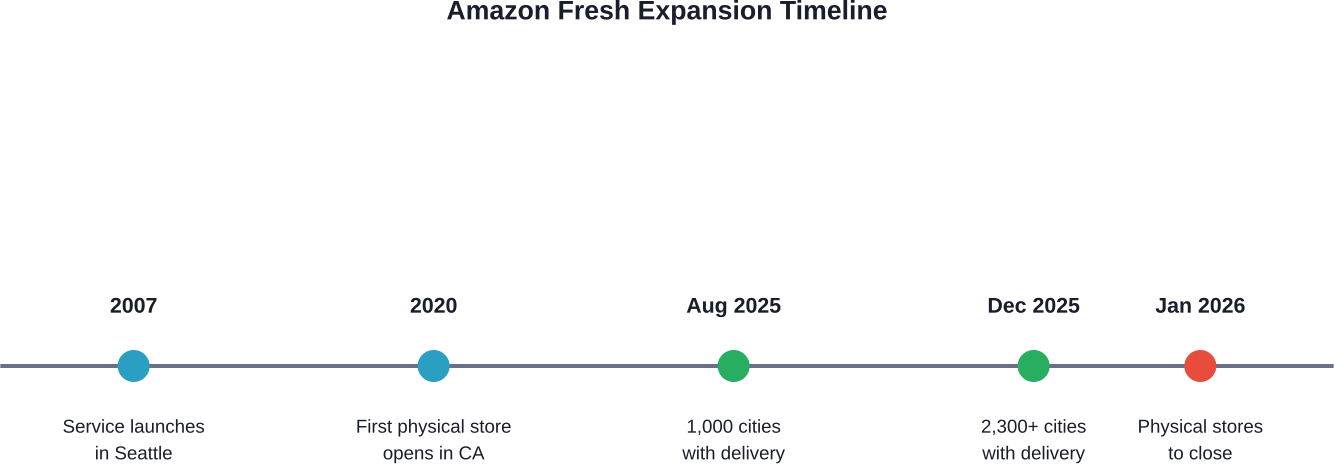
The service launched in 2007, making it one of Amazon’s longer-running initiatives. What started as a limited grocery delivery pilot in Seattle has expanded into a nationwide network covering thousands of cities.
Here’s what makes Amazon Fresh distinct: it combines perishable groceries like fresh produce, meat, and dairy with the convenience of ordering non-food items from Amazon’s massive catalog—all in a single cart and delivery.
Online Delivery Service
The online component is where Amazon Fresh really shines. According to Amazon’s announcement in December 2025, the service now reaches over 2,300 cities and towns across the United States, with continued expansion planned for 2026.
Prime members get free same-day delivery on grocery orders over $25. Orders below that threshold cost $2.99 for Prime members, while non-Prime customers pay $12.99 with no minimum order requirement.
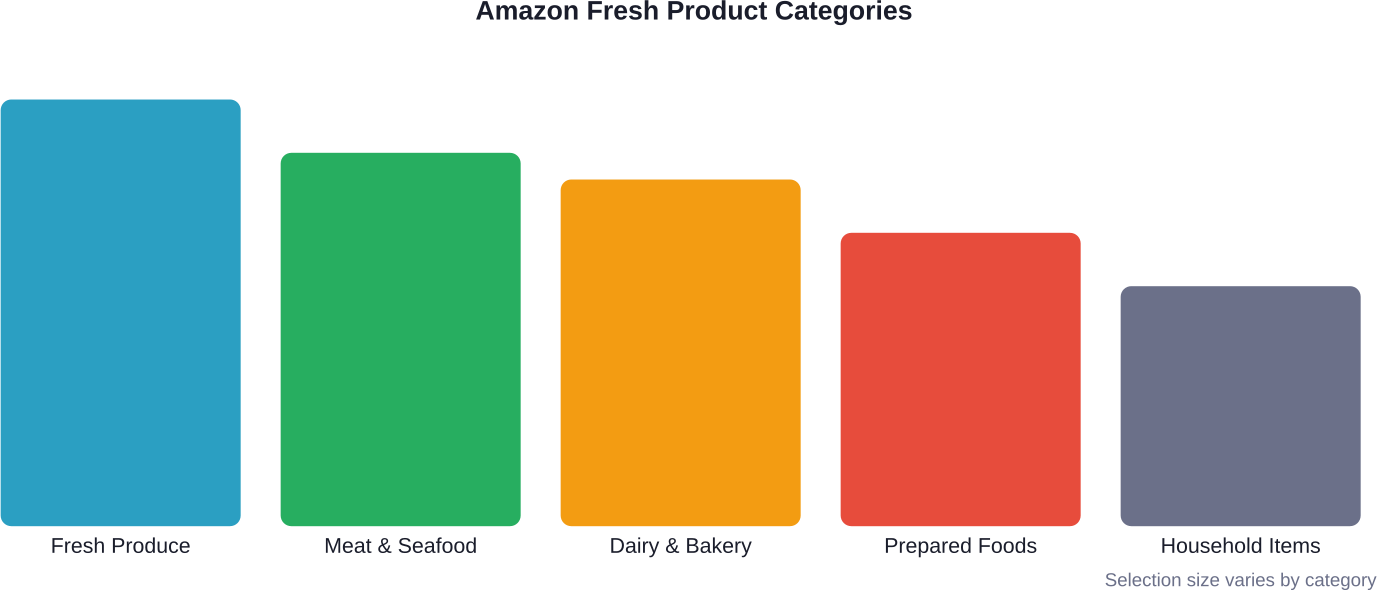
The selection includes thousands of fresh perishable items—produce, meat, seafood, dairy, bakery goods, and prepared foods—alongside household essentials, electronics, and other Amazon products. Data from Amazon shows that nine of the ten bestselling items in areas with perishable delivery are now fresh groceries.
Physical Store Locations
Amazon Fresh also operates brick-and-mortar grocery stores in select metropolitan areas. The first full-size Amazon Fresh store opened in Woodland Hills, California in 2020.
As of early 2026, however, Amazon has announced a strategic shift. According to industry reporting from McMillanDoolittle in January 2026, Amazon revealed plans to close all Amazon Fresh and Amazon Go stores as part of a refocusing of its grocery strategy.
This represents a significant pivot away from physical retail and back toward Amazon’s core strength: online delivery and logistics.
Scale Your Grocery or CPG Brand on Amazon
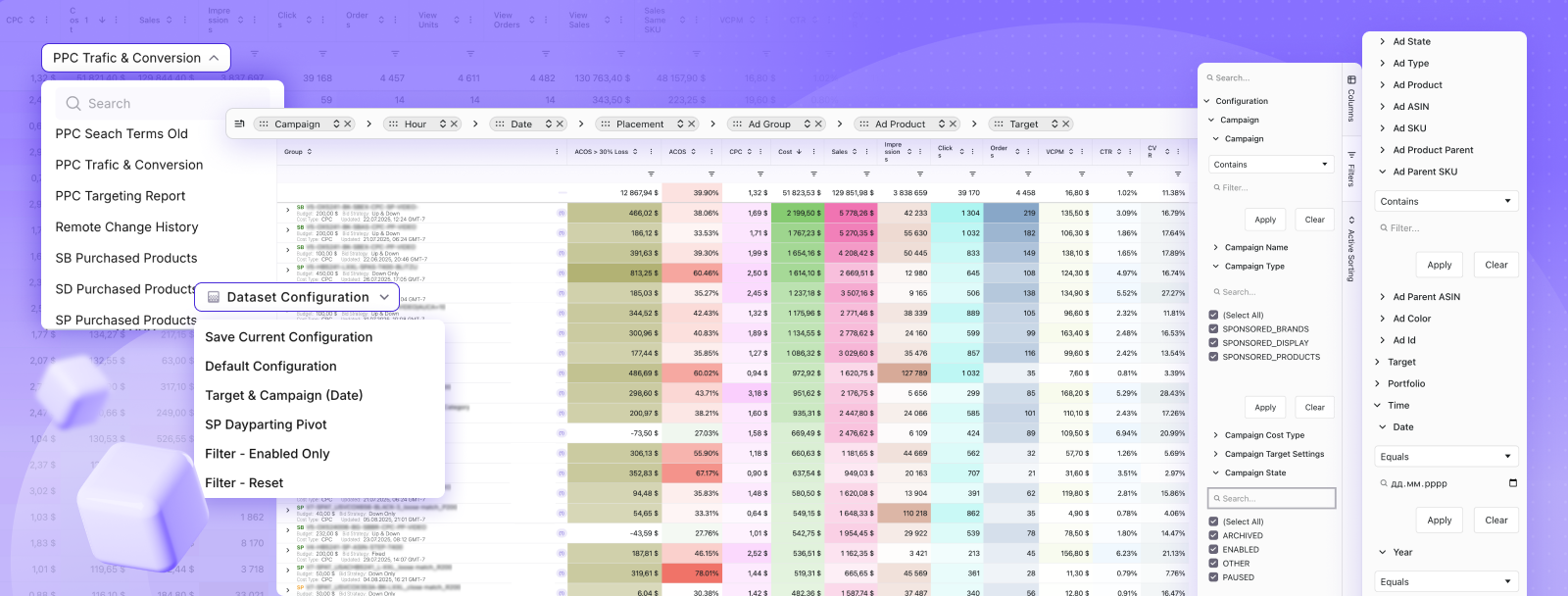
As Amazon Fresh expands the reach of grocery and perishable goods, the competition for visibility in the “Everyday Essentials” category has increased. Success in this high-frequency niche requires precise inventory management and aggressive, data-driven advertising to stay ahead of household names. WisePPC provides specialized Amazon account management and PPC services, helping brands in the grocery and CPG sectors maintain top-tier search rankings and healthy margins.
- Category-Specific PPC: Optimized ad campaigns designed to capture recurring customers and improve “Subscribe & Save” rates.
- Listing Optimization: Professional management of product data to ensure high conversion in the fast-paced grocery marketplace.
- Account Health Maintenance: Constant monitoring of seller metrics to meet the strict delivery and quality standards of Amazon’s grocery platforms.
- Strategic Scaling: Expert guidance on expanding your product catalog and increasing market share within the Amazon ecosystem.
Professionalize your Amazon sales strategy with WisePPC.
How Amazon Fresh Delivery Works
The delivery model is surprisingly straightforward. Customers shop online through the Amazon website or mobile app, selecting from thousands of grocery items alongside regular Amazon products.
Amazon uses a specialized temperature-controlled fulfillment network to ensure quality. According to Amazon’s official announcement in August 2025, every perishable item undergoes a six-point quality check upon arrival at the facility and again before leaving for delivery.
Temperature-sensitive products arrive in insulated bags designed to maintain proper conditions during transit. Deliveries happen within hours of ordering in most coverage areas.
Here’s what makes this different from traditional grocery delivery: customers can combine fresh tomatoes, chicken breast, and yogurt with paper towels, electronics, gifts, and household goods in a single order. Doug Herrington, CEO of Worldwide Amazon Stores, noted that customers are actively using this capability to consolidate shopping.
Coverage Areas and Availability
As of December 2025, Amazon Fresh same-day delivery covers over 2,300 cities and towns. Recent expansions include areas around Boise, ID, Salt Lake City, UT, Fort Collins, CO, Omaha, NE, Sugar Land, TX, Des Moines, IA, Kennesaw, GA, and Gaithersburg, MD.
The service continues expanding throughout 2026. Not every location has access yet, but Amazon’s logistics infrastructure allows for rapid rollout to new markets.
Pricing and Prime Membership Benefits
The pricing structure is simple but heavily favors Prime members. Free same-day delivery applies to orders over $25 for Prime members in most areas. Below that threshold, delivery costs $2.99.
For non-Prime customers, the fee jumps to $12.99 per order with no minimum purchase requirement. This pricing model clearly incentivizes Prime membership for anyone planning to use the service regularly.
Prime membership costs are available at various price points; current pricing should be verified on Amazon.com as it varies by region and membership type. Beyond Amazon Fresh, that membership includes free two-day shipping on millions of items, Prime Video, Prime Music, and other benefits.
| Order Amount | Prime Member Cost | Non-Prime Cost |
|---|---|---|
| Under $25 | $2.99 delivery | $12.99 delivery |
| $25 and over | Free delivery | $12.99 delivery |
Additional Savings for Prime Members
According to Amazon’s official Prime benefits page, Prime members in select markets receive extra savings on grocery items already on sale. The specific discounts vary by location and product.
Amazon emphasizes that lower prices at Amazon Fresh are here to stay, positioning the service as a value-oriented option rather than a premium offering.
Product Selection and Quality
The product range includes national brands and high-quality fresh items. According to Amazon’s official grocery page, customers find a wide assortment of national brands alongside quality produce, meat, and seafood.
Amazon’s culinary team prepares ready-to-eat meals and prepared foods daily. This bridges the gap between full grocery shopping and meal kit services.
Fresh grocery data from December 2025 shows that perishables have become central to the service. Nine of the top ten bestselling items in Same-Day Delivery areas are now fresh perishable products—a significant shift from the service’s early days when shelf-stable goods dominated.
Amazon Fresh vs. Whole Foods
This is where confusion often happens. Amazon owns both Amazon Fresh and Whole Foods Market, which Amazon acquired in 2017, but they’re distinct services targeting different customer segments.
Whole Foods focuses on organic, natural, and premium products with higher price points. Amazon Fresh emphasizes everyday low prices on conventional groceries alongside some organic options.
Both services offer delivery through Amazon, but the product selection, pricing, and brand positioning differ significantly. Think of Whole Foods as the premium option and Amazon Fresh as the value-oriented mainstream choice.
| Feature | Amazon Fresh | Whole Foods |
|---|---|---|
| Positioning | Value, everyday low prices | Premium, organic focus |
| Product Focus | Conventional + some organic | Organic, natural, specialty |
| Delivery | Same-day, 2,300+ cities | Limited coverage areas |
| Physical Stores | Closing in 2026 | 500+ locations nationwide |
Competitive Landscape
Amazon Fresh competes directly with Instacart and Walmart+ in the same-day grocery delivery space. According to Grocery Dive reporting from August 2025, Amazon’s expansion to over 1,000 cities positions it as a strong competitor to these established services.
Walmart+ offers similar same-day delivery from Walmart stores; specific pricing should be verified with Walmart directly. Instacart partners with multiple grocery chains but charges per-delivery fees unless you subscribe to Instacart+.
The key differentiator? Amazon Fresh lets customers combine groceries with the entire Amazon catalog in one order. Need diapers, a phone charger, and ingredients for dinner? One cart, one delivery window.
Real talk: this integration is powerful for certain shopping patterns but doesn’t matter much if you’re just buying groceries.
The Strategic Shift Away from Physical Stores
Amazon’s January 2026 announcement about closing physical Amazon Fresh and Amazon Go locations marks a significant strategic pivot. According to McMillanDoolittle’s analysis, this isn’t a retreat from grocery—it’s a refocus on where Amazon has clear differentiation.
The physical store experiment faced challenges. Traditional grocers like Kroger, Albertsons, and Walmart already have massive brick-and-mortar footprints and decades of operational expertise. Amazon’s strength lies in logistics, delivery, and online convenience.
By concentrating resources on delivery and online shopping, Amazon plays to its core competencies rather than fighting established competitors on their home turf.
Financial Performance and Growth
Amazon doesn’t break out Amazon Fresh revenue separately in financial reports. However, according to SEC filings, Amazon’s fourth quarter 2025 results showed net sales of $213.4 billion, up 14% year-over-year, with continued growth in online retail segments.
The aggressive expansion to over 2,300 cities by late 2025 signals strong internal commitment to the grocery delivery model, even as physical stores close.
Is Amazon Fresh Worth It?
The answer depends entirely on your situation and shopping habits.
Amazon Fresh makes sense if you’re already a Prime member, live in a coverage area, and value convenience. The ability to combine grocery and non-grocery items is genuinely useful for certain household shopping patterns.
The pricing is competitive. Free delivery on orders over $25 for Prime members matches or beats many competitors. Product quality appears consistent based on the six-point quality check process Amazon describes.
But it’s not for everyone. If you prefer shopping in person, enjoy browsing produce yourself, or don’t already have Prime, the value proposition weakens significantly. The $12.99 fee for non-Prime members per delivery makes little sense for regular use.
Community discussions suggest mixed experiences. Some users praise the convenience and selection, while others report occasional substitution issues or delivery windows that don’t align with their schedules.
Frequently Asked Questions
What areas does Amazon Fresh deliver to?
Amazon Fresh delivers to over 2,300 cities and towns across the United States. Availability varies by ZIP code, so check directly on Amazon to confirm coverage in your area.
How much does Amazon Fresh cost?
Prime members get free delivery on orders over $25 or $2.99 for smaller orders. Non-Prime customers pay $12.99 per delivery.
What’s the difference between Amazon Fresh and Whole Foods delivery?
Amazon Fresh focuses on everyday groceries at lower prices, while Whole Foods delivery offers premium and organic products at higher price points.
How fast is Amazon Fresh delivery?
Amazon Fresh typically offers same-day delivery with selectable time windows, depending on location and demand.
Can I return items if there’s a problem?
Yes, damaged or incorrect items can be refunded through your Amazon account or by contacting customer service.
Do I need Prime membership for Amazon Fresh?
No, but Prime members receive significantly lower delivery fees, making it more cost-effective for regular use.
Are Amazon Fresh stores still open?
Amazon announced plans in 2026 to close its physical Amazon Fresh and Amazon Go stores, focusing more on online grocery delivery.
The Bottom Line
Amazon Fresh has evolved into a major player in online grocery delivery, reaching thousands of cities with a compelling combination of fresh groceries and Amazon’s full product catalog. The pricing favors Prime members heavily, making it an attractive option for existing subscribers who value convenience.
The closure of physical stores represents a strategic bet that Amazon’s future in grocery lies in delivery and logistics, not brick-and-mortar retail. For a company built on online commerce and supply chain innovation, that makes sense.
Whether Amazon Fresh works for your household depends on your location, Prime membership status, and how much you value consolidated online ordering. Check if your area has coverage and consider testing the service if you’re already a Prime member—the low barrier to trying it makes experimentation easy.
 No credit card required