
 EN
EN  ES
ES  FR
FR  DE
DE  IT
IT  KO
KO  JA
JA  ZH
ZH  AR
AR  PT
PT  TR
TR PL
PL
Key points
- People who want to start an online retail business often end up choosing between selling their products on Amazon or using Shopify to create a dedicated storefront for their business.
- Both platforms have numerous advantages and disadvantages.
- Amazon is an online marketplace where sellers can list their products and compete with other businesses that sell identical or similar items. The biggest advantage of Amazon is its 300 million customer base.
- Shopify is an e-commerce platform where sellers can easily create storefronts dedicated solely to their brands. The downside of Shopify is that sellers are responsible for driving traffic to their stores, which can be time-consuming and costly.
- Ultimately, the best option for business owners is to try selling their products on both platforms at the same time to diversify sales channels, maximize profits, and minimize risks.
If you’re thinking of starting your own e-commerce business or expanding your existing brick and mortar operations into the world of online retail, you have a few big decisions to make. One of these decisions is choosing the platform you’re going to use to run your business. There are dozens of different platforms, but most entrepreneurs end up choosing between Amazon and Shopify. Both of these offer some excellent benefits, so in this article, we will talk about the differences between Shopify and Amazon, their advantages and disadvantages, and give you tips for choosing the best option for your company.
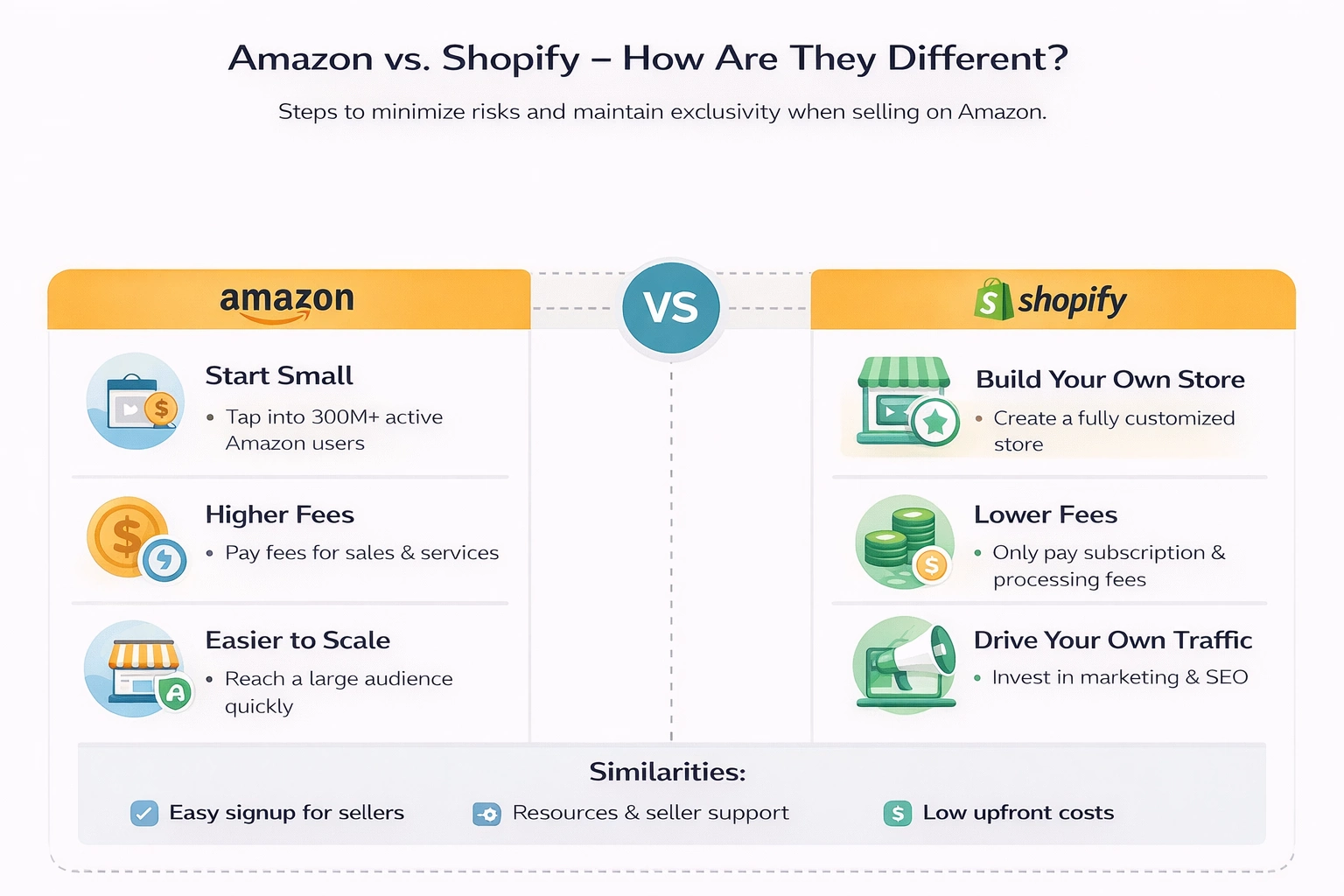
Amazon vs. Shopify – how are they different?
Amazon and Shopify are two services people most commonly use to sell products online.
Shopify and Amazon similarities
No need to register a business to become a seller
Both platforms make it very easy for sellers to sign up on the platform since they don’t require individuals to register their businesses before starting to sell products.
However, Amazon makes the process a little more challenging by asking potential sellers to submit a government-issued ID, valid credit card, and tax details before allowing them to create an account on the platform.
Simple process for adding products
You don’t need to have any programming experience or other special skills to add products on these platforms. The user interface is generally very intuitive, and both services give you a list of information you need to enter for each product to list it.
Low upfront costs
Both Amazon and Shopify make it really affordable for sellers to get started on the platforms. For instance, Shopify gives each new seller a free 14-day trial and after that, charges them $29.99 monthly under the basic plan. You can upgrade to more advanced plans if you want.
At the same time, Amazon gives you two plan options. Under the Individual plan, you have to pay a fee for each product you sell, so you won’t need to pay anything if you don’t make any sales. Alternatively, you can opt for the Professional plan, which costs $39.99 per month.
Resources and support for sellers
Starting a business is always challenging, so both Amazon and Shopify provide a lot of informational resources, articles, tools, FAQ pages, and even dedicated support teams to answer seller questions.
Differences between Amazon and Shopify
Different business models
One of the main differences between Shopify and Amazon is that the former is an e-commerce platform, and the latter is a marketplace. So when you sell on Amazon, you will have to compete with other sellers who have identical product listings. Most of the time, an Amazon product listing will have dozens, if not more, of sellers who all have the same product in stock. At the same time, the platform gives business owners limited tools to make them stand out from the competition.
On the other hand, on Shopify, you will have your own storefront with all of your products. This is very similar to creating a website from scratch to sell your stock. There will be no competition to distract customers from your brand, and you’ll have the chance to customize the way your storefront looks and its features.
Amazon gives you access to over 300 million customers
One of the most significant advantages of Amazon is that by joining the platform, you instantly gain access to its 300 million active users, half of whom have Prime memberships. This means that if you sell a relatively unique product that’s in demand with customers, you likely won’t need to spend money on advertising.
On the other hand, if you go with Shopify, you will be responsible for driving traffic to your store, resulting in significant SEO and advertising expenses.
Amazon will charge you fees
Since Amazon provides you with a huge customer base, the platform needs to find a way to make money from this model. This is where Amazon fees come in. When you sell on Amazon, you will be responsible for paying numerous fees for different actions you take on the platform. These fees can easily add up to over 30% of your total sales revenue.
Shopify fees are much lower, as you will only need to pay the price of a monthly subscription, payment processing fee, and the annual domain name registration cost.
Shopify pros and cons
In this section, we will take a detailed look at the advantages and disadvantages of selling your products on Shopify.
Shopify pros for sellers:
- You can use the platform for free for 14 days to decide whether you like it.
- You can create a completely customized online store using free and paid themes.
- On Shopify, your brand will remain front and center when customers shop your products.
- Shopify has a Fulfillment Network, which you can use to shore and ship your products, similar to the service Amazon FBA provides.
- Shopify’s fees are very reasonable and affordable for any business.
- You can make your store mobile-friendly to attract more sales.
- You can add helpful features to your store by downloading readily available Shopify plugins.
Shopify cons for sellers:
- Building a store is generally easy, but you will still need to spend some time learning how to do it the first time.
- You will need to drive customers to your store from search engines, social media, etc. This can be expensive and time-consuming.
- Most Shopify plugins are paid, and the selection of free themes is very limited, so you will likely need to spend money on a paid theme.
Shopify pricing
While Amazon has two seller plans which are pretty straightforward, Shopify plans are more complex. Essentially, sellers can choose from 3 options: the Basic plan, which costs $29 per month; the Shopify plan, which costs $79 per month; and the Advanced plan, which adds up to $299 per month.
The Basic Shopify plan allows you to create e-commerce websites and blogs, add an unlimited number of products to your store, use 2 staff accounts, utilize multichannel selling, fraud analysis, and contact Shopify support 24/7.
The Shopify plan includes everything available in the Basic plan, plus, it allows customers to purchase gift cards, sets lower credit bards fees for sellers, gives sellers access to 5 staff accounts instead of 2, allows them to create professional reports, and provides access to the point of sale extras.
Finally, the Advanced Shopify plan incudes 15 staff accounts, even lower credit card fees, advanced reports, and third-party shipping rates.
Amazon pros and cons
Now that we’ve discussed the advantages and drawbacks of Shopify, let’s look at the things sellers love and hate about Amazon:
Amazon pros for sellers:
- Once you register as a seller, you immediately get access to a massive network of people ready to buy your products.
- Customers are more likely to purchase products on Amazon than on any other e-commerce platform.
- You won’t need to build a storefront if you don’t want to. You can simply sell your products as separate listings.
- You can utilize the FBA to have Amazon handle product storage, packaging, shipping, returns, and even customer service for you.
- Amazon allows you to use various types of paid ads to draw traffic to your product listings.
- You can sell your products to customers all over the world without the need to set up a new store, figure out international shipping, etc.
- Amazon is suitable for sellers with different business models, including wholesale and dropshipping.
- You can gain access to even more tools and features by applying to the Brand Registry program.
Amazon cons for sellers:
- Amazon’s fees are significantly higher than its competitors’. They can account for between 15 and 40% of your revenue.
- With millions of active sellers, the competition on the platform is fierce.
- You don’t have a lot of opportunities to make your brand stand out.
- Your store can be removed from the platform at any time for breaking the rules. These decisions are sometimes arbitrary.
- Many Amazon business owners complain that Seller Support is generally not very helpful.
- Amazon can amend its regulations and increase its fees at any time.
- Amazon ads can be expensive.
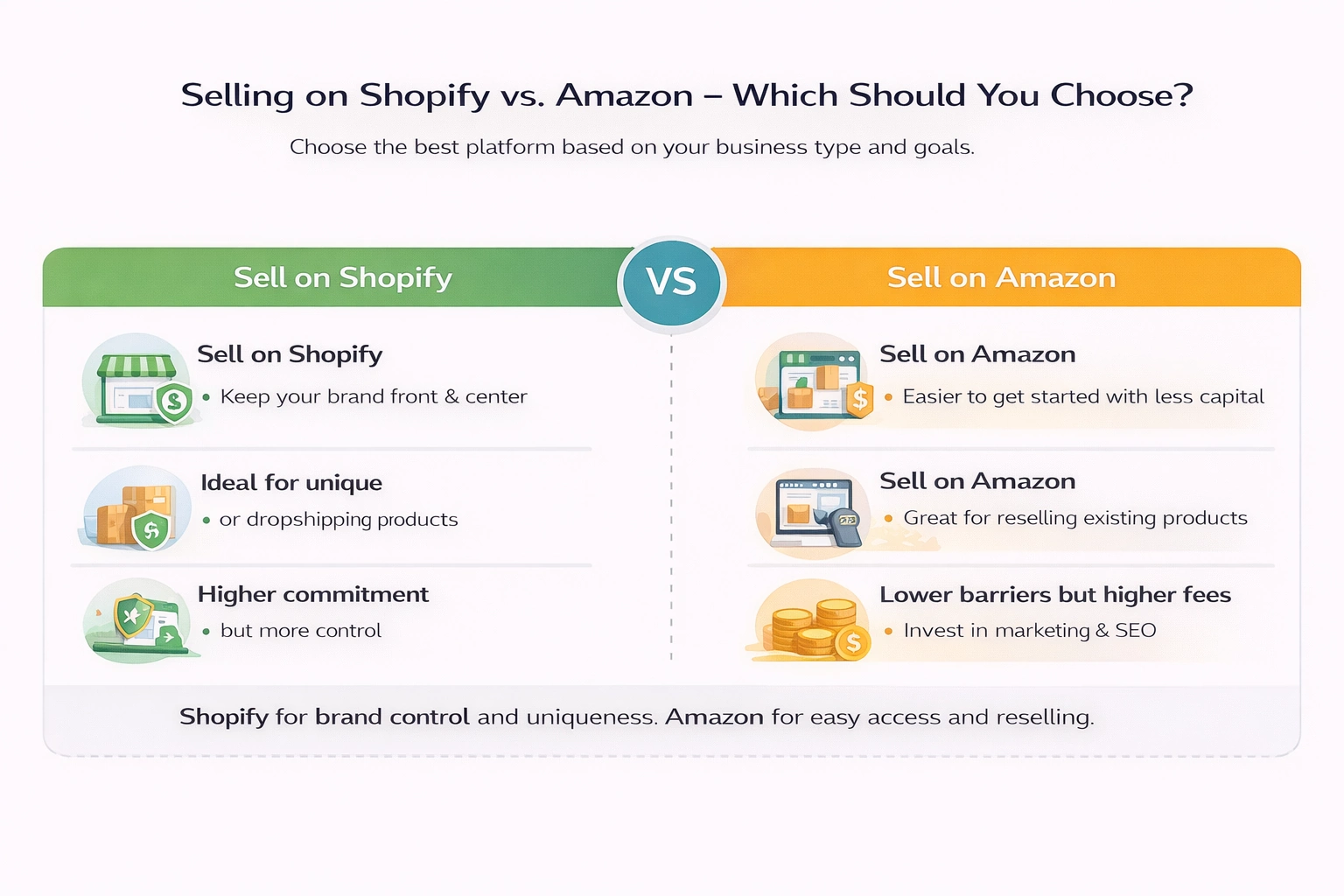
Selling on Shopify vs. Amazon – which should you choose?
All things considered, there’s no one correct answer to this question. It all depends on your business, priorities, and the amount of time and money you want to dedicate to it.
Amazon is generally a better option for people who source products from suppliers and then resell them at a profit. Since the platform most likely already has existing listings for your products, you will be able to start selling without spending a lot of time and money.
At the same time, if you create a unique product and want to keep your brand front and center, Shopify is a better option. People with dropshipping businesses also generally prefer Shopify over Amazon.
It’s also worth mentioning that Amazon has lower entry requirements, so it’s a better platform for beginners. If you don’t have any experience with online retail and want to try it out without investing a lot of capital, Amazon is a good option. That being said, even large corporations can benefit from having an Amazon presence, so it’s worth joining the platform even if your company is already successful.
The best course of action
As we’ve explained above, both Amazon and Shopify have a huge number of advantages for sellers. But, in the end, neither of the platforms is better or worse – they are just different. This is why we advise you to try both! In fact, this is a brilliant business decision since it will allow you to diversify your sales channels and reduce risks.
Sellers who use Amazon FBA and Shopify simultaneously can simplify their operations and minimize the amount of work they need to do by syncing their inventories on both websites and using Amazon FBA to ship their Shopify orders.
Hire an agency to grow your Amazon business
If you ultimately decide to start selling products on Amazon, you should consider hiring an agency to help manage and grow your business. Handling all Amazon operations in-house can be a huge pain, and it can easily prevent your business from realizing its full potential.
FAQ
Are Shopify and Amazon competitors?
Amazon and Shopify are not competitors per se. However, many new sellers decide between the two platforms when launching their online retail businesses.
Why should you use Shopify?
Shopify allows sellers to create online stores without the need to spend thousands of dollars on website development and support. Instead, you can quickly create a functioning Shopify store using their free or paid templates and plugins.
Is Amazon a Shopify?
No, Amazon and Shopify and two different services. Amazon is an online marketplace where people can sell products, while Shopify is an e-commerce platform that allows the seller to create their own stores.
 No credit card required