
 EN
EN  ES
ES  FR
FR  DE
DE  IT
IT  KO
KO  JA
JA  ZH
ZH  AR
AR  PT
PT  TR
TR PL
PL
Quick Summary: Amazon Flex can be worth it if you need flexible side income and have a fuel-efficient vehicle, but actual earnings after expenses typically range from $10-15 per hour rather than the advertised $18-25. Recent regulatory changes in 2026 and algorithmic wage issues make it less reliable than traditional employment, though it offers unmatched scheduling freedom for those who value flexibility over guaranteed income.
The gig economy promises freedom and extra cash on your terms. Amazon Flex markets itself as an opportunity to earn $18-25 per hour delivering packages whenever your schedule allows. Sounds perfect, right?
But here’s the thing—advertised rates rarely tell the whole story. Between vehicle expenses, unpredictable algorithms, and recent regulatory scrutiny, the actual financial picture looks quite different from what recruitment materials suggest.
So is Amazon Flex actually worth your time and vehicle wear in 2026? Let’s break down the real numbers, hidden costs, and regulatory complications that most drivers don’t discover until they’re already on the road.
What Amazon Flex Actually Involves
Amazon Flex operates as a delivery platform where independent contractors use their own vehicles to deliver Amazon packages. The setup is straightforward: download the app, pass a background check, and start claiming delivery blocks in your area.
Delivery blocks typically last 2-4 hours. The app shows available blocks with their pay rates, and drivers grab whichever shifts fit their schedule. Once claimed, drivers pick up packages from Amazon facilities and follow GPS routes to complete deliveries.
That’s where the simplicity ends. Block availability varies wildly by location and time. During peak seasons, blocks appear frequently. During slower periods, drivers refresh the app constantly hoping to grab shifts before other contractors snatch them up.
The app uses an algorithmic system to assign blocks and determine pay rates. According to Human Rights Watch’s 2025 report ‘The Gig Trap,’ platform companies including those in delivery services use algorithmic systems for worker management. This creates uncertainty that traditional employment doesn’t have.
The Advertised Pay Versus Actual Earnings
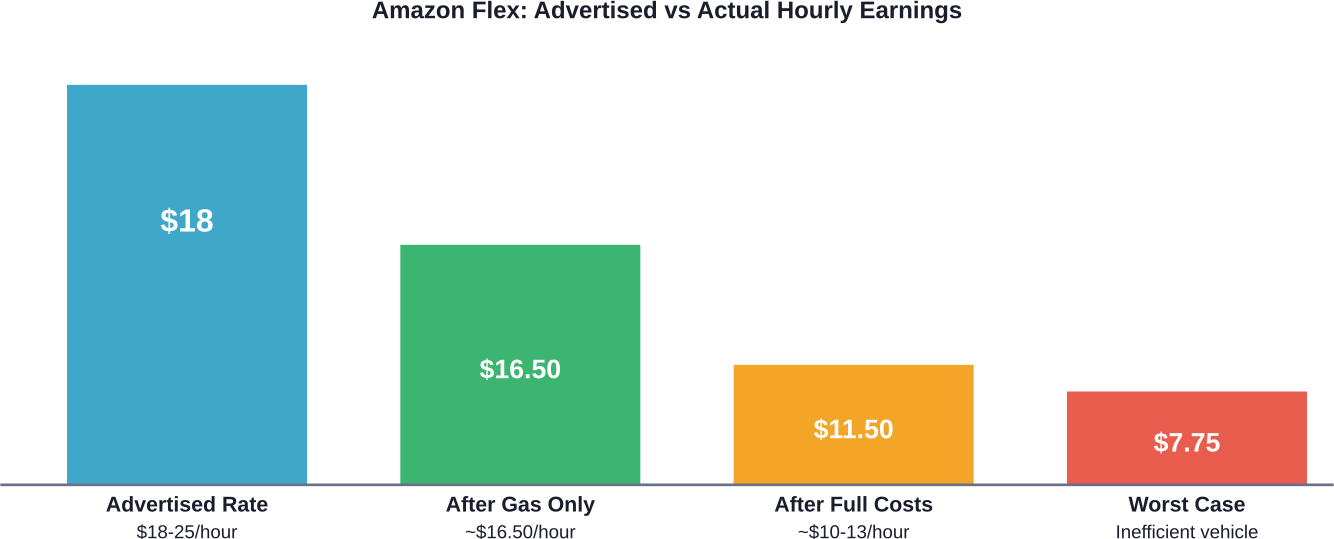
Amazon states that Flex drivers can earn $18-25 per hour. That number appears prominently in recruiting materials and app descriptions. But that’s gross pay before expenses—and expenses matter tremendously when using your own vehicle.
Here’s what a typical 4-hour block actually nets after costs:
| Item | Amount |
|---|---|
| Gross payment (4 hours at $18/hour) | $72.00 |
| Gas cost (50 miles at $3/gallon, 25 MPG) | -$6.00 |
| Vehicle depreciation and maintenance (IRS standard mileage rate $0.70 per mile) | -$35.00 |
| Net earnings | $31.00 |
| Actual hourly rate | $7.75/hour |
That calculation assumes average conditions. Real-world scenarios vary based on route density, vehicle fuel efficiency, and local gas prices. Drivers with efficient vehicles in densely-packed delivery areas fare better. Those with gas-guzzling SUVs covering rural routes see even lower effective wages.
The Federal Trade Commission has recently increased scrutiny on gig work earnings claims. In August 2025, the FTC sent more than $6.7 million to eligible people who worked for gig work company Arise for deceptive earnings claims. In February 2026, the FTC announced a settlement of a case against Walmart, Inc., resolving allegations that it misrepresented earnings for its Spark Driver service, resulting in a $100 million judgment.
This regulatory attention signals a broader problem: advertised gig work earnings often don’t reflect what workers actually take home.
Hidden Costs That Eat Into Earnings
Vehicle expenses represent the biggest hidden cost. Most new drivers underestimate how quickly delivery work degrades their car. Stop-and-go driving, frequent door openings, and heavy package loads accelerate wear beyond normal commuting.
The IRS standard mileage rate sits at $0.70 per mile. This rate attempts to capture all vehicle costs: fuel, maintenance, repairs, tire replacement, depreciation, and insurance. For a typical 50-mile delivery block, that’s $35 in true vehicle costs—nearly half the gross earnings.
But wait. Insurance presents another complication. Personal auto insurance doesn’t cover commercial delivery work. Some insurance companies drop drivers entirely if they discover Flex activity. Commercial policies cost significantly more, adding another expense layer many drivers ignore until a claim gets denied.
Then there’s phone expenses. Constant GPS navigation drains batteries and burns through data. Drivers often need phone mounts, chargers, and upgraded data plans. Small costs individually, but they accumulate.
According to Bureau of Labor Statistics data from May 2024, the median annual wage for driver/sales workers was $37,130—about $17.85 per hour. Traditional delivery employment includes benefits, workers’ compensation, and employer-covered vehicle expenses that independent contractors must shoulder themselves.
The Flexibility Advantage
So why does anyone drive for Amazon Flex? One word: flexibility.
Traditional employment requires fixed schedules. Amazon Flex lets drivers work only when they want. Need Tuesday and Thursday mornings free for classes? No problem. Want to work only weekends? That works too. This scheduling freedom appeals especially to students, parents with childcare constraints, and anyone juggling multiple income sources.
There’s no boss, no mandatory meetings, no requesting time off. If something comes up, drivers simply don’t claim blocks that day. This autonomy carries genuine value for people whose life circumstances make traditional employment difficult.
The low barrier to entry helps too. No special licenses required (unlike CDL driving jobs), minimal training, and quick approval processes mean drivers can start earning within days of applying. For someone facing immediate financial need, that speed matters.
The Downsides Most Recruiters Skip
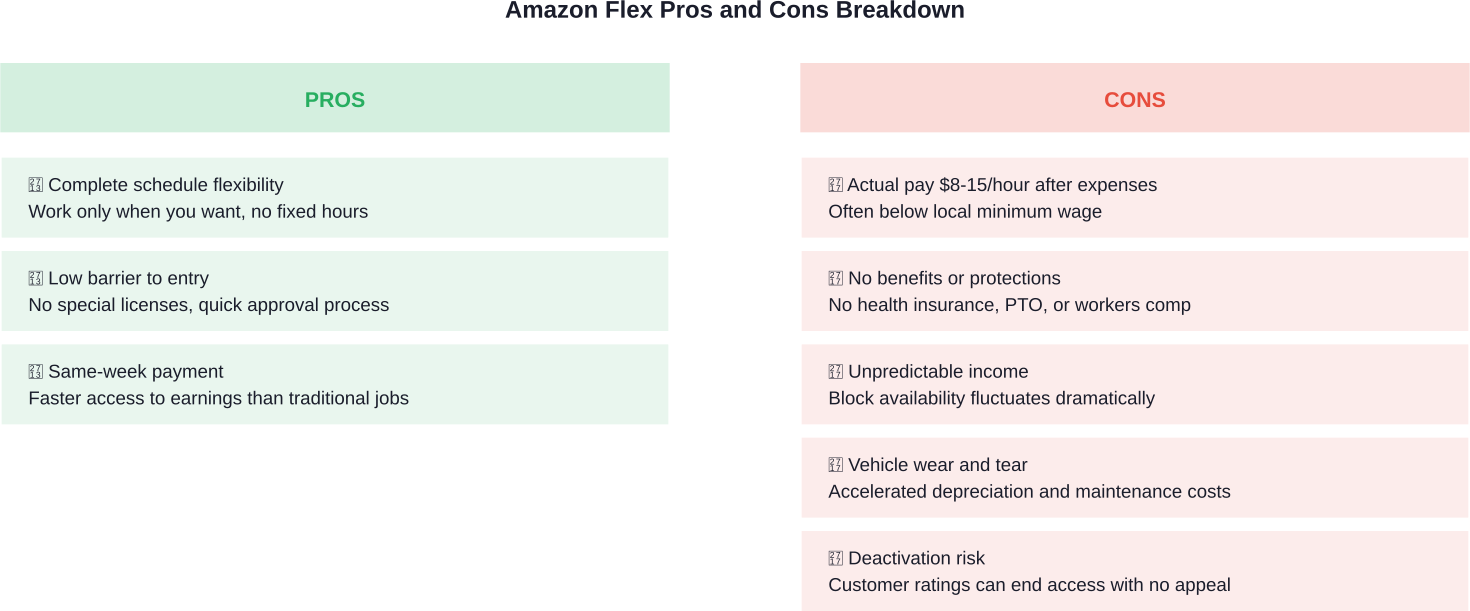
Block availability fluctuates unpredictably. During holidays and Prime Day events, blocks flood the app. During January and February? Drivers compete intensely for scarce shifts. This inconsistency makes budgeting and financial planning nearly impossible.
The algorithmic assignment system creates additional frustration. Community discussions reveal that Amazon’s system appears to favor new drivers with better block offers, potentially to hook them before reducing rates. Experienced drivers report seeing fewer high-paying blocks over time.
Package counts per block vary wildly. One 3-hour block might include 20 packages in a tight area. Another might assign 45 packages scattered across a 30-mile radius. Both pay the same, but the workload differs dramatically. Drivers have no control over which they get.
Delivery conditions present physical challenges. Apartment complexes without clear numbering, businesses with confusing loading docks, heavy packages to third-floor walkups, and aggressive dogs all come with the territory. Unlike warehouse jobs with safety protocols, delivery drivers face these situations alone.
Customer ratings affect standing. Too many negative reviews can lead to deactivation—the gig economy’s version of being fired. Yet drivers have limited ability to contest unfair ratings from customers who mark packages undelivered despite photo proof or complain about delivery times the driver didn’t control.
Regulatory Changes Creating Uncertainty
On February 26, 2026, the U.S. Department of Labor announced a Notice of Proposed Rulemaking (NPRM) addressing employee versus independent contractor classification under the Fair Labor Standards Act. This proposed rule would revise the standard for determining independent contractor status and, if finalized, would rescind the existing rule for evaluating worker classification.
Why does this matter for Amazon Flex? The classification determines whether drivers receive minimum wage protections, overtime pay, and other employment benefits. Currently classified as independent contractors, Flex drivers receive none of these protections.
The DOL’s proposal examines factors like economic dependence, skill and initiative, and permanence of working relationships. If regulations shift to classify more gig workers as employees, Amazon would face significant cost increases—potentially leading to reduced driver opportunities or operational changes.
According to the DOL’s guidance on misclassification, treating workers who should be classified as employees as independent contractors is a serious problem that deprives workers of critical protections. The agency has intensified enforcement around worker misclassification across gig platforms.
This regulatory uncertainty makes Amazon Flex’s long-term viability as a side income source less predictable than it was even two years ago.
How Amazon Flex Compares to Alternatives
The gig delivery market includes multiple platforms, each with distinct characteristics. How does Amazon Flex stack up?
| Platform | Advertised Pay | Flexibility | Key Differences |
|---|---|---|---|
| Amazon Flex | $18-25/hour | Block scheduling | Pre-scheduled blocks, predictable routes |
| DoorDash | Varies by order | Work anytime | Food delivery, smaller packages, more frequent tips |
| Uber Eats | Varies by order | Work anytime | Food delivery, can combine with rideshare |
| Instacart | $15-20/hour | Shift + on-demand | Grocery shopping involved, potential for tips |
| Traditional delivery job | $15-18/hour | Fixed schedule | Benefits included, vehicle provided or compensated |
Food delivery apps like DoorDash and Uber Eats offer true on-demand flexibility—drivers work without pre-scheduling. But earnings fluctuate even more dramatically based on order availability and customer tips. Human Rights Watch’s 2025 investigation found that these platforms also use algorithmic wage determination that can result in below minimum wage earnings.
Instacart adds shopping time to delivery work, which some drivers prefer for variety and others find tedious. Tips tend to be higher for grocery delivery than package delivery.
Traditional delivery jobs with companies like FedEx or UPS pay less per hour but include health insurance, retirement contributions, paid time off, and vehicle provisions. For drivers needing consistent income and benefits, traditional employment often provides better total compensation despite lower hourly rates.
Real Driver Experiences
Community discussions about Amazon Flex reveal mixed experiences. Some drivers report positive experiences during their first few months, particularly those in dense urban areas with fuel-efficient vehicles. These drivers appreciate the flexibility and find the work straightforward.
But longer-term drivers frequently report declining block availability and pay rates. Multiple drivers mention that after an initial “honeymoon period” of readily available high-paying blocks, opportunities become scarcer and rates drop.
Geographic location dramatically affects the experience. Drivers in major metropolitan areas with multiple Amazon facilities generally report better block availability than those in smaller markets with one facility. Rural drivers face longer distances between stops, reducing effective hourly earnings.
Vehicle type matters tremendously. Drivers with hybrid vehicles or efficient sedans report much better net earnings than those using SUVs or older vehicles with poor fuel economy. Several drivers mentioned regretting starting Flex with gas-guzzling vehicles after calculating true costs.
Seasonal variation creates feast-or-famine dynamics. November through December offers abundant blocks at elevated rates. January through March sees dramatic dropoffs that catch unprepared drivers financially off-guard.
Who Might Find Amazon Flex Worthwhile
Despite the drawbacks, Amazon Flex works well for specific situations. Students with daytime availability and efficient cars can supplement income between classes. Parents with school-hour constraints but free mornings or afternoons find the flexibility valuable. Retirees looking to stay active with supplemental income appreciate the low-commitment structure.
Amazon Flex makes the most sense as supplemental income rather than primary employment. Someone with stable primary income using Flex for occasional extra cash faces different risk calculus than someone depending on it for rent money.
Location matters critically. Dense urban and suburban areas with multiple delivery routes per square mile offer better earnings potential than spread-out rural territories. Before committing, drivers should research how many Amazon facilities operate in their area and what typical delivery zones look like.
Vehicle efficiency acts as a profitability multiplier. Running the numbers with actual vehicle costs (not just gas) provides crucial clarity. A driver earning $20/hour gross in a 40 MPG vehicle nets far more than one earning $22/hour in a 15 MPG SUV.

Move from Delivering Packages to Building an Amazon Brand
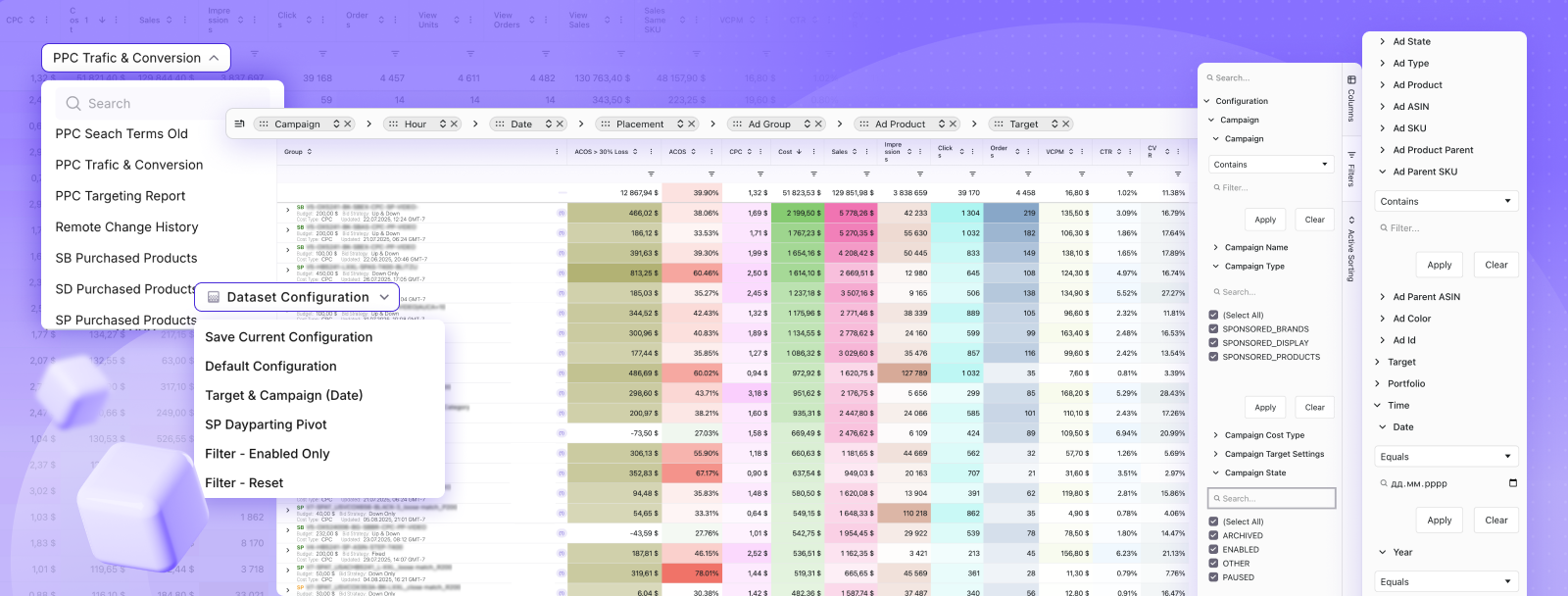
While Amazon Flex provides a way to earn hourly pay, the most significant revenue on the platform comes from owning and scaling a brand. Transitioning from a gig worker to a professional seller requires a shift toward managing advertising data and account metrics. WisePPC provides specialized Amazon account management and PPC services, helping sellers automate the technical side of the marketplace to build a scalable business.
- Managed Advertising: Data-driven PPC strategies to maximize ROI and lower customer acquisition costs.
- Operational Oversight: Full management of product listings and account health to ensure platform compliance.
- Growth Planning: Strategic scaling of your inventory and sales to move beyond manual labor into brand ownership.
- Performance Analytics: Detailed reporting on profit margins and advertising efficiency to guide business decisions.
Scale your Amazon business with WisePPC.
The Bottom Line on Amazon Flex
So is Amazon Flex worth it? That depends entirely on individual circumstances and expectations.
For someone who values flexibility above all else, has a fuel-efficient vehicle, lives in a market with good block availability, and needs supplemental rather than primary income—Amazon Flex can work reasonably well. The ability to work on your own schedule carries real value that’s difficult to find elsewhere.
But for someone needing reliable income, consistent hours, employment benefits, or who drives an inefficient vehicle in a sparse delivery area—Amazon Flex likely disappoints. The gap between advertised earnings and actual take-home pay after expenses creates frustration for drivers who don’t calculate true costs upfront.
The regulatory environment adds another layer of uncertainty. Proposed DOL rule changes could fundamentally alter how gig platforms operate, potentially improving conditions for workers or reducing available opportunities depending on how companies respond.
Before signing up, run realistic calculations using your specific vehicle’s costs and local gas prices. Research your market’s typical block availability through driver forums. Consider Amazon Flex as one option among several rather than the only path to flexible income.
Most importantly, treat it as supplemental income unless you have substantial financial cushion. The inconsistency and uncertainty make it poorly suited as a sole income source for most people.
Frequently Asked Questions
How much do Amazon Flex drivers really make per hour?
Amazon advertises $18–25 per hour, but after expenses like fuel, maintenance, and depreciation, most drivers net around $10–15 per hour. Earnings vary by location, vehicle efficiency, and delivery density.
Do I need special insurance for Amazon Flex?
Yes, personal auto insurance often doesn’t cover delivery work. Drivers typically need commercial insurance or a delivery rider, which increases overall costs.
Can I make a full-time living with Amazon Flex?
It’s possible but challenging. Block availability fluctuates, and the lack of benefits and income stability makes it less reliable than traditional full-time jobs.
How does Amazon Flex compare to DoorDash or Uber Eats?
Amazon Flex uses scheduled delivery blocks, while DoorDash and Uber Eats offer on-demand work. Earnings are similar overall, but flexibility and consistency vary by platform and market.
What are the main hidden costs of Amazon Flex?
Major hidden costs include vehicle depreciation, increased insurance, phone expenses, and self-employment taxes. These can significantly reduce take-home pay.
Can Amazon deactivate me from Flex and why?
Yes, drivers can be deactivated for low ratings, missed blocks, late deliveries, or handling issues. Appeals are limited and reactivation can be difficult.
What’s changing with gig worker regulations in 2026?
Proposed U.S. Department of Labor rules may change worker classification. If drivers are reclassified as employees, they could gain benefits but platforms may adjust opportunities.
 No credit card required