
 EN
EN  ES
ES  FR
FR  DE
DE  IT
IT  KO
KO  JA
JA  ZH
ZH  AR
AR  PT
PT  TR
TR PL
PL
Quick Summary: Amazon mystery boxes are available through liquidation companies like B-Stock, BULQ, and GRP Liquidations, which sell Amazon returns, overstock, and undeliverable items in bulk at 5-20% of retail value. Prices range from $44.99 to $699 depending on box size and contents, but buyers should expect mixed quality with both valuable finds and unusable items.
The excitement of unboxing something completely unexpected has turned Amazon mystery boxes into a viral sensation. Scroll through TikTok for five minutes and someone’s opening a pallet they bought for $85, pulling out what looks like a $400 drone.
But here’s the thing—most of those videos don’t tell the full story.
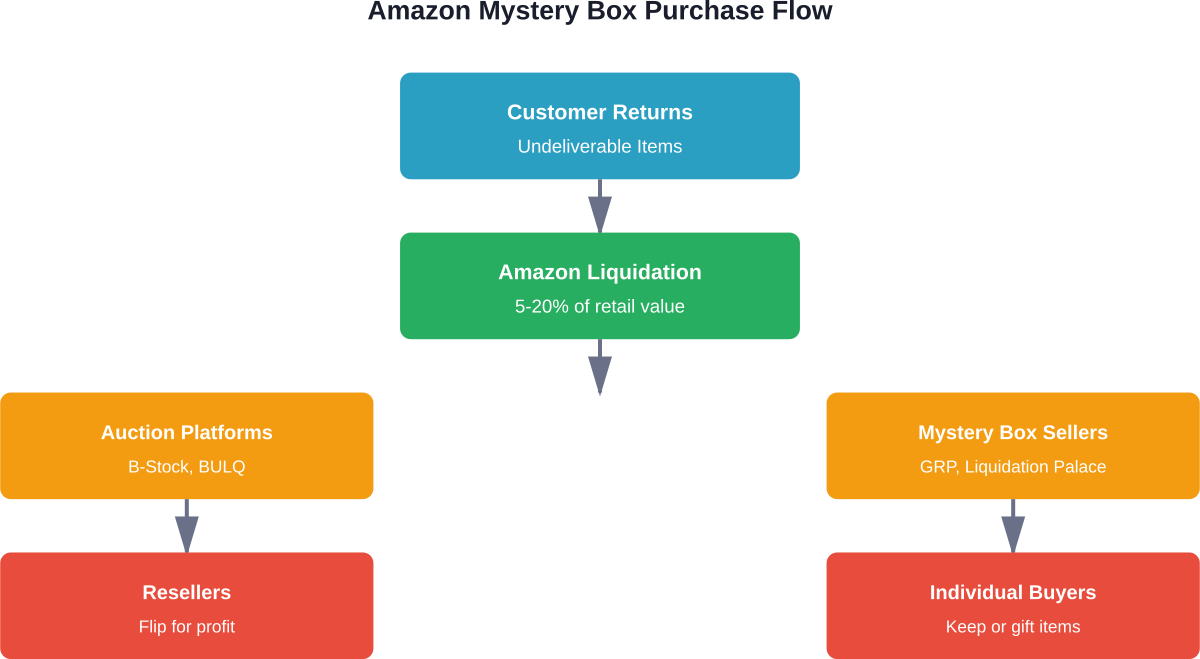
Amazon mystery boxes aren’t sold by Amazon directly. They’re liquidation inventory: customer returns, undeliverable shipments, overstock, and abandoned goods that Amazon offloads through authorized partners. These companies repackage the items into mystery boxes and sell them at steep discounts.
The real question isn’t whether these boxes exist. It’s where to actually buy them without getting scammed, and what to realistically expect when that package arrives.
What Actually Goes Into Amazon Mystery Boxes
Amazon processes billions of dollars in returns annually. When customers send items back, Amazon doesn’t always restock them. Some products get damaged in transit, others have missing parts, and some are simply unwanted goods that can’t be verified as new.
These products enter Amazon’s liquidation pipeline, where they’re sold in bulk at 5-20% of the original retail price through authorized partners. The contents typically include:
- Customer returns that may be opened, used, or missing accessories
- Undeliverable shipments that never reached the customer’s door
- Overstock inventory from seasonal sales or discontinued lines
- Abandoned warehouse goods from closed seller accounts
Quality varies wildly across mystery boxes. One buyer might receive working electronics worth several hundred dollars. Another gets a box of random cables, damaged goods, and items nobody wants.
The Federal Trade Commission warns consumers about mystery shopping scams, noting that fraudulent sellers use the excitement of surprise deals to offload worthless merchandise. Real talk: not every mystery box seller operates with the same integrity.
Legitimate Places to Buy Amazon Mystery Boxes
Several companies specialize in Amazon liquidation, but verification matters. Here’s where experienced resellers actually source their inventory.
B-Stock Supply
B-Stock operates the most direct route to Amazon inventory. They run official liquidation auctions for Amazon and other major retailers, selling return pallets through a bidding system.
Minimum bids typically start around $100-$500 depending on the manifest. The auction format means pricing fluctuates based on demand, and experienced buyers often drive up competitive lots.
B-Stock provides detailed manifests showing estimated retail value and general condition ratings. That transparency comes at a cost—popular categories get bid up quickly.
BULQ
BULQ offers smaller lot sizes starting at $100-$250, making it more accessible for first-time buyers or those testing the waters. They provide case-level buying rather than full pallets.
The platform lists general categories (electronics, home goods, toys) with estimated retail values. Shipping costs add up quickly though, sometimes adding $50-$100 to the total.
Customer service responsiveness and content consistency vary across mystery box sellers.
GRP Liquidations
GRP Liquidations sells pre-packed Amazon mystery boxes starting at $69.99. Based on Better Business Bureau reviews from March 2026, customer experiences vary significantly.
One reviewer purchased an unopened mail mystery box and reported disappointment with the contents. Another mentioned a “coffin box” priced at $199 plus shipping that contained mostly unusable merchandise.
GRP Liquidations maintains an A+ BBB rating and responds to complaints, but as they acknowledge in responses, mystery boxes carry inherent risk. The company doesn’t repack items—they ship what they receive from Amazon’s liquidation channels.
| Seller | Starting Price | Box Type | Best For |
|---|---|---|---|
| B-Stock | $100-$500 | Auction pallets | Experienced resellers |
| BULQ | $100-$250 | Case lots | First-time buyers |
| GRP Liquidations | $69.99 | Pre-packed boxes | Small-scale testing |
| Liquidation Palace | $699 | Electronics focus | Niche resellers |
Liquidation Palace
Liquidation Palace targets electronics sellers with boxes starting at $699. The higher price point reflects their focus on consumer electronics and gadgets.
According to their marketing, boxes contain gizmos and gadgets that resellers can flip for profit. But that premium pricing means less room for error—if the box contains mostly low-value items, recovery becomes difficult.
Direct Liquidation Platforms
Several other platforms connect buyers with Amazon liquidation inventory. These include wholesale lots, return pallets, and mixed manifests.
Most require business credentials or resale licenses. They’re designed for professional resellers, not casual buyers looking for a fun unboxing experience.
Price Ranges and What to Expect
Mystery box pricing varies based on size, category focus, and the seller’s business model. Here’s what the market looks like as of early 2026.
Small mystery boxes from GRP Liquidations start at $44.99, including returned mail mystery boxes. These compact boxes contain random products that couldn’t be delivered, ranging from small gadgets to household items.
Standard Amazon mystery boxes typically run $69.99-$100. These boxes weigh around 20 pounds with dimensions of roughly 22×18×15 inches. Contents include a mix of returned and overstock items across various categories.
Premium electronics-focused boxes from Liquidation Palace start at $699. The higher investment targets serious resellers who understand electronics markets and can properly test and photograph items for resale.
Individual items in unboxing videos have reportedly ranged from £10 to £50+ in retail value. Some buyers report pulling items worth triple their investment. Others receive boxes where half the contents are unusable or unsellable.
The math matters. Spending $70 on a box containing $200 of retail value sounds great—until those items are customer returns with missing parts, cosmetic damage, or functionality issues that tank resale value to $40.
Red Flags and Scams to Avoid
The mystery box market attracts both legitimate liquidation companies and outright scammers. Knowing the difference protects both money and time.
Social Media Advertisements
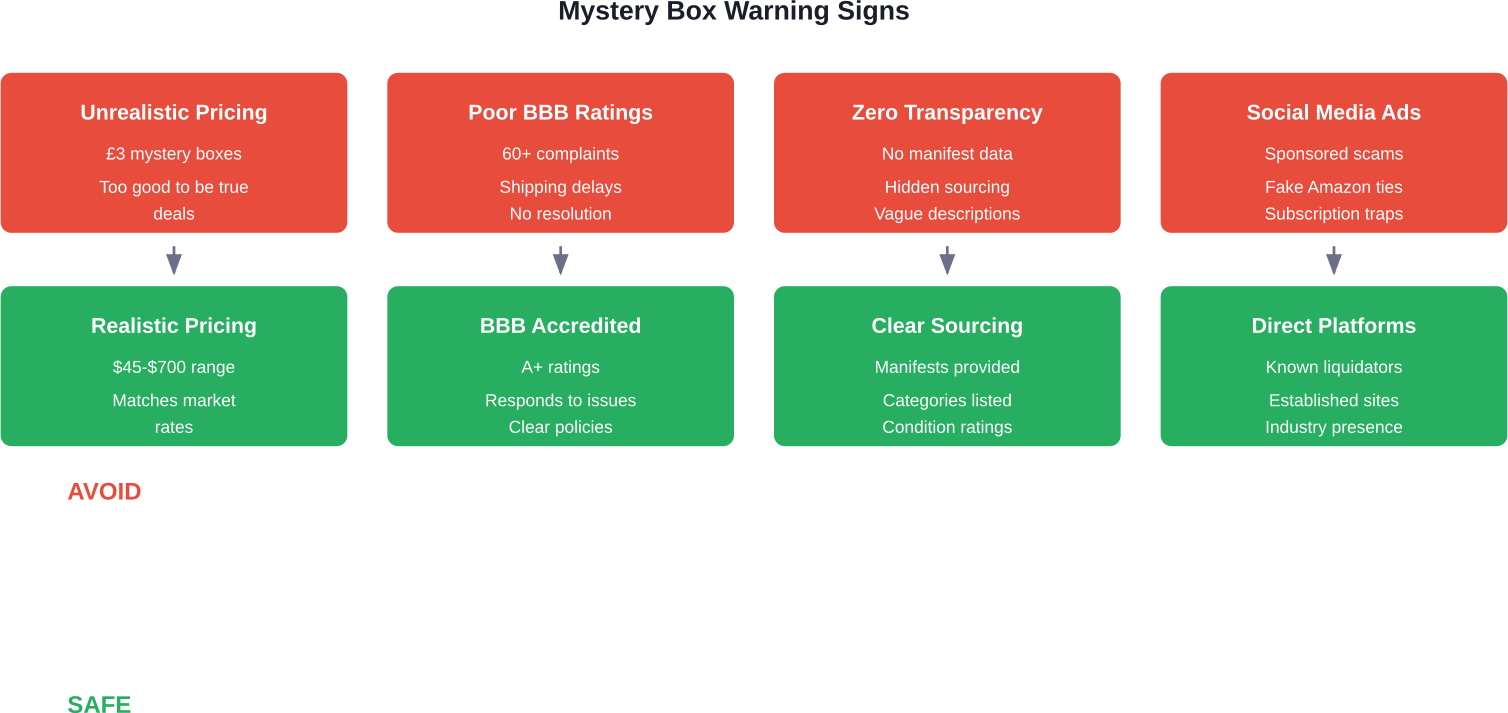
According to Trustpilot reviews from March 2026, sponsored ads claiming “Amazon £3 mystery boxes” are often scams. One reviewer warned that clicking these ads signs users up for unrelated subscription services or redirects to companies with no connection to Amazon.
Real liquidation inventory doesn’t sell for £3. When the price seems impossibly low, it usually is.
Unclaimed Mystery Box Companies
Better Business Bureau data shows significant complaints against some mystery box sellers. Discount Headquarters shows 62 total complaints in the last 3 years, with 13 closed in the last 12 months.
Nurse Deals LLC shows 81 total complaints with 44 complaints closed in the last 12 months. Customer complaints detail months-long shipping delays, with one buyer waiting since May 2025 for an order that still hasn’t shipped despite spending $223.48.
Paradise Delivered received complaints about stolen packages and poor customer service responses. One customer reported the company accused them of lying about a missing delivery rather than helping resolve the issue.
No Manifest or Transparency
Legitimate liquidation sellers provide some level of transparency—general categories, estimated retail values, or condition ratings. Complete mystery with zero information often signals problems.
If a seller can’t or won’t explain their sourcing, shipping timelines, or general contents, that’s a warning sign.
Who Actually Profits from Mystery Boxes
The viral unboxing videos create an illusion that anyone can profit from mystery boxes. Reality looks different.
Professional resellers approach liquidation inventory as a sourcing channel, not a lottery ticket. They understand pricing, can accurately grade conditions, know which platforms move specific items, and factor in all costs including shipping, storage, and listing time.
Someone buying their first mystery box as a casual experiment rarely has those advantages. Without knowing how to price items competitively, where to sell different categories, or how to handle returns and customer questions, profit margins disappear quickly.
Experienced mystery box buyers typically follow specific patterns. They specialize in categories they understand, buy in volume to average out duds, have established sales channels already running, and treat bad boxes as cost of doing business rather than personal failures.
For gift-givers or bargain hunters keeping items for personal use, the calculation changes entirely. A box containing $150 of retail value items for $70 delivers value if those items are actually wanted or usable. But a box full of random products nobody needs wastes $70 regardless of theoretical retail value.
Alternative Approaches to Amazon Liquidation
Mystery boxes represent just one slice of the liquidation market. Several alternatives offer more control and potentially better returns.
Manifested Pallets
B-Stock and similar platforms sell pallets with detailed manifests listing every item, condition, and original retail price. This transparency eliminates most of the mystery and allows informed buying decisions.
The tradeoff comes in higher minimum investments and increased competition from professional buyers who drive auction prices up.
Category-Specific Lots
Some liquidation platforms let buyers filter by category—electronics only, home goods only, toys only. Focusing on familiar categories reduces risk since expertise helps identify value and spot problems.
Amazon Warehouse Deals
Amazon sells customer returns and open-box items directly through Amazon Warehouse. These items come with product-specific photos showing actual condition, detailed descriptions of issues, and standard Amazon return policies.
The discounts aren’t as steep as liquidation boxes, but the transparency and buyer protection significantly reduce risk.
Making an Informed First Purchase
For those determined to try Amazon mystery boxes despite the risks, certain approaches minimize potential losses:
- Start small: A $45-$70 box limits exposure while providing firsthand experience with how these operations actually work. Losing $70 stings less than losing $700.
- Research the specific seller: Check Better Business Bureau complaints, search for Trustpilot reviews, and look for Reddit threads discussing that company. Recent feedback matters more than old reviews—business practices change.
- Understand shipping timelines: Some mystery box companies experience significant shipping delays spanning months, according to Better Business Bureau complaints. If buying for a specific occasion or deadline, factor in realistic delivery windows plus buffer time.
- Set realistic expectations: The median outcome isn’t a box full of valuable electronics. It’s a mix of random items where some have resale value, some are useful for personal keeping, and some go straight to donation or trash.
- Have a plan for unwanted items: Without sales channels already established, moving random liquidation goods takes significant time and effort. Donation is often the most practical disposal method for low-value items.
| Consideration | Mystery Boxes | Manifested Pallets | Amazon Warehouse |
|---|---|---|---|
| Transparency | None to minimal | Full item lists | Product-specific photos |
| Starting Price | $45-$700 | $100-$500+ | Varies by item |
| Risk Level | High | Medium | Low |
| Best For | Thrill-seekers | Experienced resellers | Personal use buyers |
| Return Policy | Usually none | Usually none | Standard Amazon returns |
Common Misconceptions About Mystery Boxes
Several persistent myths circulate about Amazon mystery boxes, often perpetuated by viral videos that show only the best outcomes:
- Myth one: Amazon sells these boxes directly. Amazon doesn’t sell mystery boxes through their main retail site. These products come from liquidation partners who purchase bulk inventory from Amazon’s return and overstock channels.
- Myth two: Every box contains hidden treasures. Confirmation bias makes great unboxings go viral while disappointing ones get ignored. Most boxes contain exactly what the pricing suggests—heavily discounted merchandise with proportionate quality issues.
- Myth three: It’s easy passive income. Turning liquidation inventory into profit requires active work: testing items, researching pricing, photographing products, writing listings, handling customer service, and managing logistics. That’s not passive.
- Myth four: The retail value listed equals actual value. A “$400 retail value” claim means nothing when items are customer returns with unknown functionality, missing parts, or obsolete technology nobody wants.

If You Plan To Resell, Don’t Ignore The Data Side
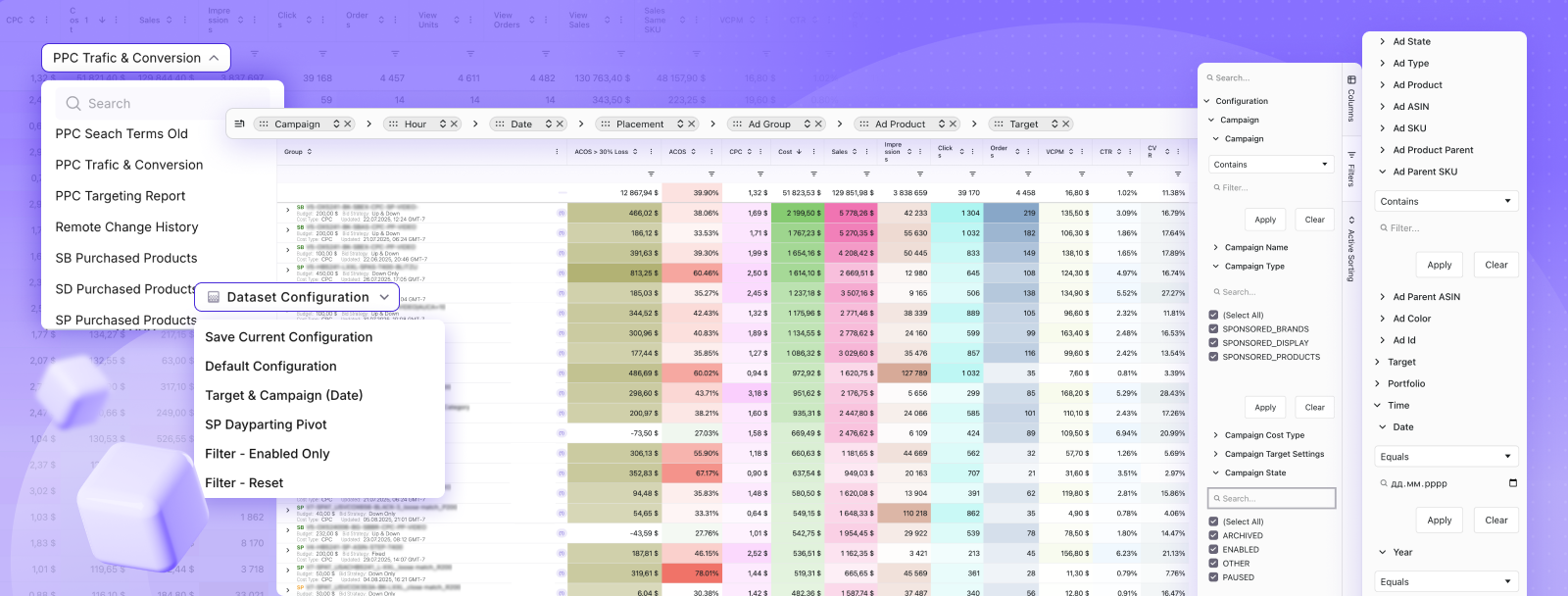
Buying Amazon mystery boxes is one thing. Figuring out how to actually sell those products consistently is another. Once listings are up and ads start running, it’s easy to lose track of what’s driving results and what’s just spending money. WisePPC focuses on that part of the process.
It connects your Amazon ads data with sales performance so you can see how campaigns impact actual outcomes, not just clicks. Instead of switching between reports, you get a single view of spend, conversions, and trends over time, plus tools to adjust bids and budgets without extra steps. It’s not about finding products or sourcing inventory. It’s about understanding what happens after – when you start promoting and scaling what you sell.
Explore and sign up for WisePPC to get a clearer view of your Amazon ads and sales performance.
Frequently Asked Questions
Are Amazon mystery boxes legal to resell?
Yes, items purchased through legitimate liquidation channels can be resold. However, sellers must follow local regulations and disclose item conditions honestly.
What’s the average profit margin on mystery boxes?
Typical net profit margins range from 10–30%, though results vary widely depending on experience and item quality.
How long does shipping take for mystery boxes?
Shipping times vary by seller, ranging from a few days to several weeks. Always check the seller’s policy and reviews.
Can I return a mystery box if I don’t like the contents?
Usually no. Most sellers do not accept returns based on dissatisfaction with contents, only for major errors or damage.
What categories have the best resale value?
Electronics, branded clothing, toys, and small appliances tend to perform best, though risk and demand vary.
Are UK mystery boxes different from US ones?
The concept is the same, but sourcing, pricing, and sellers differ by region.
Do I need a business license to buy mystery boxes?
No for personal use, but reselling may require a business license or tax registration depending on local laws.
The Bottom Line on Mystery Box Purchases
Amazon mystery boxes exist in the murky space between genuine liquidation opportunities and gamified speculation. For professional resellers with established infrastructure, they represent one potential inventory source among many. For casual buyers, they’re essentially a gamble with entertainment value.
The legitimate sellers are out there—B-Stock for auction pallets, BULQ for smaller lots, GRP Liquidations for pre-packed boxes. But legitimacy doesn’t guarantee value. Even honest sellers can’t control what’s in Amazon’s liquidation pipeline.
Those social media videos showing someone pulling a MacBook from a $50 box? They’re the exception, not the rule. The median outcome involves random items with mixed condition, uncertain resale value, and significant effort required to recoup the purchase price.
Before buying any mystery box, ask one question: Am I buying this for entertainment value and thrill, or genuinely expecting profit? If the answer is entertainment and the price seems reasonable for that experience, go ahead with eyes open. If expecting reliable profit without established resale infrastructure, reconsider the investment.
The mystery box market will continue thriving as long as people love surprises and chase the possibility of striking gold. Just remember—Amazon’s liquidation partners are running profitable businesses by selling these boxes. That profit has to come from somewhere, and it’s usually the difference between what buyers hope is inside and what actually arrives.
Want to explore Amazon liquidation without the mystery element? Check manifested pallet auctions on B-Stock or browse Amazon Warehouse Deals for transparent condition descriptions and actual product photos. Sometimes the best surprise is knowing exactly what’s coming.
 No credit card required