
 EN
EN  ES
ES  FR
FR  DE
DE  IT
IT  KO
KO  JA
JA  ZH
ZH  AR
AR  PT
PT  TR
TR PL
PL
Amazon doesn’t just sell things – it moves them. And over the past few years, it’s quietly built one of the most powerful logistics networks in the world. If you’ve ever tracked a package labeled “AMZL” and wondered what’s behind it, you’re not alone. Amazon Logistics is changing how deliveries work, not just for Prime members, but for sellers, drivers, and even FedEx and UPS.
In this article, we’ll break down what Amazon Logistics actually is, how it works behind the scenes, why it’s not always smooth sailing for third-party sellers, and what makes it different from the big-name carriers. Whether you’re managing an Amazon store or just curious about how that same-day delivery showed up at your door, this is where it all starts to make sense.
Why Amazon Built Its Own Delivery System in the First Place
For years, Amazon relied on UPS, FedEx, and USPS to handle the final leg of delivery – what’s often called the “last mile.” But here’s the problem: that last mile is messy. It’s expensive, inconsistent, and most importantly, outside of Amazon’s control.
And Amazon hates giving up control, especially when it comes to customer experience.
When a shopper clicks “Buy Now,” Amazon doesn’t want to gamble on whether a third-party carrier will deliver the package on time, damage the box, or drop it over the fence. So instead of playing middleman, Amazon slowly started building its own delivery machine.
It started small – just a pilot program in several cities. But since then, Amazon Logistics has grown into a full-blown global operation, handling billions of packages every year.
What Is Amazon Logistics, Exactly?
Amazon Logistics (often seen in tracking info as AMZL) is Amazon’s internal delivery network. It works alongside – and increasingly in place of – carriers like FedEx and USPS to deliver packages directly to customers. Unlike traditional logistics companies, Amazon doesn’t just move boxes from point A to B. It controls the entire pipeline, from warehouse inventory to doorstep delivery.
Here’s what that looks like in action:
- Amazon stores inventory close to major customer hubs using data-driven demand forecasting.
- Orders are packed and shipped from nearby fulfillment centers or sortation facilities.
- Last-mile delivery is handled by independent contractors (Amazon Flex) or Delivery Service Partners (DSPs).
This model gives Amazon way more flexibility. It can deliver on Sundays. It can promise 2-hour windows. It can reroute deliveries in real time. And it doesn’t need to negotiate with legacy carriers to do any of it.

How Delivery Actually Happens: The Key Players
There’s no single type of Amazon Logistics driver. Instead, Amazon uses two main programs to scale its delivery workforce:
1. Delivery Service Partners (DSPs)
These are small businesses that operate fleets of Amazon-branded vans. DSPs handle daily deliveries and manage teams of full-time drivers. Think of them as Amazon’s outsourced delivery teams – separate companies but tightly integrated with Amazon systems.
Requirements for becoming a DSP include:
- Around $10K startup investment.
- Managing up to 40 vans and 100 employees.
- Meeting Amazon’s strict delivery targets and safety standards.
Amazon projects these partners can make between $75K and $300K per year in profit, depending on size and performance.
2. Amazon Flex
If DSPs are Amazon’s equivalent of FedEx Ground, Flex is more like Uber Eats for packages. Flex drivers use their own vehicles, choose shifts through the Amazon Flex app, and get paid per block of time worked. It’s a gig economy model that fills in delivery gaps, especially during peak times or in urban zones.
There are also experiments with bike couriers, walkers, and even drones, but for now, DSPs and Flex make up the backbone of Amazon Logistics.
Amazon’s Tech-Heavy Edge
What makes Amazon Logistics different isn’t just scale. It’s the way the company leans on technology at every stage.
Here are a few standout features baked into its logistics system:
- Real-time driver tracking: Customers can see exactly where their driver is, how many stops away, and when their package is likely to arrive.
- Smart routing: Drivers get routes optimized based on traffic, location density, and delivery urgency.
- On-the-spot editing: Fulfillment teams can adjust inventory or shipping preferences without switching tools.
- Placement-level analytics: Amazon tracks performance not just at the campaign level, but all the way down to individual delivery routes and stops, and this data informs inventory positioning and delivery speed.
And it doesn’t stop there. Amazon is testing:
- AI-based route and pricing adjustments for deliveries.
- Drone drop-offs via parachute.
- Voice-assisted ordering and fulfillment through Alexa.
- Electric delivery vans and reduced packaging waste.
In other words, it’s not just about shipping packages. It’s about reimagining delivery altogether.
Why Sellers Should Pay Attention (Even If They Don’t Use It Directly)
If you’re an Amazon seller using FBA (Fulfillment by Amazon), you’re already part of this system. But even sellers using FBM (Fulfilled by Merchant) are affected by how Amazon Logistics performs.
Here’s why:
- Seller Feedback Risks: When deliveries go wrong – damaged boxes, missed deadlines, wrong addresses – it can affect your seller feedback, even if it wasn’t your fault.
- No Choice in Carrier: Amazon decides which carrier to use. You can’t opt out of Amazon Logistics if they assign it to your order.
- Mixed Buyer Experience: Some customers love fast AMZL deliveries. Others complain about inconsistent service, lost packages, or poor communication from Flex drivers.
- Impact on Buy Box: Negative feedback caused by delivery issues can hurt your Buy Box chances, which affects visibility and conversions.
Bottom line: Amazon Logistics is powerful, but it’s not perfect. And sellers should be aware of how it affects customer satisfaction, even behind the scenes.
The Tradeoffs: Pros and Cons of Amazon Logistics
Like any system, there are upsides and downsides. Here’s a quick breakdown of both:
Pros:
- Fast, often same-day or next-day delivery.
- Expanded delivery hours, including weekends and evenings.
- Real-time tracking and flexible rescheduling for customers.
- Integration with Amazon’s inventory and advertising systems.
- Opportunities for entrepreneurs through DSP and Flex.
Cons:
- Inconsistent service depending on third-party drivers.
- No way for sellers to choose a different carrier.
- Delivery mistakes can reflect poorly on sellers.
- Not all areas are covered equally, especially rural zones.
- Sellers have little visibility or recourse when problems occur.
For most Prime shoppers, the system feels like magic. For sellers, it’s a bit more complicated.
The Bigger Picture: Where Amazon Logistics Is Headed
Amazon’s logistics ambitions go beyond just handling its own deliveries. In the long run, the company is positioning itself to compete directly with FedEx, UPS, and regional carriers.
And it’s already started.
- By 2019, Amazon was delivering nearly half of its own packages in the US.
- In 2020 and 2021, that number jumped closer to 70%.
- Amazon is now quietly offering logistics services to non-Amazon sellers.
- Projections suggest Amazon could reach 25-28% of the total US small-parcel market by 2023.
This means that one day, you might order from a brand’s own website, and the package still shows up via AMZL, delivered by an Amazon Flex driver.
They’re not just building a system for themselves. They’re building the future of last-mile delivery.
What This Means for Retail, E-commerce, and You
Amazon Logistics isn’t just a shipping solution. It’s a competitive advantage. And it’s forcing everyone, from small Shopify sellers to major carriers, to raise the bar.
What Amazon Logistics Means for Sellers
If you’re selling on Amazon – or any marketplace, really – logistics isn’t just something that happens in the background anymore. It’s now a front-and-center part of how your business is judged. Customers expect their orders to arrive fast. Not two weeks fast. More like tomorrow. In some cases, tonight.
That shift means sellers can’t afford to think of shipping as a separate, operational problem. It’s part of the brand now. If your product arrives late or damaged, even if it’s Amazon’s logistics arm that fumbled it, your seller feedback takes the hit. That affects your visibility, your conversions, and your chances at winning the Buy Box.
Bottom line: you’re playing on Amazon’s turf, with Amazon’s rules, and that includes how your products show up on someone’s porch.
What It Feels Like for Shoppers
From the customer side, Amazon Logistics has mostly raised the bar. Deliveries are quicker. Tracking is better. Some shoppers can literally watch their driver move through the neighborhood on a live map. It’s borderline sci-fi, until it isn’t.
Because when it works, it’s seamless. But when it fails – a missing package, a confusing handoff, a delivery left in the rain – frustration tends to rise fast. People don’t always distinguish between the seller and the delivery driver. So even though Amazon Logistics is technically responsible, the customer experience still traces back to the seller’s name.
The standard has shifted. Shoppers expect fast and flawless. Anything less feels like a letdown.
What It Signals for the Industry
At a bigger-picture level, Amazon’s push into logistics is shaking up the entire delivery industry. Carriers like FedEx, UPS, and USPS aren’t just watching from the sidelines – they’re being forced to rethink how they operate. Amazon’s ability to handle weekend deliveries, track packages in real time, and tap into gig drivers on demand is setting new expectations across the board.
It’s also changing who gets to participate. Gig workers now have a new kind of job opportunity – delivering packages instead of food – but with that comes a whole new set of challenges, from fluctuating pay to algorithm-driven schedules.
What’s clear is this: the way goods move is shifting. And whether you’re a seller, a shopper, or a legacy logistics company, Amazon Logistics is now a force you can’t ignore.

WisePPC: Taking Control of Performance in an Amazon Logistics World
As Amazon continues to expand its logistics footprint, sellers are gaining speed, but not always clarity. Fast delivery is great for customers, but for businesses, it adds pressure. When packages are flying out the door via Amazon Logistics, it becomes harder to know what’s actually working, where ad dollars are going, or how organic reach compares to paid campaigns. That’s exactly why we built WisePPC.
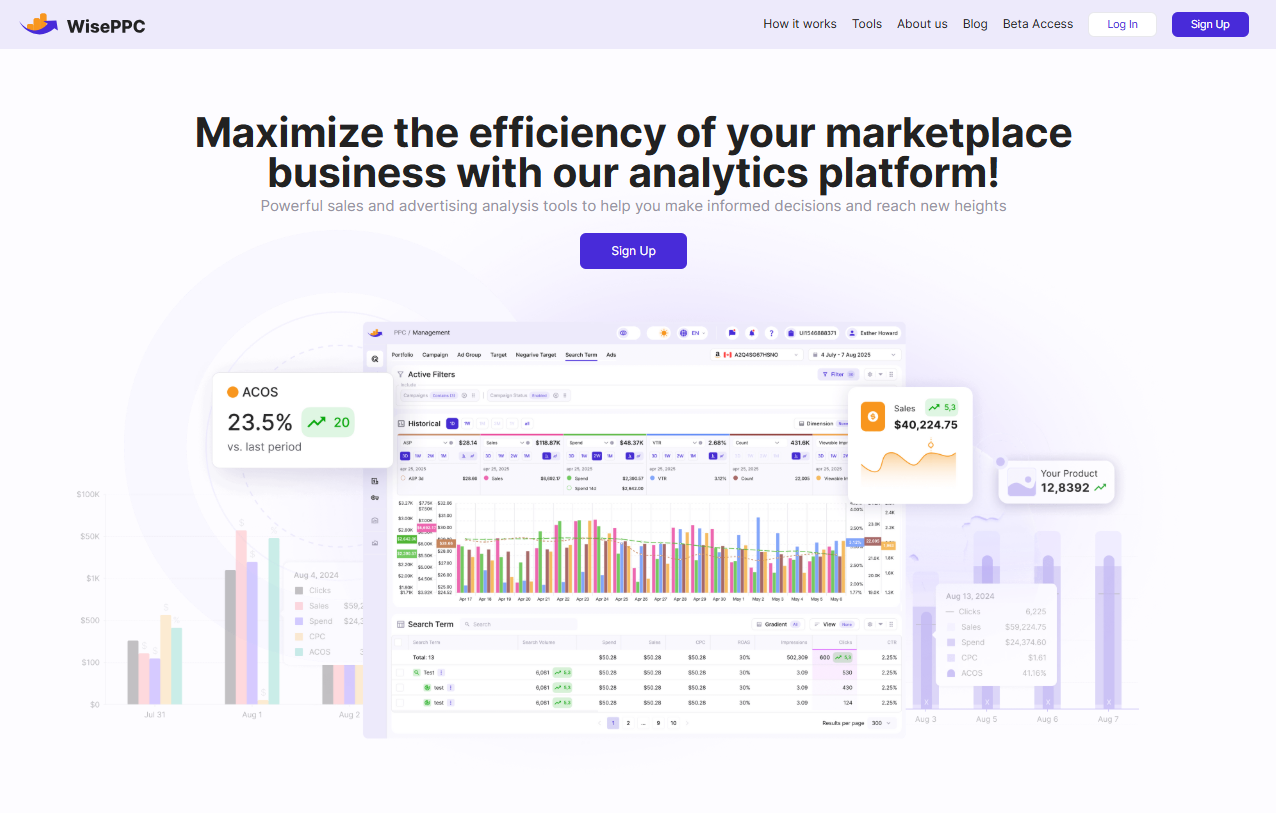
We give marketplace sellers the visibility that logistics can’t. Our platform brings together all your performance data – ads, sales, organic impact, and real-time metrics – so you’re not stuck reacting after the fact. You can track TACOS and ACOS as they shift, spot high-spend keywords before they burn your budget, and make changes that scale. Whether you’re managing 10 SKUs or 1,000, we make it easy to see what’s moving the needle, even when the logistics side feels out of reach.
With Amazon making more delivery decisions on your behalf, our job is to make sure you still have control over what counts – your strategy, your margins, and the levers that drive actual growth.
Final Thoughts
So what’s the deal with Amazon Logistics? It’s not just a delivery program. It’s Amazon taking full control of the customer journey – from product discovery to doorstep drop-off.
It’s fast, smart, tech-driven, and relentless. But it’s not perfect.
For sellers, the key is staying aware of how Amazon Logistics impacts feedback, delivery experience, and ultimately, sales. For everyone else, it’s a glimpse into how the future of shipping is being shaped not by old-school freight companies, but by a tech giant obsessed with control and customer satisfaction.
And whether you love it or hate it, it’s not going anywhere.
FAQ
1. Is Amazon Logistics the same as FBA?
Not exactly. Fulfillment by Amazon (FBA) is the broader service where Amazon handles storage, packing, and shipping on behalf of sellers. Amazon Logistics is the last-mile delivery arm that actually gets the package to the customer’s door. If you’re using FBA, your orders might still ship through USPS, UPS, or Amazon Logistics – it depends on what Amazon decides behind the scenes.
2. Why do some Amazon packages say “AMZL” in tracking?
That’s short for Amazon Logistics. If your tracking starts with AMZL or AMZL_US, it means your package is being delivered by one of Amazon’s in-house services, either a DSP driver or someone using Amazon Flex. You’ll usually get a live tracking map and a delivery window when that’s the case.
3. Can sellers choose not to use Amazon Logistics?
In most cases, no. If you’re using FBA, Amazon controls which carrier is used to deliver the order. That includes assigning it to their own logistics network when available. If you’re fulfilling orders yourself (FBM), then you can choose your shipping method – but you lose some of the speed advantages Amazon Logistics offers.
4. Is Amazon Logistics better than UPS or FedEx?
That depends on what you’re measuring. Amazon Logistics is often faster, more flexible, and built for weekends and evenings. But the service level can vary because many drivers are gig workers or part of third-party DSPs. Some customers love the fast drop-offs. Others say it can be hit or miss depending on the driver.
5. What should I do if an Amazon Logistics delivery goes wrong?
If you’re a seller, and it’s an FBA order, Amazon will handle the customer service, including refunds or replacements. But you’ll still want to monitor your feedback score. If you’re a customer, contact Amazon directly through your order page. They usually resolve delivery issues quickly, especially for Prime orders.
 No credit card required