
 EN
EN  ES
ES  FR
FR  DE
DE  IT
IT  KO
KO  JA
JA  ZH
ZH  AR
AR  PT
PT  TR
TR PL
PL
Amazon doesn’t exactly hand out blueprints for how its algorithm works – but if you’ve noticed your rankings shifting even when your ad spend stays the same, you’re not imagining things. The A10 algorithm has changed how Amazon evaluates listings, and sellers who are still optimizing for A9 are slowly getting buried.
In 2025, getting visibility on Amazon isn’t just about having a good product and cranking up PPC. It’s about building trust, driving organic traffic, and keeping customers engaged. In this guide, we’re breaking down what A10 actually rewards, what’s different from A9, and how to optimize without spinning your wheels.
What Is the A10 Algorithm?
The A10 algorithm is Amazon’s current system for ranking products in search results. It’s the evolution of the A9 algorithm, but not in a flashy, feature-loaded way. A10 is more subtle. It reshapes how different ranking signals are weighted, with a big focus on three things:
- Where your traffic is coming from.
- How customers engage with your listing.
- Whether Amazon trusts you as a seller.
Unlike A9, which leaned heavily on sales velocity and ad spend, A10 takes a broader view. It wants to know if your product actually helps people, if shoppers engage with your page, and if you’re bringing traffic to Amazon rather than just relying on it.
Why Amazon Changed the Rules
The logic behind A10 makes sense when you look at it from Amazon’s point of view. They don’t just want sellers who spend a lot on ads. They want sellers who:
- Drive new customers to Amazon.
- Keep customers happy.
- Encourage repeat purchases.
- Play by the rules.
Amazon is a customer-first platform. So it’s not surprising that they started rewarding sellers who bring in external traffic, write clear product descriptions, respond to reviews, and generally act like a business that wants to stick around.
A10 vs A9: The Real Differences
The way Amazon ranks products has taken a clear turn. Under the old A9 algorithm, everything revolved around momentum. If your product sold fast and you threw enough ad dollars behind it, chances were good you’d land near the top of the search results. Paid ads were king, and keyword relevance was your golden ticket.
But with A10, that formula doesn’t go nearly as far. Amazon has dialed down the weight of paid advertising and started placing a lot more importance on things like organic sales, off-Amazon traffic, and how customers interact with your listing. Instead of rewarding the seller who spends the most, A10 favors the one who brings in high-quality traffic and keeps shoppers engaged.
External traffic, for example, used to be a nice-to-have. Now, it’s one of the most powerful ranking signals. If you’re bringing in visitors from social, Google, or influencer referrals, Amazon sees that as a sign your product has real demand beyond their walls.
Keyword relevance still matters, of course, but it’s no longer the dominant force. It’s more balanced now. A well-optimized listing helps, but if the engagement’s not there, you’re not climbing the ranks.
Seller authority has also become a much bigger piece of the puzzle. In the A9 era, it had some influence, but now it’s a major factor. Your account history, feedback scores, and overall performance metrics speak louder than ever.
And then there’s customer engagement. It used to be more of a footnote. Now it’s center stage. How long people stay on your listing, whether they watch the video, scroll through your images, or click into the FAQ – those micro-signals help tell Amazon whether your page deserves more visibility.
Bottom line: A10 rewards value. Not in the abstract, but in the form of trust, relevance, and behavior. It’s less about what you spend and more about how customers respond.

What Signals Matter Most in A10?
Let’s get into the details. These are the signals A10 actually uses to determine whether your product should rank higher.
1. External Traffic
Amazon now heavily rewards products that bring in traffic from outside sources. That includes:
- Google Search.
- Facebook or Instagram ads.
- Blog referrals or influencer shoutouts.
- Email newsletters.
- YouTube reviews or tutorials.
When you drive customers from external platforms, you’re giving Amazon something valuable: new shoppers. That’s a strong trust signal, and it can help you rise in the rankings even without spending a ton on PPC.
2. Organic Sales Velocity
It’s not just about selling more. It’s about how you sell.
Sales that happen because someone searched and bought (without clicking a sponsored ad) carry more weight in A10. Organic conversions tell Amazon that your product is relevant and compelling.
PPC can still give you visibility, but it doesn’t directly improve your organic rank the way it used to.
3. Seller Authority and Account Health
A10 doesn’t just look at your product. It looks at you.
That means your seller metrics have a growing influence, including:
- Feedback rating.
- Order defect rate (ODR).
- Late shipment rate.
- Return handling quality.
- Responsiveness to buyer questions.
If Amazon sees that customers like buying from you, they’re more likely to show your products in search.
4. Customer Engagement Metrics
This is where it gets interesting.
Amazon now tracks what people do on your product page. It’s not just clicks and buys anymore. It’s also about:
- Click-through rate (CTR).
- Time spent on page.
- Scroll depth.
- FAQ interaction.
- Video plays.
- Add-to-cart events.
In other words, if someone lands on your page and bounces in two seconds, that’s a red flag. But if they explore, read, and add to cart, you’re in a good spot.
5. Listing Quality and Content
This isn’t new, but it matters more now. Amazon rewards listings that are complete, relevant, and easy to understand.
You can boost engagement by:
- Writing titles that are clear, not crammed with keywords.
- Using bullet points to highlight benefits, not just features.
- Adding A+ Content with lifestyle images or comparison charts.
- Including videos that explain or demonstrate the product.
Good content keeps people on the page, which in turn helps you rank higher.
6. Reviews and Ratings
Social proof still plays a major role.
A10 looks at the quality, quantity, and recency of reviews. Verified reviews and those with detailed comments matter more. Also, how you respond to reviews (especially critical ones) can influence Amazon’s perception of your seller trustworthiness.
Optimization Strategies That Work in 2025
So how do you actually improve your rankings under A10? Here’s a practical breakdown.
Bring in External Traffic:
- Share your listings via social media (especially TikTok, YouTube Shorts, and Instagram Reels).
- Collaborate with influencers and bloggers in your niche.
- Use content marketing (e.g. blog posts, tutorials, comparisons).
- Build an email list and send traffic directly to Amazon product pages.
Write Listings That Keep People Around:
- Focus on readability over keyword density.
- Use high-quality product images and infographics.
- Add an FAQ section to address hesitations before they become bounces.
- Show use cases, not just product specs.
Keep Your Seller Metrics Clean:
- Respond quickly to messages.
- Avoid late shipments or stockouts.
- Use FBA or reliable FBM logistics.
- Stay compliant with Amazon’s policies.
Encourage Reviews Without Breaking the Rules:
- Send polite follow-up messages after delivery.
- Enroll in Amazon’s Vine program for early reviews.
- Use product inserts with QR codes (as long as you’re not incentivizing).
Invest in Organic Growth Tools:
- Use Amazon Posts to build your brand.
- Run subscribe-and-save or coupon offers to boost repeat purchases.
- Use Brand Registry features like A+ Content and Brand Story.
Mistakes to Avoid
Let’s also be clear about what doesn’t work anymore.
- Keyword stuffing: You’re not fooling the algorithm (or customers).
- Over-relying on PPC: Ads help visibility, but don’t build trust.
- Ignoring listing engagement: A good click means nothing if they bounce.
- Low review quality: 500 generic five-star reviews won’t beat 50 thoughtful ones.
- Skipping external marketing: If you only rely on Amazon traffic, you’re leaving ranking power on the table.
How to Track A10 Performance
There’s no official “A10 dashboard” waiting for you inside Seller Central. You won’t see a score or magic meter telling you how well your product’s doing under the new algorithm. But that doesn’t mean you’re flying blind. You just have to watch the right signals.
Start with your organic ranking. If you’re seeing better placement in search results without cranking up your ad spend, that’s a good sign. It means A10 is recognizing the value you’re bringing through engagement or external traffic. Speaking of which, keep an eye on your click-through rate from search. If people are noticing your listing and choosing to click it, that tells Amazon your product is worth a look.
Once shoppers land on your page, how long they stay matters. Are they scrolling, clicking images, reading your bullets? Longer sessions usually mean better engagement, which A10 absolutely notices. If they’re not just browsing but also adding your product to their cart, even better. That add-to-cart rate says a lot about intent and relevance.
Another thing to watch: reviews. Not just the number, but how many you’re getting relative to orders. A solid review rate per purchase can quietly boost your ranking over time. And don’t forget to track where your traffic is actually coming from. If you’re running external campaigns, tools like UTM tags or Amazon Attribution can show how much of that off-Amazon traffic is landing and converting.
In the end, tracking A10 performance isn’t about obsessing over one number. It’s about seeing the patterns. You make a change, traffic responds, conversion shifts, and then you adjust again. That’s the loop. A10 isn’t static, and your strategy shouldn’t be either.

How WisePPC Helps Sellers Navigate A10 with Confidence
At WisePPC, we’ve built our entire platform around one core belief: sellers need more clarity and control if they want to succeed under Amazon’s evolving algorithms. A10 rewards precision, trust, and performance over brute-force ad spend, and that’s exactly where our toolkit shines. Whether you’re managing a handful of ASINs or hundreds across multiple marketplaces, we give you the data and levers to make smarter, faster decisions that actually move the needle.
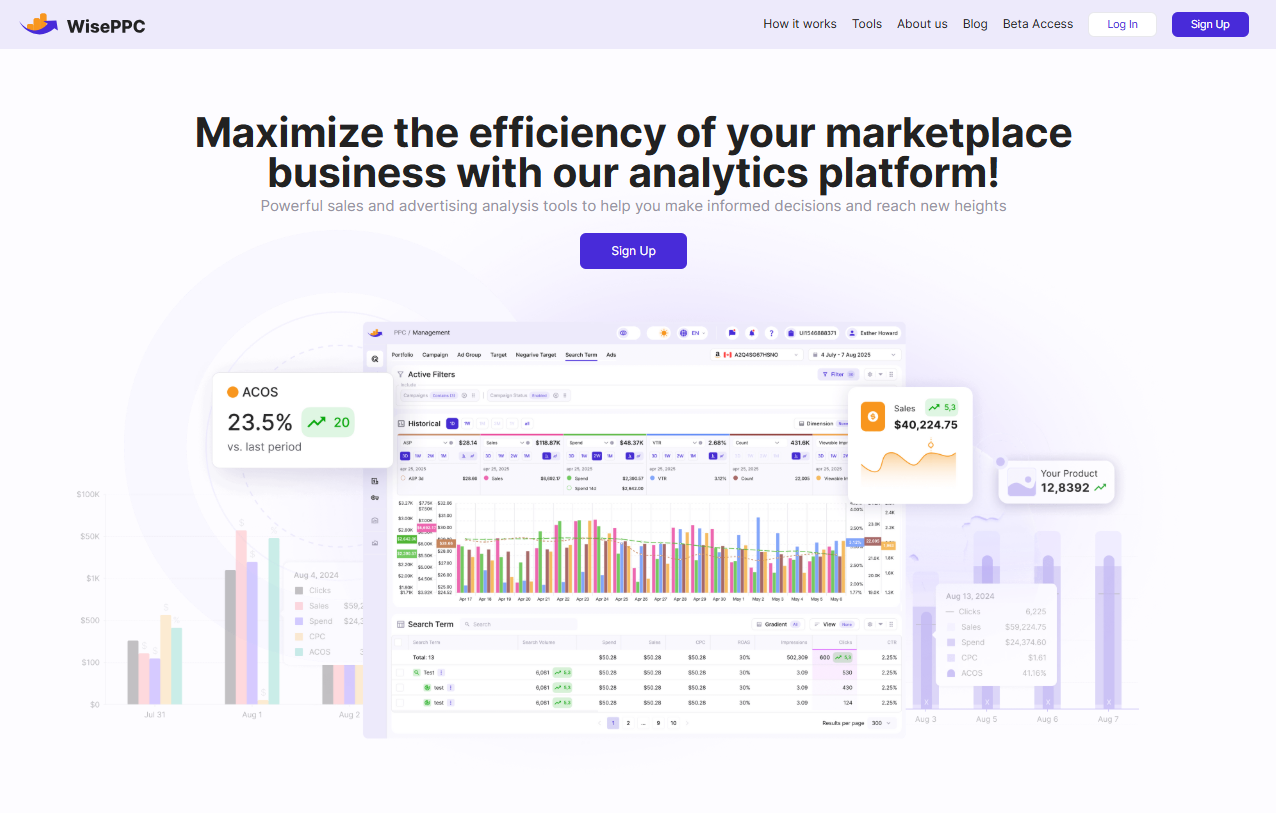
We’re not just showing you charts and numbers. We help you see what’s really driving your sales – organic or paid – and how each campaign ties back to performance. With real-time metrics, advanced filtering, automated suggestions, and long-term historical insights (not just 90 days of Amazon data), you can spot what’s working, fix what’s not, and scale without the guesswork. If A10 is pushing sellers to raise their game, we’re here to make sure you’re ready for it.
Final Thoughts: What A10 Is Really Asking You to Do
The A10 algorithm isn’t just a new ranking system. It’s Amazon making a statement about what kind of sellers they want to spotlight. At its core, it’s less about throwing money at ads and more about proving you understand your customers, building a brand that feels trustworthy, and creating product pages that people actually engage with.
If you know your audience, deliver on your promises, and show consistency over time, Amazon rewards that behavior. If instead you’re only leaning on PPC or quick wins, the algorithm will eventually catch up with you. And while that might sound tough, it’s actually a fairer game. A10 pushes sellers toward practices that build loyalty and long-term success rather than short bursts of sales.
FAQ
1. Is A10 an official Amazon update?
Not exactly. Amazon hasn’t formally announced “A10,” but sellers and experts started noticing shifts in how rankings work – less emphasis on ads, more on external traffic and engagement. The term A10 just stuck as a shorthand.
2. Can PPC still help me rank under A10?
Yes, but not in the way it used to. PPC helps with visibility and momentum, especially for new products, but it doesn’t carry the same direct weight in rankings. Organic sales and customer behavior now matter more.
3. How important is external traffic to A10?
Very. Bringing in traffic from places like Google, Instagram, or YouTube tells Amazon your product has demand beyond the platform. That kind of signal gives your listing a noticeable boost.
4. Do customer reviews still affect ranking?
Absolutely. A10 still looks at review volume, recency, and quality. A steady stream of honest, helpful reviews builds trust, with both shoppers and the algorithm.
5. How do I know if A10 is working in my favor?
Watch for signs like improved organic rank, longer session times, more add-to-carts, and sales that come without ad clicks. It’s not instant, but you’ll see patterns when you’re aligned with what A10 values.
6. What happens if I only use Amazon PPC and ignore everything else?
You’ll probably hit a ceiling. You might get clicks, maybe some sales, but you’ll struggle to maintain organic visibility. A10 needs more than just ad dollars, it needs relevance, engagement, and authority.
7. Is there a way to “measure” A10 success directly?
There’s no official scorecard, but if you’re tracking organic rank improvements, engagement metrics, and external traffic growth, you’re reading the right signals. Treat it like a feedback loop and keep adjusting.
 No credit card required