
 EN
EN  ES
ES  FR
FR  DE
DE  IT
IT  KO
KO  JA
JA  ZH
ZH  AR
AR  PT
PT  TR
TR PL
PL
Quick Summary: Amazon is not legally a monopoly yet, but the Federal Trade Commission sued the company in September 2023 for illegally maintaining monopoly power in online retail markets. The FTC alleges Amazon uses anticompetitive practices to control prices, block rivals, and harm both consumers and third-party sellers, though the case remains pending in federal court.
Amazon dominates online shopping. That’s not up for debate. But does domination equal monopoly?
The question isn’t just academic anymore. On September 26, 2023, the Federal Trade Commission, along with 18 state attorneys general, filed a landmark lawsuit against Amazon.com, Inc. The allegation? That Amazon illegally maintains monopoly power through a web of anticompetitive strategies.
The case has been pending in federal court since September 2023. But it’s already reshaping how regulators, competitors, and consumers think about Amazon’s control over e-commerce.
What Makes a Company a Monopoly?
Before diving into Amazon’s situation, it helps to understand what a monopoly actually is.
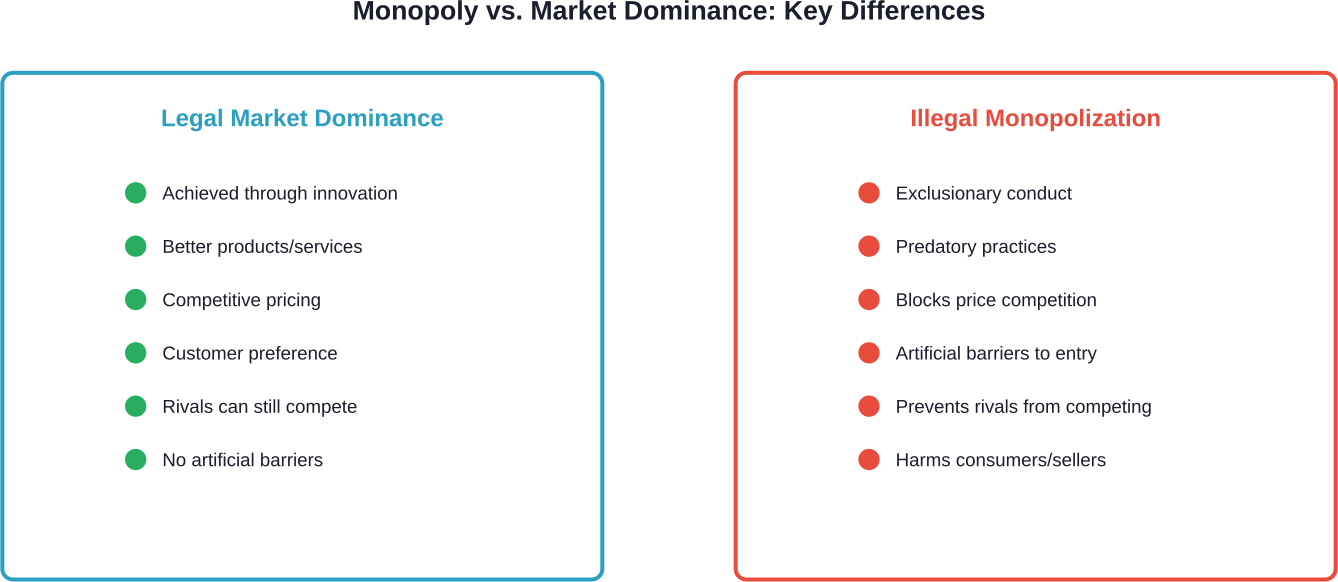
In antitrust law, a monopoly isn’t just about being big or successful. It’s about market power—the ability to control prices, exclude competition, and harm consumers without losing business. Companies can achieve monopoly status legally through innovation and competition. But maintaining that power through anticompetitive conduct? That’s illegal.
The Federal Trade Commission defines monopolization as using exclusionary or predatory practices to gain or maintain monopoly power. This matters because size alone isn’t the issue. Amazon’s actions—how it wields its market position—are what’s under scrutiny.
The FTC’s Case Against Amazon
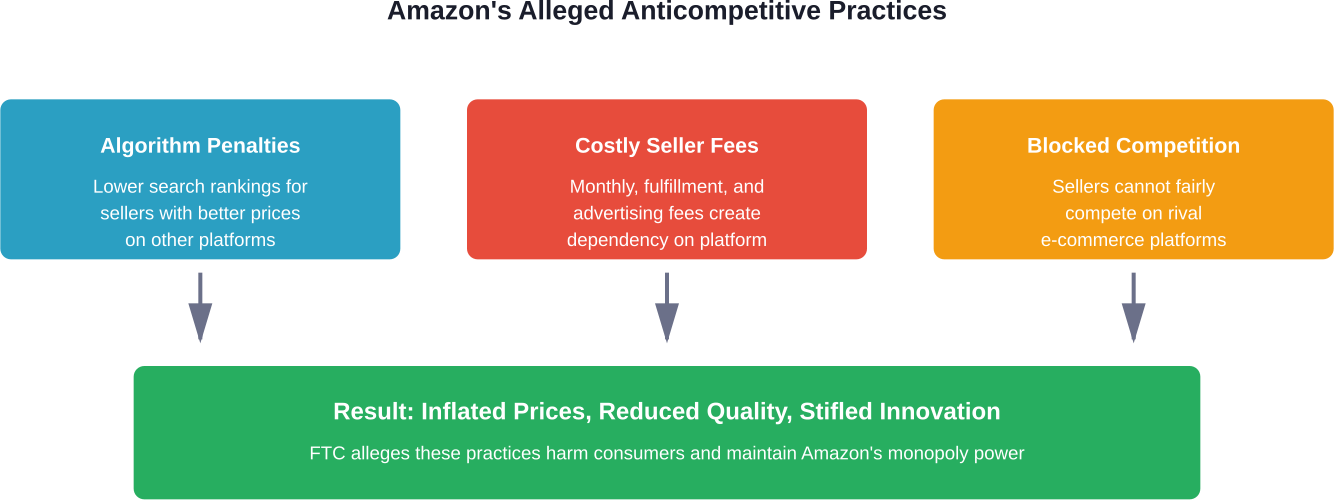
According to the FTC’s September 2023 complaint, Amazon uses interlocking anticompetitive strategies to maintain its dominance. The agency alleges the company prevents rivals and sellers from lowering prices, degrades quality for shoppers, overcharges sellers, stifles innovation, and blocks fair competition.
Here’s what that looks like in practice.
Price Control Through Algorithms
The FTC claims Amazon punishes sellers who offer lower prices on competing platforms. Through algorithm-driven penalties, products with better prices elsewhere get buried in search results or lose the coveted “Buy Box” placement that drives most sales.
This means sellers effectively can’t compete on price anywhere else. They’re locked into Amazon’s ecosystem, and consumers don’t see the lowest available prices across the market.
Costly Fees That Block Competition
Amazon charges fees to the hundreds of thousands of sellers who rely on the platform to reach customers. According to the FTC, these fees have become so substantial that sellers have no realistic alternative but to absorb the costs and raise prices.
The monthly fees, fulfillment fees, advertising costs, and other charges create a barrier that makes it nearly impossible for rival platforms to attract sellers, even if they offer better terms.
Degraded Quality and Stifled Innovation
When competition gets squeezed out, innovation suffers. The FTC argues that Amazon’s conduct prevents better platforms from emerging and gaining traction. Sellers and shoppers alike are stuck with whatever Amazon offers, with limited ability to vote with their wallets.
How Amazon Achieved Market Dominance
Amazon didn’t start as a monopoly. Jeff Bezos launched the company as an online bookstore (founding year not verified in source material). His parents were his first investors, and Bezos famously warned them there was a 70 percent chance they’d lose their money.
But Amazon grew quickly by focusing on customer experience. Free shipping through Prime, massive product selection, and competitive pricing attracted millions of shoppers. Third-party sellers flocked to the platform for access to that customer base.
Over time, that virtuous cycle turned into what critics call a stranglehold. Sellers needed Amazon to reach customers. Customers expected to find everything on Amazon. And Amazon controlled the rules of engagement for everyone involved.
Amazon’s E-Commerce Market Share
Just how dominant is Amazon in online retail? The company controls a sizable portion of e-commerce sales in the United States. As of 2023, Amazon held a substantial share of the e-commerce market, making it difficult for consumers and businesses to avoid the platform entirely.
For third-party sellers, Amazon isn’t just one sales channel among many. For hundreds of thousands of businesses, it’s the primary—sometimes only—viable way to reach online shoppers at scale.
| Market Aspect | Amazon’s Position | Competitive Impact |
|---|---|---|
| Online Retail | Dominant market share | Sellers depend on platform for customer access |
| Third-Party Marketplace | Hundreds of thousands of sellers | Limited alternatives with comparable reach |
| Pricing Control | Algorithm-driven penalties | Prevents price competition on other platforms |
| Consumer Access | First stop for online shopping | Rival platforms struggle to attract traffic |
What Happens Next?
The FTC’s lawsuit is still pending in federal court. Amazon has denied the allegations, arguing that its practices benefit consumers through lower prices and convenience.
While the major antitrust lawsuit regarding marketplace dominance remains pending, Amazon reached a historic $2.5 billion settlement with the FTC in September 2025 regarding its Prime enrollment and cancellation practices. Refunds for this settlement began reaching consumers in January 2026.
But the case represents a significant shift in how regulators approach tech platforms. The Department of Justice won a monopolization case against Google in April 2025, with the court finding Google violated antitrust law by monopolizing open-web digital advertising markets. That precedent could influence the Amazon case.
If the FTC prevails, remedies could range from behavioral changes—banning specific practices—to structural remedies like breaking up parts of Amazon’s business. The outcome won’t just affect Amazon. It’ll set the standard for how antitrust law applies to digital platforms.

See Beyond Amazon’s Control – Check Your Data Yourself
The FTC case focuses on how much control Amazon has over sellers inside its ecosystem. That control isn’t just about pricing or rankings. It also shows up in how performance data is presented – limited windows, separate reports, and no single place to see what’s actually driving results.
WisePPC gives you a way to step outside that layer. It connects ads, sales, and listing data in one view, so you can track performance without relying only on Amazon’s interface. You keep access to longer-term data and can see changes more clearly, instead of piecing things together from different reports.
If the question is how much control Amazon really has, it makes sense to look at your data outside of it. Try WisePPC and see what your numbers look like without the usual limitations.
Why This Matters for Consumers and Sellers
Here’s the thing: monopoly cases aren’t just about punishing big companies. They’re about maintaining competitive markets that drive innovation, lower prices, and give consumers real choices.
If Amazon maintains monopoly power through anticompetitive conduct, shoppers pay higher prices for lower-quality goods. Sellers face mounting fees with no alternatives. And better platforms never get the chance to compete.
The FTC’s case is ultimately about whether markets work. Not whether Amazon is big, but whether it stays big by blocking competition. That distinction matters.
Frequently Asked Questions
Is Amazon legally a monopoly right now?
No, Amazon has not been legally declared a monopoly. The FTC’s antitrust lawsuit is still pending in federal court.
What specific practices does the FTC claim are anticompetitive?
The FTC alleges Amazon penalizes sellers for lower prices elsewhere, imposes restrictive fees, and favors its own interests in search results.
How much of the e-commerce market does Amazon control?
Amazon holds a major share of U.S. online retail, with many sellers relying heavily on the platform for customer access.
Could Amazon be broken up if the FTC wins?
Potentially. Remedies could include business restrictions or structural separation, depending on the court’s ruling.
How does this case compare to other tech antitrust lawsuits?
The case is part of broader antitrust actions against major tech companies and follows increased enforcement efforts in recent years.
What happens to Amazon sellers if the company is found to be a monopoly?
Sellers could potentially benefit from lower fees, more pricing freedom, and improved competition across marketplaces.
When will the Amazon antitrust case be resolved?
Large antitrust cases often take years. The lawsuit filed in 2023 is still ongoing as of 2026.
The Bottom Line
So, is Amazon a monopoly? The legal answer is: not yet. But the FTC is making a serious case that Amazon illegally maintains monopoly power through anticompetitive conduct.
The distinction matters. Being successful isn’t illegal. Using market power to block competition, control prices, and harm consumers? That crosses the line into monopolization.
As the case moves through federal court, the outcome will shape not just Amazon’s future, but the ground rules for digital platforms and e-commerce competition for years to come. For anyone who shops online or sells products digitally, the stakes couldn’t be higher.
 No credit card required