
 EN
EN  ES
ES  FR
FR  DE
DE  IT
IT  KO
KO  JA
JA  ZH
ZH  AR
AR  PT
PT  TR
TR PL
PL
Quick Summary: Amazon Prime costs $139 per year or $14.99 per month as of April 2026. Discounted plans include Prime for Young Adults at $69/year and Prime Access at $6.99/month for eligible government assistance recipients. All memberships include free shipping, Prime Video, exclusive deals, and various digital benefits with a 30-day free trial available.
Amazon Prime has become a household staple for millions of shoppers. But with subscription costs climbing across virtually every service, the question on everyone’s mind is simple: how much does Prime actually cost in 2026?
The short answer? It depends on which membership tier fits your situation.
According to the official Amazon website, the standard Prime membership runs $139 per year or $14.99 per month. That’s roughly $11.58 monthly if you pay annually—saving you about $40 compared to the month-to-month option.
But here’s the thing: not everyone pays full price. Amazon offers several discounted membership options that cut costs significantly for students, young adults, and qualifying low-income households.
Amazon Prime Pricing Plans: What You’ll Actually Pay
Amazon structures its Prime membership around four distinct pricing tiers. Each provides identical core benefits—the only difference is who qualifies and what you pay.
| Membership Type | Monthly Cost | Annual Cost | Who Qualifies |
|---|---|---|---|
| Prime Monthly | $14.99 | — | Anyone |
| Prime Annual | — | $139 | Anyone |
| Prime for Young Adults | $7.49 | $69 | Ages 18-24 |
| Prime Access | $6.99 | — | Government assistance recipients |
All membership options include a 30-day free trial, giving you a full month to test whether the benefits justify the cost before committing.
Standard Prime Membership: $139 Per Year
The annual membership costs $139 plus applicable taxes. This breaks down to about $11.58 monthly—a savings of $40.88 compared to paying month-to-month.
For anyone planning to keep Prime longer than nine months, the annual plan makes financial sense. Cancel anytime, though no partial refunds apply if you’ve used any Prime benefits.
Monthly Prime: $14.99 Per Month
Prefer flexibility? The monthly option runs $14.99. Over a full year, this totals $179.88—noticeably more than the annual rate.
This works best for seasonal shoppers who only need Prime during specific periods (holiday shopping, Prime Day sales, back-to-school season). Join in November, use it through December, then cancel in January.
Prime for Young Adults: $7.49 Per Month
Young adults between ages 18-24 qualify for discounted membership at $69 per year. That’s nearly 35% off the standard monthly rate.
According to the official Amazon website, this tier provides all the same benefits as regular Prime—free shipping, Prime Video, exclusive deals, and the works. The only requirement? Proof of age during signup.
Prime Access: $6.99 Per Month
Amazon’s most affordable option targets eligible government assistance recipients. At $6.99 monthly, Prime Access delivers full Prime benefits at half the standard cost.
Qualification requires documentation of participation in programs like SNAP, Medicaid, or other qualifying government assistance. Income verification may also qualify certain customers.
As the official website states: “Prime Access is a discounted version of the Prime membership, available to eligible government assistance recipients or income-verified customers. It offers all the same benefits as the full-price Prime membership, but at half the cost.”
What Benefits Actually Come With Prime?
Understanding what you get matters just as much as knowing what you pay. Prime bundles shipping perks with digital entertainment and exclusive shopping benefits.
Shipping and Delivery
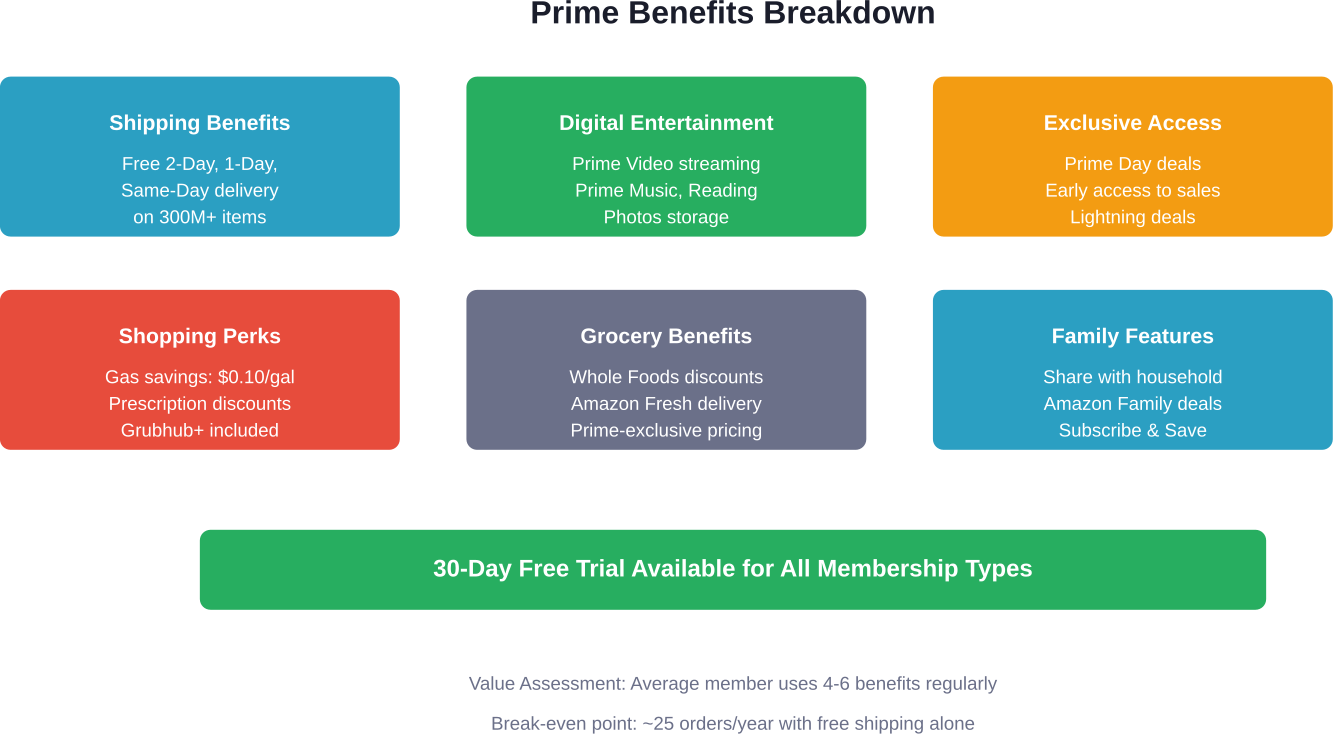
Fast, free delivery remains Prime’s flagship benefit. Members get free Two-Day shipping on millions of eligible items, with One-Day and Same-Day delivery available in many areas.
According to Amazon, more than 300 million items qualify for these accelerated shipping speeds. No minimum purchase required—order a single $8 item and it ships free.
Prime Video Streaming
Prime includes unlimited streaming access to Prime Video’s library of movies, TV shows, and Amazon Originals. This benefit alone competes with standalone streaming services that charge $10-15 monthly. Award-winning shows and exclusive content come standard with membership.
However, Prime Video includes ads by default. To remove ads and access features like 4K/UHD and Dolby Atmos, members must pay an additional ‘Prime Video Ultra’ fee of $4.99 per month.
Music, Photos, and Reading
Prime Music provides ad-free access to millions of songs and podcasts. Amazon Photos offers unlimited full-resolution photo storage plus 5GB video storage.
Prime Reading grants access to rotating selections of ebooks, magazines, and comics through Kindle apps or devices.
Exclusive Deals and Shopping Events
Prime members get exclusive access to Prime Day—Amazon’s massive annual shopping event with deals across virtually every category.
Throughout the year, members also receive early access to Lightning Deals and special Prime-only pricing on select items.
Grocery and Gas Savings
According to recent announcements, Prime members save $0.10 per gallon on gas at participating stations. Amazon estimates this saves members up to $70 annually.
Special “Fuel Up Friday” promotions occasionally boost savings to $0.20 per gallon. Whole Foods shoppers receive exclusive member discounts, and Amazon Fresh delivery is available in eligible areas.
Is Amazon Prime Worth $139 in 2026?
Whether Prime justifies its cost depends entirely on usage patterns. Community discussions reveal split opinions.
The math works like this: if you order frequently enough that saved shipping costs exceed $139 annually, the membership pays for itself. Everything else—streaming, deals, gas savings—becomes bonus value.
| Benefit Category | Estimated Annual Value | Usage Requirement |
|---|---|---|
| Free shipping | $100-300 | 25+ orders/year |
| Prime Video | $120-180 | Regular streaming use |
| Gas savings | $50-70 | Regular driving, eligible stations |
| Grubhub+ | $120 | Monthly food delivery |
| Prime Day deals | $50-200 | Strategic shopping |
| Grocery discounts | $100-300 | Regular Whole Foods shopping |
When Prime Makes Financial Sense
Prime delivers clear value for:
- Frequent online shoppers placing 25+ orders annually
- Households replacing a standalone streaming subscription with Prime Video
- Regular Whole Foods or Amazon Fresh customers
- Anyone taking advantage of multiple benefit categories simultaneously
Using just shipping and streaming benefits easily generates $250+ in annual value—nearly double the membership cost.
When You Might Skip It
Prime may not justify the expense if:
- Orders are infrequent and shipping costs rarely exceed $139 yearly
- Other streaming services already meet entertainment needs
- Local shopping remains more convenient than online ordering
- None of the additional perks (gas savings, grocery discounts, etc.) apply to daily routines
Some community members report that occasional shoppers may find better value purchasing items with free shipping thresholds or bundling orders to minimize shipping charges.
The Recent FTC Settlement and What It Means
In September 2025, Amazon reached a historic $2.5 billion settlement with the Federal Trade Commission. According to the FTC, the agency alleged that Amazon enrolled millions of consumers in Prime subscriptions without proper consent and made cancellation unnecessarily difficult.
The settlement includes $1 billion in civil penalties and $1.5 billion in consumer reimbursements. The FTC stated that approximately 35 million consumers were affected by the alleged practices.
As part of the settlement, Amazon must simplify cancellation processes and improve transparency around subscription enrollment. For consumers, this means clearer opt-in procedures and easier membership management going forward.
The FTC announced that refund distribution to eligible consumers started on November 12, 2025, with eligible consumers receiving payments automatically—no action required. Scammers have attempted to exploit this, so remember: neither the FTC nor Amazon will ever call requesting payment information or fees to process refunds.
How Prime Compares to Other Subscription Services
Context helps. How does Prime stack up against other popular subscriptions?
Netflix Premium runs roughly $26.99 per month. Spotify Premium costs $11 monthly ($132 yearly). Walmart+ charges $98 annually for shipping and gas benefits without streaming content.
Prime sits in the middle—more expensive than basic streaming services, but bundling far more benefits than any single-category subscription.
Special Membership Options and Sharing
Beyond the four main pricing tiers, Amazon offers additional ways to maximize Prime value.
Amazon Household Sharing
One Prime membership can be shared with another adult in the same household. Both adults get full Prime benefits, though certain features like payment methods and digital content remain separate.
Teen profiles (ages 13-17) can also join with parental controls. This effectively cuts per-person costs in half for couples or roommates.
Amazon Business Prime
Business accounts qualify for specialized Business Prime plans with bulk purchasing benefits, business-only pricing, and enhanced analytics.
Pricing varies based on business size and user count. According to the official Business Prime page, plans offer rewards up to 4% back on select purchases plus all standard Prime shipping benefits.
How to Cancel Amazon Prime
Cancellation takes just a few clicks. Navigate to Account Settings, select Prime Membership, then choose End Membership.
Amazon offers the option to end immediately or at the next renewal date. If you haven’t used any Prime benefits since your last payment, you may qualify for a full refund.
The recent FTC settlement requires Amazon to simplify this process further, ensuring clearer cancellation pathways and fewer retention tactics during the cancellation flow.
Maximizing Prime Value: Strategic Usage Tips
Getting the most from Prime requires intentional benefit stacking.
First, activate all included services. Download Prime Video, set up Amazon Photos, enable gas savings at participating stations. Many members pay for Prime but never activate half the available perks.
Second, time major purchases around Prime Day and seasonal sales events. Exclusive member deals often deliver 30-50% discounts on electronics, home goods, and seasonal items.
Third, combine Subscribe & Save discounts with Prime shipping. Regular household items (paper products, pet supplies, pantry staples) qualify for additional percentage discounts when delivered on subscription schedules.
Fourth, use Amazon Family for baby and child-related purchases. Diapers, wipes, and baby food receive extra discounts and exclusive offers beyond standard Prime benefits.

Stop Overpaying Amazon and Start Growing Your Profits
While tracking your Amazon Prime subscription fees is essential for budgeting, managing your advertising and inventory spend is what truly determines your business profitability. WisePPC is an Amazon Ads Verified Partner that replaces manual spreadsheets with automated analytics and real-time tracking. By integrating directly with your Seller Central account, the platform identifies high-performing keywords and monitors stock levels to prevent lost sales, ensuring every dollar you invest contributes to your bottom line.
The platform provides deep data insights like placement performance and historical search trends to help you stay ahead of the competition. You can connect your business profile in minutes to start making data-driven decisions and scaling your store across multiple marketplaces more efficiently.
Sign up at WisePPC to explore how these tools can help you optimize your Amazon advertising and business strategy.
Prime Membership Trends and Usage Data
While Amazon doesn’t publicly disclose total Prime membership numbers in real-time, financial filings indicate continued growth through 2025.
According to community discussions, some active Prime members report using 3-5 different benefit categories regularly. Shipping and streaming remain the top two, followed by exclusive deals, grocery benefits, and gas savings.
The $139 price point has remained stable since the last increase, though past patterns suggest periodic adjustments based on inflation and expanded benefit offerings.
Frequently Asked Questions
Does Amazon Prime have a free trial?
Yes. All Prime membership tiers include a 30-day free trial. Full benefits activate immediately during the trial period. Cancel before the trial ends to avoid charges.
Can I share my Prime membership with family members?
Yes. Amazon Household allows sharing one Prime membership between two adults in the same household. Teen profiles can also be added with parental controls.
What’s the difference between monthly and annual Prime membership?
The annual membership costs $139 paid once yearly. The monthly option runs $14.99 per month, totaling $179.88 annually. Benefits are identical; the difference is payment frequency and total cost.
How do I qualify for Prime Access at $6.99 per month?
Prime Access requires proof of participation in qualifying government assistance programs like SNAP, Medicaid, or other state assistance programs. Upload documentation through Amazon’s verification portal during signup.
Is Amazon Prime worth it if I only want the free shipping?
It depends on order frequency. If your shipping costs exceed $139 yearly, Prime pays for itself on shipping alone. Frequent shoppers who place 2-3 orders monthly may benefit most.
Can I get a refund if I cancel Prime mid-year?
Amazon offers full refunds for annual memberships if you haven’t used any Prime benefits since your last renewal. Monthly memberships continue through the current billing period.
Does Prime include Amazon Music Unlimited?
No. Prime includes Prime Music, but Amazon Music Unlimited is a separate paid subscription with expanded music libraries and additional features.
Final Thoughts: Making the Prime Decision
Amazon Prime costs $139 annually or $14.99 monthly in 2026, with discounted options cutting costs by 50% for eligible students, young adults, and low-income households.
The value proposition depends entirely on individual usage patterns. Frequent shoppers who leverage multiple benefit categories—shipping, streaming, grocery discounts, gas savings—can easily extract $300-500 in annual value from the $139 investment.
Casual shoppers who primarily use Amazon occasionally might find the membership cost exceeds actual value received.
The 30-day free trial eliminates guesswork. Test the service, track your usage, calculate your shipping savings and streaming consumption. The numbers will reveal whether Prime makes financial sense for your specific situation.
Ready to try Prime? Start your free 30-day trial on Amazon’s official Prime membership page and evaluate the benefits firsthand before committing.
 No credit card required