
 EN
EN  ES
ES  FR
FR  DE
DE  IT
IT  KO
KO  JA
JA  ZH
ZH  AR
AR  PT
PT  TR
TR PL
PL
Quick Summary: Amazon employs approximately 1.576 million people worldwide as of 2025, making it one of the largest private employers globally. The workforce includes full-time corporate staff, warehouse associates, part-time workers, and seasonal employees across e-commerce, cloud services, and logistics operations.
Amazon has transformed from an online bookstore into a global employment powerhouse. But just how many people work for the Seattle-based tech giant?
The numbers are staggering. With operations spanning retail, cloud computing, streaming services, and logistics, Amazon’s workforce rivals small countries in size.
Let’s break down the current employment landscape at one of the world’s most influential companies.
Current Amazon Employee Count
As of 2025, Amazon employs approximately 1.576 million full-time and part-time workers worldwide. This represents a 1.29% increase from 2024, signaling stabilization after the company’s post-pandemic workforce adjustments.
The total headcount fluctuates throughout the year due to seasonal hiring patterns, particularly during the holiday shopping season when Amazon typically hires 250,000 seasonal workers for the holiday shopping season between October and December.
Here’s the thing though—this number doesn’t tell the whole story. Amazon’s workforce composition is far more complex than a single headcount figure suggests.
Breaking Down the Numbers
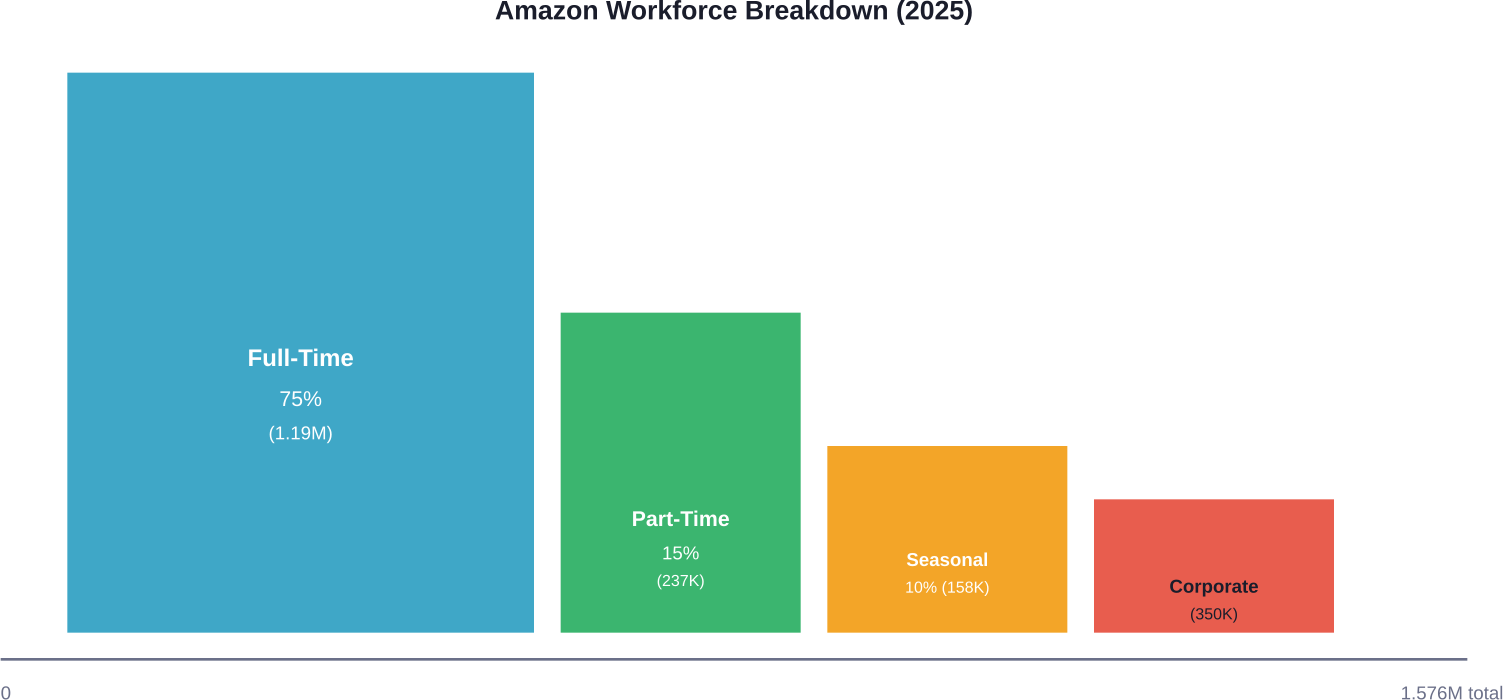
Amazon’s workforce breaks down into several distinct categories:
- Full-time employees comprise roughly 75% of the total workforce
- Part-time workers account for approximately 15%
- Seasonal and temporary staff make up the remaining 10%, fluctuating significantly by quarter
- Corporate employees represent approximately 350,000 of the total headcount
The majority of Amazon employees work in fulfillment centers, sortation facilities, and delivery stations that power the company’s logistics network.
See What Your Ads Are Actually Producing

WisePPC focuses on connecting advertising data with real sales results. Instead of reviewing campaigns, inventory, and revenue separately, it brings everything into one place so it’s easier to see what is actually working. The platform tracks performance across ads, sales, and listings, helping identify where spend leads to revenue and where it doesn’t.
Want Clearer Insight Into Performance?
- track ad spend alongside actual sales
- analyze campaign and keyword performance
- identify what drives revenue
👉 Explore WisePPC to understand your Amazon advertising data.

Amazon Employee Growth Over Time
Amazon’s headcount has experienced dramatic growth over the past decade, though recent years have shown more volatility.
The pandemic triggered unprecedented hiring as e-commerce demand surged. Amazon added over 500,000 employees in 2020 alone—a 63% year-over-year increase that made headlines globally.
But that explosive growth didn’t continue forever.
| Year | Employee Count | Year-over-Year Change | Percentage Change |
|---|---|---|---|
| 2019 | 798,000 | +150,000 | +23% |
| 2020 | 1,298,000 | +500,000 | +63% |
| 2021 | 1,608,000 | +310,000 | +24% |
| 2022 | 1,541,000 | -67,000 | -4% |
| 2023 | 1,525,000 | -16,000 | -1% |
| 2024 | 1,556,000 | +31,000 | +2% |
| 2025 | 1,576,000 | +20,000 | +1.3% |
The data shows a clear pattern: massive pandemic-era expansion followed by workforce optimization as consumer behavior normalized.
What Drove the Changes?
Several factors influenced Amazon’s employment trajectory:
The 2020-2021 hiring surge responded to skyrocketing online shopping demand during COVID-19 lockdowns. Amazon struggled to keep up with order volumes and had to rapidly scale its fulfillment network.
The 2022 downturn reflected overcorrection—Amazon had built capacity for sustained high demand that didn’t materialize post-pandemic. The company implemented hiring freezes and eliminated thousands of positions, particularly in corporate divisions.
Recent stabilization suggests Amazon has found a sustainable workforce level matching current business needs.
Geographic Distribution
Amazon’s workforce spans the globe, though concentration varies significantly by region.
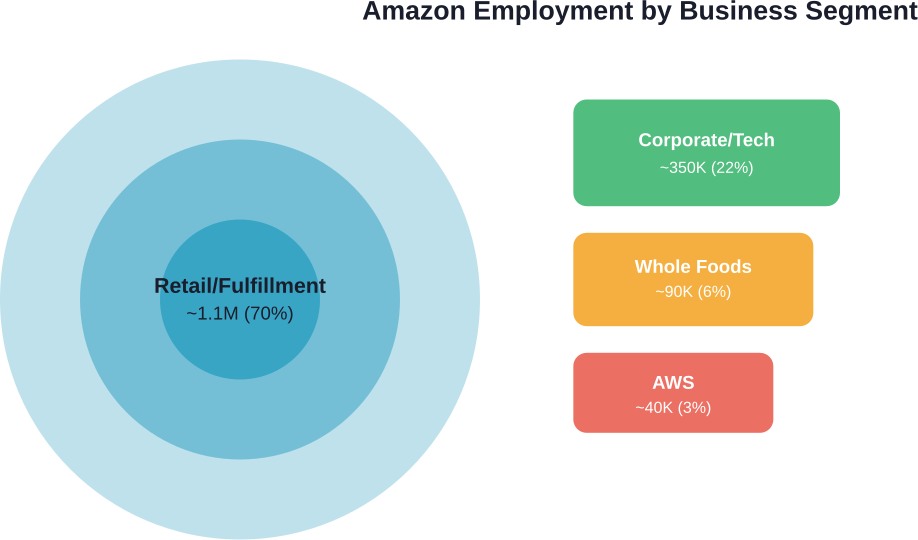
The United States remains Amazon’s largest employment market, with approximately 1.1 million employees—roughly 70% of the global workforce. This includes corporate headquarters staff in Seattle, tech workers in various hubs, and hundreds of thousands of warehouse and delivery personnel.
Europe represents a significant employment region with a substantial workforce across fulfillment centers, corporate offices, and customer service operations in countries like the UK, Germany, France, and Spain.
Asia-Pacific operations, including India and emerging markets, represent a growing employment region. India has become a major growth market for Amazon, both for e-commerce operations and cloud services support.
The remaining workforce is distributed across Latin America, the Middle East, and other regions where Amazon has established operations.
Workforce by Business Segment
Amazon operates through several major divisions, each with distinct employment profiles.
Retail and Fulfillment
The retail operations—including fulfillment centers, sortation facilities, and last-mile delivery—employ the vast majority of Amazon’s workforce. These positions include warehouse associates, delivery drivers, and logistics coordinators.
Amazon fulfillment and seasonal employees now earn an average starting wage of $18-$19 per hour, with regular employees earning an average of $23 per hour with benefits as of 2026.
Amazon Web Services (AWS)
AWS, Amazon’s cloud computing division, employs a smaller but highly skilled workforce focused on engineering, sales, and customer support. While AWS represents a fraction of total headcount, these employees command higher average salaries and drive significant revenue.
Corporate and Technology
Corporate employees work across product development, marketing, finance, human resources, and other business functions. The approximately 350,000 corporate workers include software engineers, product managers, data scientists, and business analysts.
These positions are concentrated in major tech hubs like Seattle, the San Francisco Bay Area, Austin, and Arlington, Virginia.
Whole Foods Market
Amazon’s acquisition of Whole Foods added approximately 90,000 retail grocery workers to the company’s headcount. These employees operate independently from Amazon’s e-commerce operations but fall under the corporate umbrella.
How Amazon Compares to Competitors
Amazon’s workforce dwarfs most tech companies but sits below other major retailers when measured purely by headcount.
Walmart remains the world’s largest private employer with over 2.1 million employees globally. However, Walmart’s business model relies more heavily on physical retail locations requiring significant staffing.
Among tech companies, Amazon employs far more people than Microsoft (approximately 225,000), Apple (approximately 165,000), or Google’s parent company Alphabet (approximately 182,000). The difference reflects Amazon’s labor-intensive logistics operations versus competitors’ software-focused business models.
Real talk: comparing headcount across companies with different business models provides limited insight. Amazon’s employment intensity stems from its fulfillment network—not necessarily from being “bigger” in revenue or market value terms.
Recent Layoffs and Restructuring
Amazon hasn’t been immune to the tech industry’s recent wave of workforce reductions.
In late 2025 and early 2026, Amazon initiated a major restructuring, cutting approximately 30,000 additional corporate roles.
The layoffs targeted areas where Amazon had over-hired during the pandemic or where business priorities shifted. The Alexa division, physical retail experiments, and some cloud services teams saw significant reductions.
But wait—these corporate cuts represented a small fraction of Amazon’s total workforce. Fulfillment operations saw hiring slow but experienced fewer direct layoffs, as warehouse staffing naturally adjusts through attrition and reduced seasonal hiring.
Automation’s Impact on Employment
Amazon continues investing billions in warehouse automation, robotics, and artificial intelligence. This raises obvious questions about future employment levels.
Amazon has invested heavily in warehouse automation and robotics. These machines handle repetitive tasks like moving inventory, sorting packages, and transporting items.
Yet automation hasn’t resulted in net job losses so far. Amazon argues that robots handle the most physically demanding tasks while human workers focus on problem-solving, quality control, and tasks requiring judgment.
That said, automation has likely suppressed employment growth. Amazon processes far more packages per employee than a decade ago, suggesting technology has reduced the workforce needed to handle equivalent volumes.
Diversity and Workplace Demographics
Amazon publishes annual diversity reports providing insight into workforce composition.
Based on available data, Amazon’s U.S. workforce shows variation in gender distribution across different roles. Technical positions skew more heavily male while fulfillment roles show better gender balance.
Amazon’s U.S. workforce includes diverse racial and ethnic representation across different roles and organizational levels. These percentages vary considerably between corporate and hourly positions.
Leadership diversity remains an area where Amazon, like most large tech companies, acknowledges room for improvement. The company has committed to various initiatives aimed at increasing representation in senior positions.
What’s Next for Amazon Employment?
Several trends will likely shape Amazon’s workforce in coming years.
Continued automation will transform job requirements even if total headcount remains stable. Workers will need different skills as routine tasks become mechanized.
The growth of AWS and other higher-margin businesses may shift employment composition toward more technical roles and fewer fulfillment positions as a percentage of total headcount.
Geographic expansion into emerging markets will likely drive net employment growth, particularly in regions like India, Southeast Asia, and Latin America where Amazon sees significant e-commerce potential.
Regulatory pressures around worker classification, unionization, and labor practices could affect how Amazon structures its workforce and employment relationships.
Frequently Asked Questions
How many people work for Amazon worldwide?
Amazon employs roughly 1.576 million people globally across full-time, part-time, and seasonal roles.
How many corporate employees does Amazon have?
Amazon has an estimated 350,000 corporate employees in technology, operations, and business-related positions.
Is Amazon the largest employer in the world?
No, Walmart employs more people globally, though Amazon remains one of the largest private employers.
How many people did Amazon hire during the pandemic?
Amazon hired hundreds of thousands of workers during the COVID-19 pandemic to meet increased demand.
Does Amazon plan to reduce its workforce through automation?
Amazon states that automation supports employees rather than replacing them, though robotics continue expanding across operations.
How many seasonal workers does Amazon hire?
Amazon often hires around 250,000 seasonal workers during the holiday shopping period.
What percentage of Amazon employees work in warehouses?
Approximately 70% of Amazon’s workforce is involved in fulfillment, logistics, and warehouse operations.
The Bottom Line
Amazon’s workforce of approximately 1.576 million people represents one of the largest private employment bases in the world. The headcount reflects the company’s unique position spanning labor-intensive logistics, cutting-edge cloud computing, and diverse retail operations.
After explosive pandemic-era growth followed by workforce optimization, Amazon’s employment levels have stabilized at a sustainable level matching current business needs. The composition continues evolving as automation advances and higher-margin businesses like AWS gain prominence.
Understanding Amazon’s employment landscape provides insight into broader shifts affecting retail, technology, and the future of work. The company’s workforce strategy—balancing human labor with increasing automation—will likely influence employment practices across industries for years to come.
 No credit card required