
 EN
EN  ES
ES  FR
FR  DE
DE  IT
IT  KO
KO  JA
JA  ZH
ZH  AR
AR  PT
PT  TR
TR PL
PL
Quick Summary: Jeff Bezos still owns Amazon, holding approximately 9-10% of the company’s stock as of 2026, making him the largest individual shareholder with a stake valued at over $180 billion. Though he stepped down as CEO in July 2021 to become Executive Chairman, he maintains significant ownership and influence over the company he founded in 1994.
The question of whether Jeff Bezos still owns Amazon comes up constantly, especially since he stepped back from the CEO role. Short answer? Yes, absolutely. But the details matter.
Bezos founded Amazon in 1994 as an online bookstore operating out of a Seattle garage. When the company went public in 1997, he owned more than 43% of the shares. Fast-forward to 2026, and while that percentage has dropped significantly, he remains the company’s largest individual shareholder with a stake worth more than the GDP of many countries.
Jeff Bezos’s Current Amazon Ownership Stake
As of early 2026, Jeff Bezos owns approximately 9-10% of Amazon’s outstanding shares. Different sources report slightly varying figures based on timing and recent transactions, but the consensus places his holdings around 884 million to 963 million shares.
According to recent data, Bezos’s stake represents roughly 9.01% of Amazon’s outstanding shares, valued at approximately $229.4 billion according to recent data. According to Forbes, Bezos owned 8% of Amazon as of mid-2025, valued at approximately $187 billion.
Here’s the thing though—these valuations shift constantly with Amazon’s stock price. What remains consistent is that Bezos holds the largest individual ownership position in the company, far exceeding any other single person.
How Much Has Bezos Sold?
Bezos hasn’t just held onto his original shares—he’s been systematically selling Amazon stock for years. When he stepped down as CEO in 2021, he owned 14.1% of the company according to SEC filings. By October 2025, his stake had dropped below 10% for the first time in Amazon’s history.
The reasons for these sales vary. Some proceeds funded Blue Origin, his space exploration company. Others went toward philanthropic efforts and diversifying his investment portfolio. And some sales simply represent standard estate planning and wealth management strategies for someone in his position.
But here’s what’s remarkable: even after selling billions of dollars worth of stock, Bezos remains Amazon’s largest shareholder by a substantial margin.

See What Your Ads Are Driving
WisePPC focuses on showing what ads are actually producing. It connects campaign performance, keyword data, and product metrics so it is easier to see which ads lead to sales and which ones do not. This helps reduce wasted spend and improve campaign decisions.
Trying to Understand Ad Results?
Use WisePPC to:
- analyze campaign and keyword performance
- connect ads with product sales
- identify what is driving results
👉 Explore WisePPC to understand your Amazon advertising data.
From CEO to Executive Chairman: What Changed?
In July 2021, Jeff Bezos officially stepped down as Amazon’s CEO and handed day-to-day operations to Andy Jassy, who previously led Amazon Web Services. Bezos transitioned to the role of Executive Chairman of the board.
This wasn’t a retirement or a departure—it was a strategic shift. As Executive Chairman, Bezos remains deeply involved in major strategic decisions, long-term planning, and new initiatives. He’s just not managing daily operations anymore.
The transition made sense. By 2021, Amazon had grown from that garage startup into a $1.6 trillion company (as referenced in SEC shareholder letters). Managing such an empire day-to-day is fundamentally different from building it.
Jassy, who had built AWS into a $20 billion revenue run-rate business, represented continuity and proven leadership. Meanwhile, Bezos gained bandwidth to focus on other ventures like Blue Origin and the Bezos Earth Fund.
Who Else Owns Amazon? The Major Shareholders
While Bezos holds the largest individual stake, institutional investors collectively own the majority of Amazon. Understanding the full ownership picture reveals how modern mega-cap tech companies are actually held.
| Shareholder | Ownership Type | Approximate Stake |
|---|---|---|
| Jeff Bezos | Individual/Insider | 9-10% |
| The Vanguard Group | Institutional | ~7-8% |
| BlackRock | Institutional | ~6-7% |
| State Street Corporation | Institutional | ~4-5% |
| Other Institutional Investors | Institutional | ~40-45% |
| Retail and Other | Various | ~25-30% |
Institutional investors like Vanguard and BlackRock don’t own these shares for themselves—they’re holding them on behalf of millions of individual investors through index funds, ETFs, and mutual funds. When you invest in an S&P 500 index fund, you indirectly own a tiny slice of Amazon.
Combined, institutional investors own over 65% of Amazon according to recent filings. This is typical for large-cap tech stocks and reflects how retirement accounts, pension funds, and investment portfolios worldwide hold stakes in the company.
The MacKenzie Scott Factor
One significant ownership change came from Bezos’s 2019 divorce from MacKenzie Scott. As part of the settlement, he transferred a quarter of his Amazon shares to her—roughly 4% of the company at the time.
Scott has since sold substantial portions of her stake to fund her philanthropic work, which has distributed billions to charitable causes. Her remaining Amazon holdings still represent a significant stake, though much smaller than Bezos’s current position.
Amazon’s Journey from Garage to Global Giant
To understand why Bezos’s stake matters so much, you need context on what Amazon has become. This isn’t the online bookstore from 1994 anymore.
According to SEC filings, Amazon became the fastest company ever to reach $100 billion in annual sales. Amazon Web Services reached $10 billion in annual sales even faster than the retail business hit that milestone. The company created $1.6 trillion of wealth for shareowners since going public.
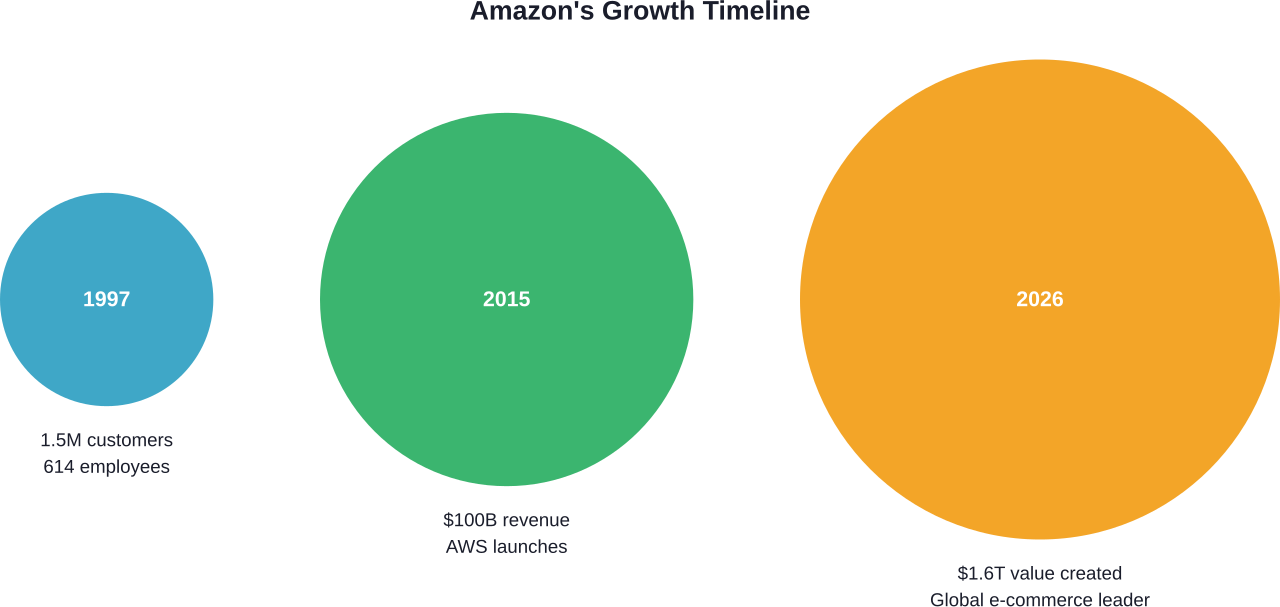
Today’s Amazon operates across multiple massive business segments:
- E-commerce platforms that dominate online retail in North America and hold significant market share globally
- Amazon Web Services (AWS), the world’s leading cloud infrastructure provider
- Prime membership, which grew substantially year-over-year with Prime Day surpassed all expectations, with Cyber Monday later surpassing it
- Advertising services that now compete with Google and Facebook
- Entertainment content through Prime Video and Amazon Studios
- Physical retail including Whole Foods and Amazon Fresh
- Devices and services like Alexa, Echo, Kindle, and Fire tablets
Each of these represents a multi-billion-dollar operation. AWS generated a $20 billion revenue run rate as noted in SEC shareholder letters, accelerating its already healthy growth.
What Bezos’s Ownership Actually Means
Owning 9-10% of Amazon in 2026 isn’t like owning 9-10% of a typical company. We’re talking about one of the five largest companies by market capitalization in the world.
According to Forbes, this stake makes Bezos the fourth-richest person globally. That ranking fluctuates with Amazon’s stock price and his stock sales, but he consistently ranks among the top five wealthiest individuals worldwide.
His ownership also grants him substantial voting power. While he doesn’t have majority control, a 9-10% stake in a company where most shares are held by passive institutional investors gives him enormous influence over corporate decisions.
As Executive Chairman, he combines this ownership stake with a formal leadership role. This means he’s involved in:
- Major strategic decisions and long-term direction
- Evaluating potential acquisitions and new business ventures
- Setting corporate culture and maintaining Amazon’s “Day 1” philosophy
- Representing Amazon’s interests to regulators and the public
The “Day 1” Philosophy
In SEC filings, Bezos articulated his famous “Day 1” philosophy: “Day 2 is stasis. Followed by irrelevance. Followed by excruciating, painful decline. Followed by death. And that is why it is always Day 1.”
This mindset—treating Amazon as if it’s still a startup despite its massive scale—has defined the company’s culture for decades. Bezos even named his office building “Day 1” and took the name with him when he moved buildings.
His continued ownership and chairman role help preserve this culture even as professional management handles daily operations.
Other Bezos Ventures Beyond Amazon
Bezos’s wealth from Amazon has funded an expanding portfolio of other interests:
- Blue Origin is perhaps his most capital-intensive venture. The space exploration company achieved a significant milestone when New Shepard reached space in 2015 and afterwards successfully landed back on Earth. Bezos himself flew into space on Blue Origin NS-16 in 2021. The company aims to make space travel more accessible and eventually enable off-world civilization.
- The Washington Post was purchased by Bezos in 2013 for $250 million (equivalent to approximately $345,535,714 in 2025 dollars). Under his ownership, the newspaper has expanded its digital presence and rebuilt its business model for the internet age.
- Bezos Earth Fund represents his philanthropic commitment to climate change, pledging $10 billion toward climate and environmental initiatives. This came alongside Amazon’s Climate Pledge, a commitment to be net zero carbon by 2040, a decade ahead of the Paris Agreement.
He also holds investments in various other companies and funds, diversifying beyond Amazon stock. These range from tech startups to established companies across multiple sectors.
How Amazon Ownership Has Evolved
The structure of Amazon ownership reflects broader trends in modern corporate governance. When Amazon went public in 1997 with Bezos owning 43%, it represented a founder-controlled company. Today’s ownership structure is more dispersed but still unusual.
Most mega-cap tech companies either have dual-class share structures that preserve founder control (like Meta and Alphabet) or have seen founders reduce their stakes to minimal levels. Amazon falls in between—Bezos maintains substantial ownership without having special voting rights.
| Year | Key Ownership Event | Bezos Stake |
|---|---|---|
| 1997 | Amazon IPO | ~43% |
| 2019 | Divorce settlement with MacKenzie Scott | ~16% (after transfer) |
| 2021 | Transition to Executive Chairman | 14.1% |
| 2025 | Continued stock sales | ~8-9% |
| 2026 | Current holdings | ~9-10% |
This gradual reduction in ownership percentage hasn’t diminished the absolute value of his stake. Amazon’s market cap has grown so substantially that 9% today is worth far more than 43% was in 1997.
Regulatory Scrutiny and Public Perception
Bezos’s ownership and leadership of Amazon haven’t been without controversy. The company faces ongoing regulatory scrutiny over antitrust concerns, labor practices, and market dominance.
As the public face of Amazon for decades, Bezos has testified before Congress, defended the company’s practices, and weathered criticism about everything from worker conditions to tax strategies to competitive practices.
His ownership stake makes him personally synonymous with Amazon’s corporate decisions in the public mind, even though he’s no longer CEO. When Amazon announces warehouse openings, changes to Prime pricing, or new environmental initiatives, Bezos’s wealth and ownership inevitably enter the conversation.
The company has responded to various criticisms with initiatives like the $15 minimum wage, sustainability commitments running on 100% renewable energy by 2030, with Amazon maintaining over 86 renewable energy projects as noted in SEC filings.
The Future of Bezos’s Amazon Stake
Will Bezos continue reducing his ownership percentage? Almost certainly. Wealthy individuals typically diversify over time, and he has other ventures requiring capital.
But a complete exit seems unlikely. Amazon represents his legacy, his creation, and a vehicle for continued wealth generation. Even if his stake drops to 5% or lower over the coming decade, he’ll likely remain the largest individual shareholder.
What’s more interesting is the governance question. As Executive Chairman, Bezos maintains formal influence. But as Andy Jassy establishes himself and the board evolves, the balance between Bezos’s vision and new leadership will shape Amazon’s direction.
The company’s recent proxy statements show a 20-for-1 stock split and various governance proposals, indicating Amazon continues maturing as a public company. These changes don’t diminish Bezos’s role but do reflect Amazon’s evolution beyond a founder-led startup.
Frequently Asked Questions
Does Jeff Bezos still control Amazon?
Bezos does not have majority control but remains highly influential through his significant ownership stake and role as Executive Chairman.
How much is Jeff Bezos’s Amazon stake worth?
As of 2026, his stake is estimated to be worth between $180–230 billion, depending on Amazon’s stock price.
When did Jeff Bezos step down as Amazon CEO?
He stepped down in July 2021 and transitioned to Executive Chairman, with Andy Jassy becoming CEO.
Why has Jeff Bezos been selling Amazon stock?
He has sold shares to fund ventures like Blue Origin, diversify investments, and support philanthropic efforts.
Who owns more Amazon stock than Jeff Bezos?
No individual owns more shares than Bezos, though large institutions like Vanguard and BlackRock hold significant stakes on behalf of investors.
What happens to Amazon if Jeff Bezos sells all his stock?
Such a move would likely occur gradually to avoid market disruption, but it is considered unlikely.
Does Jeff Bezos get a salary from Amazon?
He may receive compensation, but most of his wealth comes from his Amazon stock rather than salary.
Conclusion: Bezos’s Enduring Amazon Connection
So, does Jeff Bezos still own Amazon? Absolutely. With approximately 9-10% of the company’s shares, he remains the largest individual shareholder by a substantial margin. His stake is worth over $180 billion and represents the majority of his net worth.
His transition to Executive Chairman hasn’t severed his connection to Amazon—it’s redefined it. He’s shifted from managing daily operations to focusing on long-term strategy, new initiatives, and preserving Amazon’s culture. Meanwhile, he’s using Amazon-generated wealth to fund space exploration, media ownership, and climate initiatives.
The ownership structure will likely continue evolving. Bezos may sell more shares. Other investors’ stakes will fluctuate. But the fundamental reality seems stable: Jeff Bezos created Amazon, grew it from a garage startup to a $1.6 trillion value-creating enterprise, and maintains both significant ownership and meaningful influence over its future direction.
For investors, employees, customers, and observers, understanding this ownership structure matters. It explains who has power, where value accrues, and how decisions get made at one of the world’s most influential companies.
Want to track Amazon’s ownership changes and Bezos’s stake over time? Monitor SEC filings, which publicly report major transactions and insider holdings. These documents provide the most authoritative data on who owns Amazon and how that ownership evolves.
 No credit card required