
 EN
EN  ES
ES  FR
FR  DE
DE  IT
IT  KO
KO  JA
JA  ZH
ZH  AR
AR  PT
PT  TR
TR PL
PL
Quick Summary: Amazon’s best-selling projectors in 2026 span budget models under $200, mid-range home theater units from brands like Epson and BenQ, and premium 4K laser projectors. Top sellers include portable projectors with built-in speakers, bright business models exceeding 3000 lumens, and versatile home entertainment units balancing price and performance.
Amazon’s projector bestseller lists reveal what real buyers actually purchase when they’re ready to invest. These rankings update frequently based on sales volume, making them a reliable snapshot of which projectors deliver enough value to convert browsers into buyers.
But here’s the thing—popularity doesn’t always equal quality. Some budget models appear frequently in sales rankings through aggressive pricing while premium options sell steadily to informed buyers. Understanding what separates genuinely good projectors from cheap bestsellers requires looking beyond the sales rank.
What Makes Projectors Sell on Amazon
Sales velocity on Amazon depends on several factors that don’t always correlate with technical excellence. Price positioning matters enormously—projectors under $200 generate massive volume despite mediocre specifications.
Amazon’s Best Sellers data includes projector accessories such as carrying cases in projector-related categories. The ViewSonic PJ-CASE-008 carrying case appears in Amazon’s Best Sellers rankings, showing that buyers invest in protection and portability.
Review count amplifies sales momentum. A projector with 5,000 reviews attracts more clicks than one with 50 reviews, even if average ratings are similar. This creates a feedback loop where bestsellers continue selling because they’re already bestsellers.
Price Brackets That Dominate Sales
Amazon’s projector sales concentrate in three distinct price ranges. Budget models under $200 capture impulse buyers and first-time projector owners. Mid-range units between $300-$800 target home theater enthusiasts seeking quality without premium pricing.
Premium projectors above $2,000 sell in smaller volumes but represent serious buyers. The Panasonic PT-VMZ71 WUXGA LCD Laser Projector is priced from $3,196.00 according to Amazon’s Best Sellers data, selling to commercial and dedicated home theater customers.

Understand Performance Across Products and Campaigns
WisePPC brings together advertising data and product-level results into a single view. It helps track how different campaigns affect sales and makes it easier to compare performance without switching between multiple reports.
Trying to Get a Clearer View of Performance?
Use WisePPC to:
- analyze keyword and campaign performance
- track product sales alongside ad data
- separate paid and organic results more clearly
👉 Explore WisePPC to get a clearer view of your Amazon advertising data.
Top-Selling Budget Projectors Under $500
Budget models appear frequently in sales rankings. These units typically have lower brightness and resolution specifications but hit price points that make them accessible gifts and casual entertainment options.
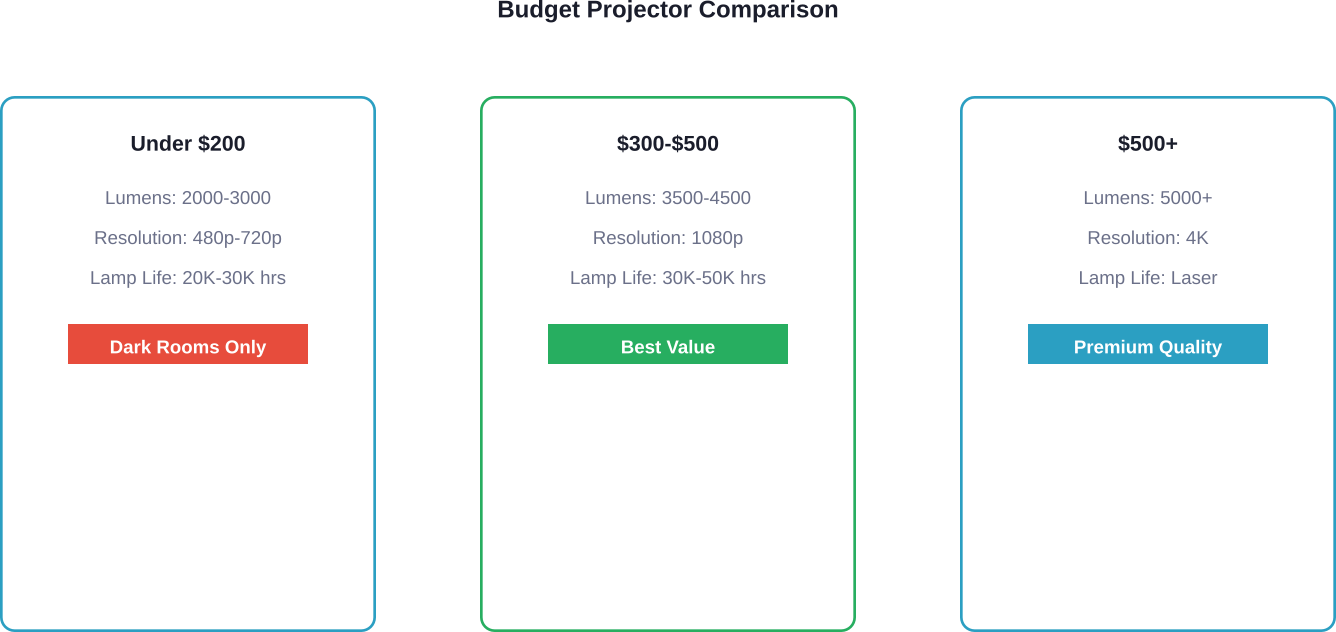
The reality? Budget projectors under $200 are typically optimized for dark room viewing with smaller screen sizes. Ambient light quickly washes out their 2000-3000 lumen output.
Some user reports indicate budget projectors work adequately for casual dark-room use but may disappoint for daytime viewing. Users report satisfaction when expectations align with capabilities—movie nights in dark basements work fine. Large screens or daytime viewing expose their limitations quickly.
InFocus Entry-Level Models
InFocus models appear consistently in Amazon’s bestseller data. The InFocus IN114xv offers DLP XGA resolution with 3800 Lumens at an offer from $379.00, positioning it as a capable presentation projector that crosses into home entertainment territory.
The InFocus IN112XV Presentation Projector offers DLP SVGA resolution with 3600 Lumens, with offers from $280.00. This model targets business presentations and educational settings where brightness matters more than pixel density.
Both models support 3D content and include HDMI connectivity—features that help them compete against cheaper alternatives lacking modern inputs.
Mid-Range Home Theater Winners
The $500-$1,500 range represents the sweet spot for serious home entertainment without professional-grade pricing. These projectors typically deliver true 1080p resolution, 3000+ lumens brightness, and lamp lifespans exceeding 30,000 hours.
According to authoritative projector buying guides from BenQ, five critical factors determine home theater projector quality: color accuracy, resolution, brightness, contrast ratio, and lens quality. Mid-range bestsellers balance these elements effectively.
Epson’s Consistent Sales Leaders
Epson models dominate Amazon’s mid-range projector sales. Testing data shows Epson projectors excel at color accuracy and brightness uniformity—factors that matter more than peak specifications for actual viewing experiences.
The Epson Home Cinema series balances price and performance effectively. While specific current models change, Epson consistently positions projectors with 3LCD technology that delivers better color accuracy than competing DLP models at similar prices.
Real talk: Epson’s dominance stems partly from aggressive pricing on older models when new releases arrive. Savvy buyers score previous-generation projectors at steep discounts while sacrificing little actual performance.
BenQ Home Entertainment Models
BenQ’s gaming and home theater projectors sell steadily through combination of low input lag and accurate color reproduction. According to BenQ’s projector specifications, their home theater models prioritize features like HDR tone mapping that budget brands omit.
BenQ models frequently include vertical lens shift and keystone correction that simplify installation. These practical features reduce the “Amazon return” risk that plagues projectors requiring complex mounting.
Premium Laser Projectors Breaking Through
Laser projectors represent the fastest-growing segment in Amazon’s projector sales. These units eliminate traditional lamp replacement while delivering superior brightness consistency and longer operational lifespans.
The ViewSonic LS630W 4500 Lumens DLP WXGA Laser Projector has offers from $735.00, making it one of the more affordable laser options. According to Amazon’s data, it maintains strong sales in the office presentation category.
Laser projectors eliminate traditional lamp replacement and offer extended operational lifespans. Traditional projector lamps have varying lifespans depending on brightness mode and model, with replacement costs ranging significantly.
Professional-Grade Units Selling to Consumers
Commercial projectors increasingly sell to serious home theater enthusiasts. The Panasonic PT-VMZ71 WUXGA LCD Laser Projector delivers 7000 Lumens—brightness that enables daytime viewing even with some ambient light.
These professional models include features like LAN control and 360-degree projection orientation that exceed typical home requirements. But their superior image quality and reliability justify the investment for dedicated installations.
Portable Projector Sales Explosion
Portable projectors represent Amazon’s fastest sales growth category. These compact units sacrifice brightness and resolution for ultimate portability and battery operation.
Testing reveals wide performance variation among portable models. Premium portable projectors deliver 2-4 hours of battery life at full brightness. Budget alternatives often provide just 45-90 minutes of usable runtime.
The portability factor drives sales despite technical compromises. Users prioritize the ability to project anywhere over image quality that’s merely adequate rather than exceptional.
What Amazon Reviews Actually Reveal
Amazon’s review system provides valuable insights when interpreted correctly. Five-star ratings mean less than reading actual review text describing real-world usage scenarios.
Common complaint patterns emerge across budget projectors: overheated units, fan noise drowning out dialogue, and color accuracy that makes skin tones appear sickly green. These issues rarely appear in product descriptions but surface consistently in three-star reviews.
Positive reviews for budget projectors often reveal low expectations—buyers express delight that a $150 projector works at all. Premium projector reviews demand more, criticizing minor color temperature variations or slight uniformity issues.
Reading Between Rating Lines
Verified purchase badges matter enormously. Non-verified reviews frequently come from promotional units provided to influencers who aren’t incentivized toward critical evaluation.
Review recency matters more for projectors than most electronics. A model with 500 five-star reviews from 2024 might have quality control issues in 2026 production runs that don’t reflect in the overall rating.
Look for reviews mentioning specific measurements—throw distance calculations, actual lumens testing, or color gamut measurements. These reviewers invested time in objective evaluation rather than subjective impressions.
Understanding Projector Specifications
Amazon product pages list specifications that buyers frequently misunderstand. Lumens ratings vary wildly in real-world meaning depending on measurement standards.
According to authoritative projector resources from BenQ, ANSI lumens provide standardized brightness measurements. Cheap projectors often list “LED lumens” or “lumens” without ANSI qualification—marketing numbers that overstate actual brightness by 3-5x.
Resolution specifications deceive through pixel-shifting technology. Some “4K” projectors use 1080p chips that rapidly shift pixels to simulate higher resolution. While not matching native 4K, pixel-shifting produces noticeably sharper images than standard 1080p.
| Specification | What It Means | What Matters |
|---|---|---|
| ANSI Lumens | Standardized brightness measurement | 3000+ for rooms with ambient light |
| Contrast Ratio | Difference between brightest white and darkest black | Higher is better, but often inflated in specs |
| Throw Ratio | Distance needed per screen width | Determines placement flexibility |
| Lamp Life | Hours before replacement needed | Check replacement cost, not just hours |
| Input Lag | Delay between signal and display | Under 50ms for gaming, less critical for movies |
The Brightness Confusion
Brightness requirements depend entirely on viewing environment. A dark home theater needs just 1500-2000 ANSI lumens for a 100-inch screen. That same screen in a room with windows requires 3000-4000+ lumens for acceptable image visibility.
According to BenQ’s projector brightness guides, ambient light, screen size, and desired image brightness all interact. Doubling screen size requires roughly quadrupling lumens to maintain equivalent brightness per square inch.
Business Projectors Crossing Into Home Use
Professional presentation projectors increasingly sell to home users seeking reliable performance. These models prioritize brightness and connectivity over home theater features like accurate color calibration.
The Optoma EH412STx Short Throw 1080p HDR Professional Projector delivers 4000 Lumens, designed for conference rooms. But its short throw ratio and high brightness make it surprisingly effective for small home theater spaces.
Business projectors typically omit features like advanced color modes or HDR support. They’re optimized for presentations and spreadsheets rather than movie watching. But that simplicity translates to reliability and value.
Outdoor Projection Driving Sales
Outdoor projector use exploded during recent years and continues driving sales of specific projector types. Outdoor projection demands higher brightness than indoor use since eliminating ambient light completely isn’t possible.
Successful outdoor projection requires minimum 3000 lumens, preferably 4000+ for any twilight viewing. Budget projectors claiming 2000 lumens produce barely visible images once the sun sets but hasn’t fully disappeared.
Weatherproofing matters less than buyers expect since most outdoor projectors live indoors between uses. Portability and ease of setup drive purchase decisions more than ruggedization.
Smart Features and Streaming Integration
Built-in streaming apps increasingly influence projector sales. These “smart projectors” eliminate external streaming devices by running Android TV or proprietary platforms directly.
But here’s the catch—built-in smart features become obsolete faster than projector hardware. A projector from 2024 might lack streaming apps that launched in 2026, while external streaming devices receive regular updates.
Sound familiar? Smart TVs face identical obsolescence issues. Dedicated streaming devices provide more flexibility despite requiring additional hardware.
When Built-In Matters
Portable projectors benefit most from integrated streaming and batteries. Carrying a single device beats managing a projector, streaming stick, and portable power supply as separate components.
Traditional home theater projectors may gain less from smart features compared to portable units. These installations typically have dedicated AV receivers and streaming devices that deliver superior audio and more comprehensive app support.
Making the Right Choice
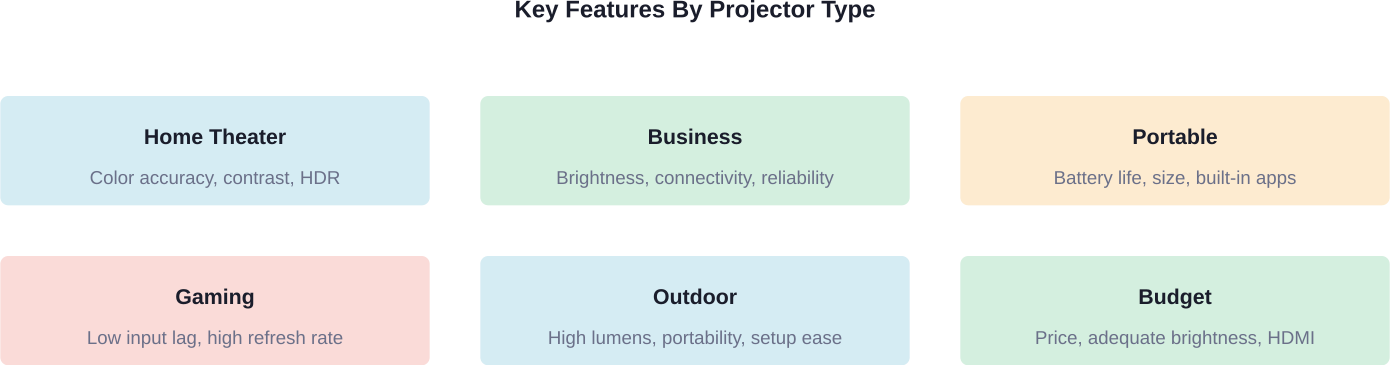
Amazon’s bestseller lists provide useful starting points but shouldn’t dictate final decisions. The best-selling projector for one use case might completely fail another.
Start by defining the viewing environment. Budget projectors perform better in dark dedicated theater rooms than in spaces with ambient light. Living rooms with windows demand significantly higher brightness and potentially short-throw designs.
Screen size plans matter enormously. A 100-inch screen requires dramatically more lumens than a 60-inch screen to achieve equivalent brightness. According to projector throw calculators, room dimensions constrain both screen size and projector placement options.
Sound quality deserves consideration beyond specifications. Built-in projector speakers rarely satisfy serious viewing. Budget for external speakers or soundbars unless only casual viewing is planned.
Now, this is where it gets interesting. The projector that’s perfect on paper might produce an image tone that bothers specific viewers. Color temperature preferences vary individually—some prefer warm tones while others want cooler, more neutral images.
Frequently Asked Questions
What’s the best budget projector on Amazon under $300?
The InFocus IN112XV consistently ranks among top sellers in this price range, delivering 3600 lumens brightness and SVGA resolution. It works well for presentations and casual movie watching in dark rooms, though it lacks the resolution for detailed content on large screens.
How many lumens do I need for daytime projector use?
Daytime viewing requires minimum 3000-3500 ANSI lumens for acceptable image visibility, with 4000-5000+ lumens providing significantly better results. According to authoritative projector brightness guides, ambient light and screen size interact—larger screens need proportionally more brightness.
Are cheap Amazon projectors worth buying?
Budget projectors under $200 are typically optimized for dark room viewing with smaller screen sizes. Some user reports indicate budget projectors work adequately for casual dark-room use but may disappoint for daytime viewing. Spending $400-600 provides dramatically better results.
Do I need 4K for a projector or is 1080p enough?
For screens under 100 inches at typical viewing distances, 1080p resolution appears sharp to most viewers. 4K becomes noticeably beneficial on screens above 120 inches or when sitting closer than 1.5x screen width. Native 4K costs significantly more than pixel-shifting pseudo-4K technology.
What’s the difference between DLP and LCD projectors?
DLP projectors use micro-mirrors and typically deliver higher contrast ratios with deeper blacks. LCD projectors (particularly 3LCD designs) generally produce more accurate colors and avoid the “rainbow effect” some viewers perceive with DLP. Both technologies work well in quality implementations.
How long do projector lamps last and what do replacements cost?
Projector lamps have varying lifespans depending on brightness mode and model, with replacement costs ranging significantly. Laser projectors eliminate traditional lamp replacement and offer extended operational lifespans. The higher upfront cost of laser projectors gets offset by eliminating replacement expenses.
Can I use a projector outdoors effectively?
Outdoor projection works well after sunset with projectors delivering 3000+ lumens. Wait until twilight fades for best results—even bright projectors struggle against significant ambient light. Dedicated outdoor screens with higher gain help but aren’t required for good results.
Conclusion
Amazon’s best-selling projectors represent what buyers actually purchase rather than what reviewers recommend. This creates interesting opportunities—budget bestsellers serve specific needs well despite technical limitations, while premium models deliver dramatically better experiences that justify their higher prices.
The right projector depends entirely on specific viewing environments and expectations. Dark rooms enable affordable projectors to perform surprisingly well. Bright spaces or large screens demand significantly more capable units regardless of bestseller status.
Check current Amazon bestseller rankings for up-to-date pricing and model availability. Sales patterns shift as new releases arrive and older models receive deep discounts. The best value often comes from previous-generation models that sacrifice little actual performance while costing significantly less than latest releases.
 No credit card required