
 EN
EN  ES
ES  FR
FR  DE
DE  IT
IT  KO
KO  JA
JA  ZH
ZH  AR
AR  PT
PT  TR
TR PL
PL
Quick Summary: Digital products dominate Amazon’s marketplace in 2026, with eBooks, audiobooks, software, printables, and online courses leading sales. According to SEC filings, Amazon’s net sales reached $213.4 billion in Q4 2025, with digital categories driving significant growth. Beauty & personal care and home & kitchen rank as the most profitable seller categories, while third-party sellers account for 61% of paid units on the platform.
Amazon’s digital marketplace has evolved into a powerhouse for creators, entrepreneurs, and established brands. With net sales increasing 14% to $213.4 billion in Q4 2025 according to SEC filings, the platform continues to demonstrate robust growth across digital categories.
Digital products offer unique advantages: no inventory management, instant delivery, and scalability that physical goods can’t match. But what actually sells? Which categories generate consistent revenue, and how has the landscape shifted in 2026?
This guide breaks down the best-selling digital products on Amazon, backed by authoritative data from SEC filings, Statista reports, and marketplace analytics. Whether evaluating market opportunities or planning a digital product launch, understanding these trends provides a competitive foundation.
Understanding Amazon’s Digital Product Ecosystem
Amazon operates multiple channels for digital products, each serving distinct markets and creator needs. The Kindle Store, Amazon Digital Services, and third-party seller marketplace collectively form an ecosystem worth hundreds of billions annually.
According to SEC filings, the United States remains Amazon’s largest market with $489.7 billion in net sales for 2025, followed by Germany at $45.9 billion and the UK at $43.2 billion. This geographic distribution matters when targeting digital products to specific audiences.
The Third-Party Seller Phenomenon
Third-party sellers now account for 61% of paid units on Amazon, according to Statista data. This shift reflects the platform’s evolution from retailer to marketplace facilitator.
The value of third-party seller services reached significant levels throughout 2025, demonstrating sustained demand for marketplace infrastructure. For digital product creators, this means access to Amazon’s massive customer base without the overhead of physical fulfillment.
Cost Structure for Digital Sellers
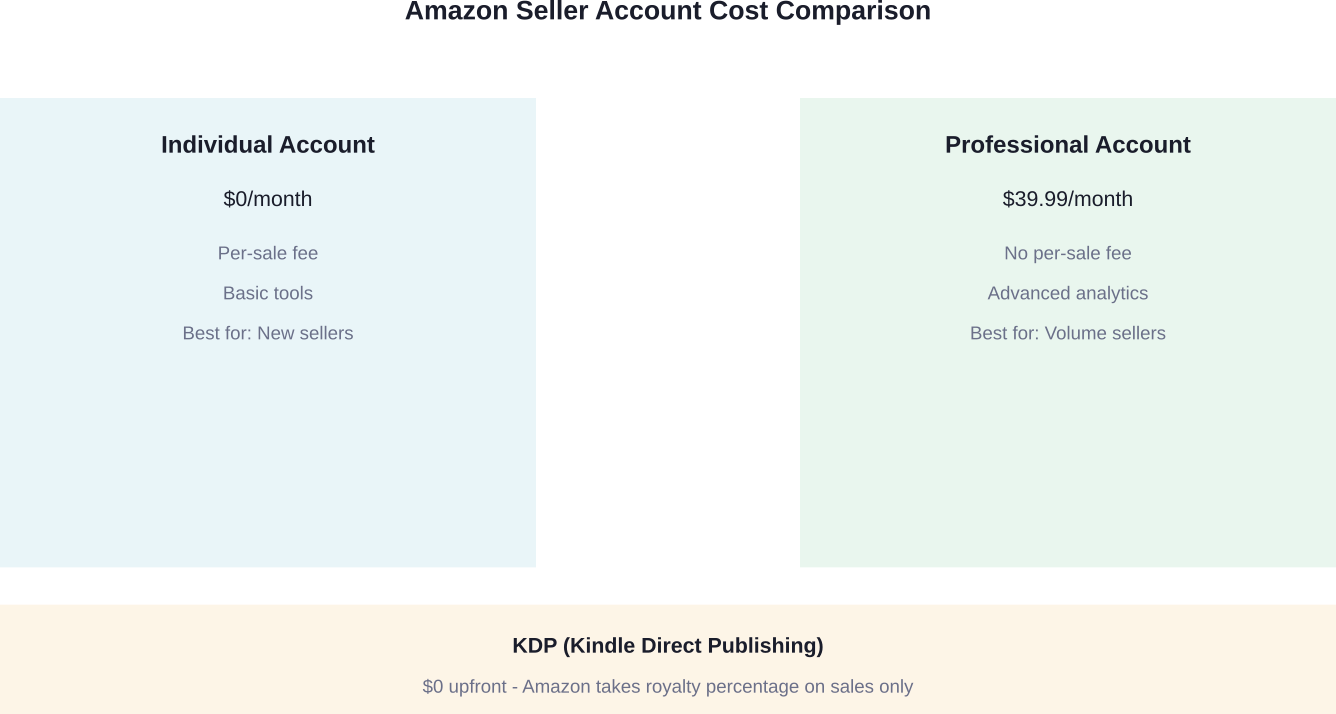
Amazon offers two seller account types with different pricing models. According to marketplace analysis, an Individual Seller Account charges per sale with no monthly fee, while a Professional Account costs $39.99 per month and includes advanced tools.
For Kindle Direct Publishing (KDP) specifically, there’s no upfront cost. Amazon takes a percentage of royalties only when sales occur, making it accessible for authors without capital investment.
Top-Selling Digital Product Categories on Amazon
Amazon’s digital marketplace spans numerous categories, but certain product types consistently outperform others. Community discussions and marketplace data reveal clear patterns in what sells.
eBooks and Kindle Publications
eBooks remain the cornerstone of Amazon’s digital product offerings. The Kindle Direct Publishing platform allows authors to publish directly to millions of readers without traditional publishing gatekeepers.
According to Amazon News, the Amazon Books Editors selected Patrick Ryan’s “Buckeye” as the top pick for 2025. Earlier in the year (mid-2025), Charlotte McConaghy’s “Wild Dark Shore” had ranked number one for the first half of 2025. These editorial choices influence buyer behavior and search trends.
The creator economy has fundamentally changed publishing. According to LA Film School’s analysis of the creator economy, it has transformed how artists build their careers by allowing direct connection with audiences.
Real talk: eBooks work because they solve the distribution problem that plagued independent authors for decades. No printing costs, no warehouse storage, no shipping logistics. Just content and customers.
Audiobooks and Audio Content
Audio content represents another major digital category on Amazon, typically distributed through Audible integration. The format has grown substantially as consumers seek content for commuting, exercise, and multitasking scenarios.
Amazon Best Sellers in Digital Media frequently feature audio editing and production titles, indicating strong interest in both consuming and creating audio content.
Software and Digital Tools
Software products, particularly productivity tools and creative applications, maintain steady sales on Amazon’s digital marketplace. These range from one-time purchase applications to subscription-based services.
The category includes specialized tools for professionals: audio editing software, video production applications, and business management systems.
Digital Courses and Educational Content
Online courses have emerged as a significant digital product category. Educational content creators package expertise into structured learning experiences that buyers can access instantly after purchase.
This category benefits from the broader creator economy trend. Experts monetize knowledge directly rather than working through traditional educational institutions or publishers.
Printables and Digital Templates
Printables represent a hybrid category: digital products designed for physical use. These include planners, worksheets, wall art, organizational templates, and similar items that buyers download and print themselves.
Community discussions frequently mention printables as an accessible entry point for new digital sellers, requiring design skills but no specialized technical knowledge.
Digital Music and Media Files
Music downloads continue to generate sales despite streaming dominance. Amazon’s digital music store offers individual tracks and albums for permanent ownership rather than subscription access.
The format appeals to collectors, audiophiles seeking high-quality files, and users who prefer ownership over rental models.
Most Profitable Categories for Digital Sellers
Sales volume doesn’t always correlate with profitability. According to a 2024 Statista survey, beauty & personal care and home & kitchen ranked as the most profitable seller categories worldwide on Amazon. Clothing, shoes, and jewelry followed closely.
But here’s the thing: these statistics cover all Amazon products, not exclusively digital ones. For digital-specific profitability, different dynamics apply.
Why Profitability Matters More Than Volume
High-volume categories often mean intense competition and downward price pressure. Lower-volume niches with dedicated audiences sometimes generate better returns for individual sellers.
Digital products eliminate manufacturing and fulfillment costs, making even modest sales volumes potentially profitable. The question becomes: which categories support sustainable pricing while maintaining demand?
| Product Category | Entry Barrier | Competition Level | Pricing Flexibility | Profit Potential |
|---|---|---|---|---|
| eBooks (fiction) | Low | Very High | Limited | Moderate |
| eBooks (technical) | Medium | Medium | High | High |
| Audiobooks | Medium | High | Medium | High |
| Software tools | High | Medium | Very High | Very High |
| Online courses | Medium | Growing | High | Very High |
| Printables | Low | High | Low | Moderate |
| Digital music | Medium | Very High | Low | Low |
Amazon’s Performance Data: What the Numbers Reveal
Amazon’s SEC filings provide concrete performance indicators for the overall platform, offering context for digital product opportunities.
Recent Financial Performance
According to SEC filings, Amazon announced Q4 2025 results showing net sales increased 14% to $213.4 billion, compared with $187.8 billion in Q4 2024. This growth occurred despite a $2.8 billion favorable impact from foreign exchange rates.
The International segment generated $1.0 billion in operating income for Q4 2025, down slightly from $1.3 billion in Q4 2024. Meanwhile, AWS (Amazon Web Services) segment operating income reached $12.5 billion, up from $10.6 billion in the prior year period.
Net income increased to $21.2 billion in Q4 2025, or $1.95 per diluted share, demonstrating strong profitability despite massive operational scale.
Cash Flow and Investment Capacity
Operating cash flow increased 15% to $113.9 billion for the trailing twelve months ending Q1 2025, compared with $99.1 billion for the same period in 2024, according to SEC filings.
However, free cash flow decreased to $25.9 billion for the trailing twelve months, compared with $50.1 billion in the prior year period. This decline reflects substantial capital expenditure in infrastructure and technology.
Quarterly Trends Throughout 2025
Looking at quarterly progression, Q3 2025 showed net sales of $180.2 billion (13% increase), while Q1 2025 reached $155.7 billion (9% increase from $143.3 billion in Q1 2024).
These figures demonstrate consistent growth across the year, with seasonal variation typical for retail operations. The platform’s scale creates opportunities for digital sellers to reach customers during these high-traffic periods.
Geographic Distribution and Market Opportunities
According to Statista data, the United States accounts for $489.7 billion in Amazon net sales for 2025, making it by far the largest market. Germany follows with $45.9 billion, and the UK with $43.2 billion.
This geographic concentration has implications for digital product strategy. English-language products access the largest market by default, while localized content for German and UK markets represents secondary opportunities with less competition.
International Expansion Considerations
Amazon operates marketplaces in numerous countries beyond the top three. For digital products with universal appeal or those easily localized, international markets offer growth potential.
Translation costs for eBooks, courses, and software remain relatively low compared to physical product expansion. A successful English-market digital product can potentially scale to German, French, Spanish, Italian, and Japanese marketplaces with modest investment.
How to Start Selling Digital Products on Amazon
Entering Amazon’s digital marketplace requires understanding platform-specific processes and requirements. The approach varies depending on product type.
Kindle Direct Publishing for eBooks
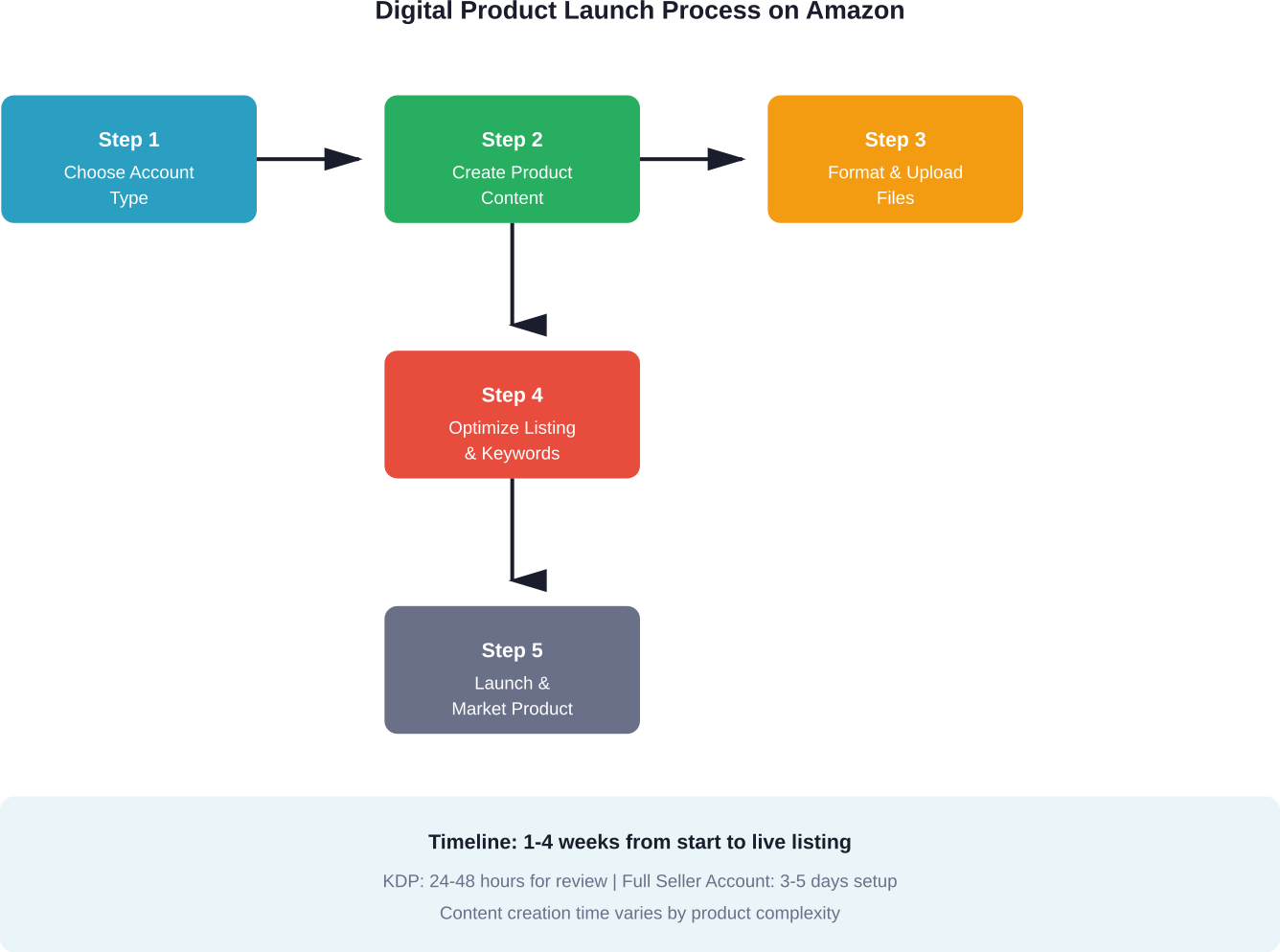
KDP represents the most accessible entry point for digital sellers. The process involves creating an account, formatting manuscript files according to specifications, designing or commissioning cover art, and uploading content.
According to marketplace guides, KDP requires no upfront costs. Amazon takes a percentage of royalties, with rates depending on pricing and distribution choices. Authors can select 35% or 70% royalty rates based on their price point and distribution preferences.
The platform handles all file delivery, payment processing, and customer service for downloads. Creators focus on content production and marketing rather than technical infrastructure.
Amazon Digital Services for Other Products
Software, courses, and other digital products typically require a Professional Seller account at $39.99 monthly. This account type provides access to necessary tools for digital delivery and customer management.
Product listing creation follows standard Amazon catalog processes: write compelling descriptions, select appropriate categories, optimize with relevant keywords, and set pricing strategies.
Printables via Print-on-Demand Integration
Printables occupy a middle ground. Sellers can list downloadable PDF files through their seller account, delivering files digitally while customers handle printing.
Alternatively, integration with Amazon’s print-on-demand services allows automatic physical fulfillment when buyers prefer pre-printed versions.
Optimizing Digital Product Listings for Amazon Search
Amazon operates a search algorithm (A9/A10) that determines product visibility. Understanding optimization fundamentals separates successful listings from invisible ones.
Keyword Research and Placement
Keywords drive discovery on Amazon. Potential customers type search terms, and the algorithm matches those terms to product listings based on relevance signals.
Research involves identifying terms customers actually use, not just industry jargon. Tools like Amazon’s own search suggestion feature reveal popular queries. Competitor analysis shows which keywords successful products target.
Strategic placement matters: titles carry the most weight, followed by bullet points, then product descriptions. Backend search terms provide additional indexing opportunities without cluttering customer-facing copy.
Title Optimization
Amazon titles follow specific best practices. Include the primary keyword, product type, key features, and format information within character limits (typically 200 characters, but category-specific rules vary).
For eBooks, this might be: “Digital Marketing Strategy 2026: Complete Guide to Social Media, SEO, and Content Marketing for Small Business Success (eBook).”
The structure provides keyword coverage while remaining readable for human shoppers.
Bullet Points and Description
Bullet points highlight key features and benefits. Each bullet should address customer questions, incorporate relevant keywords naturally, and provide specific value propositions.
Descriptions allow longer-form content. This space works for storytelling, detailed specifications, usage scenarios, and additional keyword coverage without keyword stuffing.
Pricing Strategy
Pricing affects both conversion rates and algorithm ranking. Amazon considers customer behavior signals like click-through and purchase rates when determining search visibility.
Competitive pricing within category norms tends to generate better performance than extreme high or low pricing. For digital products, psychological pricing ($9.99 vs. $10) still influences purchase decisions.
Reviews and Social Proof
Customer reviews heavily influence both algorithm ranking and purchase decisions. Products with more positive reviews typically outrank those with few or negative reviews, assuming other factors remain equal.
Amazon’s policies strictly prohibit incentivized reviews, fake reviews, or review manipulation. Building legitimate reviews requires delivering quality products and encouraging satisfied customers to share experiences.
Marketing Strategies Beyond Amazon’s Platform
While Amazon provides traffic through its search engine, external marketing amplifies reach and reduces dependence on algorithm changes.
Content Marketing and SEO
Creating blog content, YouTube videos, or podcasts related to digital product topics builds audiences that can be directed to Amazon listings. This strategy works particularly well for educational products and eBooks.
Content marketing establishes authority, provides value before asking for sales, and generates organic search traffic from Google and other search engines.
Social Media Promotion
Platforms like Instagram, TikTok, Facebook, and LinkedIn offer direct audience access. The key involves providing value and building relationships rather than pure self-promotion.
For digital products, demonstration content works well: tutorials using software, behind-the-scenes of course creation, excerpts from eBooks, or design process for printables.
Email Marketing
Building an email list creates an owned audience independent of any platform. This asset provides direct communication channels for new product launches, promotions, and content distribution.
Email sequences can nurture potential customers through educational content before introducing products, improving conversion rates compared to cold traffic.
Paid Advertising Options
Amazon offers internal advertising through Sponsored Products, Sponsored Brands, and Sponsored Display campaigns. These pay-per-click options place products prominently in search results and competitor listings.
External paid advertising through Google Ads, Facebook Ads, or other platforms can drive traffic directly to Amazon product pages, though conversion tracking becomes more complex.

Stop Guessing What Sells – Use Data Before You Scale
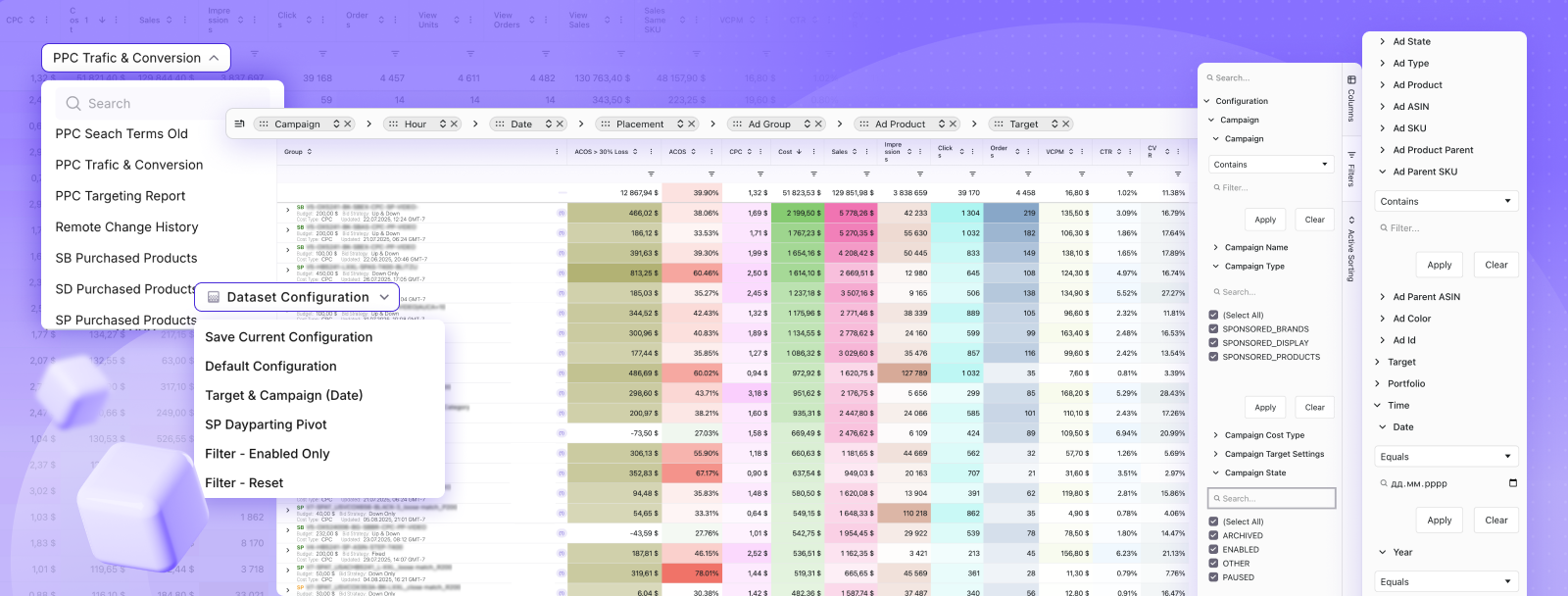
Finding a winning digital product on Amazon is one thing. Scaling it without wasting budget is a different problem. Once ads are running, it gets hard to see what’s actually driving sales and what’s just eating out. That’s where WisePPC comes in.
Instead of jumping between reports or exporting data, you get everything in one place – ads, sales, search terms, and performance. You can quickly spot which keywords bring real conversions, which campaigns are underperforming, and where your budget is leaking. It also helps separate ad-driven sales from organic ones, so you’re not overpaying for results you would have gotten anyway. If you’re testing or scaling digital products, this kind of visibility saves time and avoids bad decisions. You’re not guessing what works – you see it clearly and act on it.
Explore WisePPC or register to get a clearer view of your Amazon performance.
Current Trends Shaping Digital Products in 2026
Several macro trends influence what sells and how customers consume digital products on Amazon.
AI Integration and AI-Generated Content
Artificial intelligence tools have transformed content creation capabilities. According to LA Film School’s analysis of the creator economy, it has transformed how artists build their careers by allowing direct connection with audiences.
AI enables rapid content production, but this also increases competition and potentially commoditizes certain product types. Differentiation increasingly comes from unique perspectives, specialized knowledge, and human expertise that AI can’t replicate.
Amazon introduced the “Ask this Book” feature in 2025, available on the Kindle iOS app for U.S. customers, with plans to expand to Kindle devices and Android OS. This feature lets readers ask questions about books they’re reading and receive spoiler-free answers, changing how customers interact with content.
Interactive and Multimedia Content
Static content faces growing competition from interactive experiences. Online courses incorporating video, quizzes, and community elements outperform simple PDF downloads.
Even eBooks increasingly include multimedia elements where platforms support them: embedded audio, video links, or interactive diagrams.
Subscription and Membership Models
While Amazon primarily operates on individual purchase transactions, Kindle Unlimited represents a subscription access model. According to Amazon News from January 2023, Kindle Unlimited subscribers can access over 5 million books, audiobooks, comics, and more.
Creators can participate in Kindle Unlimited, receiving payment based on pages read rather than direct purchases. This model provides exposure but requires volume to generate significant income.
Niche Specialization
Broad, general products face intense competition. Community discussions reveal that successful sellers often operate in specialized niches targeting specific industries or underserved audiences.
A generic “productivity guide” competes with thousands of similar products. A “productivity system for remote healthcare administrators” targets a specific audience with specialized needs.
Challenges Facing Digital Product Sellers on Amazon
No marketplace offers only advantages. Understanding limitations helps set realistic expectations and develop mitigation strategies.
High Competition in Popular Categories
Popular categories like self-help eBooks or business courses contain thousands of competing products. Standing out requires exceptional quality, strategic marketing, or unique angles.
New entrants face established competitors with review histories and algorithm favorability. Building momentum takes time and persistence.
Platform Dependency Risks
Selling exclusively on Amazon creates vulnerability to policy changes, algorithm updates, or account issues. Platform dependency means Amazon controls access to customers and can change terms unilaterally.
Diversification across multiple platforms (own website, other marketplaces, social platforms) reduces this risk but increases operational complexity.
Pricing Pressure
Digital products face downward pricing pressure from multiple factors: low incremental cost encourages competitive pricing, consumers expect digital products to cost less than physical equivalents, and market saturation in popular categories drives price competition.
Maintaining profitable pricing requires strong value propositions and differentiation.
Quality Control and Piracy
Digital products can be easily copied and distributed illegally. While Amazon implements DRM (Digital Rights Management) for certain product types, determined pirates find workarounds.
Piracy primarily affects highly popular products rather than niche offerings, but it represents an ongoing challenge for digital content creators.
Review Manipulation Concerns
Amazon has struggled with fake reviews, paid reviews, and review manipulation. While the company invests heavily in detection and enforcement, the problem persists.
Legitimate sellers can find themselves competing against products with artificially inflated review counts or ratings, creating unfair competitive dynamics.
Long-Term Success Strategies for Digital Product Sellers
Short-term tactics generate initial sales, but sustainable businesses require long-term strategic thinking.
Build a Product Portfolio
Multiple related products create cross-selling opportunities and reduce dependence on single product success. An author with ten books generates more stable income than one with a single title, even if individual books sell moderately.
Product portfolios also improve algorithmic visibility through Amazon’s “customers also bought” and recommendation systems.
Focus on Customer Experience
In saturated markets, customer experience becomes a key differentiator. This includes clear product descriptions, accurate representations, responsive customer service, and genuine value delivery.
Positive customer experiences generate organic reviews, repeat purchases, and word-of-mouth marketing that compound over time.
Continuous Improvement and Updates
Digital products can be updated more easily than physical goods. Regular updates keep content current, demonstrate ongoing commitment, and provide opportunities to re-engage previous customers.
Updated products also receive algorithmic boosts as Amazon’s systems recognize fresh content.
Data-Driven Decision Making
Amazon provides sellers with substantial performance data: search terms driving traffic, conversion rates, customer demographics, and competitive positioning.
Successful sellers analyze this data systematically, testing different approaches and optimizing based on results rather than assumptions.
Brand Building Beyond Amazon
While selling on Amazon, simultaneously building a brand presence outside the platform creates long-term asset value. This includes social media following, email lists, owned websites, and industry reputation.
External brand equity provides negotiating leverage with Amazon, alternative revenue streams, and resilience against platform changes.
| Strategy | Time Investment | Difficulty | Impact on Sales | Long-Term Value |
|---|---|---|---|---|
| Listing optimization | Low | Low | High | Medium |
| Amazon PPC ads | Medium | Medium | High | Low |
| Content marketing | High | Medium | Medium | Very High |
| Email list building | High | Medium | Medium | Very High |
| Social media presence | Very High | Medium | Medium | High |
| Product portfolio expansion | Very High | High | Very High | Very High |
| Customer service excellence | Medium | Low | Medium | High |
Real-World Examples: What’s Actually Selling
Amazon Best Sellers in Digital Media provides concrete examples of successful products. The list consistently features titles like “I AM THE PROMPT: How Creatives Reclaim Their Power in the Age of AI” by Denesha Davenport, demonstrating demand for AI-related content.
Categories include audio editing, video production, and creative software tools. These technical resources appeal to the creator economy: individuals building content businesses who need skill development.
According to Amazon News coverage, books like Patrick Ryan’s “Buckeye” and Charlotte McConaghy’s “Wild Dark Shore” represent editorial picks that influence buying behavior. While these examples span both digital and physical formats, they demonstrate Amazon’s role in content discovery and promotion.
Community discussions reveal that successful sellers often operate in specialized niches: specific design templates for particular professions, educational content for niche industries, or tools solving particular workflow problems.
Emerging Opportunities in Amazon’s Digital Marketplace
Looking forward, several areas present growth potential for new and existing digital product sellers.
Technical Skills Training
As technology evolves rapidly, demand for skill development remains constant. Digital courses, eBooks, and tutorials teaching emerging technologies, software platforms, or technical methodologies consistently find audiences.
The rise of AI tools creates particular opportunities: content teaching effective AI usage, prompt engineering, or AI integration into various professions addresses current market needs.
Professional Tools and Templates
Business professionals and creators need templates, frameworks, and tools that accelerate work. Digital products offering ready-to-use resources for specific industries or functions solve immediate problems.
Examples include financial modeling templates, project management frameworks, design systems, or industry-specific document templates.
Wellness and Personal Development
Self-improvement content maintains steady demand across economic conditions. Digital products addressing mental health, productivity, relationship skills, or personal finance appeal to broad audiences.
The key to success in this crowded space involves specificity: targeting particular demographics, methodologies, or problem areas rather than generic advice.
Creative Assets for Content Creators
The creator economy needs assets: music tracks, video templates, graphic elements, sound effects, or editing presets. Digital sellers can serve other creators with production resources.
This represents selling picks and shovels during a gold rush: profiting from the creator economy trend by enabling other creators.
Frequently Asked Questions
What are the best-selling types of digital products on Amazon in 2026?
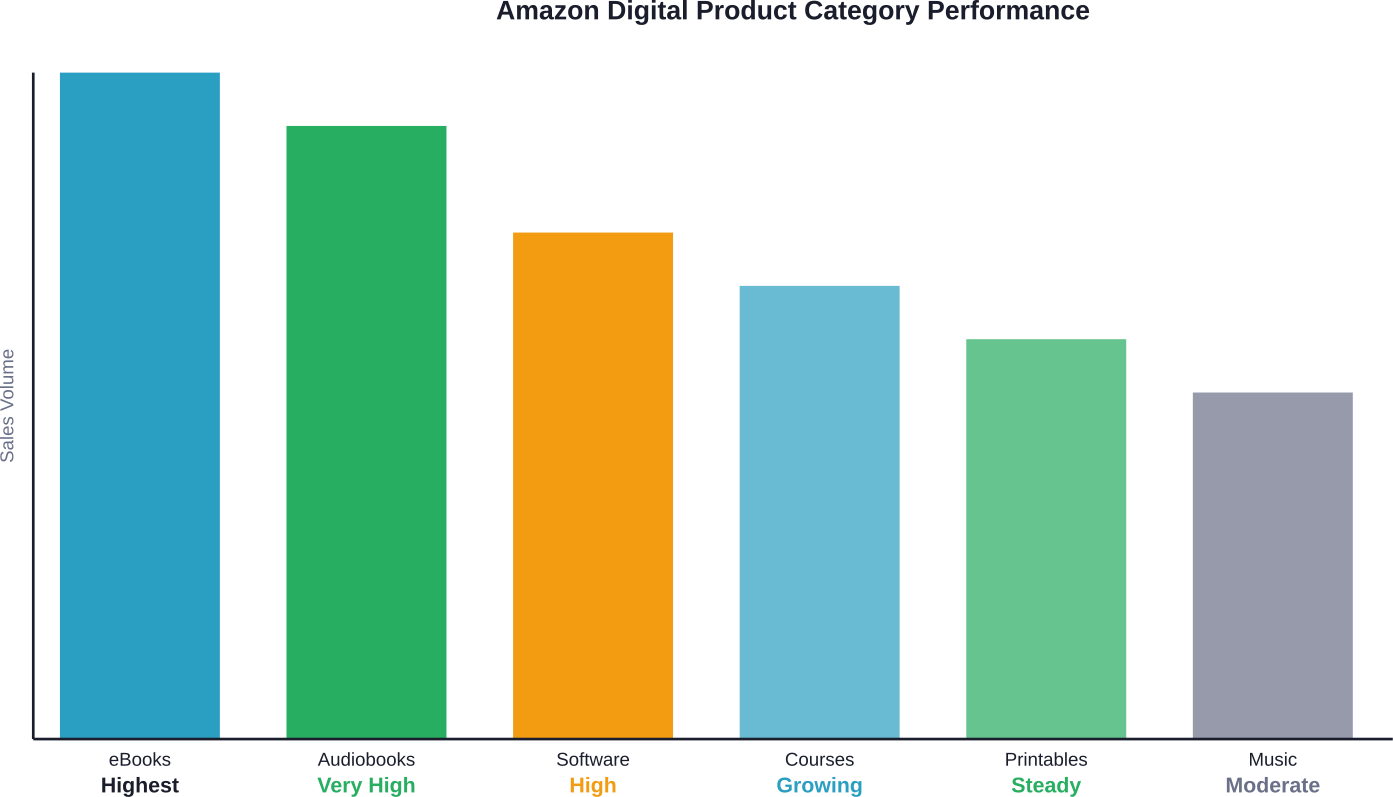
eBooks consistently lead Amazon’s digital product sales, particularly through Kindle Direct Publishing. Audiobooks rank second, followed by software tools, online courses, and printables. According to Amazon Best Sellers data, AI-related content, creative tools, and professional development materials show particularly strong performance. According to a 2024 Statista survey, beauty & personal care and home & kitchen ranked as the most profitable seller categories worldwide on Amazon, though digital-specific profitability varies by niche competition and pricing power.
How much does it cost to start selling digital products on Amazon?
Starting costs depend on the product type and seller account choice. Kindle Direct Publishing requires zero upfront investment—Amazon takes a royalty percentage only when sales occur. An Individual Seller Account charges per sale with no monthly fee, while a Professional Seller Account costs $39.99 per month according to marketplace analysis. Content creation costs vary widely: a simple eBook might cost nothing beyond time, while professional course production with video could require thousands in equipment and editing.
Can I sell digital courses on Amazon?
Amazon’s marketplace does support digital course sales, though the platform isn’t specifically optimized for course delivery like dedicated learning management systems. Sellers typically use a Professional Seller Account to list course content as downloadable files or provide access codes to externally-hosted course platforms. The limitation involves Amazon’s focus on individual product sales rather than ongoing course experiences with community features, progressive content unlocking, or student interaction tools.
How do I optimize my digital product listings for Amazon search?
Optimization starts with keyword research to identify terms customers actually search. Place primary keywords in titles, secondary keywords in bullet points, and additional terms in descriptions and backend search fields. Competitive pricing influences both conversion rates and algorithmic ranking. High-quality product images, detailed descriptions addressing customer questions, and positive customer reviews all improve search visibility. Regular monitoring of search term reports and performance data allows continuous refinement based on actual customer behavior rather than assumptions.
What’s the difference between selling on Amazon versus my own website?
Amazon provides massive existing traffic—millions of potential customers already shopping on the platform. This eliminates the need to build an audience from scratch. However, Amazon controls customer relationships, takes significant commission percentages, creates platform dependency, and offers limited brand-building opportunities. Operating an independent website provides complete control, direct customer relationships, higher profit margins, and long-term brand equity, but requires building traffic through SEO, advertising, or content marketing. Many successful sellers use both channels: Amazon for reach and discovery, owned platforms for margins and customer relationships.
Are digital products on Amazon subject to piracy?
Digital piracy remains an ongoing challenge across all platforms, including Amazon. The company implements Digital Rights Management for certain product types, particularly Kindle eBooks, which provides some protection but isn’t foolproof. Generally speaking, niche products face less piracy risk than mass-market bestsellers simply because the piracy effort doesn’t justify the limited demand. Strategies to minimize impact include competitive pricing that makes piracy less attractive, regular content updates that make pirated versions outdated, and building direct relationships with customers who prefer supporting creators directly.
How long does it take to start making money with digital products on Amazon?
Timelines vary dramatically based on product quality, market competition, marketing effort, and category selection. KDP authors report timelines ranging from immediate first-week sales to six months before consistent revenue. Products in saturated categories typically require longer to gain traction compared to niche offerings. Initial sales often come slowly as products build review history and algorithmic trust. Marketing acceleration through external traffic, advertising, or content promotion can compress timelines significantly. Most successful sellers report treating the first 3-6 months as an investment period focused on optimization and learning rather than expecting immediate profitability.
Taking the Next Step in Amazon’s Digital Marketplace
Amazon’s digital marketplace continues evolving, with net sales reaching $213.4 billion in Q4 2025 according to SEC filings. The platform offers unprecedented access to global customers, sophisticated delivery infrastructure, and payment processing that would cost thousands to replicate independently.
But success isn’t automatic. The same accessibility that benefits new sellers also intensifies competition. Standing out requires combining quality products, strategic optimization, persistent marketing, and continuous improvement.
The data is clear: eBooks, audiobooks, software tools, courses, and printables all generate substantial sales. Third-party sellers account for 61% of paid units on Amazon according to Statista, demonstrating the platform’s openness to independent creators and entrepreneurs.
Geographic opportunities extend beyond the U.S. market. With Germany generating $45.9 billion and the UK $43.2 billion in annual net sales, localized versions of successful products can access substantial additional markets.
The creator economy fundamentally changed how artists, educators, and experts monetize knowledge. As LA Film School observed, creators can now “connect directly with audiences, monetize their work without intermediaries and shape their own journey.” Amazon serves as one powerful channel within this broader transformation.
For those considering entry into Amazon’s digital marketplace, the opportunity exists. The question isn’t whether digital products can succeed on Amazon—clearly they can and do. The question is whether specific products, properly executed and marketed, can carve out profitable positions within chosen niches.
Start with thorough market research. Identify underserved needs, analyze successful competitors, and develop differentiated offerings. Invest in quality—whether that means professional editing for eBooks, clear video production for courses, or polished design for printables.
Launch strategically with optimized listings, competitive pricing, and marketing plans that extend beyond Amazon’s internal traffic. Build for the long term: expand product portfolios, nurture customer relationships, and create brand equity that transcends any single platform.
The best-selling digital products on Amazon in 2026 share common characteristics: they solve specific problems, deliver genuine value, target defined audiences, and maintain quality standards that generate positive reviews. Products meeting these criteria have viable paths to success regardless of category.
The opportunity remains substantial. The execution determines outcomes.
 No credit card required