
 EN
EN  ES
ES  FR
FR  DE
DE  IT
IT  KO
KO  JA
JA  ZH
ZH  AR
AR  PT
PT  TR
TR PL
PL
Selling on Amazon looks different depending on where you’re doing it. In the U.S., everything runs through a single market with shared tax systems and one language. Europe? It’s a mix of countries, currencies, and regulations and each one plays by slightly different rules. For experienced sellers, it’s not just about where the buyers are. It’s about how ready your business is to handle the shift.
One Platform, Two Very Different Playing Fields
Selling in the U.S. and Europe might happen under the same Amazon brand, but the setup, scale, and seller experience feel completely different once you’re in it.
- Amazon US is massive and fast-moving: Approximately 1.65 million active sellers (Marketplace Pulse estimate as of end of 2025) compete across the marketplace. One tax system. One language. One FBA network. You move fast, or you fall behind.
- Europe is fragmented-but full of opportunity: You’re not selling in “Amazon Europe.” You’re listing in Germany, France, Spain, Italy, and the UK – each with its own rules, shopper habits, and tax authorities.
- The U.S. has volume: In recent years (e.g., North America segment reached $426.3 billion in 2025), it drives significantly higher volume than EU markets combined. But it also comes with saturation. Standing out means aggressive pricing or heavy ad investment.
- Europe rewards precision: Less competition in certain categories (like Home & Kitchen or Pet Supplies) means sellers who do the work – translations, VAT setup, localized branding – can carve out space without a price war.
- Growth paths are different: U.S. expansion tends to be about scaling products that already work. In Europe, it’s more about adapting to fit each country and optimizing for longer-term diversification.
Sometimes the biggest difference isn’t the size of the market: It’s how many steps you need to take to reach the customer. And that shift changes everything about how you plan, track, and optimize performance.
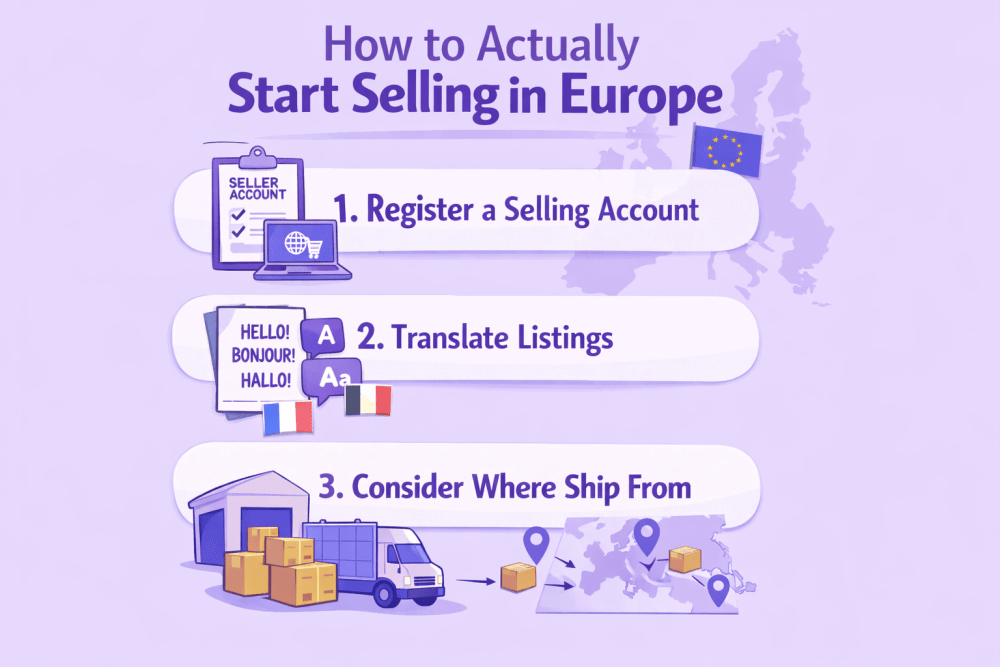
How to Actually Start Selling in Europe
Getting into Amazon Europe isn’t hard. But it’s not one-click either. The process works – if you know what to expect. Here’s how sellers typically make the jump from the U.S. to Europe without spinning their wheels.
Register a Selling Account for Europe
You’ll need to set up a European account through Amazon Global Selling. This doesn’t mean you get one master account for all of Europe: You’ll still be selling into individual countries like Germany, Italy, or France. What the global setup does is let you manage it all through one login and one central place in Seller Central. Start by going to the “Sell Globally” tab under Inventory. From there, you can register for new marketplaces and begin syncing listings.
Translate Listings and Match Local Categories
Europe isn’t just one audience. Your U.S. listings won’t carry over word-for-word. Amazon requires that you translate your listings into the local language of each country where you sell. That includes bullet points, product titles, descriptions – everything the customer sees.
Also, product categories don’t always map cleanly. A product that’s listed under “Patio, Lawn & Garden” in the U.S. might fall under a completely different structure in the German marketplace. You’ll need to recheck placement to keep discoverability intact.
Consider Where You’ll Ship From
Some U.S. sellers ship cross-border directly from U.S. warehouses to European customers. Others use Fulfillment by Amazon in Europe. Each has pros and tradeoffs:
- Shipping from the U.S.: No need to register for VAT up front, but slower delivery and higher costs. Works better for low-volume tests.
- Pan-European FBA: Faster delivery, local shipping rates, but requires VAT registration in each country where inventory is stored. More upfront work, better customer experience.
If you’re serious about scaling in Europe, Pan-EU FBA is the smoother long-term move – even if it’s more setup early on.

From Data Chaos to Control – WisePPC and Cross-Market Clarity
Selling across multiple Amazon regions sounds like scale. In reality, it often means juggling disconnected dashboards, short data windows, and guessing where your actual profit comes from. It’s too easy to lose the thread when each marketplace tracks performance differently.
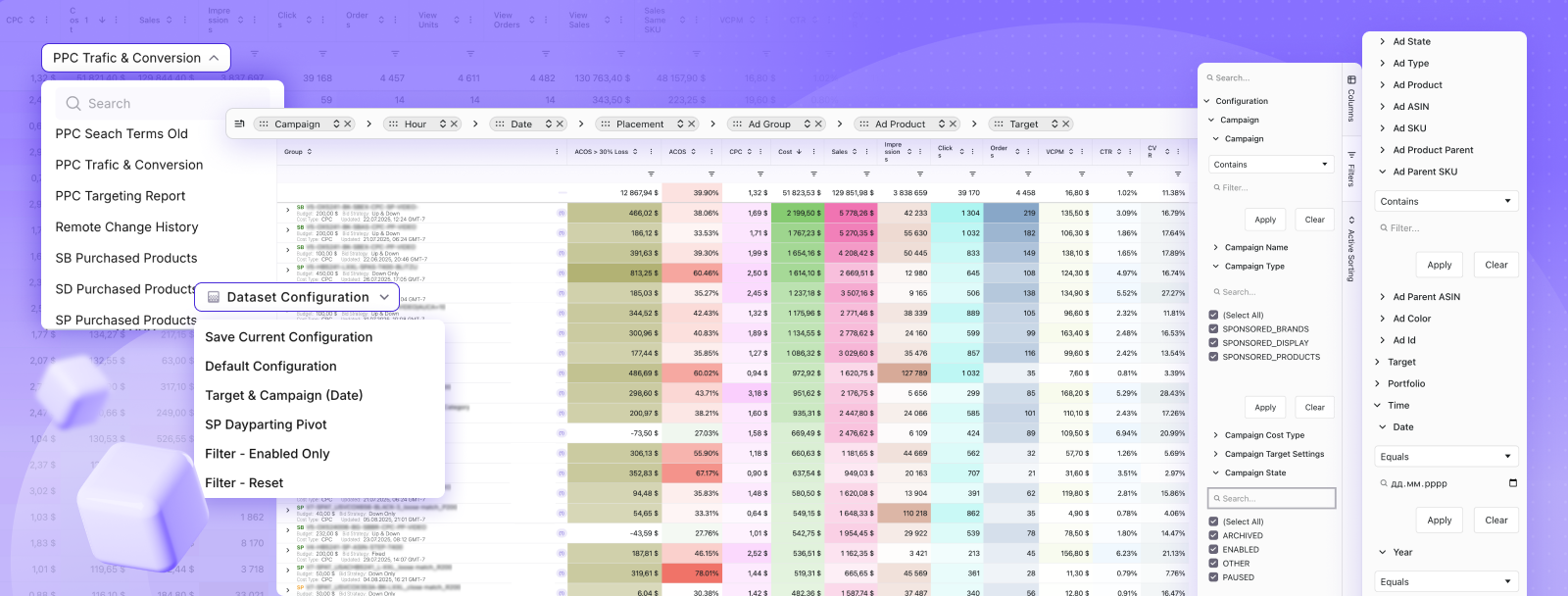
That’s exactly why we built WisePPC. Our platform connects directly with Amazon to give you real-time performance insights, historical trends, and campaign-level clarity – all in one place. You can compare marketplaces side by side, track organic vs. ad-driven sales, and spot wasted spend before it turns into a pattern. Whether you’re expanding into Europe, growing in the U.S., or doing both, we help you stay grounded in the data that matters.
We’re not just another dashboard. WisePPC is a toolkit built to simplify complexity for brands scaling across borders. You can follow updates on Facebook, Instagram, or LinkedIn, or reach out directly with a question. We pay attention to feedback, and it shapes how the product evolves.
Selling Across Borders Means Understanding VAT
If you’ve only sold in the U.S., VAT is going to feel like a curveball at first. Unlike U.S. sales tax – which gets added at checkout – Value Added Tax is baked into the listed price. It’s charged at every stage of the supply chain, not just the final sale. And it’s not optional: if you’re storing or shipping inventory in Europe, you’re going to need a VAT number in each country where that happens.
Rates vary depending on the country – around 19% in Germany, closer to 20% in the UK or France. That means your margins shift, and your pricing has to account for that. On top of that, there’s distance selling thresholds to keep in mind. If you’re shipping cross-border from one EU country into another and pass a certain revenue threshold, you’re legally required to register for VAT there too.
None of this is meant to scare you off. The system is navigable. Amazon offers tools like the VAT Calculation Service to automate the math, and there are local advisors and accountants who specialize in marketplace sellers. The key is to approach it early – don’t wait until your first EU payout to realize you needed a VAT number six weeks ago.
Tax and Trade Rules You Shouldn’t Ignore
Selling in Europe isn’t just about uploading a product and watching sales roll in. Every country has its own layer of rules – some straightforward, others less so. Miss one, and it could delay shipments or trigger account issues down the line. Here’s what sellers often overlook:
- Customs and import duties: If you’re shipping from outside the EU, expect duties at the border. These depend on product classification, declared value, and shipping terms.
- Labeling requirements: Each country may require specific labels – recycling icons, CE marks, language compliance, or even safety certifications depending on product category.
- Product regulations: What’s legal to sell in the U.S. isn’t always allowed in Europe. That includes things like electronic devices, supplements, and toys. EU safety directives apply by default.
- Environmental compliance: Some EU countries require that you register for packaging waste or electronics recycling schemes. This isn’t handled by Amazon – it’s on you.
- Parallel import restrictions: If you’re selling branded items, check if they’re protected by IP laws in that region. You could run into blocked listings or even legal complaints.
- Export control laws: Selling cross-border sometimes triggers rules around encryption, dual-use goods, or restricted countries. It’s niche, but worth knowing if you’re in a sensitive category.
If you’re not sure how to handle these, Amazon’s Service Provider Network is a decent starting point. There are vetted local firms who specialize in keeping marketplace sellers compliant – so you can stay focused on inventory, pricing, and performance.
Selling in a Dozen Languages
If you’re expanding into Europe, English only gets you so far. Amazon requires that your listings match the native language of the marketplace you’re targeting – German for Amazon.de, Italian for Amazon.it, and so on. That’s not a suggestion. It’s a basic part of discoverability, customer trust, and even compliance in some categories.
But it’s not just about translation – it’s about getting the tone right. German buyers tend to favor precise, technical product details. French shoppers often care more about how something looks and feels, and Spanish customers might look for a more practical, benefit-driven format. One-size-fits-all copy written for the U.S. rarely works without adjustments. Literal translations miss intent. That’s why many sellers end up investing in localized copywriting, not just language services.
Treat every listing like a performance metric: it either converts or it doesn’t. And just like you’d test bids or placements, it’s worth testing your messaging across markets too. Language isn’t just a barrier – it’s part of the sales strategy.
Timing Is Different Everywhere
Promotions don’t land the same way across borders. Prime Day might be global, but everything else – from back-to-school timing to Mother’s Day – shifts depending on where your customer is. The U.K. celebrates Mother’s Day in March. Germany’s peak shopping periods don’t fully match France’s. Even Christmas cutoffs vary based on local carriers and shopping behavior.
If you’re running ads or prepping inventory based on U.S. timing, you’ll likely miss your window. That’s where data starts to matter. Watch your country-level conversion rates. Track when traffic spikes. Look at year-over-year trends once you have a full cycle of European sales. It’s less about copying your U.S. calendar and more about rebuilding one that fits each region.
Treat timing like you would any other performance signal: track, test, adjust. Because in Europe, being early or late – by a week can make a measurable difference in ROI.
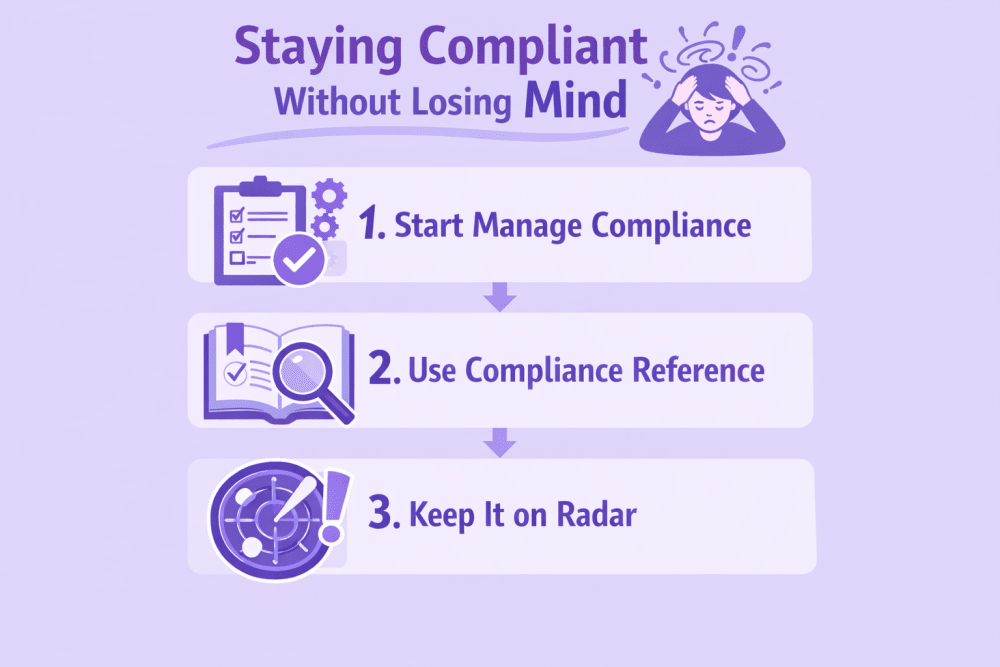
Staying Compliant Without Losing Your Mind
Once you start listing products across borders, compliance becomes part of the day-to-day. Every country has its own safety rules, documentation needs, and category-specific standards. Ignore them, and you’re not just risking a policy warning – you’re risking blocked listings and lost sales.
Start with “Manage Your Compliance”
Amazon’s built-in tool shows what’s required per product – safety documents, test results, certifications – and when it’s due. You can upload files in bulk, check status, and respond to requests without jumping between tabs.
What matters most is timing. It’s easy to forget compliance until something goes wrong, but by then, it’s already affecting sales. Before you launch a new product or ship into a new country, check if documentation is needed. It’s faster to handle upfront than after something’s been flagged.
Use the “Compliance Reference” Tool to Save Time
This one’s for early-stage planning. If you’re not sure what’s required for your category in, say, Germany versus Italy, this tool gives you a searchable list by ASIN, category, or product type. It also links out to vetted service providers who can help with testing or certification.
It won’t fill out the forms for you, but it’ll save hours of searching across forums, PDFs, and conflicting advice.
Keep It on Your Radar
Compliance doesn’t end after you upload a document. Requirements can change. Amazon can update policies. What passed in 2024 might need updates in 2026. Build this into your product workflow – check documents the same way you check performance metrics. You don’t need to micromanage it, but you do need to stay in the loop.
Conclusion
There’s no universal answer here. The U.S. is still Amazon’s biggest market, with infrastructure and volume to match. It’s fast, competitive, and familiar to most sellers who’ve already found traction. Europe, on the other hand, is more complex – but the friction comes with room to grow. If your team has the bandwidth to handle VAT, language, and logistics, Europe can become a long-term play for diversification and margin stability.
What makes the difference isn’t just geography – it’s clarity. If you can see what’s actually driving performance across regions, manage your inputs, and act fast when something shifts, both markets are viable. Just not with the same playbook.
FAQ
1. Do I need a separate Amazon account to sell in Europe?
Not entirely. Amazon lets you manage U.S. and European accounts through a unified Global Selling setup. But each region still has its own backend rules, local settings, and tax obligations. You’re technically working within one interface, but you’re running multiple marketplaces.
2. Is VAT registration required before I start selling?
It depends where your inventory is stored. If you’re fulfilling from outside the EU and shipping orders one by one, you might not hit registration thresholds right away. But once you store products in an EU country or cross a revenue limit, you’ll need a VAT number – and that’s not optional.
3. Can I use the same product listing across all countries?
Not really. You’ll need to translate each listing into the local language, and in many cases, rework the structure to match how customers in that region search, read, and buy. What works in the U.S. might feel tone-deaf or incomplete elsewhere.
4. How do returns work in Europe compared to the U.S.?
EU law gives buyers 14 days to return most items, but Amazon’s policy is usually 30 days. You don’t always have to cover return shipping – it depends on the reason and your policy – but if you sell from outside Europe, return logistics need planning.
 No credit card required