EN
EN  ES
ES  FR
FR  DE
DE  IT
IT  KO
KO  JA
JA  ZH
ZH  AR
AR  PT
PT  TR
TR  PL
PL Amazon PPC Automation vs Manual Management: Finding the Right Balance

If you spend enough time inside Amazon Ads, you eventually run into the same question: should campaigns be automated or managed manually? On paper, automation promises efficiency and scale. Manual management promises control and precision. In reality, most accounts struggle not because they chose the wrong approach, but because they leaned too far in one direction.
Amazon advertising has simply become too complex to handle entirely by hand, yet too connected to real business decisions to leave fully to algorithms. Bids, budgets, inventory pressure, launches, margins, brand positioning – none of these exist in isolation. Good performance usually comes from knowing when to let systems handle repetitive work and when to step in and make deliberate choices.
This article looks at both sides without trying to crown a winner. The goal is to understand what automation actually does well, where manual management still matters, and how experienced advertisers combine both without losing control of the account.
Why This Debate Exists In The First Place
The automation versus manual argument exists because Amazon PPC sits at the intersection of data and judgment. Some decisions are purely numerical. Others depend on context that software cannot fully understand.
Automation thrives on repetition. Bid adjustments, budget pacing, keyword harvesting, and performance monitoring all follow patterns that machines can execute faster and more consistently than humans. When campaigns scale into thousands of keywords, manual management alone becomes unrealistic.
At the same time, Amazon advertising is not just a math problem. Inventory levels change. Margins shift. Product launches require temporary inefficiency. Competitor behavior alters strategy overnight. These are business decisions, not optimization problems. Algorithms respond to metrics, not intent.
Most frustrations with automation come from expecting it to solve strategic problems. Most frustrations with manual management come from trying to handle operational volume without tools. The tension between the two approaches comes from misunderstanding their roles.
What Automation Actually Does Well
Automation works best when the task is frequent, rule-based, and does not require interpretation beyond predefined thresholds. In other words, when consistency matters more than creativity.
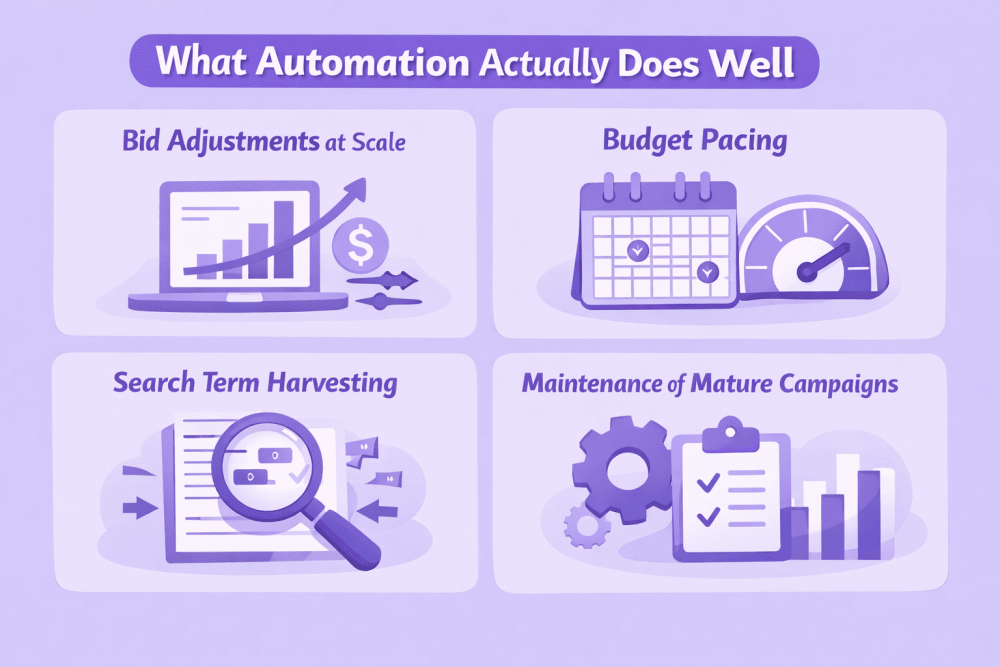
Bid Adjustments at Scale
Bid management is the most obvious example. Performance changes constantly across keywords and placements. A human cannot realistically monitor every change in real time, especially in large accounts. Automation can apply consistent logic around the clock, adjusting bids based on performance signals without fatigue or delay.
This is not about replacing judgment. It is about executing decisions faster once the rules are defined. A well-configured system follows the logic you set, not its own agenda.
Budget Pacing and Allocation
Manual budget management often creates inefficiency without anyone noticing. Strong campaigns run out of budget early while weaker campaigns continue spending. Automation can rebalance spend within defined limits, keeping total budgets intact while directing spend toward better performers.
The key detail here is guardrails. Automation works when limits are clear. Without them, it can optimize toward short-term metrics that do not reflect business goals.
Search Term Harvesting and Negatives
Moving converting search terms into structured campaigns and filtering out poor performers is repetitive work. It follows clear logic and happens continuously. Automation handles this well because the decision criteria rarely change. Humans still review results, but the sorting itself does not require daily attention.
Maintenance of Mature Campaigns
Once campaigns reach stability, most work becomes incremental. Small bid adjustments, minor budget shifts, and routine optimization dominate. This is maintenance, not strategy. Automation frees time that would otherwise be spent on low-impact tasks.
The common thread across these examples is simple. Automation excels when the question is “how often” rather than “why.”

Ad Impact and Revenue Attribution Control With WisePPC
At WisePPC, we see automation as support, not replacement. The goal is to make campaign management faster and clearer without taking decisions away from the people running the business. Amazon advertising moves quickly, and without reliable data it becomes easy to react instead of act with intention. Our approach focuses on giving teams visibility first, then automation second.
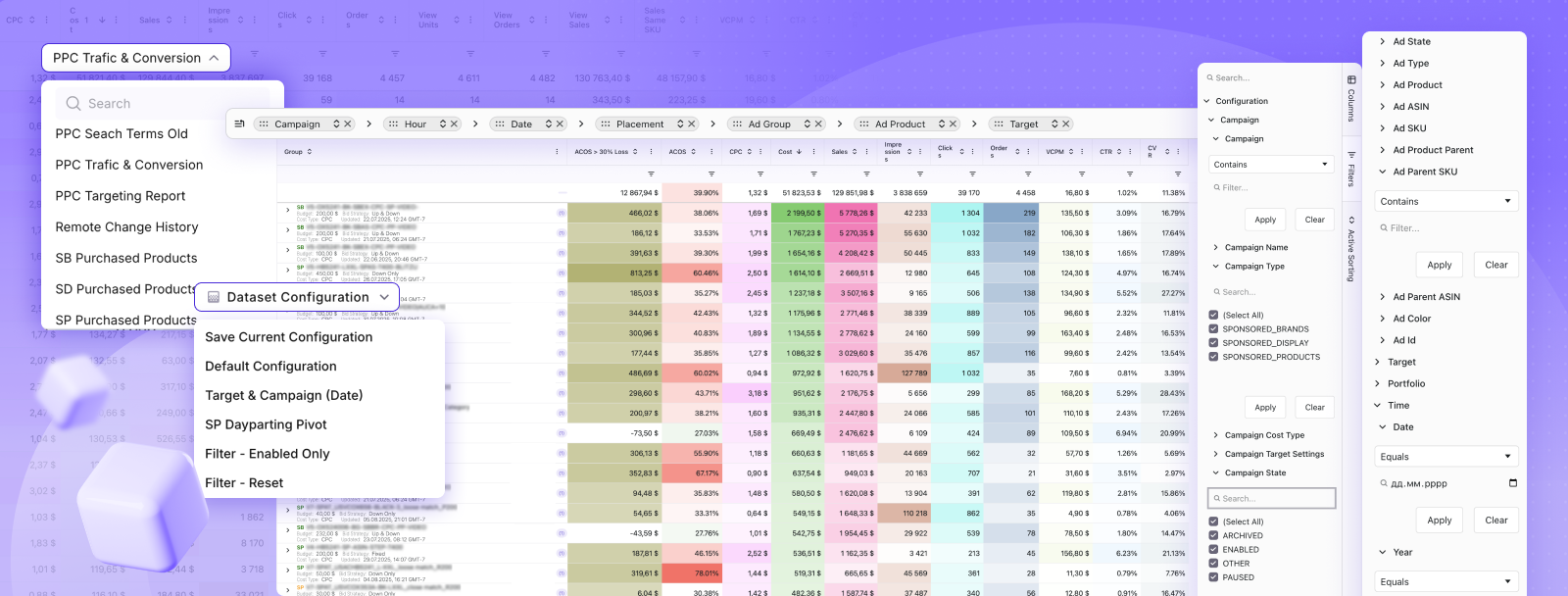
We built WisePPC around clear analytics and practical execution. Real-time performance tracking, advanced filtering, and long-term historical data help teams understand what is actually driving results across ads and sales. Instead of relying on assumptions, advertisers can see trends, compare performance over time, and make decisions based on context rather than short-term fluctuations.
Automation then handles the repetitive side of campaign management. Bulk updates, bid adjustments, and performance monitoring reduce manual workload while keeping control in human hands. The idea is simple – remove complexity where it slows teams down, so they can spend more time on strategy, growth, and the decisions that actually move the business forward.
Where Manual Management Still Matters
Despite improvements in automation tools, some areas remain firmly human-led. These are the places where context matters more than speed.
Campaign Architecture and Targeting Logic
How campaigns are structured determines everything that happens later. Product grouping, match type segmentation, branded versus non-branded separation, and competitor targeting approaches shape data quality and control.
Automation cannot design architecture. It can only operate within it. Poor structure leads to poor automation outcomes, no matter how advanced the tool.
Product Launches and Ranking Phases
Launch periods break most automated logic. Early campaigns often run inefficiently on purpose to build visibility and momentum. Automation typically interprets this as poor performance and reduces bids or spend, undermining the strategy.
Humans understand phases. A launch has different goals in week one than in week six. Automation does not recognize intent unless someone actively adjusts the rules.
Creative Direction and Messaging
Automation can test variations, measure click-through rates, and identify winners. It cannot decide what story a brand should tell or why a message resonates. Creative decisions depend on positioning, audience understanding, and brand consistency across channels.
The testing framework can be automated. The thinking behind what to test cannot.
Business-Level Decisions
Advertising performance rarely exists in isolation. Inventory shortages, cash flow considerations, pricing changes, or broader brand strategy all influence how aggressively ads should run. These decisions involve trade-offs beyond campaign metrics.
An algorithm sees performance data. A human sees the business behind it.
Amazon PPC Automation Vs Manual Management: Pros and Cons
Looking at automation and manual management side by side makes the trade-offs easier to understand. Neither approach is universally better. Each solves a different problem, and most successful accounts rely on both depending on the task and stage of growth.
| Approach | Pros | Cons |
| Automation | Handles large data volumes efficiently | Can optimize for the wrong metric if rules are poorly set |
| Applies changes consistently without fatigue | May react poorly to unusual situations like stockouts or launches | |
| Saves time on repetitive tasks | Requires ongoing supervision and rule adjustments | |
| Faster reaction to performance changes | Less awareness of business context or strategy | |
| Scales easily across large catalogs | Can reduce visibility into why changes happen | |
| Manual Management | Full control over bids, structure, and targeting | Difficult to scale across large accounts |
| Easier to apply business context and judgment | Slower reaction to performance shifts | |
| Greater flexibility for testing and experimentation | Time-intensive and operationally heavy | |
| Better suited for launches and strategic phases | Higher risk of inconsistency or missed signals | |
| Deeper understanding of account behavior over time | Can limit strategic work if too much time is spent on execution |
The table makes one thing clear. Automation improves execution speed and consistency, while manual management improves decision quality. The balance comes from letting each do what it does best rather than forcing one approach to handle everything.
The Hybrid Approach Most Experienced Teams Use
The strongest Amazon advertisers rarely choose sides. Instead, they divide responsibilities.
Machines handle execution. Humans handle direction.
A practical way to think about this is in three layers:
- Automate repetitive execution such as bid adjustments, harvesting, and budget pacing.
- Supervise performance at the portfolio level to ensure automation aligns with business goals.
- Own strategic decisions like launches, structure, and creative direction.
This structure reduces workload without removing accountability. Automation becomes an extension of strategy rather than a replacement for it.
The difference is subtle but important. Automation should follow strategy, not define it.
How to Decide What to Automate In Your Own Account
There is no universal setup because every account differs in scale, margins, and goals. Still, a simple exercise helps clarify decisions.
Start by listing recurring tasks performed weekly or monthly. Bid updates, search term analysis, campaign creation, reporting, budget allocation, creative testing. Then ask a straightforward question for each task: does this require judgment every time?
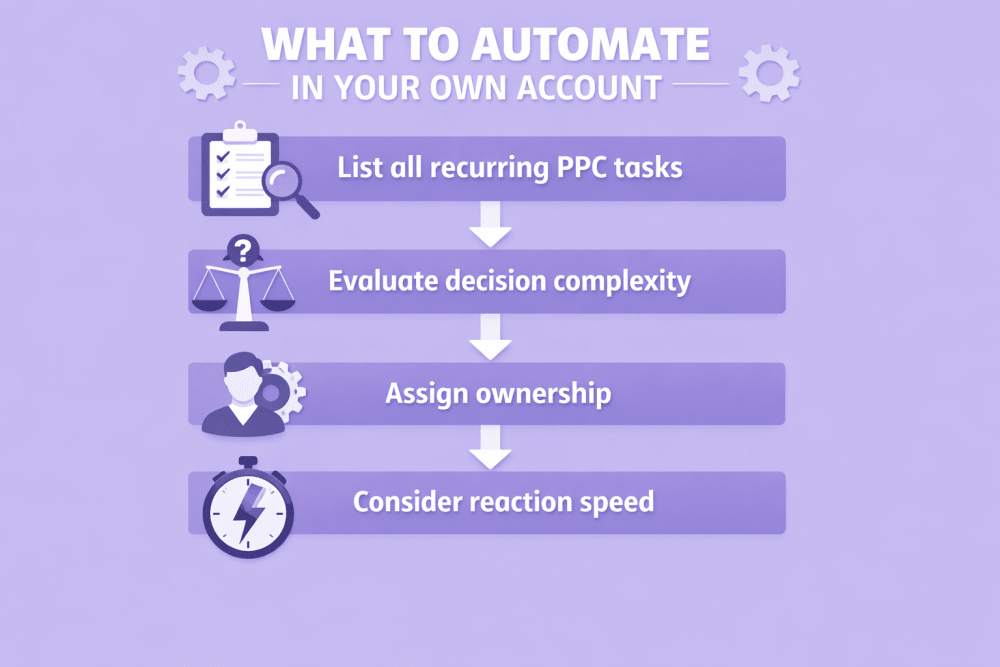
A practical way to work through this looks like this:
- List all recurring PPC tasks. Include everything your team touches regularly, from bid adjustments and keyword harvesting to reporting and campaign setup.
- Evaluate decision complexity. Ask whether the task follows clear rules or requires interpretation and business context.
- Assign ownership. Tasks that rarely need judgment belong in automation. Tasks that occasionally require intervention should be supervised. Tasks driven by strategy should remain human-led.
- Consider reaction speed. If performance improves when changes happen quickly and consistently, automation usually makes sense. If timing and context matter more, manual control is safer.
- Review outcomes regularly. Automation decisions are not permanent. Revisit them as campaigns scale, margins change, or business priorities shift.
This process shifts the conversation away from tools and toward ownership, which is usually where better decisions start.
Finding the Right Balance Over Time
Balance is not static. Accounts evolve.
Early-stage sellers often rely more on manual control while learning what drives performance. As catalogs grow and data becomes cleaner, automation gradually takes over repetitive tasks. During launches or strategic shifts, manual involvement increases again.
The balance moves with the business. What worked six months ago may not make sense today. Periodic reviews of automation rules and manual workflows prevent drift.
This is where many accounts quietly lose efficiency. Automation is set once and forgotten, or manual habits persist long after they stop adding value.
Conclusion
Amazon PPC automation versus manual management is not a competition with a clear winner. Both exist because Amazon advertising demands different types of decisions at different moments. Automation brings speed, consistency, and scale. Manual management brings judgment, context, and strategic intent.
Accounts struggle when one replaces the other entirely. They improve when responsibilities are clear. Let machines handle the repetitive work that drains time and attention. Keep humans focused on decisions that shape direction and risk.
In the end, the goal is not to automate more or manage more manually. It is to make sure every decision in the account is owned by the right layer. When that happens, automation stops feeling risky and manual work stops feeling overwhelming. The system simply works the way it should.
Frequently Asked Questions
Is Amazon PPC automation better than manual management?
Neither approach is universally better. Automation works well for repetitive, data-heavy tasks that require speed and consistency, while manual management is stronger when decisions involve strategy, launches, or business context. Most successful accounts use a combination of both rather than choosing one exclusively.
Can automation fully manage an Amazon PPC account?
In practice, no. Automation can handle execution such as bid adjustments or budget pacing, but it cannot understand inventory constraints, profit goals, or brand positioning. Human supervision is still necessary to ensure automated decisions align with overall business objectives.
When should campaigns be managed manually?
Manual management makes the most sense during product launches, major strategy shifts, creative testing, or when restructuring campaigns. These situations require judgment and flexibility that automation cannot reliably provide on its own.
Does automation always improve performance?
Not automatically. Automation improves efficiency when rules and goals are set correctly. Poorly configured automation can optimize toward the wrong metrics or react too aggressively to short-term changes, which may hurt long-term growth.
How often should automated rules be reviewed?
A light review once a month is usually enough to catch unexpected behavior, while a deeper review every quarter helps ensure thresholds and goals still match margins, competition, and business priorities.
Join the WisePPC Beta and Get Exclusive Access Benefits
WisePPC is now in beta — and we’re inviting a limited number of early users to join. As a beta tester, you'll get free access, lifetime perks, and a chance to help shape the product — from an Amazon Ads Verified Partner you can trust.
 No credit card required
Free in beta and free extra month free after release
25% off for life — limited beta offer
Access metrics Amazon Ads won’t show you
Be part of shaping the product with your feedback
No credit card required
Free in beta and free extra month free after release
25% off for life — limited beta offer
Access metrics Amazon Ads won’t show you
Be part of shaping the product with your feedback