
 EN
EN  ES
ES  FR
FR  DE
DE  IT
IT  KO
KO  JA
JA  ZH
ZH  AR
AR  PT
PT  TR
TR PL
PL
In 2025, the competitive landscape of Amazon advertising demands a well-rounded and data-driven marketing strategy. Whether you’re aiming to boost visibility or drive sales, understanding the core elements of Amazon marketing is crucial. This guide outlines essential strategies, including PPC optimization, product targeting, and brand-building techniques to help you succeed in one of the largest e-commerce platforms in the world.
What is Amazon Marketing Strategy?
Amazon marketing strategy refers to the approach businesses take to promote and sell their products on the Amazon platform. With millions of products and sellers competing for attention, having an effective marketing strategy is essential to stand out. It involves leveraging Amazon’s suite of advertising tools, optimizing product listings, managing customer reviews, and using data-driven tactics to increase visibility and sales.
The strategy typically revolves around understanding customer behavior, targeting the right audience, and using the most relevant advertising options, such as Sponsored Products, Sponsored Brands, and Amazon DSP. A well-crafted Amazon marketing strategy not only helps businesses increase their reach but also ensures they stay competitive in an ever-changing marketplace. It can include key tactics like keyword optimization, bid management, and advanced targeting to drive sales while maintaining a strong ROI.

Understanding Amazon’s Advertising Options
Amazon offers a range of advertising solutions to help businesses increase visibility and sales on its platform. The primary ad types are Sponsored Products, Sponsored Brands, and Sponsored Display Ads.
Sponsored Products
These are the most common and straightforward ads on Amazon. Sponsored Product ads appear within search results and on product detail pages. They promote individual products by targeting specific keywords or products. Sponsored Products are an excellent option for driving immediate sales and increasing product visibility.
Sponsored Brands
Sponsored Brands ads are designed to enhance brand awareness. These ads allow you to feature your brand logo, a custom headline, and multiple products in a banner format. Sponsored Brands ads appear at the top of search results and are particularly effective for businesses looking to drive more traffic to their Amazon Storefront or increase brand visibility across multiple products.
Sponsored Display Ads
Sponsored Display Ads allow you to target customers both on and off Amazon. These ads can appear on Amazon’s product detail pages, reviews pages, and even on external websites. Sponsored Display Ads can retarget customers who have shown interest in your product or similar products, making it an excellent option for re-engaging potential customers.
Key Differences:
- Sponsored Products focus on promoting individual items, making them ideal for specific product sales.
- Sponsored Brands target brand visibility and drive traffic to a company’s storefront, helping to boost overall brand awareness.
- Sponsored Display Ads are more versatile and can target both on-site and off-site customers, useful for retargeting.
Keyword Research and Optimization for Amazon
Effective keyword research and optimization are essential for driving traffic to your listings and ads on Amazon. Here’s how you can maximize your keyword strategy:
Importance of Selecting the Right Keywords
Keywords are the backbone of any Amazon marketing campaign. The right keywords will help your products appear in relevant searches, leading to increased visibility and higher chances of conversion. Choosing the wrong keywords can lead to irrelevant traffic and wasted ad spend.
Tools and Methods for Effective Keyword Research on Amazon
- Amazon’s Keyword Tool: Utilize Amazon’s built-in search bar to identify popular search queries. The autocomplete suggestions can provide insight into what shoppers are looking for.
- Third-Party Tools: Tools like Helium 10, Jungle Scout, and MerchantWords can help you uncover high-volume, relevant keywords. These tools provide data on search volume, competition, and trends.
- Competitor Research: Analyze the keywords your competitors are ranking for and see which ones are driving traffic to their listings.
- Amazon Advertising Reports: Use reports from Amazon’s advertising console to evaluate which keywords are performing well in your campaigns.
Best Practices for Optimizing Product Listings
- Incorporate Relevant Keywords: Ensure that your product titles, bullet points, product descriptions, and backend search terms are optimized with relevant keywords.
- Avoid Keyword Stuffing: While it’s important to use keywords, stuffing your product listings with too many can hurt readability and harm your ranking.
- Focus on Customer Intent: Choose keywords that align with what potential customers are searching for, focusing on product attributes, benefits, and specific buyer needs.
Effective Bid Management and Budgeting
Managing bids and budgets efficiently on Amazon is essential for maximizing return on investment (ROI) and ensuring your campaigns are sustainable. Here’s a deeper look at how to optimize your bidding and budgeting:
Tips for Managing Your Bids Efficiently
- Start with Automatic Bidding: For those new to Amazon ads, starting with automatic bidding allows Amazon to set bids based on the likelihood of a sale. This can be a good way to gather data and see which keywords and products are performing well.
- Switch to Manual Bidding Once You Have Data: Once you have enough data from automatic bidding, consider switching to manual bidding for more control. This allows you to adjust bids on specific keywords based on their performance.
- Optimize Bids Based on Placement: Amazon allows you to adjust bids for different ad placements (e.g., top of search results vs. product detail pages). Adjust your bids to prioritize placements that generate the most conversions.
- Use Bid Adjustments: You can set bid adjustments to increase bids for specific times of the day, days of the week, or devices. Use this feature to target high-converting times.
How to Set a Sustainable Budget for Amazon Ads
- Define Your Goals: Establish clear objectives for your campaigns (e.g., brand awareness, increased sales, or lead generation). This will help you decide on a reasonable ad spend.
- Set a Daily Budget: Start with a daily budget that fits within your overall marketing budget. Monitor performance and adjust accordingly. A daily budget helps prevent overspending while allowing flexibility to make adjustments.
- Allocate Budgets Based on Product Performance: If certain products or campaigns are generating higher returns, allocate more budget to those while scaling back on less-performing ones.
- Consider the Sales Funnel: Allocate budgets to campaigns that align with the customer journey. For example, Sponsored Brands ads may require a higher budget for long-term brand visibility, while Sponsored Products may need more immediate funding for direct conversions.
How to Analyze and Adjust Campaigns to Maximize Returns
- Monitor Key Metrics: Regularly track key metrics such as ACoS (Advertising Cost of Sales), CTR (Click-Through Rate), CPC (Cost Per Click), and ROI. This will help you understand how well your campaigns are performing and whether they need adjustment.
- Test and Optimize: Continually test different keywords, bids, ad types, and targeting strategies. Small tweaks like adjusting bids, switching to more specific keywords, or revising your product images can improve performance over time.
- Pause or Adjust Low-Performing Campaigns: If certain campaigns or keywords aren’t generating conversions or are too costly, pause or adjust them. Focus on high-performing areas to get the most out of your budget.
By implementing these strategies, you can optimize your Amazon marketing efforts, reduce wasteful spending, and drive better results for your business.

WisePPC: Alternative to Traditional Amazon Marketing Strategies
Traditional Amazon marketing strategies often rely on basic keyword targeting and manual bid adjustments, but we offer a more advanced, data-driven approach to optimizing advertising campaigns with WisePPC. As an Amazon Ads Verified Partner, we provide powerful tools that go beyond Amazon’s built-in capabilities, allowing you to take your marketing efforts to the next level.
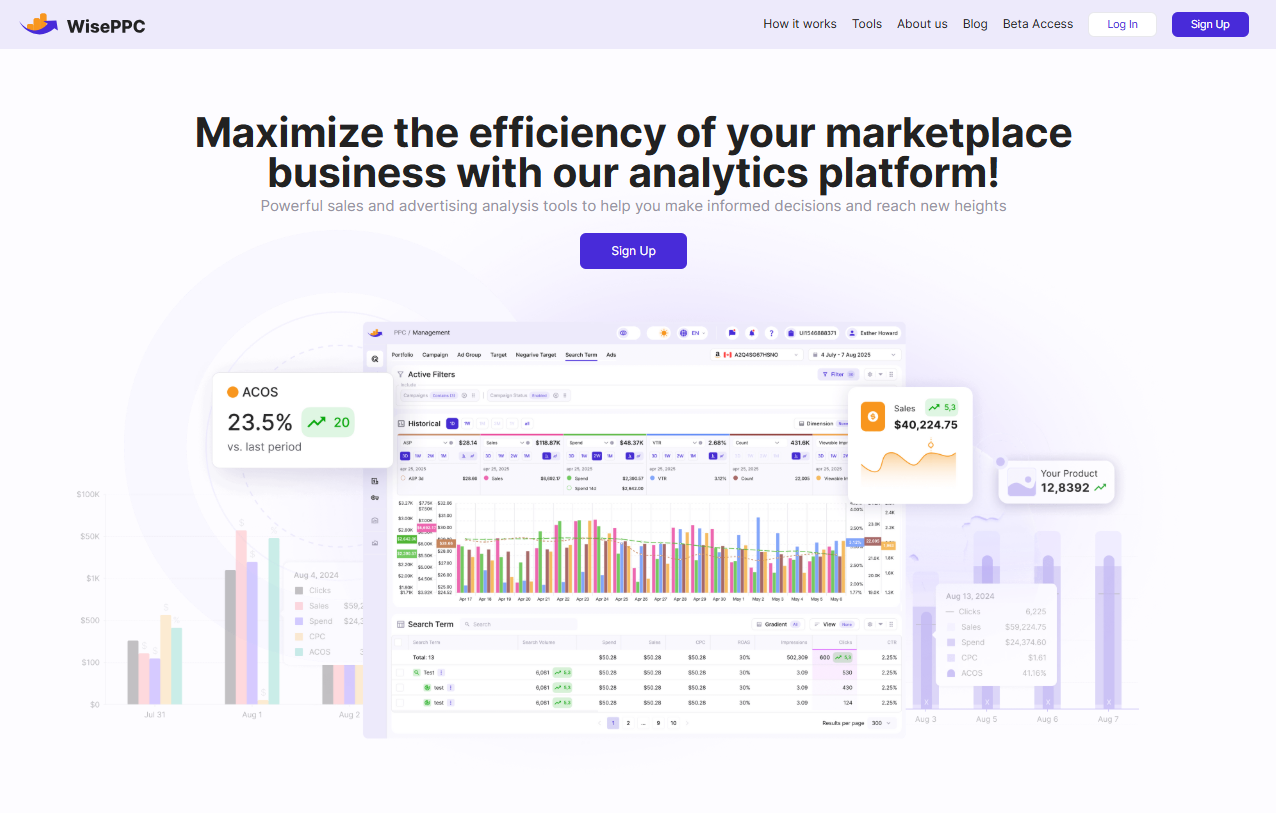
How WisePPC Improves Your Amazon Marketing Strategy
Centralized Analytics
Unlike Amazon’s default interface, WisePPC unifies your data across all of your Amazon accounts and regional marketplaces, giving you a comprehensive view of sales and advertising performance in one dashboard. This allows you to track not only your ad campaigns but also align them with organic performance and conversions.
Real-Time Performance Tracking
We provide up-to-the-minute updates on key metrics like TACOS (Total Advertising Cost of Sales), ACOS (Advertising Cost of Sales), CTR (Click-Through Rate), and more. This allows for immediate action and optimized ad spend, reducing the risk of ineffective spending.
Advanced Filtering and Bulk Actions
With powerful filters, we enable you to quickly pinpoint relevant data and analyze performance across various parameters–campaigns, ad groups, products, and keywords. Additionally, the bulk actions feature allows you to apply changes to multiple campaigns simultaneously, saving hours of manual work.
Historical Data Storage
Unlike Amazon, which only retains data for 60-90 days, we store historical data for the long term, providing you with access to years of past campaign results. This is invaluable for tracking seasonal trends, understanding patterns, and adjusting strategies based on long-term data.
Bring-Your-Own-AI Integration
Connect your own AI assistant — Claude, ChatGPT, or any MCP-compatible agent — to your WisePPC data through MCP. Ask about your campaigns in plain English, and your assistant analyzes past performance and proposes bid, budget, and negative-keyword changes for you to review and approve inside WisePPC. You get AI-driven analysis to improve your ROI while keeping full control over every change.
Multi-Account Performance
If you manage multiple Amazon accounts across different regional marketplaces, WisePPC allows you to view their performance in a single interface. This feature is especially useful for scaling your business and quickly comparing performance across accounts.
By integrating WisePPC into your Amazon marketing strategy, you can move from basic, manual ad management to a smarter, data-driven approach. With our deep analytics, real-time tracking, and your own AI connected over MCP, WisePPC is a powerful alternative to traditional methods, ensuring you achieve better results and enhanced operational efficiency.
Conclusion
In today’s competitive e-commerce landscape, a well-defined Amazon marketing strategy is crucial for driving growth and maintaining visibility. By leveraging tools such as Sponsored Products, Sponsored Brands, and Sponsored Display ads, businesses can reach targeted audiences and boost product visibility. However, beyond just ad types, success on Amazon also depends on effective keyword research, optimized bidding strategies, and the use of advanced analytics to track and refine campaigns.
Implementing a data-driven approach with real-time performance tracking and continuous optimization helps marketers stay ahead of the curve. Moreover, with the use of automation and AI, businesses can streamline campaign management and maximize their ROI. By focusing on these key strategies, sellers can improve their overall presence on Amazon, enhance customer engagement, and drive consistent sales growth.
With the right mix of strategic tools and tactics, businesses can unlock the full potential of Amazon’s vast marketplace and create a sustainable path toward long-term success.
FAQ
What is the most effective ad type on Amazon for driving sales?
The most effective ad type depends on your goals. Sponsored Products are ideal for immediate sales and product visibility. Sponsored Brands help with brand awareness, while Sponsored Display Ads are great for retargeting and reaching customers both on and off Amazon.
How can I improve my Amazon marketing strategy?
Improving your strategy involves conducting thorough keyword research, optimizing your product listings, regularly adjusting bids, and using Amazon’s advertising tools like Sponsored Products and Sponsored Brands. Analyzing your campaign data and adjusting based on performance is key to continuous improvement.
What is the importance of bid management in Amazon marketing?
Effective bid management helps ensure that you are not overpaying for clicks while still getting your ads in front of the right audience. By regularly adjusting your bids based on performance and targeting the best placements, you can maximize your ad spend and improve your return on investment (ROI).
How do I choose the right keywords for my Amazon ads?
Choosing the right keywords requires research and understanding customer intent. Tools like Amazon’s own search suggestions, third-party keyword research tools, and competitor analysis can help you identify relevant keywords. Focus on long-tail keywords and make sure they align with your product’s features and customer needs.
Can I scale my Amazon marketing efforts?
Yes, scaling your efforts is possible by increasing your ad budgets, expanding keyword targeting, and leveraging data insights to optimize campaigns. Using advanced tools like AI-powered bidding and real-time performance tracking can help manage growth effectively while maintaining optimal efficiency.
 No credit card required