
 EN
EN  ES
ES  FR
FR  DE
DE  IT
IT  KO
KO  JA
JA  ZH
ZH  AR
AR  PT
PT  TR
TR PL
PL
Amazon’s marketing strategy is a masterclass in data-driven decision-making, seamless customer experience, and aggressive market positioning. By blending performance marketing, advanced SEO, and product-level personalization, Amazon has built one of the most effective marketing engines in the world. This article analyzes the core elements behind Amazon’s success and how its strategy continues to evolve in a competitive digital landscape.

The Foundation: Customer Obsession and Experience
Amazon’s marketing dominance begins with a single, powerful principle: obsessive customer focus. This foundation shapes every interaction, product, and service Amazon offers. Rather than treating customers as mere transactions, Amazon views each relationship as a long-term partnership built on trust, convenience, and personalized experiences. This unwavering commitment to the customer drives loyalty and fuels the company’s exponential growth.
Why Customer Obsession is the Core of Amazon’s Strategy
Amazon’s customer obsession goes far beyond typical service standards. It influences marketing, product development, logistics, and even corporate culture.
- Long-term Relationship Building: Amazon aims to keep customers for life, not just secure one-time purchases.
- Listening to Customer Feedback: Amazon actively collects and analyzes reviews, surveys, and behavioral data to improve services continually.
- Commitment to Convenience: Making the shopping experience effortless and fast is a core priority.
- Trust as a Differentiator: Amazon’s reputation for reliability and transparency reduces purchase anxiety and boosts confidence.
By focusing relentlessly on customers’ needs and preferences, Amazon creates a competitive moat that few can penetrate.
Key Components of Amazon’s Customer Experience
Amazon integrates multiple elements that together deliver an unmatched customer journey. These core components help explain why Amazon consistently ranks high in customer satisfaction and loyalty.
Fast and Reliable Delivery
Amazon’s investment in its logistics infrastructure is unmatched in e-commerce.
- Massive network of fulfillment centers strategically located for speed.
- Advanced inventory management ensures products are available close to consumers.
- Prime membership guarantees two-day shipping, with many areas receiving same-day or next-day delivery.
- Innovative last-mile solutions, including Amazon Flex and delivery drones in limited testing for future scalability..
Fast delivery not only meets customer expectations but often exceeds them, fostering repeat purchases.
Easy Returns and Refunds
Amazon understands that purchase decisions hinge on the ease of returns and refunds.
- Simple, no-questions-asked return policies build buyer confidence.
- Online return processing with minimal steps reduces friction.
- Free return shipping on eligible items eliminates cost concerns.
- Rapid refunds ensure a positive post-purchase experience.
This hassle-free approach encourages customers to buy more freely and trust the platform.
Personalized Recommendations and Shopping Experience
Amazon’s use of AI and machine learning personalizes every aspect of the shopping journey.
- Sophisticated algorithms analyze browsing behavior, past purchases, and even search queries.
- Personalized product recommendations appear on the homepage, product pages, and in marketing emails.
- Dynamic merchandising shows relevant deals and new arrivals tailored to each customer.
- Dynamic pricing and targeted promotions in some markets further enhance relevance..
This personalization boosts average order value and conversion rates by showing customers what they want before they search for it.
How Customer Obsession Creates a Sustainable Marketing Advantage
The cumulative effect of Amazon’s customer-centric initiatives is a powerful marketing advantage that underpins all its other strategies.
- Customer Retention: Satisfied customers return more often, lowering acquisition costs.
- Brand Advocacy: Positive experiences lead to word-of-mouth referrals and strong brand loyalty.
- Higher Lifetime Value: Repeat customers spend more over time, supporting Amazon’s growth.
- Data Collection: Every interaction generates data that refines personalization and marketing precision.
By consistently exceeding customer expectations, Amazon locks in loyalty and turns its audience into advocates, which is far more effective than traditional marketing.
Amazon’s obsession with customer experience is the foundation of its marketing strategy. By delivering fast, reliable service, easy returns, and personalized interactions, Amazon builds trust and loyalty that power every other marketing initiative. This customer-first philosophy is a critical factor behind Amazon’s sustained global e-commerce success.
Leveraging Data and Technology for Targeted Marketing
Amazon’s marketing strength heavily relies on its unmatched ability to collect, analyze, and act upon vast amounts of data. Every click, search, purchase, and browsing session on Amazon’s platform generates valuable information. By harnessing this data with advanced technology, Amazon creates highly targeted marketing campaigns that resonate with individual customers and adapt instantly to market changes. This data-driven approach ensures marketing precision, efficiency, and continuous improvement.
How Amazon Uses Data to Optimize Pricing and Product Placement
Amazon’s dynamic pricing strategy is a perfect example of how data empowers real-time decision-making to balance competitiveness and profitability.
- Dynamic Pricing Algorithms: Amazon monitors competitor prices, inventory levels, demand fluctuations, and customer behavior simultaneously. Prices are automatically adjusted multiple times a day to reflect market conditions. This keeps Amazon competitive without sacrificing profit margins.
- Demand Forecasting and Inventory Management: Advanced predictive analytics anticipate product demand, enabling Amazon to stock the right items in the right locations. This data guides marketing efforts by prioritizing promotions for trending or overstocked products.
- Optimized Product Listings: Data on click-through rates, conversions, and bounce rates help Amazon refine product placement on search results pages. Products with higher engagement get more visibility, boosting sales.
Personalized Advertising Powered by Technology
Amazon’s advertising platform leverages shopper data to deliver personalized marketing messages and product promotions across devices and channels, enhancing relevance and ROI.
- Sponsored Products and Sponsored Brands: Sellers and Amazon use these ad formats to promote products in highly visible locations like search results and product detail pages. Targeting is based on shopper search terms, purchase history, and interests.
- Amazon DSP (Demand-Side Platform): Amazon DSP extends advertising beyond its own website, enabling programmatic buying of display, video, and audio ads across the internet. This allows advertisers to target audiences precisely using Amazon’s rich shopper data.
- Cross-Device and Cross-Platform Targeting: By tracking user behavior across desktop, mobile apps, and even voice devices, Amazon ensures ads are shown where they are most likely to convert.
Continuous Experimentation through A/B Testing and Machine Learning
Amazon constantly tests and refines its marketing elements to maximize effectiveness and adapt to customer preferences.
- A/B Testing of Webpages and Offers: Amazon experiments with different webpage layouts, product descriptions, pricing, and promotional offers to see which versions perform best in terms of clicks and conversions.
- Algorithmic Learning: Machine learning models analyze vast datasets to identify patterns and predict customer responses, which are then used to personalize marketing messages and product recommendations dynamically.
- Real-Time Optimization: Campaign performance data feeds back into Amazon’s systems instantly, allowing quick adjustments to bids, budgets, and targeting parameters.
Why a Data-Driven Approach Gives Amazon a Marketing Edge
Amazon’s investment in data and technology enables marketing that is:
- Highly Relevant: Ads and offers reflect individual customer preferences, reducing wasted impressions.
- Cost-Efficient: Dynamic pricing and targeted ads ensure marketing spend drives maximum sales impact.
- Agile and Responsive: Real-time data allows Amazon to react instantly to competitor moves and market trends.
- Continuously Improving: Automated testing and learning refine strategies on an ongoing basis.
Amazon’s mastery of data collection, analysis, and technology integration forms the backbone of its targeted marketing. By using dynamic pricing, personalized advertising, and rigorous experimentation, Amazon ensures its marketing campaigns are both efficient and highly relevant. This data-driven precision is a key factor in Amazon’s sustained leadership in the global e-commerce marketplace.
Marketplace Model and Third-Party Sellers
Amazon’s marketplace model is one of the most important factors behind its massive growth and dominance in global e-commerce. By allowing third-party sellers to offer products alongside its own inventory, Amazon expands its product range dramatically without the risks and costs of holding all inventory itself. This model not only increases product diversity but also shapes Amazon’s marketing strategy in multiple impactful ways.
How the Marketplace Model Expands Product Range and Customer Choice
The marketplace transforms Amazon from a retailer into a vast digital bazaar where millions of sellers can connect with buyers worldwide.
- Millions of Products Across Categories: Amazon’s marketplace hosts a staggering variety of products, spanning everything from electronics and fashion to niche hobby items and groceries.
- Appeals to Diverse Customer Segments: A wide selection ensures that shoppers with different tastes, budgets, and needs find what they want in one place.
- Fresh and Unique Offerings: Small businesses and specialty sellers bring exclusive and hard-to-find items, enriching the catalog beyond traditional retail.
This extensive selection keeps customers returning, knowing they can find virtually anything on Amazon.
The Role of Competition in Pricing and Customer Benefit
Competition among third-party sellers creates a dynamic environment that benefits consumers and strengthens Amazon’s market position.
- Multiple Sellers per Product: Many products have several sellers competing, which often results in lower prices and special offers.
- Price Monitoring and Adjustments: Sellers use tools to track competitor prices and adjust theirs quickly, creating a constantly competitive pricing landscape.
- Deals and Discounts: The marketplace frequently features time-limited discounts, lightning deals, and promotional campaigns that attract bargain hunters.
Marketing Tools and Support for Third-Party Sellers
Amazon empowers its sellers with a suite of marketing services that help drive traffic and increase sales. This seller-driven marketing activity contributes to Amazon’s overall ecosystem strength.
Advertising Services for Sellers
- Sponsored Products: Sellers can promote individual listings to appear prominently in search results and product pages.
- Sponsored Brands: Sellers use this format to highlight their brand and product portfolios, increasing brand recognition.
- Amazon Stores: Sellers create custom-branded storefronts within Amazon to showcase their range and tell their brand story.
Seller Analytics and Performance Tools
- Business Reports: Detailed sales and traffic reports help sellers optimize marketing and inventory strategies.
- Customer Feedback and Ratings: Sellers receive insights into product reviews, enabling them to improve offerings and customer experience.
How Amazon Benefits from the Marketplace Model
The marketplace model offers multiple advantages to Amazon itself beyond just product diversity.
Increased Product Variety without Inventory Risks
- Amazon hosts millions of products without needing to stock every item.
- This reduces capital expenditure and inventory management complexity.
- Allows Amazon to scale rapidly and respond to market trends.
Enhanced Marketing Reach through Seller Participation
- Third-party sellers actively market their products, increasing overall platform traffic.
- Advertising revenues from sellers contribute significantly to Amazon’s income.
- Seller competition encourages innovation in product offerings and promotions.
Consistent Customer Experience Maintained by Amazon
- Amazon controls the checkout process, payment systems, and fulfillment options.
- Fulfillment by Amazon (FBA) ensures sellers meet Amazon’s delivery and service standards.
- Customer service and return policies remain uniform, preserving trust and reliability.
Amazon’s marketplace model is a cornerstone of its marketing and growth strategy. By enabling millions of third-party sellers to offer a wide variety of competitively priced products, Amazon creates a vibrant and diverse shopping destination that appeals to a broad customer base. Seller access to powerful advertising tools drives marketing activity that benefits both the sellers and Amazon. Meanwhile, Amazon maintains control over fulfillment and customer experience, ensuring reliability and trust.
Prime Membership: Building Loyalty Through Value
Amazon Prime is far more than a simple subscription service. It is a central pillar of Amazon’s marketing strategy that strengthens customer loyalty, encourages frequent purchases, and creates a steady revenue stream. By bundling multiple high-value benefits into one package, Amazon makes Prime membership an irresistible offer that keeps customers engaged across its ecosystem.
The Value Proposition Behind Prime Membership
Amazon carefully designs Prime to deliver exceptional value that appeals to a wide range of customers. The combination of convenience, entertainment, and exclusivity forms the core of Prime’s appeal.
- Free and Fast Shipping: Two-day shipping on millions of items, with many locations offering same-day or one-day delivery, removes friction in the purchase process.
- Entertainment Offerings: Access to Prime Video, Prime Music, and Prime Reading adds entertainment value that goes beyond shopping, making the subscription more versatile.
- Early Access to Deals and Special Sales: Prime members enjoy early entry to events like Prime Day and Lightning Deals, encouraging urgency and frequent visits.
- Additional Perks: Includes benefits such as Amazon Fresh grocery delivery, Prime Gaming perks, and discounts on select products.
These bundled benefits create a perception of high value that justifies the membership fee for millions of customers.
How Prime Increases Customer Purchase Frequency and Spend
Prime’s benefits influence customer shopping behavior significantly, resulting in increased sales and loyalty.
- Higher Annual Spend: Prime members typically spend significantly more each year than non-members, driven by convenience and exclusive offers.
- More Frequent Purchases: Fast, free shipping encourages customers to shop more often rather than delaying purchases or shopping elsewhere.
- Broader Product Exploration: Access to deals and personalized recommendations encourages members to discover and buy new products.
- Reduced Churn: Prime’s value keeps customers from switching to competing platforms.
Prime as a Platform for Cross-Promotion and Ecosystem Engagement
Amazon leverages Prime as a gateway to promote additional services and deepen customer engagement within its ecosystem.
- Introducing New Services: Members are exposed to services like Audible, Kindle Unlimited, Amazon Fresh, and Amazon Pharmacy through targeted marketing.
- Bundling Offers: Amazon occasionally bundles Prime with other subscriptions or products, increasing overall customer lifetime value.
- Personalized Marketing: Data from Prime usage allows Amazon to tailor product recommendations and exclusive offers specifically for members.
- Encouraging Multi-Channel Usage: Prime members often engage with Amazon across devices, including Echo smart speakers, Fire TV, and mobile apps.
Why Prime is a Strategic Marketing Asset for Amazon
Prime membership locks in customers through a combination of value and convenience, creating a stable foundation for Amazon’s broader marketing initiatives.
- Predictable Revenue Stream: Subscription fees provide Amazon with steady income that funds innovation and expansion.
- Customer Loyalty and Retention: Prime members show higher retention rates, reducing customer acquisition costs.
- Data Collection and Insights: Amazon gathers rich data on member preferences, fueling further marketing personalization.
- Competitive Barrier: Prime’s value proposition makes it difficult for competitors to lure customers away.
Amazon Prime is a cornerstone of Amazon’s marketing strategy, expertly crafted to build customer loyalty and increase purchase frequency. Through a mix of exclusive benefits, entertainment options, and cross-promotion opportunities, Prime keeps customers deeply engaged within Amazon’s ecosystem. This membership model not only secures a stable and recurring revenue stream for Amazon but also enhances its ability to market more effectively and compete globally.
Advertising Innovations and Amazon DSP
Amazon’s advertising platform is a cornerstone of its marketing strategy, playing a crucial role in driving sales, increasing product visibility, and building brand awareness. By continuously innovating its advertising tools, Amazon offers sellers and brands powerful ways to connect with shoppers at multiple touchpoints throughout the buying journey. This investment in advertising technology positions Amazon as a strong competitor alongside digital advertising giants like Google and Facebook.
Sponsored Ads: Capturing Buyer Attention at Key Moments
Sponsored ads are Amazon’s most visible and widely used advertising formats. They allow sellers and brands to promote products directly where customers are actively searching and shopping.
- Sponsored Products: These ads promote individual products and appear within search results and on product detail pages, helping to increase discoverability and drive immediate sales.
- Sponsored Brands: These ads showcase a brand logo, custom headline, and multiple products, appearing prominently at the top of search results to build brand awareness and drive product discovery.
- Sponsored Display Ads: These ads target shoppers both on and off Amazon, appearing on product detail pages, customer review pages, and third-party websites. Sponsored Display helps brands retarget interested buyers and reach new audiences.
Sponsored ads are highly effective because they catch shoppers at the precise moment of purchase intent, maximizing conversion potential.
Amazon DSP: Programmatic Advertising for Precise Audience Targeting
Amazon Demand-Side Platform (DSP) is an advanced advertising tool that extends Amazon’s marketing reach beyond its own ecosystem.
- Programmatic Buying: DSP allows advertisers to purchase video and display ads programmatically across Amazon-owned properties and third-party websites and apps.
- Rich Shopper Data: Leveraging Amazon’s vast shopper data, DSP enables precise targeting based on shopping history, browsing behavior, demographics, and interests.
- Multi-Channel Reach: DSP supports multiple ad formats including desktop and mobile display ads, video ads, and connected TV ads, allowing brands to engage customers across devices.
- Brand Awareness and Retargeting: Brands use DSP for both building awareness among new audiences and retargeting shoppers who have shown interest but not yet converted.
This programmatic platform is essential for brands looking to execute sophisticated, data-driven advertising campaigns that go beyond Amazon’s marketplace.
Brand Stores and Video Ads: Enhancing Brand Storytelling and Engagement
Amazon offers sellers and brands additional tools to create immersive and engaging experiences that go beyond simple product listings.
- Amazon Brand Stores: These are customized, multi-page storefronts within Amazon where brands can showcase their entire product portfolio, share their story, and control the shopping experience.
- Video Ads: Video ads allow brands to deliver richer, more engaging content that demonstrates product features, tells a brand story, or educates shoppers. These can appear in search results, on product pages, and within Amazon’s streaming services.
- Interactive and Shoppable Content: Brands increasingly use video and interactive content to capture attention and encourage direct purchase actions, enhancing customer engagement.
Together, Brand Stores and video advertising help brands build deeper connections with customers, differentiate from competitors, and increase sales.
Why Amazon’s Advertising Innovations Matter
Amazon’s continued investment in advertising technology helps it maintain a competitive edge in the digital marketing landscape.
- Integration of Shopping and Advertising: Amazon uniquely combines e-commerce data with advertising, allowing for highly targeted and measurable campaigns.
- Growing Advertising Revenue: Amazon’s advertising business is a major growth driver, rivaling established digital ad platforms.
- Seller and Brand Empowerment: Amazon’s ad tools enable sellers of all sizes to compete effectively and scale their marketing efforts.
- Data-Driven Optimization: Automated bidding, targeting, and testing powered by machine learning continuously improve campaign performance.
Amazon’s advertising ecosystem, centered around Sponsored Ads, Amazon DSP, Brand Stores, and video ads, offers a comprehensive suite of tools that help sellers and brands reach shoppers effectively throughout the customer journey. By leveraging rich shopper data and advanced technology, Amazon ensures that advertising on its platform is both precise and impactful. This focus on innovation keeps Amazon competitive with digital advertising leaders and solidifies its position as a global marketing powerhouse.

Leveraging Advanced Analytics with WisePPC: Enhancing Amazon Marketing Efficiency
At WisePPC, we specialize in helping marketplace sellers unlock the full potential of their Amazon and Shopify businesses through powerful analytics and automation tools. Our platform provides deep insights into sales and advertising performance, offering granular hourly data, and enabling bulk updates to streamline campaign management. Whether you manage a small product catalog or thousands of listings, WisePPC simplifies complex data into actionable information so your team can focus on growth and efficiency.
We enable real-time decision-making by highlighting which campaigns and keywords are performing well and which need attention. Our platform automates bid optimization and budget adjustments, allowing you to react quickly to changing market conditions and reduce wasted ad spend. With on-spot campaign editing directly in the dashboard, you save time and keep your marketing efforts agile and effective. This automation, combined with precise data analysi,s helps improve return on ad spend (ROAS) and overall campaign efficiency.
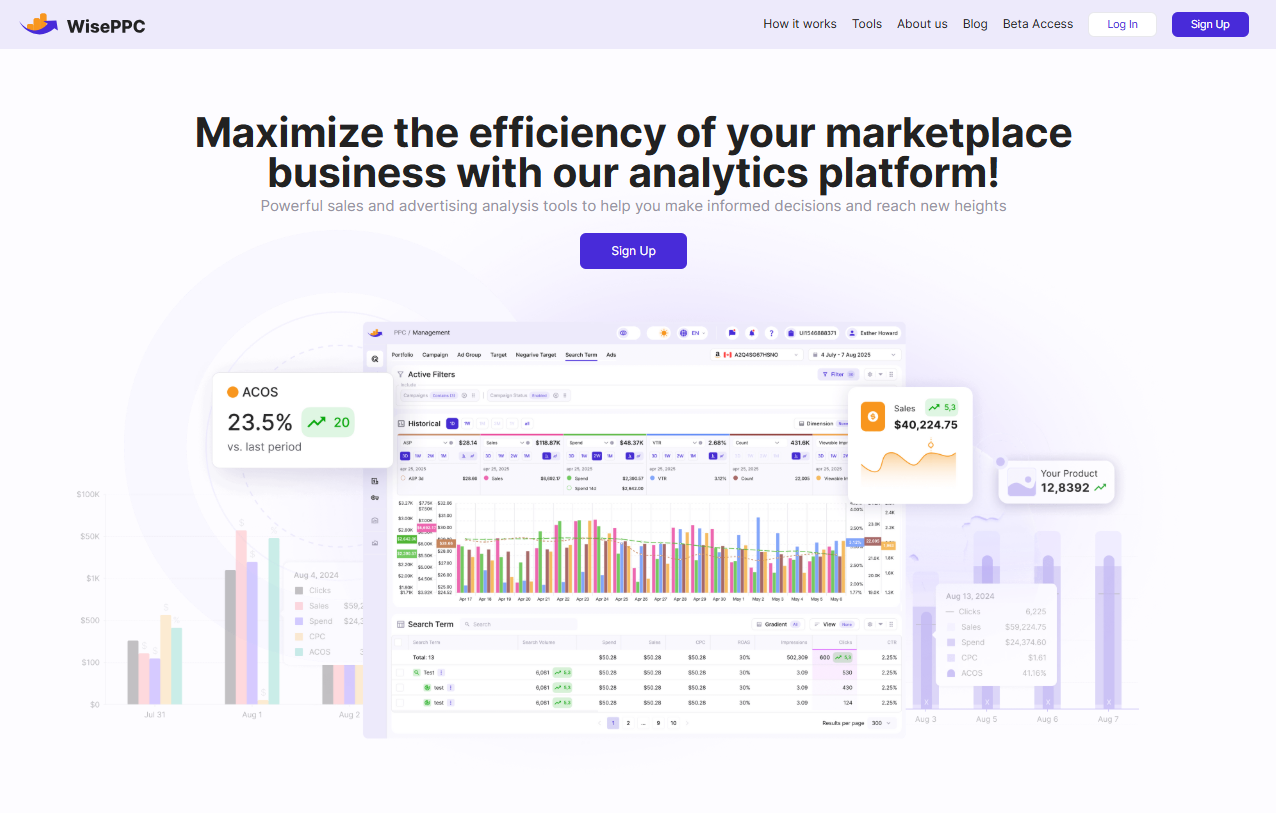
Unlike Amazon’s limited data retention window of 60-90 days, WisePPC stores your historical data indefinitely, giving you access to long-term trends and seasonality insights. This allows for better strategic planning and performance comparisons over time. We also provide a centralized dashboard where you can view performance across multiple marketplaces and channels in one place, offering a complete picture of your business. This cross-platform integration supports scaling and informed decision-making across your entire marketplace presence.
By leveraging WisePPC alongside Amazon’s own advertising innovations, sellers gain a competitive advantage in managing complex campaigns and maximizing marketing ROI. Our advanced analytics and automation tools complement Amazon’s Sponsored Ads and DSP platforms by providing clarity, control, and actionable insights. Together, this powerful combination helps sellers optimize advertising spend, increase sales, and grow sustainably in the fast-paced e-commerce environment.
Conclusion
Amazon’s marketing strategy is a masterclass in combining customer obsession, data-driven innovation, and ecosystem growth to dominate the global e-commerce market. By focusing relentlessly on customer experience through fast delivery, easy returns, and personalized engagement, Amazon builds lasting loyalty and trust. Its marketplace model expands product variety and competitive pricing without excessive inventory risk, while Prime membership locks in customers by offering exceptional value. Amazon’s advertising innovations, including Sponsored Ads and DSP, empower sellers and brands to reach precise audiences efficiently. Finally, leveraging advanced analytics platforms like WisePPC helps sellers optimize campaigns and scale effectively. Together, these interconnected strategies form a powerful framework that keeps Amazon at the forefront of e-commerce success worldwide.
FAQ
What makes Amazon’s customer experience stand out in e-commerce?
Amazon’s success is rooted in its customer-first philosophy, which prioritizes fast and reliable delivery, easy returns, and highly personalized product recommendations. This focus creates convenience and trust, encouraging repeat purchases and long-term loyalty.
How does Amazon’s marketplace model benefit both sellers and customers?
The marketplace allows millions of third-party sellers to offer diverse products alongside Amazon’s own inventory, expanding product choice and maintaining competitive pricing. Sellers gain access to Amazon’s massive customer base and marketing tools, while customers enjoy variety and better deals.
What role does Amazon Prime play in the company’s marketing strategy?
Prime is a cornerstone subscription service that builds loyalty by bundling fast shipping, entertainment, and exclusive deals. Prime members spend more frequently and engage across Amazon’s ecosystem, creating a stable revenue source and marketing platform for cross-promotion.
How do Amazon’s advertising solutions help sellers grow?
Amazon’s advertising products, including Sponsored Products, Sponsored Brands, and Amazon DSP, allow sellers to target shoppers with precision using rich data. These tools increase product visibility, improve brand awareness, and help sellers maximize their advertising ROI.
Why is data analytics crucial for Amazon sellers today?
With the complexity and competition of marketplace selling, using advanced analytics platforms like WisePPC enables sellers to track detailed performance metrics, optimize bids and budgets in real time, and identify what truly drives sales. Data-driven decisions reduce wasted spend and enhance growth potential.
 No credit card required