EN
EN  ES
ES  FR
FR  DE
DE  IT
IT  KO
KO  JA
JA  ZH
ZH  AR
AR  PT
PT  TR
TR  PL
PL Brand Tailored Promotions: A Smarter Way to Discount on Amazon

Running discounts on Amazon used to feel like flipping a switch and hoping for the best. You’d launch a coupon, watch your margins shrink, and pray the lift in sales made it worth it. Sometimes it did. Often, it didn’t.
Brand Tailored Promotions change that dynamic. Instead of broadcasting a discount to everyone, you can offer it only to the people who are most likely to convert. Cart abandoners. Repeat buyers. High spend customers. Even shoppers who follow your brand.
It’s not just another promo feature buried in Seller Central. Used well, it’s a way to turn discounts into strategy instead of damage control.
What Are Brand Tailored Promotions
Brand Tailored Promotions allow sellers enrolled in Amazon Brand Registry to offer exclusive discounts to specific customer segments. Instead of promoting a deal to the entire marketplace, you can target groups such as:
- Cart abandoners
- Repeat customers
- High-spend customers
- Brand followers
- At-risk customers
- Potential new customers
- Complementary product buyers
This targeting is based on customer behavior. Amazon uses purchase history, browsing activity, and engagement signals to place customers into audience groups. When you create a tailored promotion, only the selected audience can see and redeem the offer.
From a strategic standpoint, this is a big deal. You are no longer discounting blindly. You are discounting with intent.
Who Can Use Brand Tailored Promotions
Not every seller has access to this feature.
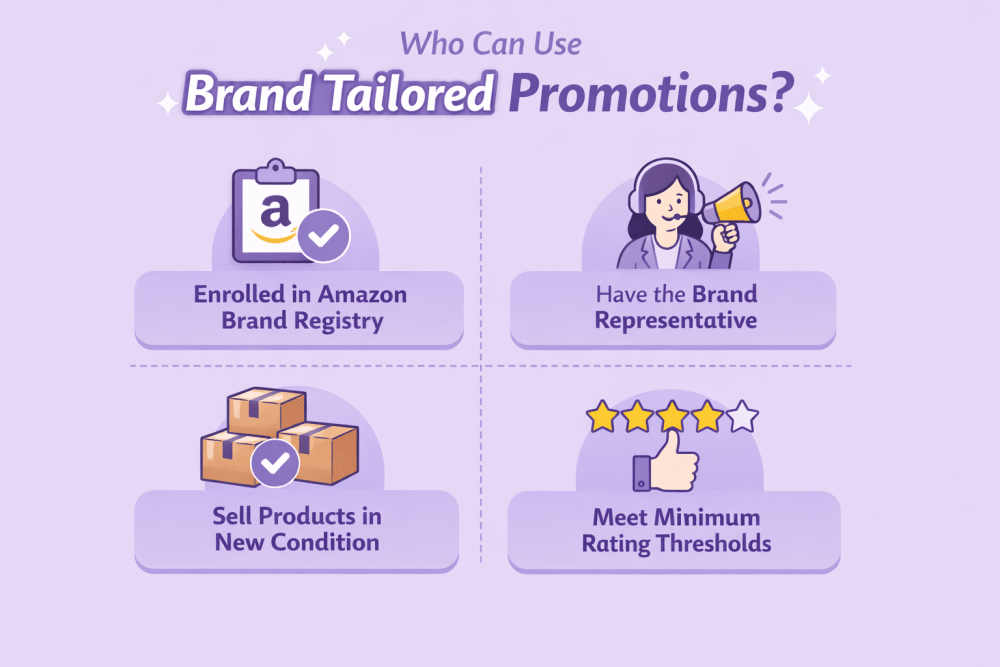
To create Brand Tailored Promotions, you must:
- Be enrolled in Amazon Brand Registry
- Have the Brand Representative role assigned
- Sell products in new condition
- Meet minimum rating thresholds if products have reviews
- Avoid restricted categories such as adult, hunting, firearms, and certain sensitive product types
There is also an audience size requirement. In most cases, the audience must contain at least 1,000 customers before you can activate a promotion. If your segment is too small, Amazon will not allow the campaign to run.
That minimum threshold prevents micro-targeting but still leaves plenty of room for strategic segmentation.
Smarter Brand Tailored Promotions with WisePPC
At WisePPC, we believe discounts should be backed by data, not assumptions. Brand Tailored Promotions can drive real growth, but without proper visibility, it is easy to overspend or misread performance.
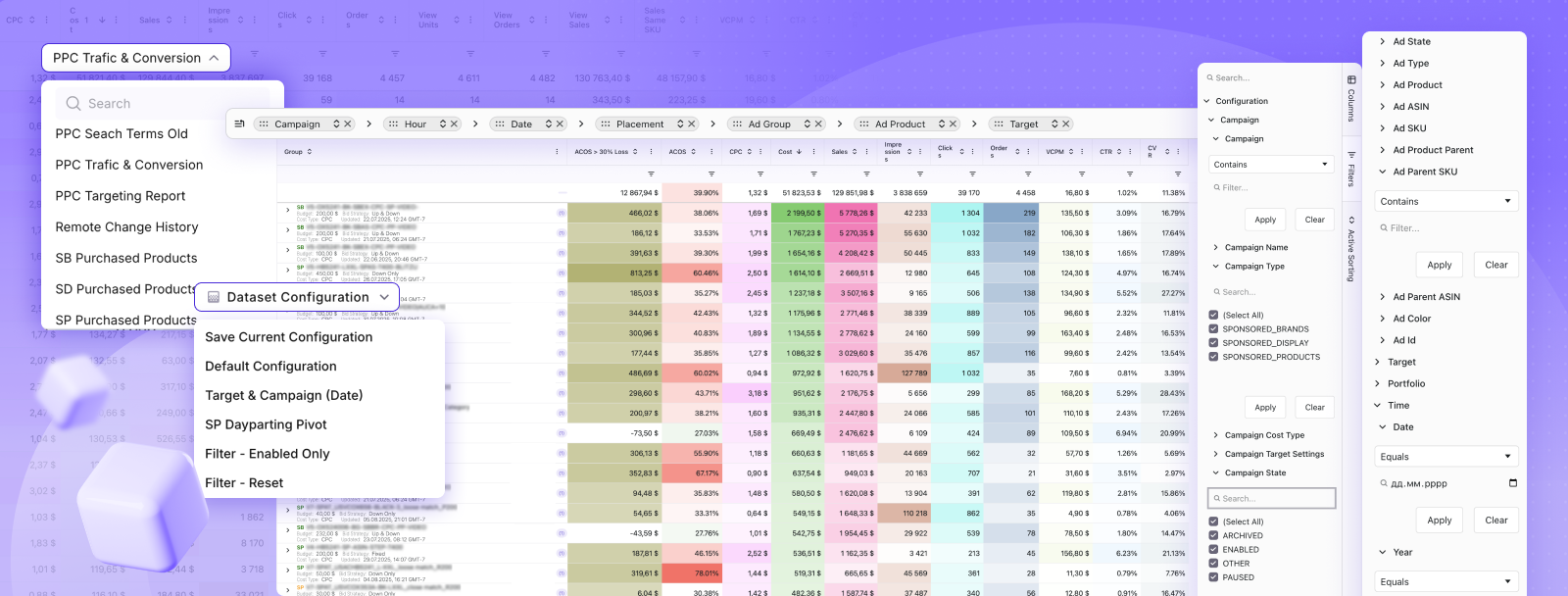
As an Amazon Ads Verified Partner, WisePPC connects through official integrations and provides sellers with deeper insight than Seller Central alone. The platform tracks more than 30 key performance metrics, stores long-term historical data well beyond Amazon’s standard 60 to 90 day window, and enables advanced filtering across campaigns, placements, bid strategies, and match types.
When running Brand Tailored Promotions, this level of visibility makes a real difference. Sellers can clearly see how discounts affect TACOS, ACOS, profit margins, and organic sales in real time. Bulk editing tools allow thousands of updates in seconds, while performance insights surface wasted spend and underperforming segments before they turn into margin issues.
Instead of treating promotions as isolated tactics, WisePPC positions them within a structured growth system. The platform helps brands analyze, optimize, and scale their advertising and promotional strategy with greater control and confidence.
Why Traditional Amazon Discounts Often Fail
Before diving deeper, it is important to understand why Brand Tailored Promotions matter in the first place.
Traditional promotions on Amazon come with several limitations:
- Everyone sees the discount.
- Loyal buyers receive the same offer as new shoppers.
- Margins suffer due to unnecessary discounts.
- Promotions stack with other deals if you are not careful.
- There is little lifecycle strategy behind the offer.
Imagine giving a 20 percent coupon to customers who would have purchased anyway. That is not marketing. That is margin erosion.
Brand Tailored Promotions fix this by allowing segmentation. Instead of rewarding everyone equally, you reward behavior. That is a very different mindset.
Understanding the Audience Segments
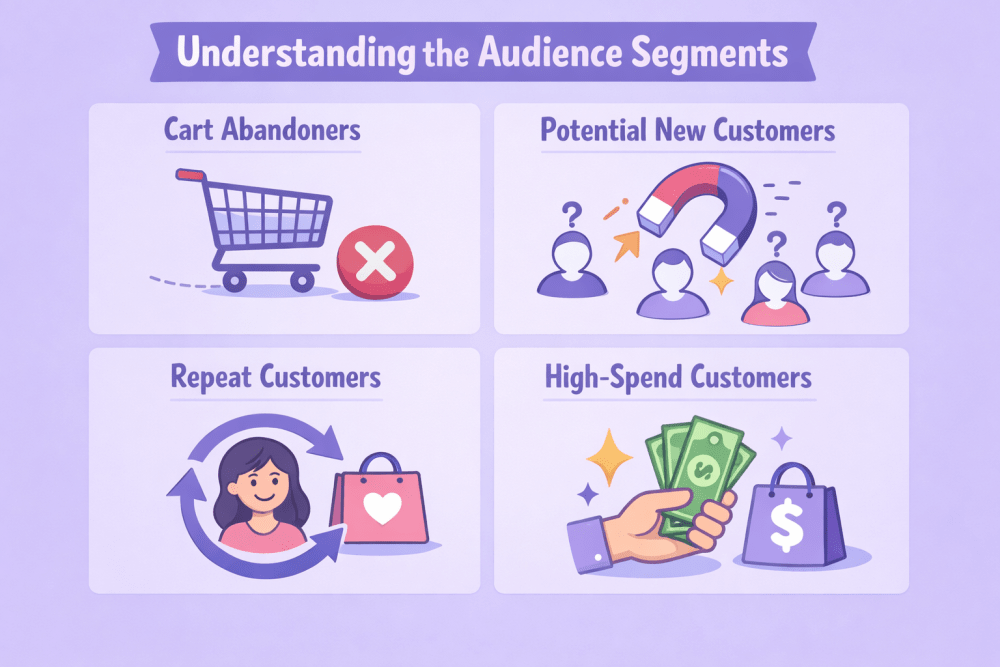
This is where things get interesting. Each audience type serves a different business objective. If you use them correctly, you can build a full customer lifecycle strategy inside Amazon.
Cart Abandoners
These customers added your product to their cart but did not complete the purchase. They showed strong buying intent but stopped short.
A small incentive – often 10 to 20 percent – can be enough to convert them. This is usually one of the highest performing segments.
Potential New Customers
These shoppers interacted with your product in the last 90 days but have not purchased from your brand in the past year.
They are curious but not convinced. This audience works well for acquisition campaigns, especially when paired with entry-level products.
Repeat Customers
Customers who have purchased from your brand more than once in the last 12 months.
These buyers already trust you. The goal here is retention, not aggressive discounting. Often, 10 to 15 percent is sufficient.
High-Spend Customers
The top 5 percent of your customers based on purchase volume.
These buyers drive a disproportionate share of revenue. A well-timed exclusive offer strengthens loyalty without needing extreme discounts.
At-Risk Customers
Shoppers who have not purchased recently and may be drifting away.
Re-engagement campaigns targeting this group can bring back lost revenue. Discounts here tend to be slightly stronger, often 15 to 25 percent.
Complementary Product Buyers
This newer audience category allows you to target customers who purchased related products. For example, if someone bought running shoes, you could promote athletic socks.
This cross-sell capability expands your reach beyond your existing buyers.
How to Create a Brand Tailored Promotion
The setup inside Seller Central is simple. The real work is in choosing the right audience and discount. Here is the streamlined process:
- Go to the Advertising tab and select Brand Tailored Promotions. Make sure you have Brand Registry access and the correct permissions.
- Click Create Promotion and select your brand. If you manage multiple brands, double-check you are working under the right one.
- Choose your target audience. This is the most important step. Pick the segment that matches your goal – acquisition, retention, re-engagement, or cross-sell.
- Select products. You can apply the promotion to your entire catalog or limit it to specific ASINs for tighter control.
- Set discount, budget, and duration. Remember that the budget reflects total discount spend. Plan it based on realistic redemption expectations.
- Review for stacking conflicts, then submit. Check for active coupons or deals that might overlap before activating.
Technically, it only takes a few minutes. Strategically, it deserves much more thought.
Budget Planning – The Part Most Sellers Get Wrong
Amazon allows you to set a maximum budget for each promotion. The budget represents the total discount spend, not total revenue.
Here is where things become practical. Amazon suggests estimating budget using:
Average Order Value x Discount Percentage x Audience Size x Expected Redemption Rate
Example
- Average Order Value: $30
- Discount: 10 percent
- Audience Size: 100,000
- Estimated Redemption: 5 percent
Calculation
30 x 0.10 x 100,000 x 0.05 = $15,000 budget
Many sellers skip this math. They set low budgets and wonder why promotions end after a few hours. Others overshoot and burn through more than intended during high traffic events.
Take the time to calculate realistic budget projections. It prevents unpleasant surprises.
Promotion Caps and Operational Limits
Amazon limits sellers to 20 active or scheduled Brand Tailored Promotions at one time. At first, that sounds like plenty. In reality, once you start segmenting by audience and product line, those slots can disappear quickly.
This limit forces discipline. You cannot run endless small experiments. Each promotion should have a clear objective – acquisition, retention, re-engagement, or cross-sell – rather than existing just because there is room for it.
If you are targeting the same audience across multiple ASINs, consider grouping them into a single promotion instead of splitting them up. It simplifies management and protects your limited slots.
Also remember that scheduled campaigns count toward the cap. Keep track of what is planned so you are not locked out when you need flexibility.
The Stacking Risk – Protecting Your Margins
This is the hidden danger that most sellers overlook until it shows up in their numbers.
Brand Tailored Promotions can stack with certain types of discounts, including Lightning Deals, standard coupons, and Subscribe and Save discounts. They do not stack with other preferential claim code promotions. However, stacking with visible deals and coupons can still reduce margins more than expected.
How Stacking Actually Hurts
Imagine running a 20 percent tailored promotion on a product that is already discounted 15 percent during a Lightning Deal. On paper, each promotion looks reasonable. Combined, they can wipe out profit on every unit sold.
During high-traffic periods, this effect multiplies quickly. More visibility leads to more redemptions, and more redemptions mean more discounted revenue than you originally planned for.
Where Sellers Get Caught
Stacking issues usually happen when multiple teams manage pricing and promotions separately, when coupons are left running in the background, or when holiday deals overlap with retention campaigns. Sometimes budgets are set without accounting for combined discounts.
It is rarely intentional. It is often just poor coordination or a missed detail.
How to Reduce the Risk
Before launching a tailored promotion:
- Audit active promotions
- Pause conflicting coupons
- Avoid overlapping deal windows
- Monitor performance daily
Do not assume everything is clean just because you set it that way last week. Things change quickly inside Seller Central.
Discount stacking is not theoretical. It happens. And when it does, it quietly eats into profit while sales numbers look great on the surface.
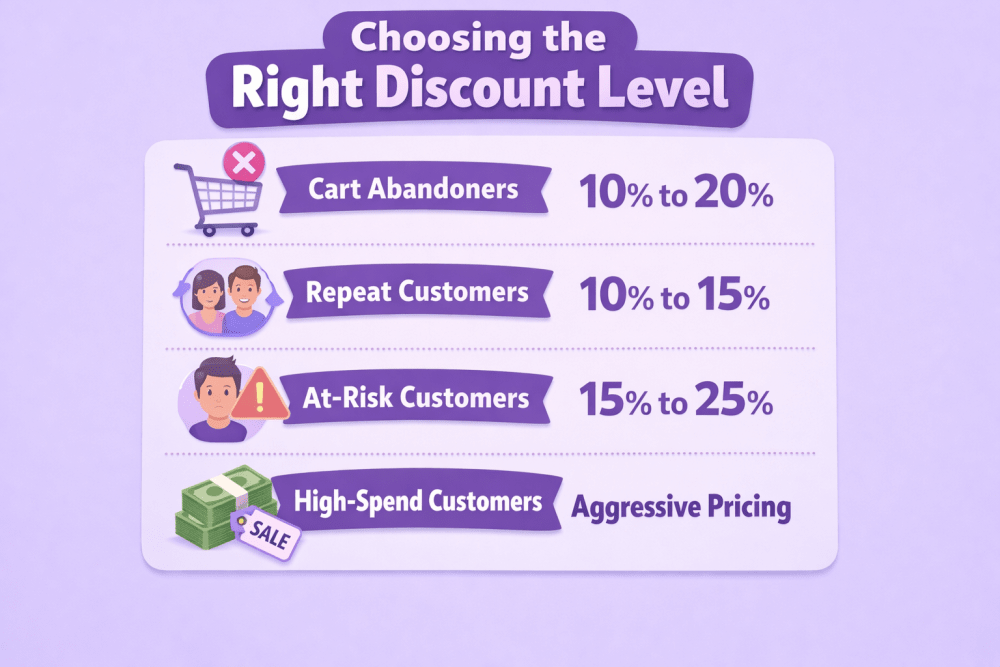
Choosing the Right Discount Level
Not every audience needs a deep discount.
Based on observed performance trends:
- Cart abandoners often respond at 10 to 20 percent.
- Repeat customers may convert at 10 to 15 percent.
- At-risk customers might require 15 to 25 percent.
- High-spend customers rarely need aggressive pricing.
Higher discounts do not always mean higher profit. The goal is efficient conversion, not maximum volume at any cost.
Strategic Lifecycle Planning
Instead of treating Brand Tailored Promotions as isolated campaigns, it helps to think in terms of customer lifecycle. Different audiences require different objectives, discount levels, and timing. When mapped correctly, these promotions become part of a structured growth system rather than random discount bursts.
Here is a simple way to frame it:
| Lifecycle Phase | Target Audience | Strategic Focus |
| Acquisition | Potential new customers, in-market shoppers | Moderate entry-level discounts to drive first purchase |
| Conversion | Cart abandoners, product viewers | Timely incentives to close high-intent buyers |
| Retention | Repeat customers, high-spend customers | Loyalty-focused offers to increase frequency and LTV |
| Re-engagement | At-risk customers, lapsed buyers | Stronger incentives to bring customers back |
| Cross-sell | Complementary product buyers, brand followers | Promote related products to increase basket size |
When structured this way, Brand Tailored Promotions stop being reactive. They become a deliberate part of your revenue engine, supporting customers at every stage of their journey with your brand.
When Brand Tailored Promotions Make the Most Sense
They work best when:
- You have enough brand data and traffic
- You want to improve repeat purchase rates
- You are trying to reduce wasted discount spend
- You want better targeting than traditional coupons provide
If you are brand registered and serious about retention and profitability, this feature deserves attention.
Final Thoughts
Brand Tailored Promotions represent a shift in how Amazon sellers can approach discounting. It is no longer just about offering lower prices. It is about offering the right price to the right customer at the right time.
That distinction changes everything.
Used carelessly, it becomes another promotion tool that eats into your margins. Used strategically, it becomes a precision instrument for growth.
Start small. Test segments individually. Calculate your budgets carefully. Monitor stacking. Refine based on performance.
Discounting does not have to mean sacrificing profit. With Brand Tailored Promotions, it can actually mean protecting it.
Frequently Asked Questions
What are Brand Tailored Promotions on Amazon?
Brand Tailored Promotions are audience-based discounts available to sellers enrolled in Amazon Brand Registry. Instead of offering a deal to all shoppers, you can target specific customer segments such as repeat buyers, cart abandoners, high-spend customers, or potential new customers.
Who is eligible to use Brand Tailored Promotions?
You must be enrolled in Amazon Brand Registry and have the appropriate Brand Representative role assigned. Your products must be in new condition and meet Amazon’s rating requirements if reviews are present. Some restricted categories are not eligible.
Is there a fee to create a Brand Tailored Promotion?
No. Amazon does not charge a setup fee. However, you are responsible for funding the discount itself, which comes out of your margin.
What is the minimum audience size required?
In most cases, the selected audience must contain at least 1,000 customers. If the audience size is smaller, Amazon will not allow the promotion to go live.
How many Brand Tailored Promotions can I run at once?
Amazon allows up to 20 active or scheduled Brand Tailored Promotions at any given time. Scheduled campaigns count toward this limit.
Join the WisePPC Beta and Get Exclusive Access Benefits
WisePPC is now in beta — and we’re inviting a limited number of early users to join. As a beta tester, you'll get free access, lifetime perks, and a chance to help shape the product — from an Amazon Ads Verified Partner you can trust.
 No credit card required
Free in beta and free extra month free after release
25% off for life — limited beta offer
Access metrics Amazon Ads won’t show you
Be part of shaping the product with your feedback
No credit card required
Free in beta and free extra month free after release
25% off for life — limited beta offer
Access metrics Amazon Ads won’t show you
Be part of shaping the product with your feedback