EN
EN  ES
ES  FR
FR  DE
DE  IT
IT  KO
KO  JA
JA  ZH
ZH  AR
AR  PT
PT  TR
TR  PL
PL  ID
ID  VI
VI What Is Amazon FBA and How Does Fulfillment by Amazon Work?

Selling on Amazon means making decisions fast. One of the first big ones is fulfillment. Do you ship orders yourself, or let Amazon handle it?
That’s where Fulfillment by Amazon comes in. FBA is Amazon’s in-house logistics service that takes care of storage, packing, shipping, returns, and customer support for sellers. It simplifies operations, but it also adds fees that need to be understood upfront.
This guide breaks down how Amazon FBA works, what it costs, the real pros and cons, and how to decide if it fits your business.
What Is Amazon FBA?
Fulfillment by Amazon, usually shortened to FBA, is a service where sellers send inventory to Amazon’s fulfillment centers. Once your products arrive, Amazon stores them and ships each order when a customer buys.
Amazon also handles customer service and returns for FBA orders. From the buyer’s perspective, it feels like they’re buying directly from Amazon, even though the product belongs to a third-party seller.
Because of that trust and speed, FBA has become the default choice for many sellers. A large majority of third-party sellers use it in some capacity.
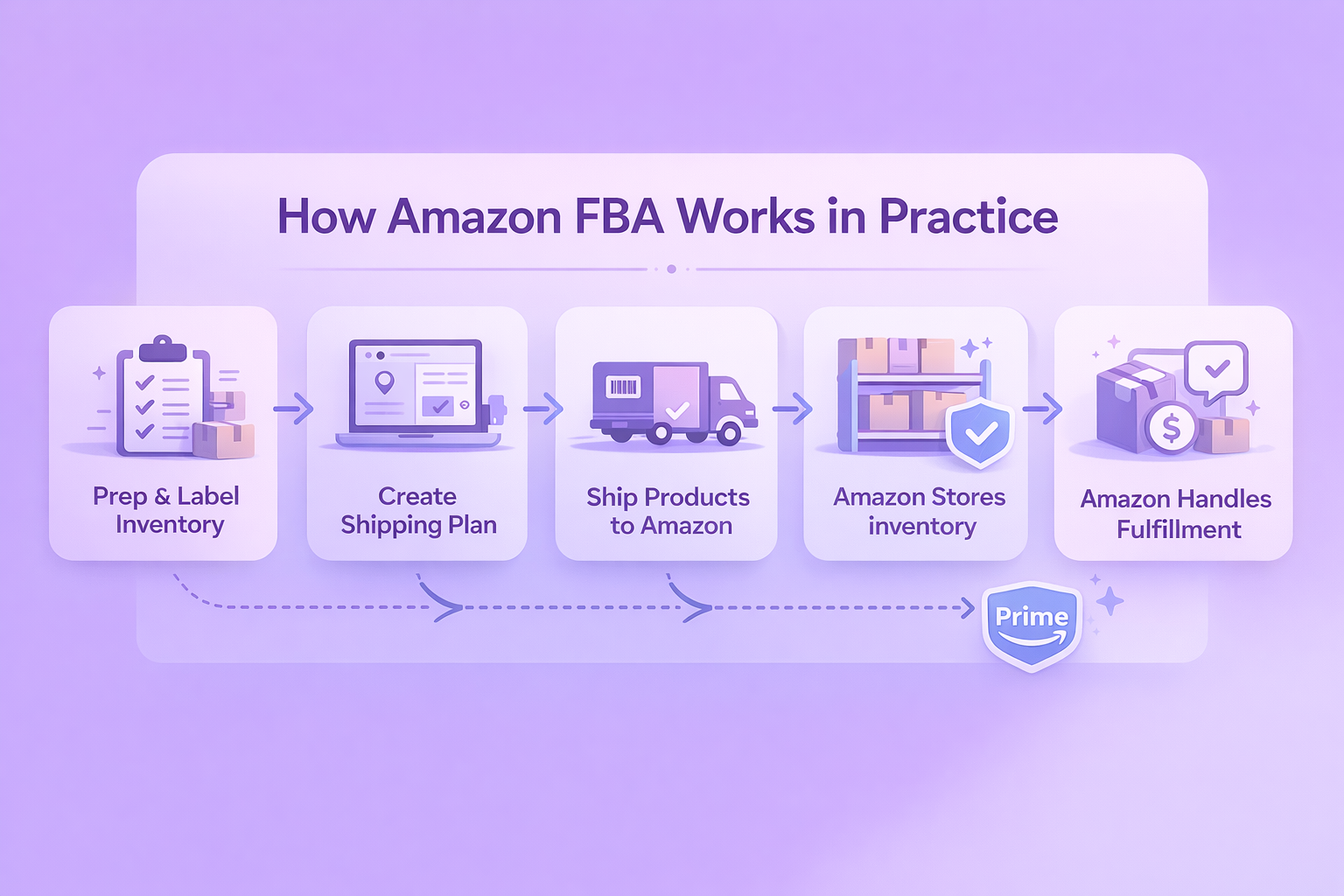
How Amazon FBA Works in Practice
The FBA process is designed to remove most of the day-to-day fulfillment work from your plate:
- You prepare and label your inventory. Products must meet Amazon’s packaging and labeling requirements before they’re sent in.
- You create a shipping plan in Seller Central. This step tells Amazon what you’re sending, how many units, and which fulfillment centers will receive them.
- You send products to Amazon’s warehouses.
Inventory is shipped using your own carrier or Amazon’s partnered shipping options at discounted rates. - Amazon stores the inventory until it sells. Your products remain in Amazon fulfillment centers and are ready to ship as soon as an order is placed.
- Orders are packed, shipped, and supported by Amazon. Amazon handles picking, packing, delivery, customer service, and returns for FBA orders.
Once inventory is checked in and active, your listings become eligible for Prime shipping, which often improves visibility, trust, and conversion rates.
Why Sellers Choose FBA
Amazon didn’t build FBA just for convenience. It’s designed to remove operational friction.
Key Benefits of Using FBA
- Prime eligibility. Products fulfilled by Amazon qualify for Prime, which gives customers fast delivery and easy returns. This alone can significantly impact sales.
- Hands-off logistics/ You don’t need to run a warehouse or pack boxes every day. Amazon handles picking, packing, and shipping.
- Customer trust. Orders arrive in Amazon packaging, backed by Amazon’s customer service. That familiarity reduces hesitation for buyers.
- Returns management. Returns are processed automatically. If items come back in sellable condition, they’re added back to your inventory.
- Multi-channel fulfillment. FBA inventory can also be used to fulfill orders from your own website or other marketplaces.

Where FBA Can Become a Problem
FBA isn’t perfect, and it’s not cheap.
Common Drawbacks Sellers Run Into
- Fulfillment fees add up. Between referral fees, fulfillment fees, and storage costs, total fees can reach 30 to 40 percent of the product price.
- Storage costs increase seasonally. Storage fees rise sharply during the holiday season, which can hurt slow-moving inventory.
- Inventory limits. Amazon limits how much you can store based on performance metrics and sell-through rates.
- Higher return rates. Easy returns are great for customers, but they can lead to more refunds compared to other channels.
Getting Started With Amazon FBA
Once your Amazon seller account is active, enrolling in FBA is a straightforward process that doesn’t require technical experience.
- Create a shipping plan in Seller Central. Select the products you want to send, enter quantities, and follow Amazon’s step-by-step instructions for inbound shipments.
- Prepare products according to Amazon’s requirements. This includes proper packaging, labeling, and any prep work needed to meet FBA guidelines.
- Ship inventory using Amazon’s partnered carriers. Amazon offers discounted shipping rates through its partnered carriers, which can reduce inbound shipping costs.
- Wait for check-in and activation. Once your shipment arrives, Amazon inspects, receives, and processes the inventory at the fulfillment center.
- Listings go live automatically once inventory is available. Your products become active, Prime-eligible, and ready for customers without any additional setup.
This setup allows sellers to start using FBA quickly while Amazon manages fulfillment behind the scenes.
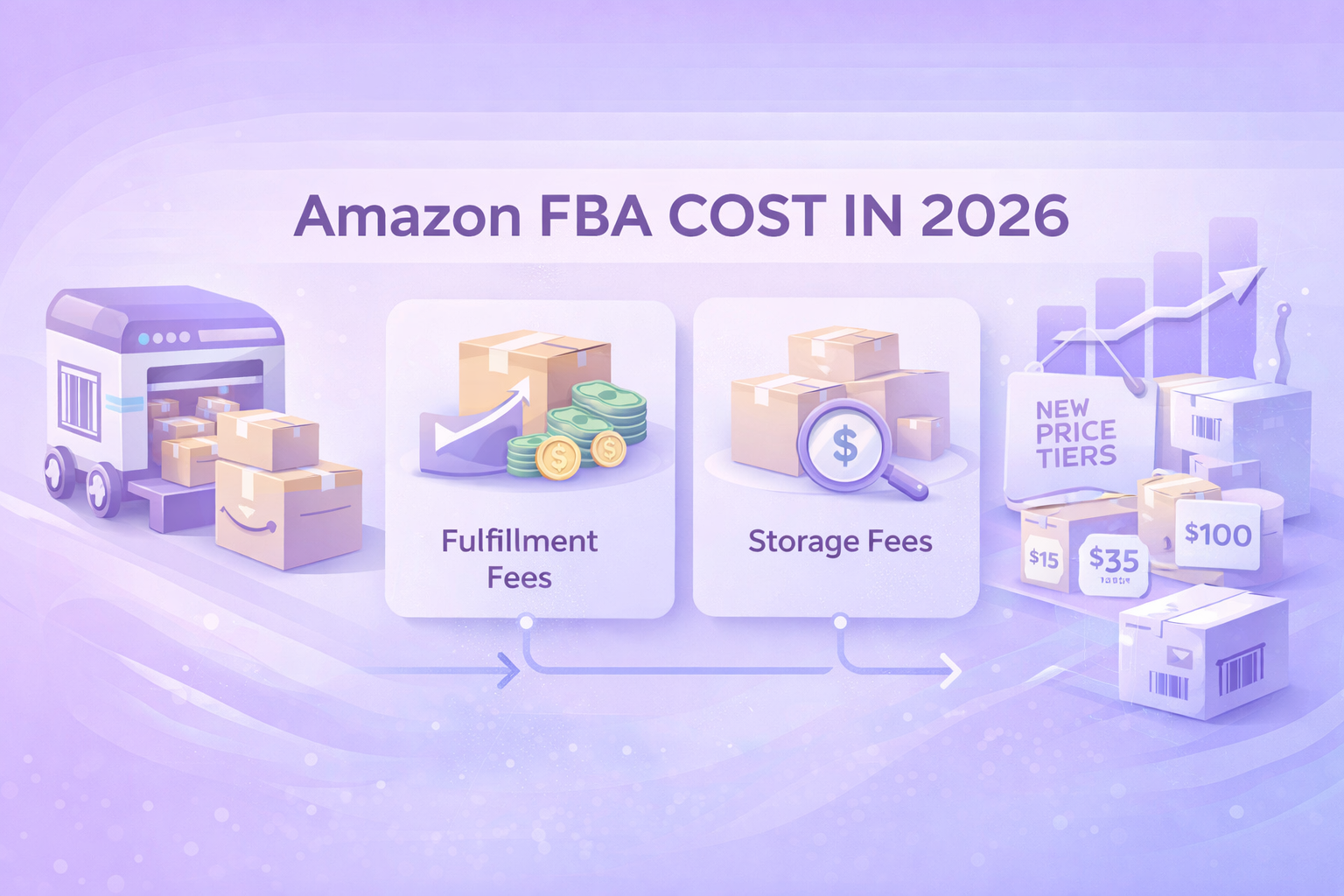
How Much Does Amazon FBA Cost in 2026?
Amazon FBA fees are made up of several components, but for most sellers, two matter the most for day-to-day decisions: fulfillment fees and storage fees.
Starting in 2026, Amazon introduced more price-based fee tiers and adjusted rates across standard-size products. The goal is to better align fees with product price, size, and handling complexity.
Below is a practical breakdown using the most common scenarios sellers encounter.
FBA Small and Light Fulfillment Fees (Low-Price Items)
The Small and Light program is designed for lower-priced products, typically under $10, with reduced fulfillment costs.
Small Standard (Up to 15″ × 12″ × 0.75″)
| Shipping Weight | Fulfillment Fee |
| 4 oz or less | $2.47 |
| 4+ to 8 oz | $2.54 |
| 8+ to 12 oz | $2.61 |
| 12+ to 16 oz | $3.15 |
Large Standard (Up to 18″ x 14″ x 8″)
| Shipping Weight | Fulfillment Fee |
| 4 oz or less | $2.66 |
| 4+ to 8 oz | $2.77 |
| 8+ to 12 oz | $2.94 |
| 12+ to 16 oz | $3.77 |
| 1+ to 1.5 lb | $4.42 |
| 1.5+ to 2 lb | $4.68 |
| 2+ to 2.5 lb | $5.19 |
| 2.5+ to 3 lb | $5.40 |
These rates remain the most cost-efficient option for lightweight, fast-moving SKUs.
FBA Fulfillment Fees for Apparel (Standard Size)
Apparel continues to carry higher fees due to handling complexity and return rates.
| Shipping Weight | Small Standard | Large Standard |
| 4 oz or less | $3.43 | $4.43 |
| 4+ to 8 oz | $3.58 | $4.63 |
| 8+ to 12 oz | $3.87 | $4.84 |
| 12+ to 16 oz | $4.15 | $5.32 |
| 1+ to 1.5 lb | – | $6.10 |
| 1.5+ to 2 lb | – | $6.37 |
| 2+ to 2.5 lb | – | $6.83 |
| 2.5+ to 3 lb | – | $7.05 |
Oversize apparel items are charged separately and can increase quickly depending on dimensions.
FBA Fulfillment Fees for Non-Apparel (Standard Size)
| Shipping Weight | Small Standard | Large Standard |
| 4 oz or less | $3.22 | $3.86 |
| 4+ to 8 oz | $3.40 | $4.08 |
| 8+ to 12 oz | $3.58 | $4.24 |
| 12+ to 16 oz | $3.77 | $4.75 |
| 1+ to 1.5 lb | – | $5.40 |
| 1.5+ to 2 lb | – | $5.69 |
| 2+ to 2.5 lb | – | $6.10 |
| 2.5+ to 3 lb | – | $6.39 |
Oversize non-apparel items can exceed $80-$150 per unit, depending on weight and dimensions.
Amazon FBA Storage Fees (Monthly)
Storage fees are charged based on how much space your inventory occupies and increase sharply during peak season.
| Period | Standard Size | Oversize |
| January-September | $0.87 per cubic foot | $0.56 per cubic foot |
| October-December | $2.40 per cubic foot | $1.40 per cubic foot |
Additional surcharges apply for aged inventory and low inventory levels.
What Changed in 2026: Important Notes
Starting January 15, 2026, Amazon adjusted fulfillment fees based on product price tiers:
- Products under $10 receive discounted Low-Price FBA rates
- Products priced $10–$50 saw small average increases
- Products over $50 carry higher fees due to increased handling and service levels
Amazon also expanded:
- Dimensional weight pricing
- Overmax surcharges for oversized items
- Low-inventory-level fees when stock drops below 28 days of supply
These changes make accurate fee tracking more important than ever.
Using FBA With FBM Together
FBA doesn’t have to be an all-or-nothing decision. Many sellers use a hybrid approach that combines Fulfillment by Amazon with Fulfilled by Merchant.
In this setup, some products are stored and shipped by Amazon, while others are handled directly by the seller. This is common for oversized or heavy items where FBA fees are high, seasonal products that don’t justify long-term storage, or new listings you want to test before sending inventory to Amazon.
Using both fulfillment methods gives you more control over costs and inventory risk. You can take advantage of Prime eligibility and Amazon’s logistics where it makes sense, while keeping flexibility for products that are better managed on your own. Over time, many sellers adjust which items use FBA and which use FBM based on performance, margins, and demand.

When Amazon FBA Makes Sense (and When It Doesn’t)
FBA can be a strong fit in the right situations, especially when speed and simplicity matter more than hands-on control.
Situations Where FBA Makes Sense
- Products are small and lightweight. Lower size and weight usually mean lower fulfillment and storage fees, which helps protect margins.
- Margins can absorb fulfillment fees. If your pricing allows room for Amazon’s fees, FBA can simplify operations without hurting profitability.
- Prime eligibility matters for competition. In crowded categories, the Prime badge often plays a big role in winning clicks and conversions.
- You don’t want to manage daily shipping. FBA works well for sellers who want to avoid packing orders, handling customer service, and managing returns.
When FBA May Not Be the Best Choice
- Heavy or bulky items. Larger products can quickly become expensive to store and ship through FBA.
- Custom packaging requirements. If your brand relies on special inserts, bundles, or presentation, FBA may feel limiting.
- Products with low margins/ Thin margins leave little room for fulfillment and storage fees.
- Sellers who already operate warehouses/ If you have in-house fulfillment systems in place, FBA may add cost without much benefit.
Choosing FBA often comes down to testing. Many sellers start with a few products, review the numbers, and adjust their fulfillment mix over time.
Is Amazon FBA Right for You?
There’s no universal answer. FBA is a powerful system, but it only works when the numbers make sense.
Before committing, calculate every fee, including storage and returns. Test with a small shipment first. You can always adjust later.
Many successful sellers mix FBA and FBM depending on the product. That flexibility is often where the best results come from.

Make Smarter FBA Decisions With WisePPC
Using Amazon FBA is rarely just a fulfillment decision. It directly affects margins, ad efficiency, inventory planning, and long-term growth. That’s exactly where we come in.
At WisePPC, we help sellers understand what’s really happening behind their FBA performance. Instead of guessing whether fees, ads, or pricing changes are helping or hurting profitability, we give you clear visibility across both advertising and sales data in one place.
Our platform is built around advanced analytics that go far beyond what Amazon shows by default. We store historical data for years, not just weeks, so you can see long-term trends, seasonality, and the real impact of FBA fees and ad spend over time. That makes it easier to decide which products should stay in FBA, which should move to FBM, and where adjustments actually make sense.
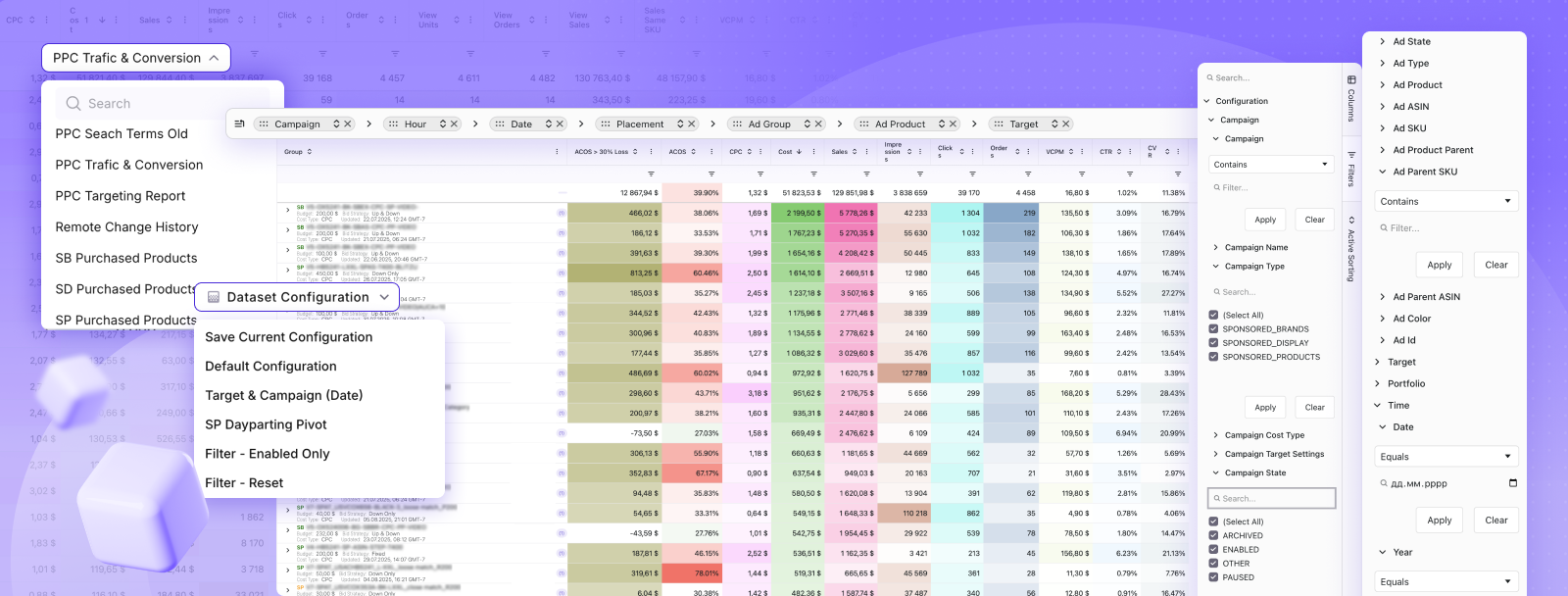
We’re also an Amazon Ads Verified Partner, which means we use official integrations and follow Amazon’s best practices. For sellers using FBA, that translates into more reliable data, faster insights, and fewer blind spots when making decisions.
FBA can be powerful, but only when the numbers are clear. Our goal is to replace guesswork with visibility, so you can scale smarter, adjust faster, and grow with confidence.
Conclusion
Amazon FBA can simplify a lot of the hard parts of selling online. Storage, shipping, returns, and customer service are handled for you, which frees up time to focus on sourcing products, pricing, and growth. For many sellers, Prime eligibility alone makes FBA worth serious consideration.
That said, FBA isn’t a universal solution. Fees, storage limits, and return behavior can affect profitability if they’re not planned for. The best approach is often flexible. Test FBA with a few products, review the numbers, and adjust as you go. Many successful sellers combine FBA and FBM to balance convenience, control, and cost.
The key is understanding how FBA fits into your specific business model, not forcing your business to fit FBA.
FAQ
What does Amazon FBA stand for?
Amazon FBA stands for Fulfillment by Amazon. It’s a service where Amazon stores, packs, ships, and supports orders for third-party sellers.
Do I need a professional seller account to use FBA?
No. Both individual and professional Amazon sellers can use FBA, though professional accounts offer more selling features.
Does using FBA guarantee Prime eligibility?
Most FBA products are eligible for Prime, but listings must still meet Amazon’s performance and compliance requirements.
How are Amazon FBA fees calculated?
FBA fees are based on product size, weight, category, and storage time. Sellers also pay a referral fee based on the product category.
Can I use FBA and FBM at the same time?
Yes. Many sellers use a hybrid model, fulfilling some products through Amazon and others themselves.
Join the WisePPC Beta and Get Exclusive Access Benefits
WisePPC is now in beta — and we’re inviting a limited number of early users to join. As a beta tester, you'll get free access, lifetime perks, and a chance to help shape the product — from an Amazon Ads Verified Partner you can trust.
 No credit card required
Free in beta and free extra month free after release
25% off for life — limited beta offer
Access metrics Amazon Ads won’t show you
Be part of shaping the product with your feedback
No credit card required
Free in beta and free extra month free after release
25% off for life — limited beta offer
Access metrics Amazon Ads won’t show you
Be part of shaping the product with your feedback