EN
EN  ES
ES  FR
FR  DE
DE  IT
IT  KO
KO  JA
JA  ZH
ZH  AR
AR  PT
PT  TR
TR  PL
PL Shoppable Videos in Product Listings: What They Are and Why They Work

Product listings have a hard job. They need to explain, persuade, and build trust without letting customers touch or try anything. Text and images help, but they often leave gaps. That’s where shoppable videos come in.
A good product video shows how something actually works, what it looks like in real use, and whether it fits a buyer’s expectations. When done right, it removes uncertainty and speeds up decisions. Instead of guessing, shoppers can see the product in motion and decide with more confidence.
This article breaks down what shoppable videos are, how they fit into modern product listings, and why they’ve become one of the most practical tools for improving conversion rates without overcomplicating the buying experience.
What Shoppable Videos Actually Are
A shoppable video is a short, pre-recorded product video that appears directly inside a product listing, usually near the primary images. It is not an ad in the traditional sense. There is no forced autoplay, no interruption, and no external click required to learn more.
The key difference between a shoppable video and other ecommerce videos is placement. These videos live where buying decisions happen. On platforms like Amazon, they appear in the main media block of the product detail page, above the fold, alongside images. That positioning matters.
Shoppable videos are designed to answer practical questions quickly:
- What does this product look like when used?
- How big is it relative to real-world objects?
- How does it work out of the box?
- What problem does it actually solve?
They can take different forms. Some are quick overviews. Others show setup, unboxing, or everyday use. What they share is purpose. They exist to clarify, not entertain.
Why Product Listings Need Video Now More Than Ever
Online marketplaces are crowded. Even strong products struggle to stand out when dozens of listings offer similar features at similar prices. At that point, shoppers are not comparing specs anymore. They are trying to reduce risk.
Video helps with that in ways text cannot.
A short video can communicate texture, scale, movement, and usability in seconds. It removes guesswork. It answers questions before they turn into hesitation. That matters because hesitation is where conversions are lost.
Modern shoppers are also impatient. Long descriptions are skimmed. Bullet points are scanned. Video, on the other hand, invites attention without demanding effort. Watching feels easier than reading, especially on mobile.
This is not about replacing good copy or images. It is about completing the picture.
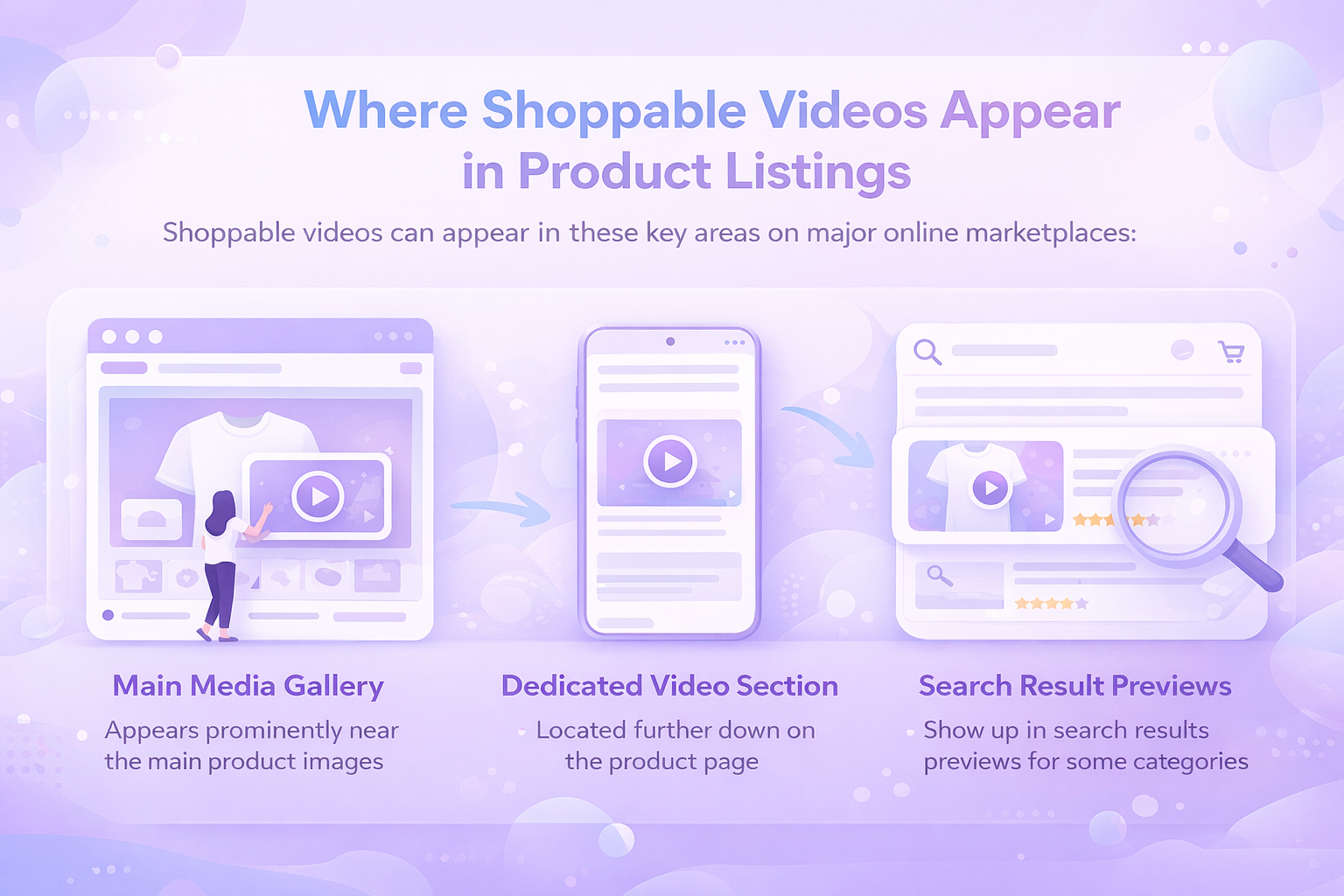
Where Shoppable Videos Appear in Product Listings
Placement is what gives shoppable videos their impact.
On most major marketplaces, these videos appear in one or more of the following locations:
- The main media gallery near product images
- A dedicated video section further down the page
- Search result previews in some categories
The most valuable position is the main media block. This is the area shoppers see first when the page loads. It is where they decide whether to keep scrolling or leave.
Videos placed here are optional to watch, but highly visible. They do not interrupt the experience. They enhance it.
Because of this placement, shoppable videos influence decisions early. They shape first impressions before pricing, reviews, or descriptions fully enter the picture.
The Role of Shoppable Videos in Buyer Confidence
Confidence is the real currency of ecommerce. When buyers feel confident, they buy faster and return less.
Shoppable videos build confidence by removing ambiguity.
A written description might say a fabric is soft. A video shows how it moves. A photo might show a kitchen tool on a counter. A video shows it being used, cleaned, and stored. These details matter, especially for practical products.
Video also sets expectations. When buyers know what they are getting, they are less likely to be surprised. That directly affects return rates. Many returns are not about defects. They are about mismatch between expectation and reality.
By showing reality upfront, videos protect both the buyer and the seller.
How Shoppable Videos Influence Conversion Rates
Conversion improvements from video are not accidental. They follow predictable patterns.
- First, videos increase time on page. Shoppers who watch a video spend more time engaging with the listing. That extra attention often leads to deeper exploration of images, reviews, and details.
- Second, videos reduce uncertainty. When fewer questions remain unanswered, the mental friction before clicking Buy Now is lower.
- Third, videos work well on mobile. A growing share of ecommerce traffic comes from phones. On small screens, video often communicates more effectively than text-heavy layouts.
The result is not just more clicks, but better-qualified clicks. Buyers who convert after watching a product video tend to be more informed and more satisfied.

Common Types of Shoppable Videos That Work
Not all videos perform equally. The most effective ones share a clear focus.
Product Overviews
These videos give a quick, clear explanation of what the product is and what it does. They work best when they stay under one minute and focus on the main benefit.
How-To Demonstrations
Showing how to use a product builds immediate understanding. This is especially valuable for tools, devices, and items with setup steps.
Unboxing Videos
Unboxing videos help set expectations about packaging, included accessories, and first impressions. They work well for electronics, gifts, and premium products.
Setup and Installation
For products that require assembly or configuration, setup videos remove anxiety. Buyers can see that the process is manageable.
Use-in-Context Videos
Showing a product in a real environment helps buyers imagine ownership. This works well for home goods, apparel, and lifestyle products.
The common thread is usefulness. The video should answer a question the buyer already has.
Video Length and Attention Span Reality
Shorter is almost always better.
Most effective shoppable videos fall between 30 and 90 seconds. That window allows enough time to explain the product without losing attention.
The first few seconds matter most. Shoppers decide quickly whether to keep watching. The opening should show the product immediately and hint at its main benefit.
Longer videos are not forbidden, but they should earn their length. If a product truly requires explanation, structure matters. Clear pacing, visual variety, and purpose-driven scenes keep viewers engaged.
When in doubt, clarity beats completeness.

Technical Requirements and Why They Matter
Technical standards are not just rules. They shape how a video is displayed and whether it gets approved.
Most marketplaces require:
- Common formats like MP4 or MOV
- High-definition resolution, typically up to 1080p
- Reasonable file sizes to ensure fast loading
- Clear visuals and clean audio
- Compliance with content and claims policies
Ignoring these requirements leads to rejections or poor display quality. Worse, it wastes time.
Technical quality also affects perception. A blurry or poorly lit video undermines trust. Shoppers associate presentation quality with product quality, even if that is not always fair.
Good lighting, steady shots, and simple framing go a long way.
Why Authentic Videos Often Outperform Polished Ones
There is a common misconception that product videos need to look like commercials. In reality, authenticity often performs better.
Shoppers respond to realism. Seeing a product used in a normal setting feels more trustworthy than a heavily staged shoot. Slight imperfections can make a video feel honest rather than amateur.
This does not mean quality should be ignored. It means the focus should be on clarity, not production tricks.
A smartphone, natural light, and a clear plan are often enough.
Using Text and Captions Without Overdoing It
Many shoppers watch videos without sound. Captions and on-screen text help ensure the message still lands.
Text should support the visuals, not replace them. Short phrases highlighting key benefits or steps work well. Long paragraphs do not.
Captions also improve accessibility and help clarify complex points. They are especially useful for instructional content.
The goal is reinforcement, not distraction.

Measuring the Impact of Shoppable Videos
Video performance should not be guessed. It should be observed.
Key signals to watch include:
- Changes in conversion rate
- Time spent on the product page
- Return rate trends
- Customer questions and feedback
Video is not a silver bullet. It works best when paired with strong images, accurate descriptions, and competitive pricing. When it underperforms, the issue is often focus, not format.
Refining videos based on performance data leads to steady improvement over time.

Optimize Your Marketplace Operations With WisePPC
At WisePPC, we focus on removing friction from everyday marketplace operations. Our platform brings advertising, sales, and performance data into one centralized system, so teams don’t have to jump between tools or rely on exports and spreadsheets. Everything that matters is visible in one place, updated in real time.
We help teams move faster by turning complex data into clear actions. With advanced filtering, bulk actions, and inline editing, it’s easy to spot what’s underperforming and fix it immediately. Campaigns, bids, budgets, and targets can be adjusted at scale, saving hours of manual work and reducing costly delays in decision-making.
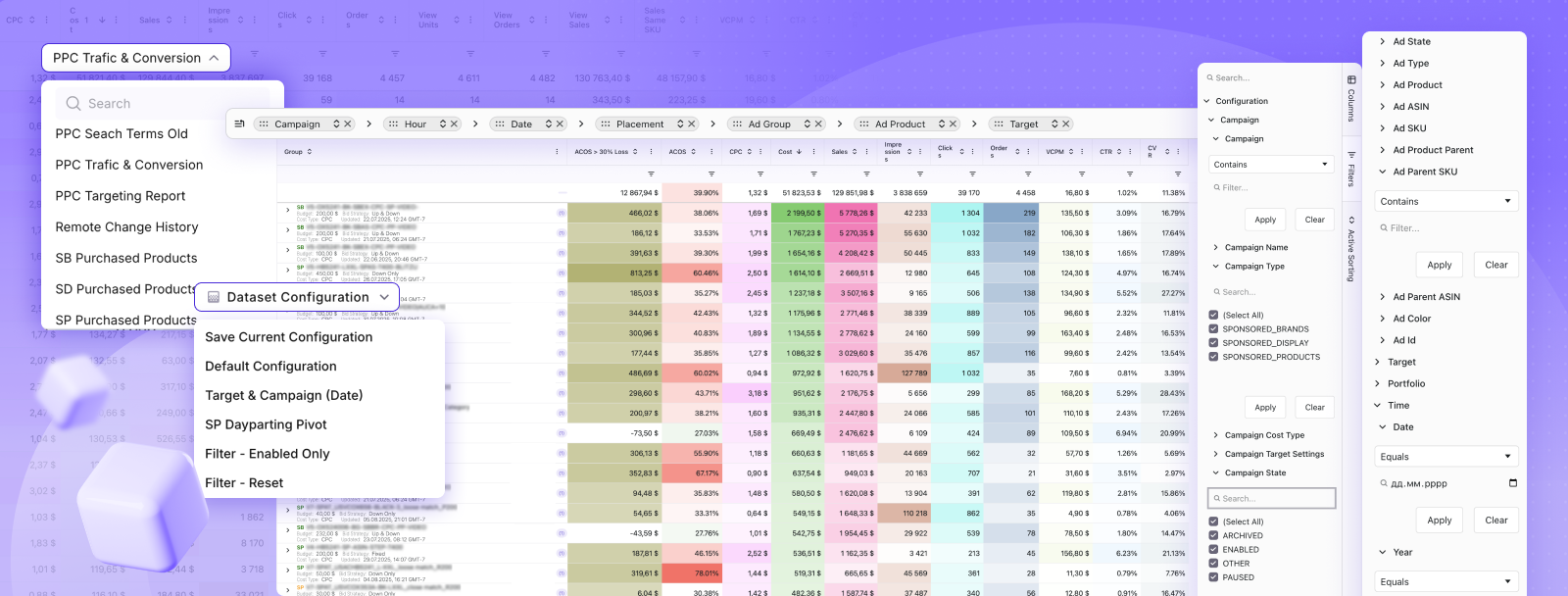
Long-term data access is another core advantage. While marketplaces often limit historical visibility, we keep performance data for years. That makes it easier to identify patterns, compare past and present results, and make smarter strategic decisions as a business grows. The result is a more efficient workflow, better control over spend, and decisions driven by evidence rather than guesswork.

Common Mistakes to Avoid
Many product videos fail for predictable reasons. Instead of helping shoppers decide, they slow them down or create more doubt. Some lean too heavily into branding and forget to show how the product actually works. Others try to cover every detail at once, which often leaves viewers confused rather than informed. A few end up feeling like ads instead of useful buying aids.
Other common mistakes include:
- Overly long introductions that delay the product reveal and lose attention early
- No clear use-case shown, leaving shoppers unsure how the product fits into real life
- Poor lighting or shaky footage, which hurts credibility and perceived quality
- Misleading visuals or exaggerated claims that lead to disappointment and returns
In most cases, avoiding these mistakes has a bigger impact on results than adding advanced effects or higher production value. Clarity, honesty, and focus tend to convert better than polish alone.
Why Shoppable Videos Are Now a Baseline, Not a Bonus
A few years ago, video was a competitive advantage. Today, it is becoming a baseline expectation in many categories.
Shoppers notice when listings lack video. Absence feels like missing information, not simplicity. As more sellers adopt video, those who do not risk looking incomplete.
This does not mean every product needs a complex production. It means every product benefits from being seen, not just described.
Wrapping It Up
Shoppable videos work because they respect the buyer. They do not shout. They explain. They show. They reduce doubt at the exact moment it matters most.
For sellers, they are one of the most efficient ways to improve listing performance without rewriting everything from scratch. For shoppers, they turn abstract listings into tangible experiences.
The best shoppable videos are not flashy. They are useful. And in ecommerce, usefulness wins more often than hype.
When products are shown clearly, honestly, and in context, the decision becomes easier. That is why shoppable videos continue to earn their place at the center of modern product listings.
Frequently Asked Questions
What is a shoppable video in a product listing?
A shoppable video is a short product video placed directly within a product listing, usually near the main images. It helps shoppers understand how a product looks, works, or fits into real use before making a purchase.
Do shoppable videos actually increase sales?
Yes, in many cases they do. Videos help reduce uncertainty, keep shoppers engaged longer, and clarify product details that are hard to explain with text alone. When buyers feel more confident, they are more likely to convert.
How long should a product video be?
Most effective product videos are between 30 and 90 seconds. That’s usually enough time to show the product in use, highlight key benefits, and answer common questions without losing attention.
Do product videos need professional production?
Not necessarily. Clear visuals, steady shots, and good lighting matter more than polished effects. Many high-performing videos are simple, authentic demonstrations filmed in real environments.
Can one video be used for multiple product variations?
Often, yes. If the core functionality stays the same across sizes or colors, one video can usually support all variations. This saves time and keeps messaging consistent.
Where do these videos appear on product pages?
Depending on the platform, videos can appear in the main image gallery, a dedicated video section, or sometimes in search results. Placement near the main images tends to have the biggest impact.
Join the WisePPC Beta and Get Exclusive Access Benefits
WisePPC is now in beta — and we’re inviting a limited number of early users to join. As a beta tester, you'll get free access, lifetime perks, and a chance to help shape the product — from an Amazon Ads Verified Partner you can trust.
 No credit card required
Free in beta and free extra month free after release
25% off for life — limited beta offer
Access metrics Amazon Ads won’t show you
Be part of shaping the product with your feedback
No credit card required
Free in beta and free extra month free after release
25% off for life — limited beta offer
Access metrics Amazon Ads won’t show you
Be part of shaping the product with your feedback