EN
EN  ES
ES  FR
FR  DE
DE  IT
IT  KO
KO  JA
JA  ZH
ZH  AR
AR  PT
PT  TR
TR  PL
PL Prime Day 2026: How to Get Your Store Ready Before the Rush

Prime Day is not just another sales spike. For many sellers, it’s one of the most important traffic surges of the year. In 2025, Amazon reported record-breaking participation from independent sellers, with hundreds of millions of items sold during the event. Expectations for 2026 are even higher.
If you’re planning to sell during Prime Day 2026, preparation matters. The sellers who see the biggest lift are usually the ones who plan weeks in advance, not days.
Below is a practical guide to help you prepare, whether you’re a Professional seller or you manage a registered brand.
Preparing Your Amazon Store for Prime Day 2026
Prime Day is not just a spike in traffic. It’s a stress test for your entire operation. Listings, inventory, ads, creative, pricing. Everything gets pressure at once.
If you prepare early, the surge works in your favor. If you don’t, it exposes weak spots fast. Below is a practical, no-fluff breakdown of what to focus on before and during Prime Day 2026.
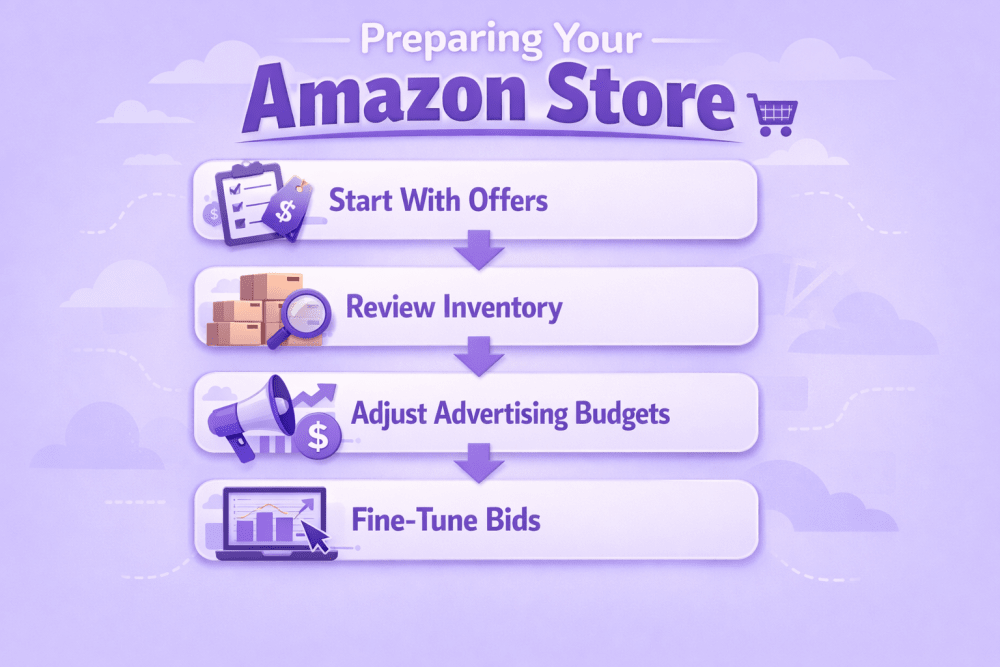
1. Start With Offers That Actually Stand Out
When traffic increases, so does competition. Shoppers scroll fast. Your listing needs a reason to pause them.
Use Coupons the Right Way
Coupons are still one of the easiest visibility boosters. That small badge in search results can lift click-through rate, especially during major events.
If you plan to run coupons:
- Schedule them exactly around Prime Day dates
- Make the discount noticeable, not symbolic
- Target Prime members where possible
Small discounts rarely move the needle during high-volume events. Be intentional.
Add Limited-Time Promotions
Beyond coupons, consider Best Deals or Lightning Deals. Time pressure works well during short event windows.
Just double-check your margins. A discount that looks strong but erodes profit too much won’t help long term.
Prime-exclusive price discounts are another option. These allow you to control duration and unit limits, but not every SKU qualifies, so check eligibility early.
2. Review Inventory Before You Increase Traffic
It sounds basic. It’s also where many sellers slip.
Prime Day traffic can drain stock faster than expected. Running out mid-event doesn’t just stop sales. It can affect ranking and future visibility.
Before the event:
- Check FBA inventory levels
- Review inbound shipment timelines
- Account for processing delays
If you rely on Fulfillment by Amazon, build in buffer time. Warehouses move quickly during peak season, but they also receive massive volume.
3. Adjust Advertising Budgets Ahead of Time
Prime Day clicks are more frequent and often more expensive.
If your daily budget runs out at noon, your ads shut off. That means lost exposure during peak hours.
Use Schedule-Based Budget Rules
Set budget increases in advance:
- Raise budgets by percentage during event dates
- Apply automatic increases for a defined window
- Scale back once the event ends
Don’t wait until Prime Day morning to adjust budgets. By then, performance data may already be skewed.
4. Fine-Tune Bids for Higher Competition
Cost-per-click almost always climbs during major shopping events. More sellers compete for the same placements, which means hesitation can cost you visibility.
Start by reviewing your strongest performers. Look at the keywords and ASIN targets that consistently convert, not just the ones that drive traffic. If something already proves it can turn clicks into orders, it’s usually worth protecting that position during Prime Day. A moderate bid increase on high-converting terms can help you stay competitive when auction pressure rises.
Dynamic bidding can also work in your favor. With strategies that adjust in real time based on conversion likelihood, your budget is more likely to flow toward impressions that matter. It won’t guarantee top placement, but it helps prioritize smarter clicks instead of random exposure.
It’s important not to overcorrect. The goal is not to win every auction or dominate every placement. It’s to stay visible where performance is strongest and margins still make sense. Watch performance daily during the event. If CPC spikes without a lift in conversion, scale back. If a campaign holds steady and drives profit, lean in.
Once Prime Day wraps, revisit everything. Lower inflated bids, review placement data, and compare pre- and post-event efficiency. The auction will cool down. Your structure should adjust with it.
5. Optimize Your Storefront for Event Traffic
If your brand is enrolled in Amazon Brand Registry, you have more control.
Create a Prime Day Storefront Version
Use the scheduling feature inside Stores to launch a temporary Prime Day layout. This allows you to:
- Highlight active deals and promotions
- Feature specific product collections
- Automatically revert after the event
Submit updates at least a week early to leave room for moderation.
You can also add a Featured Deals widget so promotional items appear dynamically while the promotion runs.
6. Use External Traffic Strategically
Prime Day exposure doesn’t have to stay inside Amazon. In fact, relying only on on-platform traffic can limit your reach, especially if competitors are increasing ad spend at the same time.
Driving traffic through social media, email campaigns, influencer partnerships, or paid search can strengthen overall sell-through during the event window. If you already have an audience, Prime Day is a good moment to activate it. A short, focused campaign tied directly to your Prime Day offers can bring in shoppers who were not actively browsing Amazon that day.
If you use Amazon Attribution tags, you may qualify for the Brand Referral Bonus. This program provides credits on qualifying sales generated from external traffic. It does not apply to Amazon Ads campaigns themselves, but it can help offset referral fees tied to off-platform marketing efforts.
Alignment is important. Promote the same products, the same discounts, and the same timing across channels. Mixed messaging creates confusion. Clear, consistent communication makes it easier for shoppers to act quickly, especially during a short event like Prime Day.
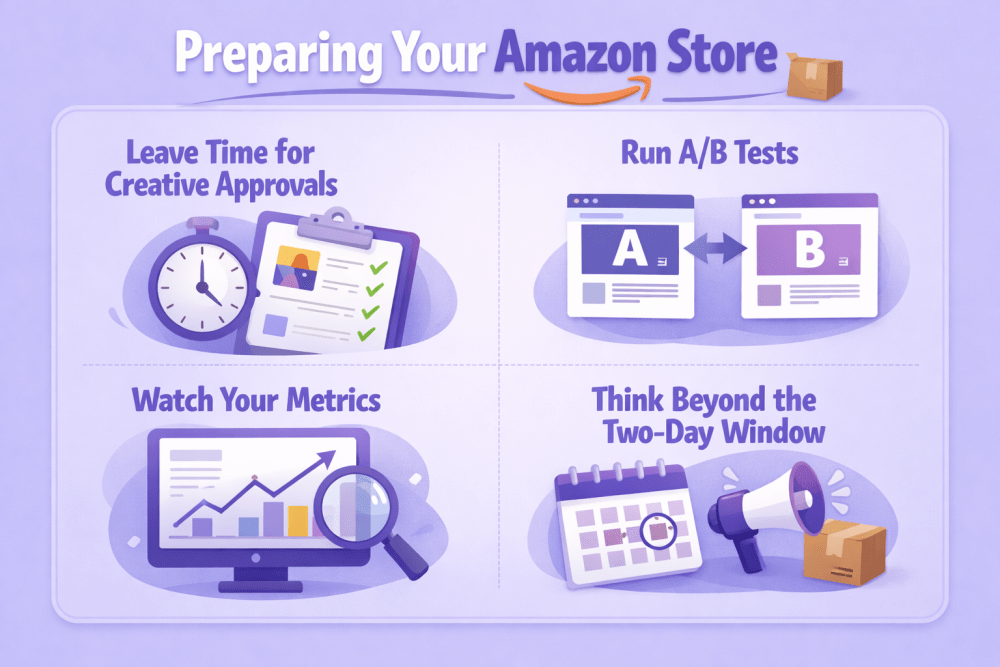
7. Leave Time for Creative Approvals
Content moderation takes time. During peak seasons, it can take longer.
If you’re updating:
- Storefronts
- A+ Content
- Sponsored Brand creatives
Submit at least one week early. If something gets rejected, you’ll have time to revise and resubmit.
A+ Content remains one of the strongest tools for brand-registered sellers. Clear visuals and structured comparison sections help shoppers decide faster, especially during high-traffic events.
8. Run A/B Tests Before the Event
Prime Day is not the moment to experiment from scratch. When traffic surges, every percentage point in conversion matters. That’s not the time to guess which image works better or whether a new title might perform well.
If you’re enrolled in Brand Registry, use Manage Your Experiments well before the event. Give your tests enough time to collect meaningful data. A few days of traffic is rarely enough to draw conclusions, especially if your sales volume fluctuates.
Use Manage Your Experiments in Advance
Focus on the elements that influence conversion the most:
- Main images
- Titles
- Bullet points
- A+ layouts
Even small changes can shift performance. A clearer main image, a tighter value proposition in the title, or more structured comparison charts in A+ Content can improve shopper confidence.
Once you identify a winner, publish it before Prime Day traffic peaks. When volume increases, you want your strongest version live. High traffic amplifies whatever is on the page, good or bad. Better to make those decisions calmly ahead of time than under pressure during the event.
9. Watch Your Metrics in Real Time
Once Prime Day starts, things move quickly.
What to Monitor Closely
- Conversion rate
- ACOS and TACOS
- Session volume
- Inventory levels
If something underperforms, adjust. If something overperforms, consider reallocating budget.
Sellers who actively monitor during the event usually outperform those who set campaigns and walk away.
10. Think Beyond the Two-Day Window
Prime Day often creates momentum that extends well beyond the event itself. The spike in traffic is temporary, but the impact can carry forward for weeks if you pay attention.
New customers may come back. Product rankings can shift. Advertising data collected during the surge can reveal patterns you wouldn’t see during a normal week. What converted under pressure? Which keywords scaled efficiently? Where did margins tighten?
After Prime Day, take time to review your top-performing SKUs, dig into keyword performance, and compare results from before, during, and after the event. Look at both paid and organic lift. Sometimes the real value shows up in improved ranking and repeat purchases, not just those two headline days.
Treat Prime Day as both a revenue opportunity and a data opportunity. The sales matter. The insights matter just as much.

Take Control of Prime Day With WisePPC
Prime Day moves fast. Budgets disappear quicker than usual, and small decisions can have big impact. That’s exactly why we built WisePPC.
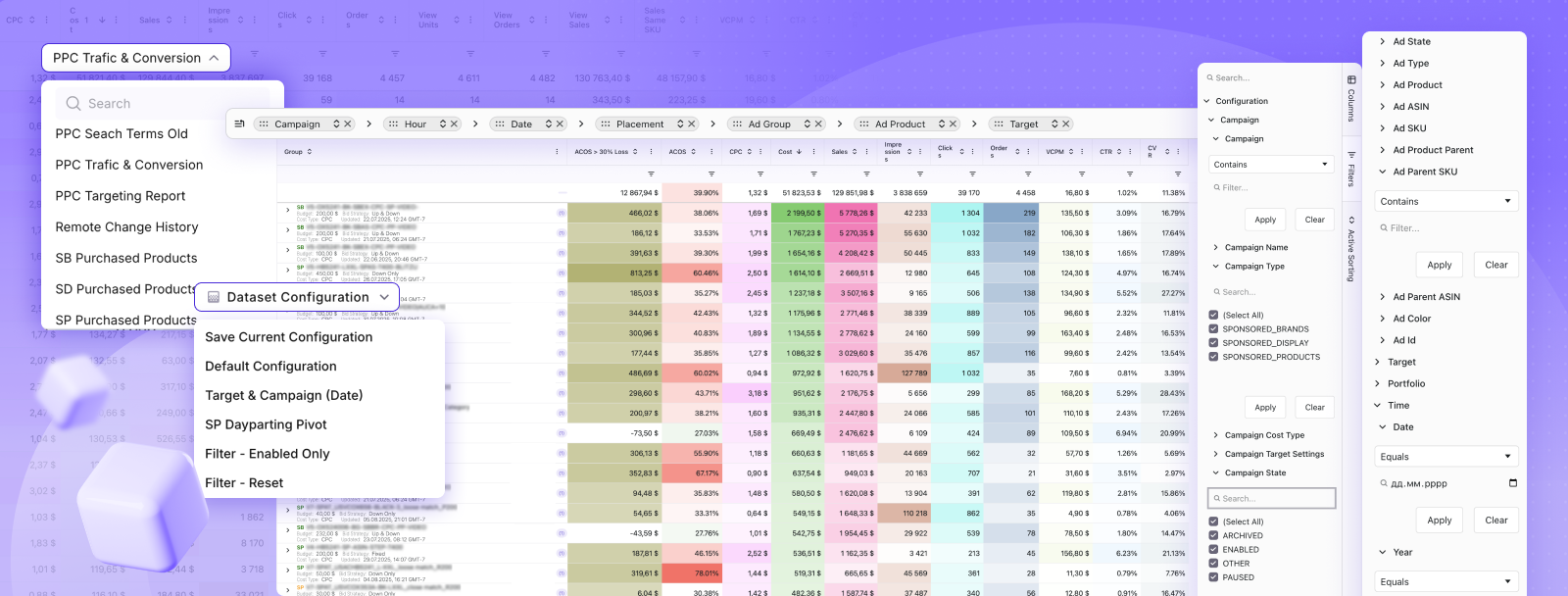
As an Amazon Ads Verified Partner, WisePPC works through official integrations and provides deeper visibility than standard reports alone. The platform tracks 30+ advanced metrics, stores long-term historical data well beyond Amazon’s default window, and clearly separates what drives revenue, ads or organic.
During high-pressure events, clarity wins. Inside WisePPC, sellers can compare up to six KPIs on one chart, apply bulk bid or budget changes in seconds, and instantly filter campaigns to spot wasted spend. Placement data, keyword trends, bid strategies, everything is structured so decisions can be made quickly without digging through multiple dashboards.
Instead of spreadsheets and guesswork, WisePPC delivers one clean system built for real-time decisions. Prime Day doesn’t have to feel chaotic. With the right data in front of you, it becomes a controlled push, not a scramble.
Final Thoughts
Prime Day 2026 will likely bring even more competition and even more opportunity. The difference usually comes down to preparation.
Strong offers. Sufficient inventory. Structured ad budgets. Optimized listings. And enough time to get everything approved.
Whether you’re just starting with a Professional selling plan or building a registered brand with advanced tools, the fundamentals stay the same: plan early, monitor closely, and make data-backed decisions.
That approach works on Prime Day. And it works the rest of the year, too.
FAQ
When should I start preparing for Prime Day 2026?
Ideally, several weeks in advance. Inventory planning and creative approvals can take longer than expected, especially during peak seasons. Advertising adjustments and A/B tests should also be finalized before traffic spikes. The earlier you prepare, the fewer last-minute decisions you’ll have to make.
Do I need to run discounts to succeed on Prime Day?
Not necessarily, but competitive pricing helps. Prime Day shoppers expect visible value. Coupons, Lightning Deals, or Prime-exclusive discounts can improve click-through and conversion rates. Just make sure your margins still work after fees and ad spend.
How much should I increase my ad budget?
There’s no universal number. It depends on your category, conversion rate, and historical Prime Day performance. A common approach is to increase budgets for top-performing campaigns and monitor closely during the event. The goal is to avoid running out of budget during peak hours.
Should I raise bids across all campaigns?
No. Focus on campaigns and keywords that already convert well. Protect visibility where performance is strongest. Raising bids across low-performing campaigns can increase costs without improving results.
Is external traffic worth it during Prime Day?
It can be, especially if you already have an audience. Social media, email marketing, and paid search can help amplify visibility. If you use Amazon Attribution tags, you may qualify for the Brand Referral Bonus on eligible sales generated from external traffic.
Join the WisePPC Beta and Get Exclusive Access Benefits
WisePPC is now in beta — and we’re inviting a limited number of early users to join. As a beta tester, you'll get free access, lifetime perks, and a chance to help shape the product — from an Amazon Ads Verified Partner you can trust.
 No credit card required
Free in beta and free extra month free after release
25% off for life — limited beta offer
Access metrics Amazon Ads won’t show you
Be part of shaping the product with your feedback
No credit card required
Free in beta and free extra month free after release
25% off for life — limited beta offer
Access metrics Amazon Ads won’t show you
Be part of shaping the product with your feedback