EN
EN  ES
ES  FR
FR  DE
DE  IT
IT  KO
KO  JA
JA  ZH
ZH  AR
AR  PT
PT How to Reduce ACOS and Improve ROAS: Data-Driven Strategies for Amazon Sellers

Introduction
ACOS—Advertising Cost of Sale—is the metric that keeps Amazon sellers awake at night. It’s the clearest signal of whether your ad spend generates profit or burns cash. When ACOS climbs above your margin, every sale costs more than it earns. When it drops below target, you’ve found the holy grail of scalable, profitable advertising.
But here’s the uncomfortable truth: most Amazon advertisers don’t truly understand their ACOS. They see the headline number in Campaign Manager, make reactive bid adjustments, and hope for improvement. They miss the structural drivers of high ACOS. They ignore the relationship between ACOS and ROAS (Return on Ad Spend). They fail to account for product lifecycle, competitive dynamics, and customer acquisition value.
This guide changes that. We’ll dissect ACOS from every angle—what drives it, how to diagnose problems, and most importantly, systematic strategies to reduce it while maintaining (or growing) sales volume. These aren’t theoretical concepts; they’re battle-tested approaches from accounts managing millions in monthly ad spend.
Whether you’re struggling with 100%+ ACOS bleeding money, or optimizing a profitable 15% ACOS for even better returns, you’ll find actionable tactics here.
Understanding ACOS: Beyond the Headline Number
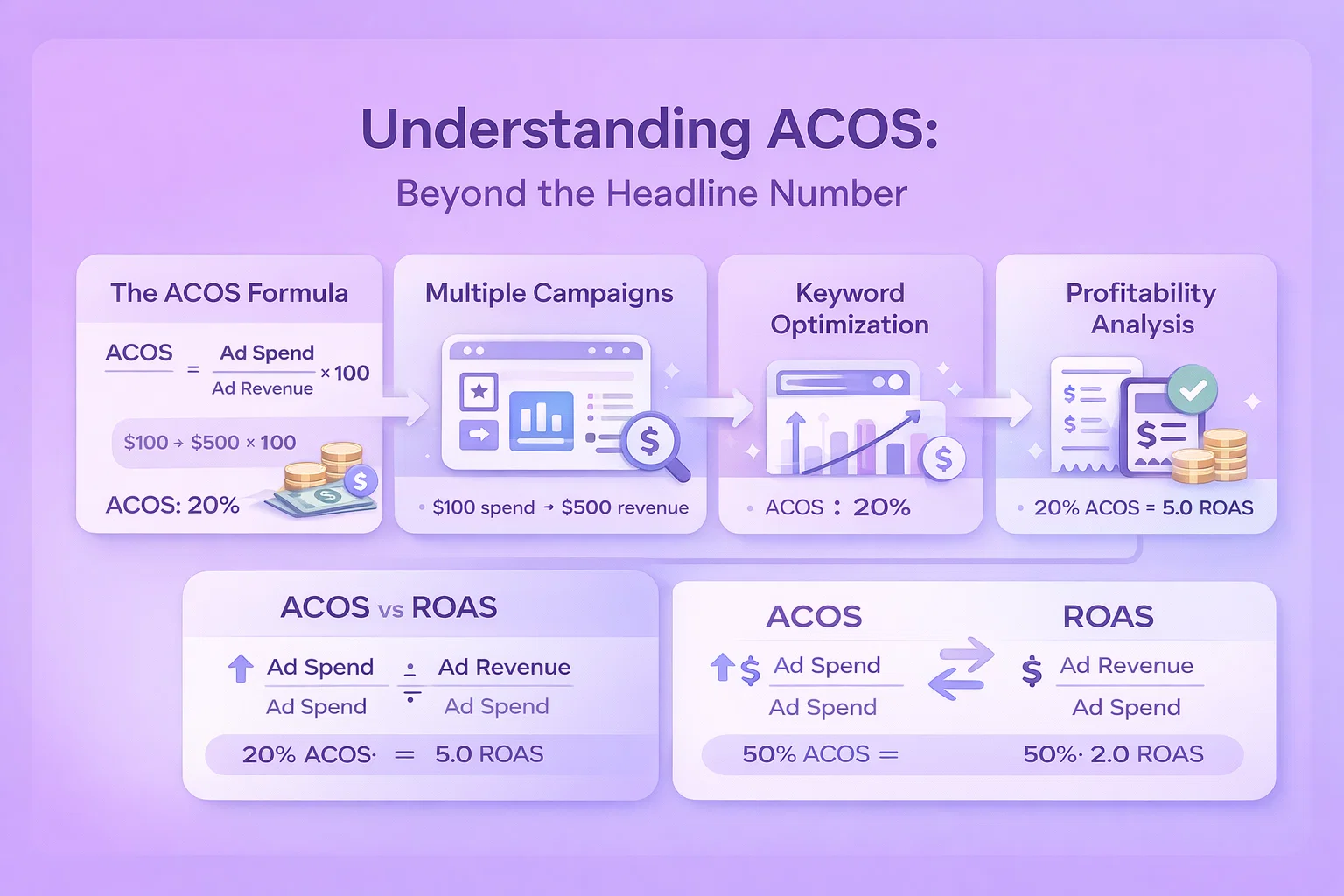
The ACOS Formula
ACOS = (Ad Spend / Ad Revenue) × 100
Simple enough. Spend $100, generate $500 in sales, ACOS is 20%. But this simplicity masks enormous complexity. The headline ACOS in Campaign Manager aggregates diverse performance across:
- Multiple campaigns with different objectives
- Keywords at various stages of optimization
- Products with different margin profiles
- Customer segments with varying lifetime value
- Time periods with seasonal fluctuations
Treating this as a single number is like diagnosing a patient’s health from their weight alone. You need to unpack the components.
ACOS vs. ROAS: Two Sides of the Same Coin
ROAS = Ad Revenue / Ad Spend
ACOS and ROAS measure the same relationship inverted:
- 20% ACOS = 5.0 ROAS
- 50% ACOS = 2.0 ROAS
- 10% ACOS = 10.0 ROAS
Different contexts favor different metrics:
- ACOS is intuitive for margin-based thinking (“I have 30% margin, so 25% ACOS is profitable”)
- ROAS is intuitive for return-based thinking (“Every $1 spent returns $4 in revenue”)
Use whichever aligns with your mental model, but understand both. Some optimization decisions are clearer through one lens than the other.
Break-Even ACOS: Your North Star
Before optimizing ACOS, you must know your break-even point:
Break-Even ACOS = Profit Margin Before Ads
Calculate this for each product:
- Selling Price: $50
- Amazon Fees (15% referral + FBA): $18
- Cost of Goods Sold: $15
- Other Costs (returns, storage): $2
- Profit Margin: $15 (30%)
Your break-even ACOS is 30%. Spend more, you lose money on every ad-attributed sale. Spend less, advertising generates incremental profit.
Critical Insight: Break-even ACOS varies dramatically by product. A premium item with 45% margin can sustain 40% ACOS and still profit. A thin-margin product at 15% margin must achieve sub-15% ACOS or advertising destroys profitability.
Never optimize to a single account-wide ACOS target. Set product-specific targets based on margin and strategic objectives.
The ACOS Spectrum: From Bleeding to Scaling
Different ACOS levels indicate different situations:
ACOS > 100%: Losing money on every sale. Immediate intervention required. Check for:
- Incorrect bids (bidding $5 on a $10 product)
- Irrelevant keyword targeting
- Technical tracking issues
- New campaigns in learning phase
ACOS 50-100%: Marginally unprofitable or break-even. Common for:
- Competitive keywords in early optimization
- Brand awareness campaigns
- New product launches building sales velocity
- High-intent, low-margin categories
ACOS 25-50%: Moderately profitable for most categories. Typical for:
- Mature campaigns with ongoing optimization
- Competitive markets with reasonable margins
- Mixed portfolio of proven and experimental targeting
ACOS 10-25%: Strong profitability. Usually indicates:
- Brand keyword campaigns (highest intent, lowest competition)
- Long-tail keyword focus
- Defensive advertising on owned ASINs
- High-margin products with limited competition
ACOS < 10%: Exceptional performance. Possible scenarios:
- Brand defense campaigns
- Retargeting to past purchasers
- Product with strong organic rank amplifying ad efficiency
- Underinvestment (could scale volume profitably)
Diagnosing High ACOS: Root Cause Analysis
Before fixing ACOS, diagnose why it’s high. Different problems require different solutions.
Diagnostic Framework: The ACOS Tree
Start with the headline number, then drill down:
Account-Level ACOS → By Campaign Type (Sponsored Products vs. Brands vs. Display) → By Campaign Objective (Brand Defense vs. Conquesting vs. Awareness) → By Product/Margin Profile → By Keyword Category (Brand vs. Category vs. Competitor) → By Match Type (Exact vs. Phrase vs. Broad) → By Placement (Top of Search vs. Product Pages vs. Rest of Search)
Each branch reveals different optimization opportunities.
Common High ACOS Causes
- Bid Inflation
Symptoms: High CPCs, competitive keywords, auction pressure
Root causes:
- Bidding wars with aggressive competitors
- Automatic campaign overbidding
- New entrants with high bids and low quality scores
- Seasonal competition (Q4, Prime Day)
Solution approach: Strategic bid management, not blanket reductions
- Poor Keyword Relevance
Symptoms: Low CTR (<0.3%), high bounce rate, few conversions
Root causes:
- Broad match bleeding on irrelevant queries
- Missing negative keywords
- Keyword-product mismatch
- Search terms not matching customer intent
Solution approach: Tighter targeting, extensive negatives
- Weak Conversion Rate
Symptoms: Good CTR, many clicks, few sales
Root causes:
- Listing quality issues (images, bullets, reviews)
- Price uncompetitive
- Poor inventory (out of stock, slow shipping)
- Weak product-market fit
Solution approach: Fix the listing before the ads
- Wrong Campaign Structure
Symptoms: Uneven performance within campaigns, conflicting metrics
Root causes:
- Too many keywords per ad group
- Mixed intent in same campaign
- No segmentation by margin or objective
- Inherited legacy structure
Solution approach: Restructure for control and clarity
- Inappropriate Targets
Symptoms: High spend, low conversion, unrelated search terms
Root causes:
- Automatic campaigns without proper negatives
- ASIN targeting on irrelevant products
- Broad match without monitoring
- Competitor conquesting on mismatched offerings
Solution approach: Surgical targeting refinement
Strategy 1: Precision Bid Management
Bid management is the most direct ACOS lever. These approaches reduce wasteful spend while preserving volume.
The Bid-ACOS Relationship
Mathematically, ACOS = (CPC × Clicks) / (CVR × Clicks × Price) = CPC / (CVR × Price)
Your ACOS is directly proportional to CPC and inversely proportional to conversion rate and price. To reduce ACOS:
- Lower CPC (reduce bids)
- Increase CVR (improve listing/offers)
- Focus on higher-priced variants
Bid adjustments are immediate; conversion optimization takes time. Start with bids for quick wins.
Bid Reduction Strategies
The Gradual Descent
Never slash bids 50% hoping to halve ACOS. You’ll kill volume and destroy campaign history. Instead:
Week 1: Reduce bids 15% on high-ACOS keywords Week 2: Evaluate impact—if ACOS improved and volume acceptable, reduce another 10% Week 3: Find the floor where ACOS targets meet minimum volume thresholds
The Position Targeting Approach
Different positions have different ACOS profiles:
- Position 1 (Top of Search): Highest visibility, often highest ACOS due to competitive bidding
- Position 2-3: Sweet spot for many keywords—good visibility, better efficiency
- Position 4-6: Lower volume, potentially better ACOS for long-tail terms
Use placement reports to identify where your ACOS is highest. Reduce Top of Search multipliers if that placement drives poor efficiency.
The Portfolio Rebalancing
Not all keywords deserve the same bid approach:
- Defensive Brand Keywords: Lower bids to maintain position 1-2 at efficient ACOS
- Category Keywords: Aggressive bids only on proven converters; test new ones conservatively
- Competitor Keywords: High bids rarely sustainable; focus on where you win
- Long-Tail Keywords: Often underbid—these can scale profitably with higher bids
Dynamic Bid Rules
Set up systematic bid adjustments based on performance signals:
Rule Set: Weekly Optimization
| Metric Threshold | Action |
|---|---|
| ACOS > 2× target | Reduce bid 20% |
| ACOS 1.5-2× target | Reduce bid 10% |
| ACOS 1.0-1.5× target | Reduce bid 5% |
| ACOS 0.5-1.0× target | Maintain bid |
| ACOS < 0.5× target | Increase bid 15% |
| Spend > $50, Orders = 0 | Pause keyword |
Apply these rules weekly across your account for systematic ACOS improvement.
Bid Caps and Floors
Prevent extreme bids that destroy ACOS:
Maximum Bid Formula: Max Bid = Target ACOS × Product Price × Expected CVR
Example: 25% target ACOS, $40 product, 10% expected CVR Max Bid = 0.25 × $40 × 0.10 = $1.00
Never bid above this ceiling regardless of competition.
Minimum Bid Consideration: Too-low bids lose volume and learning data. Generally, maintain bids that generate at least 10 clicks per week per keyword.
Strategy 2: Surgical Keyword Optimization
Keywords are where intent meets your product. Precision here dramatically impacts ACOS.
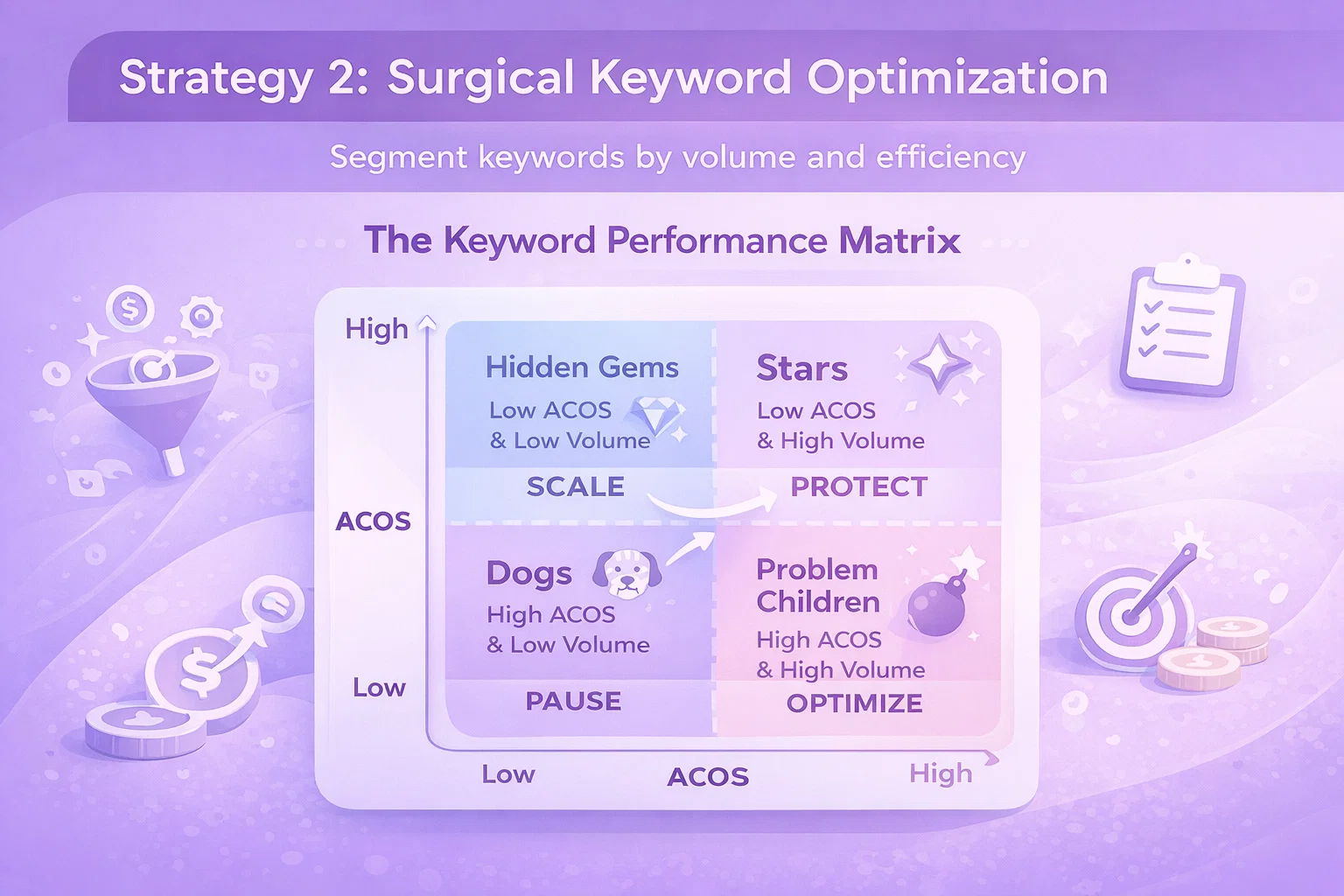
The Keyword Performance Matrix
Segment keywords by volume and efficiency:
High Volume, Low ACOS (Stars):
- Action: Protect and expand
- Increase bids moderately to capture more volume
- Add as exact match negatives to broader campaigns to prevent cannibalization
- Monitor closely for competitive pressure
High Volume, High ACOS (Problem Children):
- Action: Optimize or eliminate
- Reduce bids aggressively if conversion possible
- Add negative if fundamentally mismatched
- Check search term alignment
Low Volume, Low ACOS (Hidden Gems):
- Action: Scale
- Increase bids to test volume potential
- Expand match type or add variations
- Often underinvested opportunities
Low Volume, High ACOS (Dogs):
- Action: Pause
- Minimal impact but drag down account
- Free up budget for better performers
Match Type Strategy
Different match types have different ACOS profiles:
Exact Match: Highest control, typically best ACOS
- Use for proven keywords with sufficient volume
- Highest bids justified by performance certainty
Phrase Match: Moderate expansion, monitor ACOS closely
- Broader than exact but still targeted
- Higher volume potential with some quality loss
Broad Match: Maximum reach, often ACOS killer
- Only use with extensive negative keyword lists
- Best for discovery, not core performance
- Consider broad match modifiers or phrase instead
Recommended Structure:
- 70% budget in exact match (proven performers)
- 20% budget in phrase match (controlled expansion)
- 10% budget in broad match (discovery only, heavy negatives)
Negative Keyword Discipline
The fastest way to improve ACOS is stopping spend on irrelevant traffic.
Weekly Negative Keyword Workflow:
- Pull Search Term Report (last 30 days)
- Filter: Spend > $15, Orders = 0
- Review each term—would a customer searching this buy your product?
- Add obvious mismatches as negative exact match
- Add broader irrelevant themes as negative phrase match
The 30-Day Rule: Any search term with 30+ clicks and zero conversions is a negative keyword candidate. No exceptions.
Preemptive Negatives:
Maintain lists of universally irrelevant terms:
- Free, giveaway, sample, trial
- DIY, homemade, how to make, build
- Cheap, discount, wholesale, bulk
- Jobs, careers, employment, hiring
- Competitor brand names you don’t want to conquest
Apply these to new campaigns before launch.
Keyword Expansion vs. ACOS
Growing keywords can temporarily spike ACOS. New keywords go through phases:
Phase 1: Learning (Weeks 1-2)
- High ACOS as algorithm tests placement
- Limited data for optimization
- Accept higher ACOS temporarily
Phase 2: Optimization (Weeks 3-6)
- Performance stabilizes
- Apply bid adjustments based on emerging data
- Prune or scale based on early signals
Phase 3: Maturity (Week 6+)
- Stable, predictable performance
- ACOS reaches steady state
- Optimize incrementally
Budget for learning phase ACOS. Don’t kill promising keywords too early, but set spend limits (e.g., $50 without conversion = pause).
Strategy 3: Campaign Structure for ACOS Control
Structure determines how precisely you can optimize. Poor structure forces averaged decisions; good structure enables surgical precision.
The Single Keyword Ad Group (SKAG) Approach
Traditional structure: Multiple keywords per ad group SKAG structure: One keyword per ad group
Advantages for ACOS:
- Bid at keyword level, not ad group average
- Search term mapping is clear
- Quality Score optimization per keyword
- Negative keyword control at keyword level
Trade-off: More management overhead. Use bulk tools to handle scale.
Margin-Based Campaign Segmentation
Group products by margin profile:
High-Margin Campaigns (40%+ margin):
- Target ACOS: 30-35% (profitable with volume)
- Aggressive bidding on proven keywords
- Higher appetite for testing
Medium-Margin Campaigns (20-40% margin):
- Target ACOS: 15-25%
- Balanced approach to growth and efficiency
- Careful keyword selection
Low-Margin Campaigns (<20% margin):
- Target ACOS: <15%
- Defensive strategy—brand protection, proven keywords only
- Minimal testing, maximum efficiency
Never average these together. Averaging forces suboptimal decisions on both high and low margin products.
Objective-Based Structure
Separate campaigns by goal, each with appropriate ACOS tolerance:
Profit Campaigns: Direct sales, strict ACOS targets Growth Campaigns: New products, review generation, accept higher ACOS temporarily
Defense Campaigns: Brand protection, maintain presence regardless of ACOS Research Campaigns: Testing, learning, limited budgets
Report and optimize each separately. Don’t let research campaigns poison profit campaign metrics.
Portfolio-Level ACOS Management
At scale, manage ACOS across portfolio, not individual keywords:
The Portfolio Rule: Some keywords will have high ACOS. That’s okay if they serve strategic purposes (new customer acquisition, competitor conquesting, awareness). Maintain portfolio-level ACOS below target while allowing individual variation.
Structure to enable this:
- Label campaigns by objective
- Set different ACOS targets by label
- Report aggregate ACOS by label group
- Make optimization decisions within context
Strategy 4: Placement and Timing Optimization
When and where ads appear affects ACOS as much as what they target.
Placement Performance Analysis
Amazon offers three placement types:
Top of Search (First Page): Premium position, often premium CPC
- Check placement report: is ACOS here sustainable?
- Adjust placement multipliers based on performance
- Sometimes lowering Top of Search bids improves overall ACOS significantly
Product Pages: Competitor ASIN targeting, related products
- Often different ACOS profile than search
- May convert better for certain product categories
- Adjust placement modifiers separately from search bids
Rest of Search: Lower positions on first page and subsequent pages
- Usually lower CPC, variable conversion
- Balance volume vs. efficiency
The Placement Modifier Formula:
If Top of Search ACOS is 40% vs. 20% Rest of Search, and your target is 25%:
- Current Top of Search multiplier: 100%
- Reduce to 50% to align ACOS closer to target
- Test and iterate
Dayparting for ACOS Control
Performance varies by time of day:
Analysis Approach:
- Pull placement/time reports
- Calculate ACOS by hour
- Identify patterns (often: business hours = competitive = higher ACOS)
Common Patterns:
- Early morning (5-8 AM): Lower competition, sometimes better ACOS
- Business hours (9 AM-5 PM): Peak competition, often higher ACOS
- Evening (7-10 PM): High intent, variable ACOS
- Late night (11 PM-4 AM): Low volume, unpredictable ACOS
Dayparting Strategy: Reduce bids 20-30% during consistently high-ACOS hours. Increase during efficient hours. This is advanced optimization—ensure you have sufficient data before implementing.
Strategy 5: Conversion Rate Optimization
ACOS depends on conversion rate. Improve CVR, and the same bids produce better ACOS.
The CVR-ACOS Relationship
Double your conversion rate, halve your ACOS (assuming constant CPC).
Before: 5% CVR, $1 CPC, $40 product ACOS = $1 / (0.05 × $40) = 50%
After: 10% CVR, $1 CPC, $40 product
ACOS = $1 / (0.10 × $40) = 25%
Conversion optimization is ACOS optimization.
Listing Quality Impact on ACOS
Before adjusting bids on high-ACOS keywords, audit your listing:
Images:
- Main image drives CTR
- Lifestyle images drive conversion
- Infographics communicate value
- Video increases engagemen
Test: Pause a high-ACOS keyword, improve listing, relaunch. Often ACOS improves without bid changes.
Pricing:
- Check competitor pricing
- Consider promotional pricing for new products
- Bundle strategy for value perception
Reviews:
- Products with <10 reviews struggle to convert
- Consider Vine program for new launches
- Address negative feedback patterns
Content:
- Bullet points should answer customer questions
- A+ Content increases conversion 5-15%
- Brand Story builds trust
Inventory and Fulfillment Impact
Out-of-stock products waste ad spend. Slow shipping reduces conversion.
Inventory-Based Rules:
- < 30 days inventory: Reduce bids 40%
- Out of stock: Pause campaigns immediately
- Overstock: Increase bids to drive velocity
WisePPC’s inventory integration automates this, preventing ACOS damage from fulfillment issues.
Strategy 6: Product-Level ACOS Management
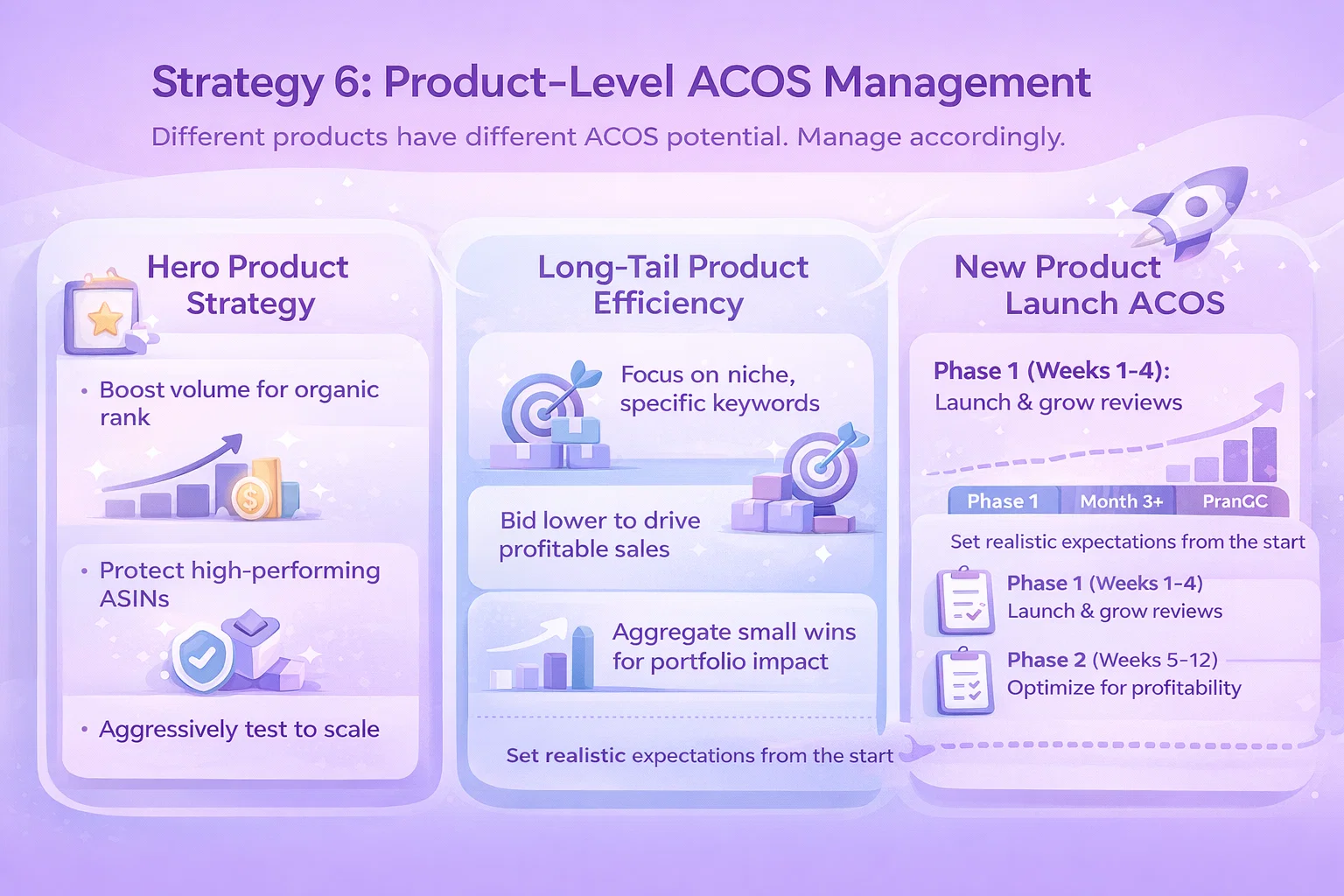
Different products have different ACOS potential. Manage accordingly.
Hero Product Strategy
Your top sellers deserve special treatment:
- Accept higher ACOS for volume leaders (builds organic rank)
- Protect ASINs with proven performance
- Test aggressively to find scaling opportunities
ACOS on hero products is an investment in organic visibility, not just direct profit.
Long-Tail Product Efficiency
Low-volume products often achieve better ACOS with less competition:
- Target specific, long-tail keywords
- Lower bids sufficient for niche terms
- Aggregate many small wins for portfolio impact
New Product Launch ACOS
New products start with zero reviews and no organic rank. Expect high ACOS initially:
Phase 1 (Weeks 1-4): Launch and review generation
- Target ACOS: Break-even or slightly above
- Goal: Sales velocity and initial reviews
- Aggressive bidding to generate data
Phase 2 (Weeks 5-12): Optimization
- Target ACOS: Gradual reduction to profitable level
- Prune poor performers, scale winners
- Build toward target ACOS
Phase 3 (Month 3+): Profitability
- Target ACOS: Margin-appropriate level
- Maintain with ongoing optimization
- Scale volume within ACOS constraints
Don’t kill new products in Phase 1. Set appropriate expectations and timelines.
Measuring and Reporting ACOS Progress
The ACOS Dashboard
Track these metrics weekly:
Overall ACOS: Portfolio aggregate ACOS by Product Category: Identify problem areas ACOS by Campaign Type: SP vs. SB vs. SD performance ACOS Trend: 7-day, 30-day, 90-day moving averages ACOS vs. Target: Gap analysis by segment

Granular Reporting with WisePPC
WisePPC enables multi-dimensional ACOS analysis impossible in native Amazon:
Cross-Dimension Analysis:
- ACOS by keyword × placement
- ACOS by time × campaign type
- ACOS by product × match type
Historical Tracking:
- ACOS trends over any time period
- Impact of specific optimization actions
- Seasonal ACOS patterns
Automated Alerts:
- ACOS spikes above threshold
- Keywords exceeding spend without conversion
- Campaigns deviating from target
This granularity reveals ACOS drivers invisible in aggregated reporting.
Common ACOS Mistakes to Avoid
Mistake 1: Chasing Low ACOS at All Costs
A 5% ACOS sounds great. But if it’s on $100/month spend, who cares? Volume matters. Sometimes 25% ACOS on $10,000/month generates more profit than 10% on $1,000.
Rule: Optimize for profit, not ACOS percentage.
Mistake 2: Ignoring Customer Lifetime Value
First-order ACOS ignores repeat purchases. A 50% ACOS on a customer who buys 3 more times at 0% ACOS (organic) is actually excellent.
Solution: Track blended ACOS including organic attribution for repeat customers.
Mistake 3: Comparing ACOS Across Categories
Beauty products average 30% ACOS. Electronics might average 15%. Comparing them is meaningless.
Solution: Benchmark against category competitors, not arbitrary targets.
Mistake 4: Overreacting to Short-Term Fluctuation
ACOS varies day-to-day. Panic adjustments based on 3-day data create volatility.
Solution: Make decisions on 14+ day windows minimum. 30-day preferred.
Mistake 5: Neglecting Organic Impact
Advertising drives organic rank. A 35% ACOS campaign might be profitable indirectly through improved organic visibility.
Solution: Measure total sales (organic + paid), not just ACOS.
Advanced ACOS Optimization
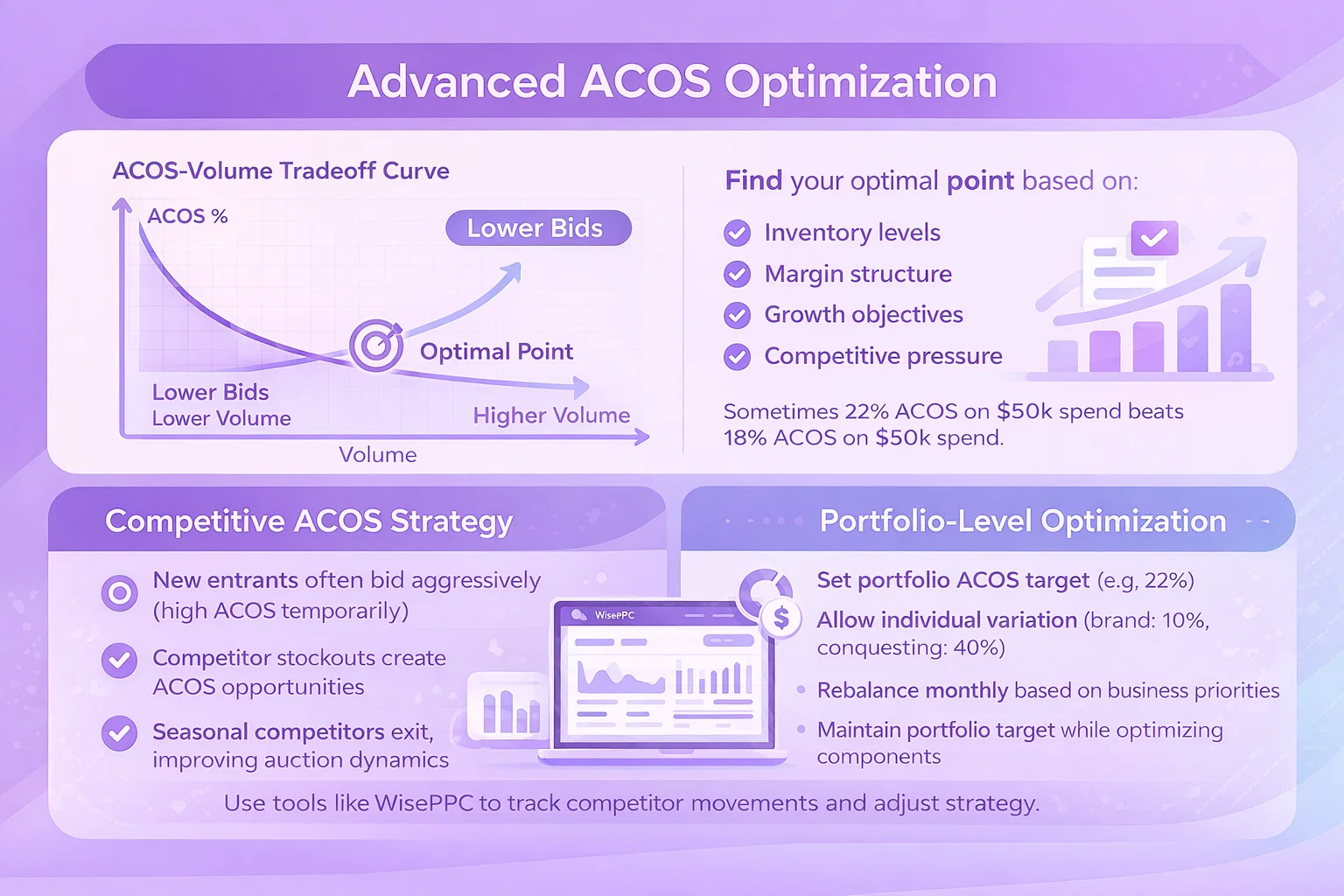
The ACOS-Volume Tradeoff Curve
There’s a relationship between ACOS and volume:
- Lower bids → Lower ACOS, Lower Volume
- Higher bids → Higher ACOS, Higher Volume
Find your optimal point based on:
- Inventory levels
- Margin structure
- Growth objectives
- Competitive pressure
Sometimes 22% ACOS on $50k spend beats 18% ACOS on $30k spend.
Competitive ACOS Strategy
Monitor competitor actions:
- New entrants often bid aggressively (high ACOS temporarily)
- Competitor stockouts create ACOS opportunities
- Seasonal competitors exit, improving auction dynamics
Use tools like WisePPC to track competitor movements and adjust strategy.
Portfolio-Level Optimization
Advanced advertisers optimize across portfolio, not individual campaigns:
- Set portfolio ACOS target (e.g., 22%)
- Allow individual variation (brand: 10%, conquesting: 40%)
- Rebalance monthly based on business priorities
- Maintain portfolio target while optimizing components
Conclusion
Reducing ACOS isn’t about slashing bids and praying. It’s systematic diagnosis, surgical optimization, and strategic tradeoffs between efficiency and growth.
The advertisers who master ACOS don’t just follow generic best practices. They understand their specific situation: margin structure, product lifecycle, competitive dynamics, and business objectives. They segment intelligently. They measure granularly. They optimize continuously.
Start with diagnosis—understand why your ACOS is where it is. Apply the strategies in order: bid management for quick wins, keyword precision for targeting efficiency, structure for long-term control, and conversion optimization for fundamental improvement.
Track progress weekly. Celebrate improvements. Learn from setbacks. ACOS optimization is a journey, not a destination.
Your path to profitable Amazon advertising starts with the first systematic adjustment. Make it today.
Quick Reference: ACOS Optimization Checklist
Weekly Tasks:
- Review keywords with >$20 spend, 0 orders → Add negatives
- Adjust bids on 1.5×+ ACOS keywords
- Check search term reports for irrelevant traffic
- Review placement performance, adjust modifiers
Monthly Tasks:
- Audit campaign structure for efficiency
- Analyze ACOS by product category
- Test new keywords with conservative bids
- Review and update negative keyword lists
Quarterly Tasks:
- Restructure underperforming campaigns
- Audit listing quality for high-ACOS products
- Reassess ACOS targets by product margin
- Competitive landscape analysis
Ready to take control of your ACOS? Try WisePPC for advanced analytics and optimization tools designed for serious Amazon advertisers.
Join the WisePPC Beta and Get Exclusive Access Benefits
WisePPC is now in beta — and we’re inviting a limited number of early users to join. As a beta tester, you'll get free access, lifetime perks, and a chance to help shape the product — from an Amazon Ads Verified Partner you can trust.
 No credit card required
Free in beta and free extra month free after release
25% off for life — limited beta offer
Access metrics Amazon Ads won’t show you
Be part of shaping the product with your feedback
No credit card required
Free in beta and free extra month free after release
25% off for life — limited beta offer
Access metrics Amazon Ads won’t show you
Be part of shaping the product with your feedback