EN
EN  ES
ES  FR
FR  DE
DE  IT
IT  KO
KO  JA
JA  ZH
ZH  AR
AR  PT
PT  TR
TR  PL
PL How to Lower ACoS on Amazon and Keep Your Growth Intact

Lowering ACoS sounds simple. Spend less, earn more. In reality, it’s rarely that clean.
Most sellers try to fix ACoS by cutting bids or pausing keywords. Sometimes it works. Often, it just slows everything down. Sales drop, ranking slips, and now you’re fixing two problems instead of one.
ACoS is not the enemy. It’s a signal. When it’s high, something underneath is off. Maybe traffic quality. Maybe conversion. Maybe structure. The goal isn’t to chase a lower percentage. The goal is to make your ad spend work harder without shrinking your growth.
Let’s break down how to do that properly.
A Practical Guide to Lower ACoS Without Slowing Growth
Lowering ACoS is not one action. It is a sequence of decisions. If you jump straight to cutting bids, you usually fix the symptom and damage the system.
This guide walks through the right order of operations.
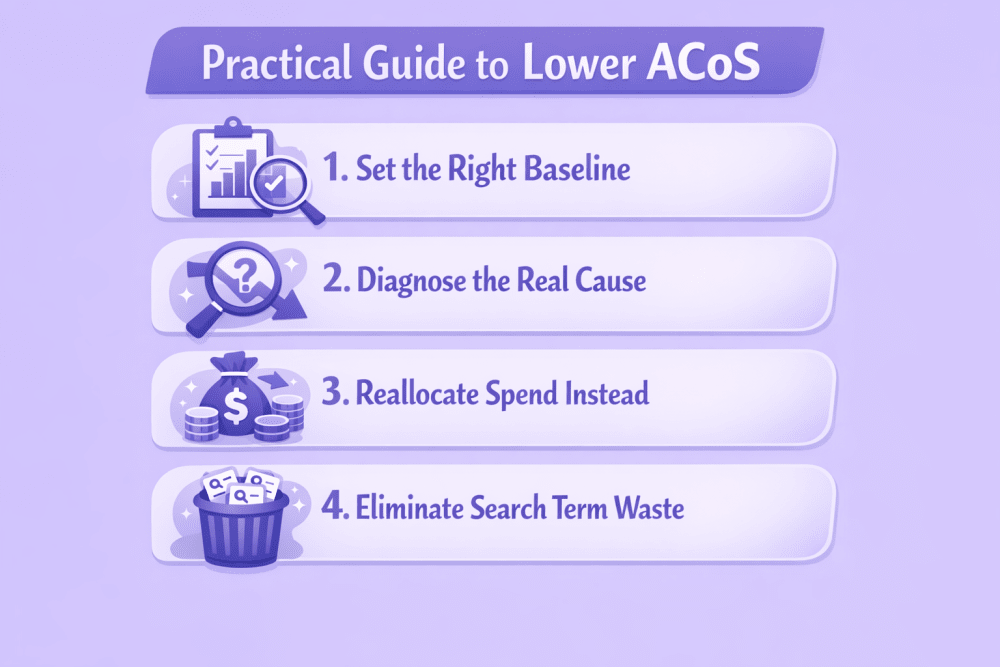
1. Set the Right Baseline Before You Optimize
Before touching bids or keywords, step back.
There is no universal good ACoS.
A 15 percent ACoS can be terrible if your margin is 12 percent. A 45 percent ACoS can be completely acceptable during a launch if it fuels organic ranking and repeat purchases.
Instead of chasing benchmarks, calculate your break-even ACoS.
Break-even ACoS formula
Break-even ACoS = Profit margin before ads
If your product sells for $40 and your total landed cost including Amazon fees is $28, your pre-ad profit is $12. That is a 30 percent margin. That means 30 percent is your break-even ACoS.
Anything under 30 percent is profitable. Anything above that requires a strategic reason.
Without this number, every optimization decision is guesswork.
2. Diagnose the Real Cause of High ACoS
When ACoS rises, the instinct is to lower bids. It feels like the quickest fix. Sometimes it works. More often, it just hides the real issue and slows down sales without solving anything underneath.
High ACoS usually comes from one of three sources: expensive traffic, poor conversion, or structural inefficiency. The problem is not the percentage itself. The problem is what is driving it. If CPC remains stable but your conversion rate drops, your listing likely needs attention.
Lowering bids in that situation only reduces traffic to an already underperforming page. If conversion is strong but CPC suddenly increases, you may be dealing with competitive pressure or an aggressive bidding strategy. And if some campaigns are consistently profitable while others bleed spend, the issue is probably budget distribution rather than keyword quality.
The key is to analyze ACoS in context. Look at CPC trends, conversion rate shifts, placement performance, and campaign segmentation together. When you understand what changed, the right adjustment becomes obvious. When you react only to the percentage, you risk fixing the wrong thing.
3. Reallocate Spend Instead of Cutting Everything
One of the biggest mistakes sellers make is broad optimization.
They reduce bids across all campaigns or slash budgets account-wide. It feels decisive. It is usually destructive.
Instead, split campaigns into three buckets:
- Profitable and scaling
- Break-even but stable
- Over target and inefficient
Your goal is not to reduce ACoS everywhere. Your goal is to redirect spend.
ACoS improves faster when you reallocate spend rather than restrict it.
4. Eliminate Search Term Waste
Keywords do not spend money. Search terms do. That distinction matters more than most sellers realize.
Every week, pull your search term report and look at what shoppers actually typed before clicking your ad. Patterns start to appear quickly. Some queries generate spend without producing a single sale. Others attract clicks but fail to convert. In some cases, impressions pile up while click-through rate remains weak, which usually signals a relevance issue.
If a search term spends more than 1.5 times your target CPA without generating revenue, it is usually a candidate for negation. When CTR is strong but conversion is low, the issue may not be the keyword itself but a mismatch between the search intent and your listing. And when impressions are high but CTR remains weak, the ad is likely showing for traffic that is not truly aligned with your product.
Negation is one of the fastest ways to improve efficiency without sacrificing scale. Just be careful not to move too quickly. Decisions based on limited data can remove potential winners before they have enough time to prove themselves.
5. Improve Conversion Before Lowering Bids
ACoS is driven by two variables: cost per click and revenue per click. You can lower CPC or increase revenue per click. Increasing conversion rate is often the cleaner and more sustainable solution.
Listing Upgrades That Consistently Move Performance
- Main image optimized for mobile clarity
- First two bullet points focused on benefits, not features
- A+ content that addresses objections directly
- Pricing aligned with perceived value
- Clear differentiation from competitors
A 15 percent lift in conversion rate can drop ACoS significantly without touching bids.
Ads amplify listing strength. They also amplify listing weakness.
6. Separate High Intent from Discovery Traffic
When campaigns mix high intent and exploratory traffic, budgets get distorted. Amazon’s algorithm does not automatically prioritize what is most profitable for you. If both types compete inside the same campaign, exploratory traffic often absorbs spend before high converting queries get the chance.
The solution is to clearly separate intent levels and manage them differently.
| Traffic Type | Examples | Budget & Bidding Approach |
| High Intent | Exact product name, brand plus product type, competitor ASIN targeting, strong purchase intent phrases | Higher bids, consistent funding, performance monitored closely for scaling |
| Discovery Traffic | Broad match terms, auto campaigns, category-level phrases | Controlled budgets, cautious bidding, longer data evaluation before scaling |
High intent campaigns typically justify stronger bids because the likelihood of conversion is higher. Discovery campaigns, on the other hand, should be treated as testing environments. They require tighter cost control and more patience while gathering data.
Separating intent ensures your most valuable traffic does not lose budget to low converting exploratory clicks. Over time, this structure protects efficiency while still allowing room for expansion.
7. Use Match Types as a Funnel
Each match type has a specific role in a well structured account. Auto and broad campaigns act as discovery engines. Phrase helps refine intent. Exact match is where controlled scaling and consistent profitability usually happen.
A strong system follows this progression:
- Harvest winning search terms from auto and broad campaigns
- Move those proven terms into exact match campaigns
- Adjust bids based on profitability and conversion data
- Add negatives in discovery campaigns to prevent duplication and budget overlap
Over time, this funnel shifts more spend toward controlled, high intent traffic. As more budget flows into proven exact terms, efficiency improves naturally without sacrificing scale.
8. Optimize Placement, Not Just Base Bids
Top of Search, Rest of Search, and Product Pages do not perform equally. Treating them as if they do leaves efficiency on the table.
If Top of Search converts twice as well as other placements, increasing the placement adjustment there can actually improve overall performance, even if your average CPC rises slightly. What matters is revenue per click, not just cost per click. Paying a bit more for traffic that converts significantly better often results in stronger overall efficiency.
Pull your placement reports and study them carefully. Compare conversion rates by placement, examine performance differences, and look at where revenue is truly concentrated. When you shift more spend toward placements where buyers are decisive, performance stabilizes.
Placement optimization is often overlooked because it feels secondary to bidding. In reality, it can be one of the most controlled ways to improve results without cutting traffic.
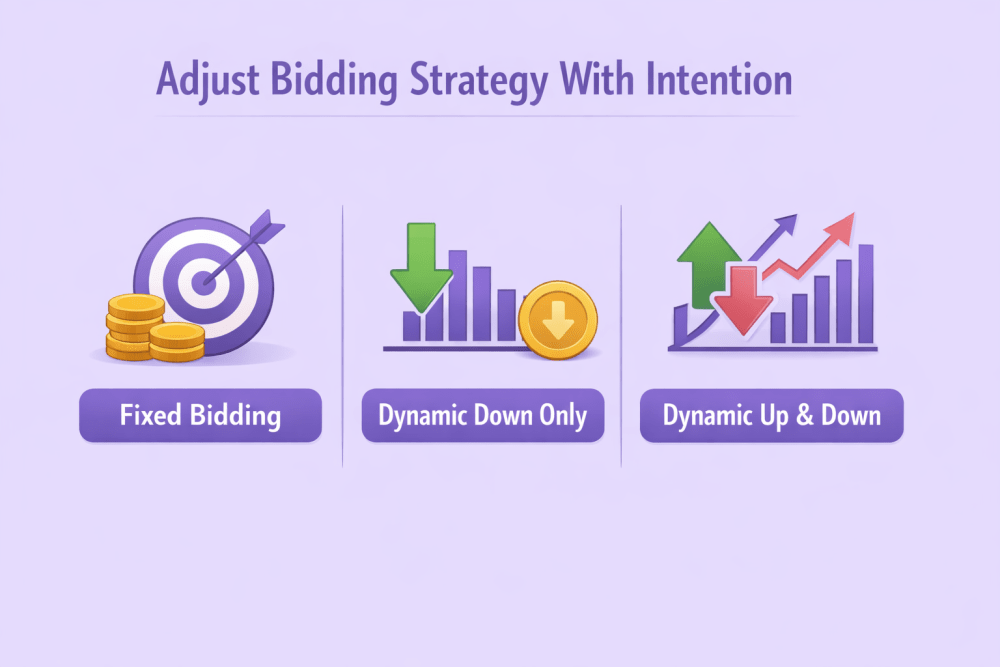
9. Adjust Bidding Strategy With Intention
Amazon gives you three primary bidding strategies, and each one changes how aggressively your ads compete in auctions. Understanding how they behave is critical before making adjustments.
- Fixed bidding. Amazon uses your exact bid without raising or lowering it. This gives you full control and predictable CPC behavior. It is often useful when you want stability or when you are testing profitability at specific bid levels.
- Dynamic down only. Amazon can lower your bid in auctions where conversion likelihood appears weaker, but it will never raise it above your base bid. This approach is typically safer for efficiency-focused campaigns and can reduce wasted spend without aggressively limiting traffic.
- Dynamic up and down. Amazon can both increase and decrease your bid, sometimes by a significant percentage, depending on perceived conversion potential. This strategy can help capture high intent traffic more aggressively, but it can also push CPC higher than expected if left unchecked.
If performance declines unexpectedly, review which strategy is active. Dynamic up and down can quietly inflate CPC during competitive periods. Switching to fixed or down only may stabilize costs quickly.
However, bidding strategy changes should not be emotional reactions. Lowering aggressiveness can reduce CPC, but it can also slow traffic and ranking momentum. Treat bidding strategy as a precision lever, not a panic button.
10. Optimize Budgets Without Strangling Growth
Budgets influence performance more than most sellers realize. Sometimes ACoS looks inflated not because bids are wrong, but because too much spend is flowing into the wrong campaigns.
If a campaign is significantly over target and consuming a large share of daily spend, reducing its budget can quickly stabilize overall performance. This is especially useful when you need breathing room while you fix keywords, placements, or conversion issues in the background.
At the same time, avoid overcorrecting. Campaigns that are only slightly above target often improve with small bid adjustments, better negation, or listing refinements. Cutting their budget too aggressively can slow sales velocity and hurt ranking.
Reserve firm budget cuts for clear underperformers with consistent data. Meanwhile, increase budgets on strong performers to protect revenue momentum. Budget optimization should redirect growth, not restrict it.
11. Use Dayparting Only When Data Supports It
Dayparting can work, but not universally.
Some niches show strong hourly or weekday performance differences. Others remain consistent throughout the week.
If your data shows weak weekend performance or low converting late night traffic, adjusting bids during those windows can improve efficiency.
Just do not implement dayparting blindly. Review at least 30 days of hourly performance before making changes.
12. Think Beyond ACoS Before You Cut
Lower ACoS is not always the right objective in the short term. If you focus only on the percentage, you risk making decisions that look efficient but damage long term growth.
This is where context matters.
Monitor TACoS to See the Full Impact
ACoS measures ad efficiency. TACoS measures overall business impact.
TACoS formula: TACoS = Ad Spend / Total Sales
ACoS tells you how efficiently ads convert into attributed sales. TACoS shows how ads affect total revenue, including organic sales.
The difference is important.
If ACoS is high but TACoS is declining, your ads may be improving organic ranking and increasing overall revenue. That is often a healthy pattern. It means paid traffic is strengthening your position instead of just buying isolated sales.
If both ACoS and TACoS are high, ads are not supporting long term growth effectively. In that case, something deeper needs fixing.
Healthy accounts typically show:
- Stable or gradually declining TACoS over time
- Increasing organic share of total sales
- Profitable exact campaigns driving consistent revenue
Looking at TACoS keeps you from making short sighted cuts that hurt momentum.
Know When Higher ACoS Is Strategic
This is where many sellers get too aggressive.
There are moments when accepting a higher ACoS makes sense:
- New product launches
- Ranking pushes for competitive keywords
- Competitive brand defense
- Seasonal demand spikes
If a temporary increase in ACoS improves organic rank, review velocity, or brand visibility, it can pay off later.
The mistake is not running high ACoS campaigns. The mistake is running them without a clear objective.
Temporary investment is strategic. Permanent inefficiency is not.
When you understand the difference, you stop reacting to ACoS emotionally and start using it as a controlled growth lever.
How WisePPC Helps You Scale With Control
At WisePPC, we built the platform around one simple idea – growth should be driven by clarity, not guesswork.
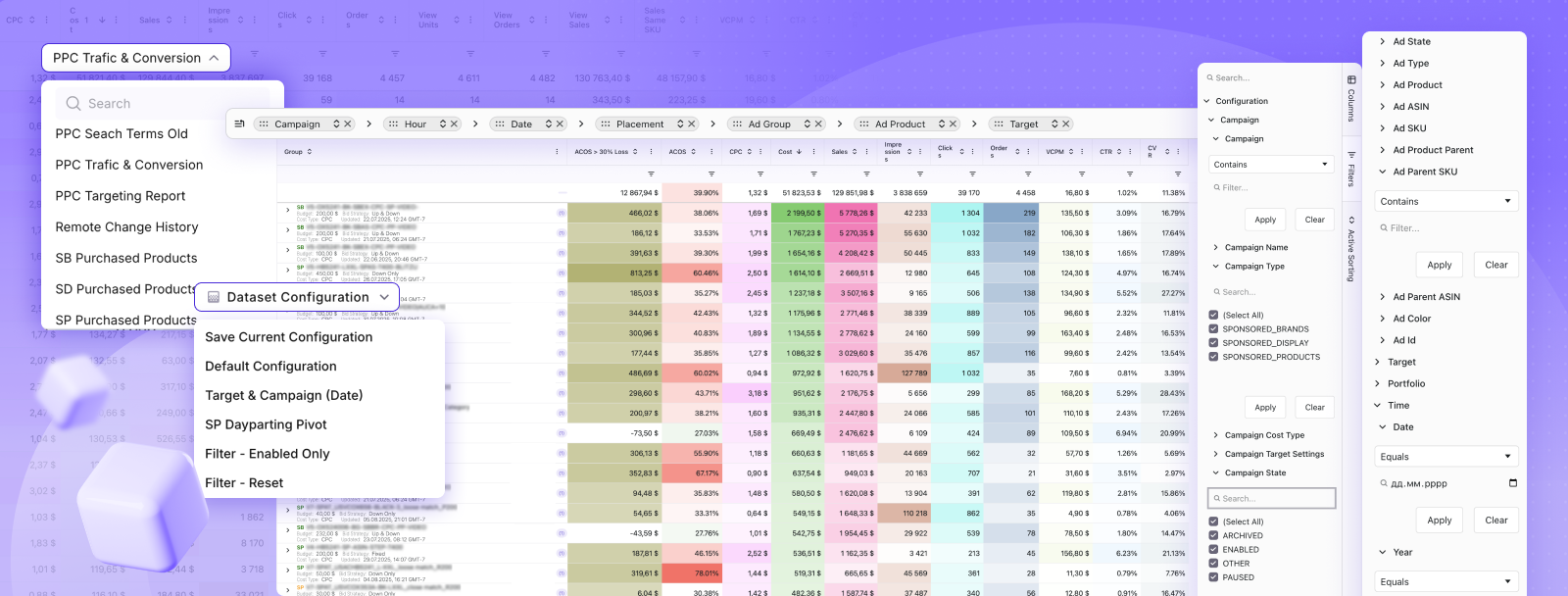
As an Amazon Ads Verified Partner, WisePPC connects through official integrations and provides full visibility into what is actually driving performance. The platform tracks more than 30 key metrics in real time, stores long term historical data far beyond Amazon’s limited retention window, and separates paid impact from organic revenue so the full business picture is always clear.
Instead of switching between disconnected reports, everything is centralized in one structured dashboard. Campaigns can be filtered instantly. Bids and budgets can be edited directly inside the table. Up to six KPIs can be compared on a single chart. Smart visual highlights make inefficiencies obvious without digging through spreadsheets. Bulk actions allow thousands of targets to be adjusted in seconds, and placement level analysis shows exactly where profit is generated.
Built for sellers managing growth at any scale, WisePPC supports both smaller catalogs and complex multi account operations. Automated optimization features, AI driven bid adjustments, advanced segmentation, and long term trend tracking create a more structured decision making process.
Scaling does not have to mean losing efficiency. With clear data and actionable insights in one place, growth becomes intentional rather than reactive.
Build a Monthly Optimization Rhythm
Daily emotional adjustments destroy performance. Small fluctuations are normal. Reacting to every dip is not.
Instead of constant tweaking, build a structured rhythm. This keeps decisions data-driven and prevents overcorrection.
| Timeframe | Focus Area | Key Actions |
| Weekly | Search term efficiency | Review search term reports, add negative keywords, adjust obvious bid outliers that clearly exceed targets |
| Bi-weekly | Budget and placement control | Rebalance budgets between profitable and underperforming campaigns, review placement data to shift spend toward stronger converting positions |
| Monthly | Strategic performance review | Evaluate TACoS trends, assess listing conversion improvements, recalculate break-even margins if costs or pricing have changed |
This structured cadence stabilizes performance.
Instead of reacting to noise, you respond to patterns. And over time, that consistency compounds.
Conclusion
Lowering ACoS is rarely about one adjustment or a single trick. Most of the time, it comes down to understanding what the numbers are actually telling you and resisting the urge to react too quickly. When sellers chase a lower percentage without context, they often end up reducing visibility, slowing sales, and creating new problems that take longer to fix than the original one.
The accounts that improve consistently tend to follow a different pattern. They focus on structure first, conversion second, and bidding last. Spend moves toward what already works, waste is removed gradually, and decisions are made with enough data behind them. Over time, ACoS improves not because traffic was cut, but because efficiency increased naturally.
In the end, ACoS works best as a guide rather than a target. When campaigns are built around clear intent, strong listings, and controlled testing, performance becomes more predictable. Growth and efficiency stop competing with each other, and optimization turns into a steady process instead of a constant reset.
FAQ
What is a good ACoS on Amazon?
There is no universal number that works for every seller. ACoS only makes sense when compared to your margins and your current growth stage. A profitable ACoS for one product may be unsustainable for another. The more useful reference point is your break-even ACoS, because it tells you how much advertising you can afford before profitability disappears.
Why does my ACoS increase even when sales stay stable?
This usually happens when click costs rise or conversion rate drops slightly. Competition, seasonal demand shifts, or listing changes can all influence performance without immediately affecting sales volume. Looking at CPC trends and conversion data together usually reveals what changed.
Should I lower bids immediately when ACoS goes up?
Not always. Lowering bids can reduce spend quickly, but it can also slow traffic and hurt ranking if the real issue sits elsewhere. It is usually better to first understand whether the problem comes from traffic quality, conversion issues, or campaign structure before adjusting bids.
How long should I wait before optimizing a campaign?
Most campaigns need enough data before decisions make sense. For many sellers, that means waiting until a keyword or search term has generated meaningful clicks or spend relative to your target CPA. Optimizing too early often removes potential winners before they have time to perform.
Is a high ACoS ever acceptable?
Yes, in certain situations. Launch phases, ranking pushes, or competitive periods sometimes require higher ad spend to build visibility and organic momentum. The important part is having a clear reason behind it and knowing when that higher ACoS should return to normal levels.
Join the WisePPC Beta and Get Exclusive Access Benefits
WisePPC is now in beta — and we’re inviting a limited number of early users to join. As a beta tester, you'll get free access, lifetime perks, and a chance to help shape the product — from an Amazon Ads Verified Partner you can trust.
 No credit card required
Free in beta and free extra month free after release
25% off for life — limited beta offer
Access metrics Amazon Ads won’t show you
Be part of shaping the product with your feedback
No credit card required
Free in beta and free extra month free after release
25% off for life — limited beta offer
Access metrics Amazon Ads won’t show you
Be part of shaping the product with your feedback