EN
EN  ES
ES  FR
FR  DE
DE  IT
IT  KO
KO  JA
JA  ZH
ZH  AR
AR  PT
PT  TR
TR  PL
PL How to Build and Grow Your Brand on Amazon

Amazon is no longer just a place to list products. It’s a platform where brands are built, reputations are earned, and long-term customer relationships take root. But growing a brand here isn’t about flashy packaging or crossing your fingers after launch. It takes clarity, consistency, and smart use of the tools Amazon puts at your fingertips.
In this guide, we’ll break down the real-world strategies that help sellers build recognition, drive repeat purchases, and stay competitive in a crowded marketplace. Whether you’re just starting out or trying to scale an existing brand, this isn’t about doing more – it’s about doing it with purpose.
What a Brand Actually Means
A brand isn’t just your logo, color palette, or catchy slogan. Those are just signals. The brand itself lives in the minds of your customers. It’s how people recognize you, how they feel when they interact with your business, and what they say about your product when you’re not in the room.
In simple terms, your brand is a combination of perception (what people believe about you), experience (what it’s like to buy or use your product), and promise (what you consistently deliver).
Think of Apple, Patagonia, or even niche brands like Hydro Flask or Glossier. You don’t need a paragraph to explain what they stand for – you feel it instantly. That’s brand power. On Amazon, you may not have a glossy storefront on Fifth Avenue, but the brand principles are the same. You build trust through clarity, consistency, and value over time.
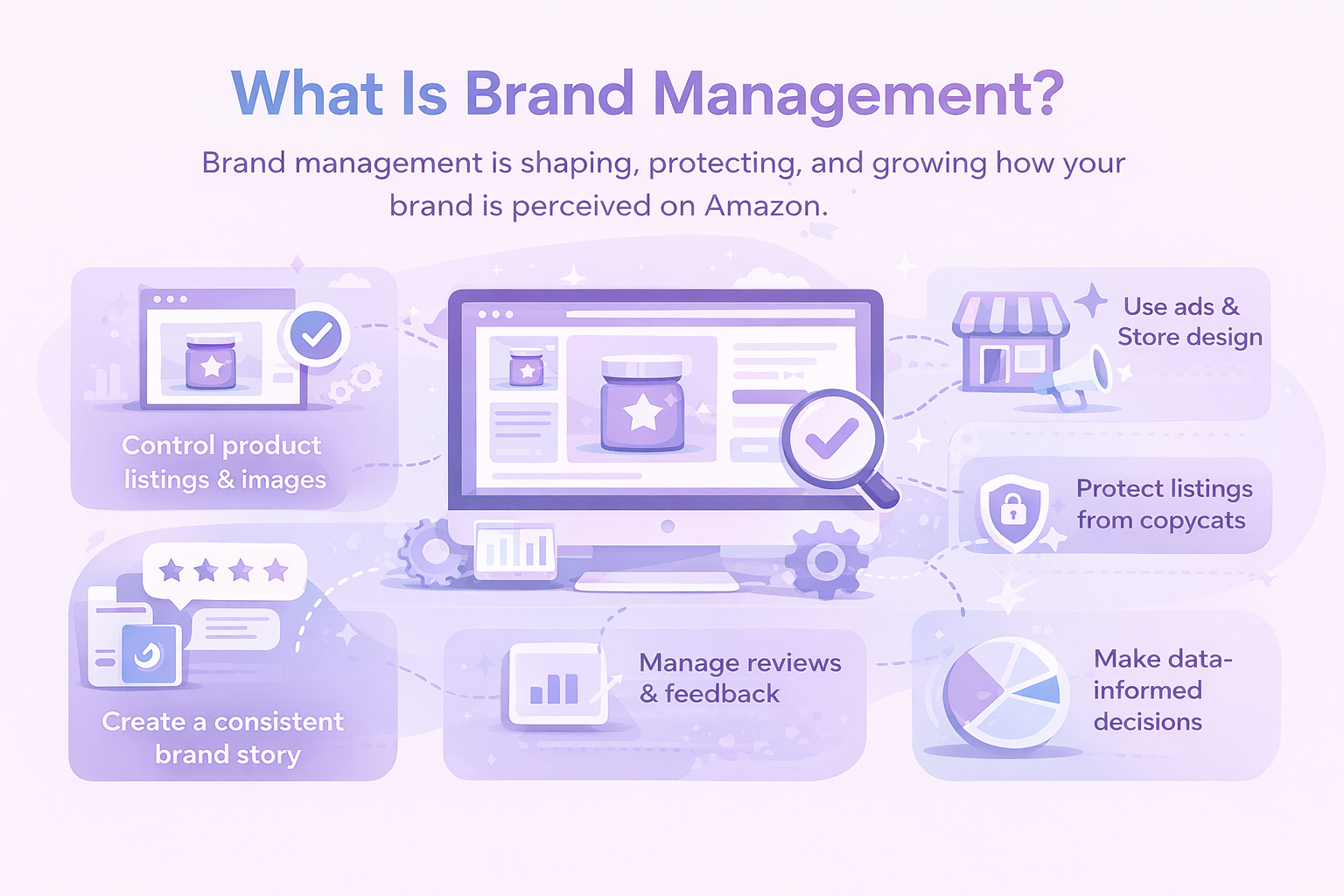
What Is Brand Management?
Brand management is everything you do to shape, protect, and grow how your brand is perceived. It’s the behind-the-scenes strategy that keeps your product from becoming just another option in a sea of sameness.
On Amazon, brand management includes:
- Controlling your product listings and images.
- Creating a consistent brand story across all touchpoints.
- Managing customer reviews and feedback.
- Protecting your listings from hijackers or copycats.
- Using advertising and Store design to reinforce your message.
- Making data-informed decisions to optimize the experience.
It’s not about micromanaging every detail. It’s about building systems that help your brand scale without losing focus.
Why Brand Management on Amazon Actually Matters
Here’s the deal: Amazon is crowded. Over 2 million active sellers are competing for attention, and unless you’re offering something wildly unique (spoiler: you’re probably not), your brand is what sets you apart.
And buyers? They make decisions in seconds. They don’t read your entire listing or scroll through every image. They pick up on visual cues, reviews, product titles, and your overall presence, and decide if they trust you.
Why investing in your brand pays off:
- Higher conversion rates: Customers buy from brands they trust.
- Repeat customers: A strong brand gives people a reason to come back.
- Stronger margins: Branded products can charge more than generic ones.
- Better ad performance: Recognition improves click-through and lowers cost-per-click.
- Business valuation: If you ever want to sell, buyers look at brand equity, not just SKUs.
In short, strong brand management leads to long-term value. It’s not about winning one sale – it’s about building a brand people remember and return to.

Key Stages for Building and Growing Your Brand on Amazon
Before you jump into storefronts, ads, or analytics, it helps to understand the core stages involved in shaping a strong brand on Amazon. The steps below break down the essential work that moves your brand from basic presence to real recognition. Each stage builds on the one before it, forming a practical path you can follow no matter your niche or experience level.
1. Define What Your Brand Actually Stands For
Before you worry about storefronts or ads, nail your foundation. What does your brand represent? What problems do your products solve, and who exactly are they for?
This means locking in three things: a clear mission and brand voice, a product point of view (what makes you different?), and a specific audience you’re solving for.
Generic doesn’t win. “Premium quality at a great price” is not a brand – it’s a default setting. Think like a customer scrolling through five similar listings. What would make them stop on yours?
If your brand doesn’t stand for anything in particular, Amazon shoppers will scroll past it like wallpaper.
2. Set Yourself Up With Amazon Brand Registry
Once you have a brand name, logo, and a registered (or pending) trademark, enroll in Amazon Brand Registry. This is step one if you’re serious about growing on the platform.
Why it matters:
- You gain control over your product listings.
- You unlock tools like A+ Content and Amazon Stores.
- You get access to enhanced protection against hijackers and counterfeiters.
Don’t have a trademark yet? Amazon’s IP Accelerator connects you with vetted lawyers who can speed up the process, and you can still access Brand Registry features while the application is pending.
3. Use A+ Content to Tell a Better Story
Once you’re in the registry, you can enhance your product detail pages with A+ Content. This lets you move beyond bullet points and add real visuals, comparison charts, branded modules, and structured layouts.
But don’t just paste in marketing filler. Use A+ Content to:
- Preemptively answer common buyer questions.
- Show product use in real-life scenarios.
- Visually differentiate from competitors.
- Reinforce your brand’s tone and style across every listing.
Brands that use A+ Content see higher conversion rates, better review quality, and fewer returns. Think of it as your chance to build trust before the shopper even adds to cart.
4. Build a Real Storefront, Not Just Listings
Amazon Stores let you create a multi-page branded storefront – like a mini website inside Amazon. It’s free, and honestly underused by most sellers.
A strong Store setup can help you group related products by use case or collection, showcase your top sellers, bundles, and new releases, and tell your brand story in one place with images, videos, and headlines.
Use your Store as a destination for Sponsored Brands ads and off-Amazon campaigns (like Instagram or YouTube). Amazon gives you traffic and sales analytics for your Store, so you can see what’s working and what’s getting ignored.
5. Make Smart Use of Sponsored Brands Ads
Let’s talk about visibility. Sponsored Products ads are great for direct sales, but if you’re building a brand, Sponsored Brands campaigns are where you plant the flag.
These ads appear at the top of search results and let you feature:
- Your brand logo and a custom headline.
- Up to three products or a video.
- A link to your Store.
Here’s what to focus on:
- Don’t treat this like a product pitch. Highlight your brand’s promise.
- Use copy that reinforces your positioning, not just features.
- Test different headlines and visuals to see what resonates.
Brand-building isn’t just about awareness – it’s about leaving an impression. Sponsored Brands ads give you room to do both.
6. Go Beyond Amazon With Attribution and Off-Platform Marketing
While Amazon’s massive audience is powerful, you don’t want to live in a vacuum. Off-Amazon efforts like influencer marketing, email campaigns, and paid social should also drive traffic back to your listings or Store.
Amazon Attribution lets you track what’s actually working by linking off-site traffic to Amazon conversions. It covers email campaigns, Google and Facebook Ads, social posts, influencer links, blog, or site traffic.
This matters because it’s easy to burn money off-Amazon if you can’t see what actually drives revenue. Attribution helps you optimize your outreach and reward the channels that perform.
7. Lean on Brand Analytics to Understand Your Market
Amazon’s Brand Analytics tools give you visibility into shopper behavior you won’t get from basic reports.
You’ll find:
- Search terms that led to your products.
- Click and conversion share compared to competitors.
- Market basket analysis (what other products are purchased with yours).
- Demographic breakdowns of your customers.
Use this data to:
- Refine your product listings and keyword targeting.
- Spot upsell and bundling opportunities.
- Adjust pricing or offers based on what’s converting best.
Data isn’t just for optimization – it’s how you avoid wasting ad spend and doubling down on what’s already working.
8. Use Reviews and Customer Feedback to Strengthen the Brand
Reviews are social proof, but they’re also product intelligence. Amazon’s Voice of the Customer dashboard helps you spot patterns in complaints, questions, or praise.
Your job:
- Respond quickly and professionally to negative feedback.
- Use positive reviews in your Store or A+ Content.
- Identify recurring issues and improve your listings or product design.
Also: consider enrolling in Amazon Vine to collect trusted reviews on new launches. These early reviews can make or break a product’s momentum.
9. Test, Iterate, and Optimize
Amazon isn’t static. Buyer behavior shifts. Competition evolves. Tools change.
Use Manage Your Experiments (MYE) to A/B test titles, main images, A+ Content, and bullet point structures.
And don’t just run a test and move on. Use the insights to revise your broader strategy. Branding is a continuous loop of learning and adjusting.
10. Track Brand Growth With the Right Metrics
Amazon now gives you better insight into how your brand is performing at every stage of the funnel. Some key metrics to keep an eye on:
- Total brand shoppers.
- Engaged shopper rate.
- Customer conversion rate.
- % of sales from new-to-brand buyers.
- Subscribe & Save rate or repeat purchase rate.
Benchmark these against competitors in your category using Amazon’s Brand Metrics dashboard. Over time, you’ll be able to tell if your efforts are gaining traction or just holding the line.

Turning Data Into an Edge for Your Brand
Building a brand is one thing, knowing what’s actually driving results is another. That’s where we step in. At WisePPC, we help brands go beyond gut instinct by making sense of the data behind every click, sale, and ad decision. If you’re selling on Amazon or across multiple marketplaces, getting clear on performance isn’t optional – it’s how you stay competitive.
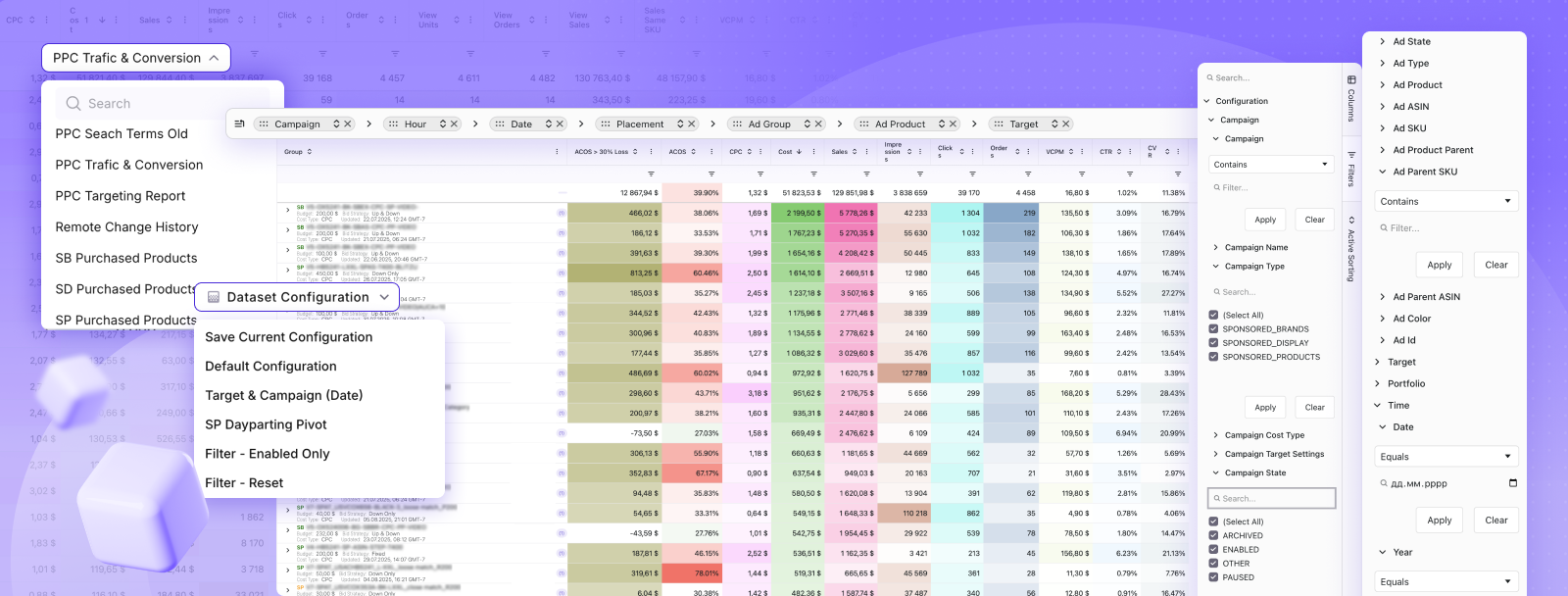
We designed WisePPC as a platform that simplifies complexity without watering anything down. Our tools give you real-time visibility across campaigns, product listings, and marketplace accounts, so you can see what’s working and fix what isn’t before it costs you. From automated bid optimization to deep placement analysis, it’s all built to help brands grow smarter, not just bigger.
Final Thoughts: Think Like a Brand, Not a Product
Too many sellers focus on the listing. The trick is to focus on the customer.
What do they need to see, feel, or believe to choose your brand over the others?
Growing on Amazon isn’t about being everywhere – it’s about being memorable where it counts. If you invest in the right systems, protect your identity, and constantly adapt to how shoppers behave, your brand won’t just survive. It’ll scale.
Now go make something worth remembering.
FAQ
1. Do I need a trademark before I can start building a brand on Amazon?
You can start building your brand presence anytime, but to unlock key tools like Brand Registry, A+ Content, and storefront customization, you’ll need a registered trademark or at least a pending one through Amazon’s IP Accelerator. It’s not just a formality. That trademark is what gives you control over your listings and helps protect your brand from copycats.
2. What’s the difference between selling a product and building a brand?
Selling a product is transactional. Building a brand means creating something that people recognize, remember, and come back to. On Amazon, that translates into better conversions, stronger reviews, and a business that’s a lot harder for competitors to knock off.
3. Is A+ Content actually worth the time?
Absolutely, if you use it well. It’s not about stuffing it with nice images and buzzwords. The brands that win here use A+ to answer questions before they’re asked, show the product in context, and reinforce what makes them different. It’s a trust builder, and it pays off in conversions and fewer returns.
4. How do I know if my brand is growing on Amazon?
Look beyond just sales. Use Amazon’s Brand Metrics and Brand Analytics to track how many new customers are buying, how often they’re coming back, and how you stack up against similar brands. Growth isn’t just volume, it’s how well your brand holds attention and earns loyalty over time.
5. Should I be sending traffic from social media or my own website to Amazon?
Yes, especially if you’re using Amazon Attribution to track it. Driving traffic from off-Amazon sources like Instagram, YouTube, or email can boost visibility, sales, and even ranking. Just make sure you’re not flying blind. Attribution helps you see what’s working and what’s wasting your time.
Join the WisePPC Beta and Get Exclusive Access Benefits
WisePPC is now in beta — and we’re inviting a limited number of early users to join. As a beta tester, you'll get free access, lifetime perks, and a chance to help shape the product — from an Amazon Ads Verified Partner you can trust.
 No credit card required
Free in beta and free extra month free after release
25% off for life — limited beta offer
Access metrics Amazon Ads won’t show you
Be part of shaping the product with your feedback
No credit card required
Free in beta and free extra month free after release
25% off for life — limited beta offer
Access metrics Amazon Ads won’t show you
Be part of shaping the product with your feedback