EN
EN  ES
ES  FR
FR  DE
DE  IT
IT  KO
KO  JA
JA  ZH
ZH  AR
AR  PT
PT How to Improve Conversion Rates for Products You Sell Online

Quick Summary: Improving online conversion rates requires simplifying checkout, optimizing product pages with clear visuals and compelling copy, using A/B testing to identify what resonates with customers, and leveraging AI-powered personalization. According to UC Berkeley research, AI agents drove 60% higher purchase completion rates for Amazon users, demonstrating the power of intelligent assistance in the buying process.
Online retailers face a persistent challenge: traffic doesn’t automatically translate into sales. According to U.S. Census Bureau data, e-commerce sales in the third quarter of 2025 increased 5.1 percent from the third quarter of 2024, while total retail sales increased 4.1 percent in the same period. But that growth means nothing if visitors leave without purchasing.
The gap between browsing and buying is where conversion rate optimization comes into play. Small changes to checkout flows, product presentations, and customer interactions can dramatically shift purchase completion rates.
This guide covers actionable strategies backed by recent research and real-world results. No fluff, just practical tactics that work in 2026.
Understanding Conversion Rate Fundamentals
Conversion rate measures the percentage of visitors who complete a desired action—typically making a purchase. Calculate it by dividing total conversions by total visitors, then multiplying by 100.
A retailer with 1,000 monthly visitors and 30 sales has a 3% conversion rate. That might sound modest, but context matters. Industry benchmarks vary wildly depending on product category, price point, and traffic source.
Here’s the thing though—obsessing over industry averages misses the point. The goal isn’t matching arbitrary benchmarks. It’s improving from wherever the baseline currently sits.
Why Conversion Rates Matter More Than Traffic
Driving traffic costs money. Whether through paid ads, content marketing, or social media campaigns, every visitor represents an investment. Improving conversion efficiency means extracting more value from existing traffic without additional acquisition costs.
Consider two scenarios: doubling traffic while maintaining a 2% conversion rate, versus keeping traffic steady while improving conversions to 4%. The second approach delivers identical results without doubling marketing spend.
According to research on digital marketing in 2026, AI-assisted targeting and data-led personalization have become standard practice for high-performing teams. Manual targeting and static approaches no longer compete effectively.
Simplify the Checkout Process
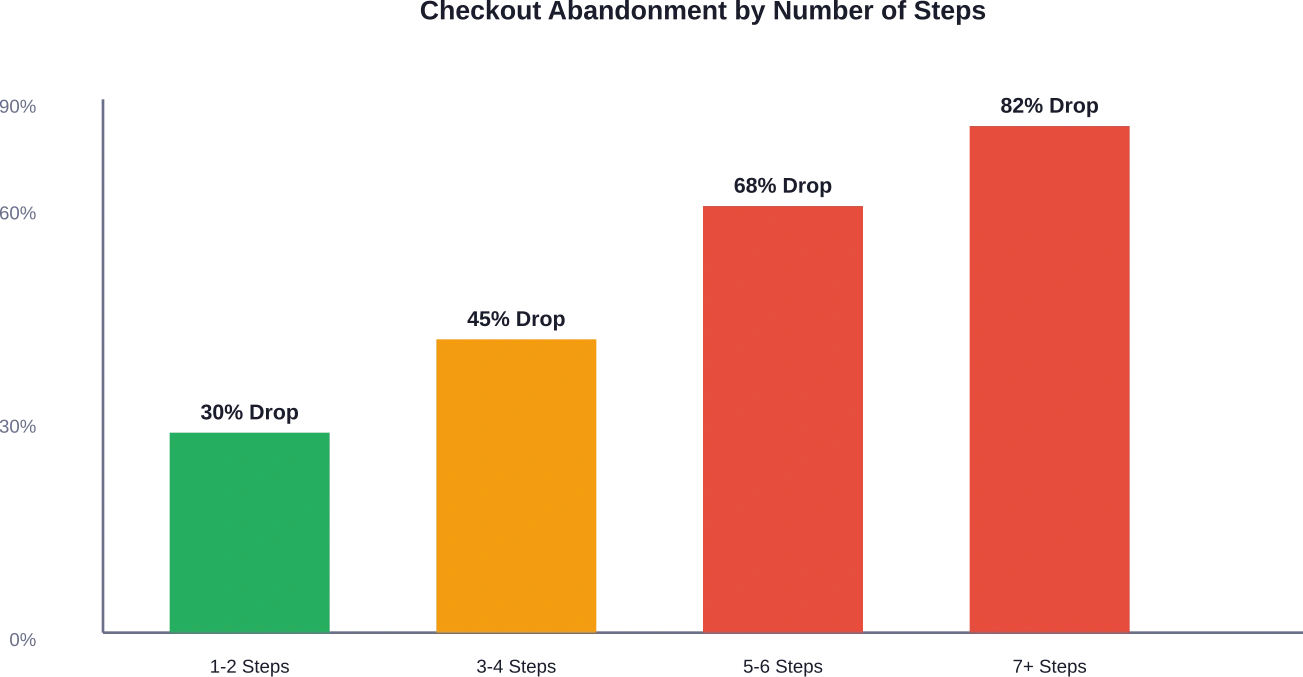
Cart abandonment remains one of the biggest conversion killers. Complicated checkout flows create friction that sends customers elsewhere.
Start by counting steps. How many pages stand between adding items to cart and purchase completion? Each additional step increases abandonment probability.
Key Checkout Optimizations
Guest checkout options eliminate forced account creation. Many customers abandon purchases rather than create yet another account. Offering a guest path reduces this friction immediately.
Auto-fill capabilities speed up form completion. Address lookup tools and saved payment methods cut completion time significantly. Mobile users particularly benefit from reduced typing requirements.
Progress indicators show customers exactly where they stand in the process. Knowing “Step 2 of 3” provides psychological reassurance that completion is near.
Multiple payment options matter more than ever. Credit cards, digital wallets, buy-now-pay-later services—customer payment preferences vary widely. Limiting options means losing sales.
Optimize Product Pages for Conversion
Product pages serve as digital salespeople. They need to answer questions, overcome objections, and motivate action—all without human interaction.
High-quality product images rank among the most critical elements. Multiple angles, zoom functionality, and lifestyle context shots help customers visualize ownership. Video demonstrations perform even better for complex products.
But visuals alone don’t close sales. Product descriptions need to balance technical specifications with benefit-oriented copy. Customers care about what products do for them, not just what they are.
Writing Compelling Product Copy
Effective product descriptions address specific customer pain points. Instead of generic feature lists, focus on problems solved and outcomes achieved.
Social proof elements—reviews, ratings, testimonials—build trust and reduce purchase anxiety. According to Federal Trade Commission guidelines, these endorsements must be truthful and not misleading. Fake reviews violate consumer protection standards and damage credibility when discovered.
Scarcity and urgency elements can drive action when used authentically. Limited stock indicators or time-sensitive offers create motivation. The key word is authentic—fabricated scarcity backfires when customers recognize manipulation.
| Element | Impact on Conversion | Implementation Priority |
|---|---|---|
| High-quality images | High | Critical |
| Customer reviews | High | Critical |
| Clear pricing | High | Critical |
| Detailed descriptions | Medium | Important |
| Video demonstrations | Medium | Important |
| Size guides | Medium | Category-dependent |
| Related products | Low-Medium | Optional |

Use WisePPC to Track Ad and Sales Performance
Improving conversion rates often depends on understanding how traffic and advertising interact with product listings. WisePPC gives sellers detailed visibility into campaign results, keyword performance, and product metrics. This helps sellers see which ads bring qualified traffic and how that traffic contributes to product sales.
Looking at How Ads Influence Product Sales?
Use WisePPC to:
- analyze campaign and keyword performance
- identify ads driving product sales
- manage and optimize Amazon PPC campaigns
Leverage A/B Testing to Identify What Works
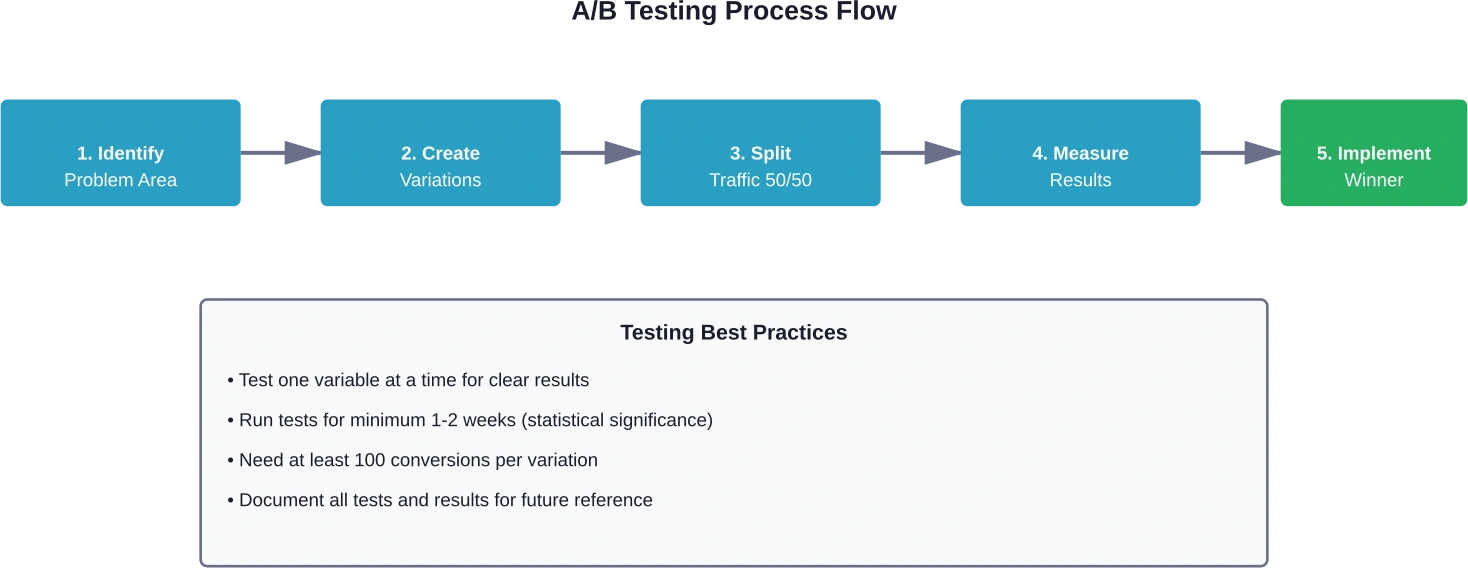
Assumptions about customer preferences frequently prove wrong. A/B testing replaces guesswork with data.
The concept is straightforward: show different versions to different visitor segments, then measure which performs better. Version A might feature a green “Add to Cart” button, while Version B uses orange. Actual results determine the winner.
According to shared case studies, testing three ad variations for a single-product store showed version “B” brought $1,000 in just 72 hours—significantly outperforming the alternatives.
What to Test First
Prioritize high-impact elements before minor details. Headline variations, primary images, and call-to-action buttons typically produce the most significant results.
Pricing presentation deserves testing attention. Does showing the original price with a discount convert better than displaying the sale price alone? Does bundling multiple items increase average order value? Test to find out.
Product page layout variations can reveal surprising preferences. Some audiences prefer detailed information above the fold, while others respond better to visual-heavy presentations with expandable detail sections.
Implement AI-Powered Personalization
Generic experiences no longer cut it. According to UC Berkeley’s California Management Review, AI agents are fundamentally changing how purchases happen. Amazon’s Rufus assistant drove over $10 billion in additional annual sales by fall 2025, with users who engaged the assistant completing purchases at 60% higher rates.
That’s not a small improvement—it’s a massive conversion lift from intelligent assistance.
Personalization extends beyond product recommendations. Dynamic pricing, customized messaging, and individualized content all contribute to higher conversion rates.
Practical Personalization Tactics
Behavioral targeting shows different content based on browsing history. Someone viewing running shoes repeatedly might appreciate seeing new arrivals in that category prominently featured.
Geographic personalization adjusts content for location-specific preferences, weather patterns, or local events. A retailer selling outdoor gear might promote rain jackets to Pacific Northwest visitors while highlighting sun protection products for Southwest customers.
Abandoned cart recovery emails remain one of the highest-converting personalization tactics. Automated reminders with product images and direct purchase links recapture sales that would otherwise be lost.
According to digital marketing research, automation and data-led personalization are now built into high-performing strategies. Manual approaches simply can’t match the scale and responsiveness of AI-assisted systems.
Optimize Site Speed and Mobile Experience
Technical performance directly impacts conversion rates. Slow-loading pages lose customers before they ever see product offerings.
Research consistently shows that page load time correlates inversely with conversion rates. Each additional second of delay costs sales. Mobile users prove particularly impatient with slow experiences.
Speaking of mobile—U.S. Census Bureau data shows e-commerce continuing its strong growth trajectory. Much of that activity happens on smartphones. Sites that don’t perform flawlessly on mobile devices leave money on the table.
Technical Optimization Priorities
Image compression reduces file sizes without noticeable quality loss. Large, unoptimized images are often the primary culprit behind slow load times.
Content delivery networks distribute site assets across multiple servers geographically. This reduces the physical distance between servers and users, improving load speeds globally.
Mobile-responsive design isn’t optional anymore. Layouts must adapt seamlessly to various screen sizes. Buttons need adequate sizing for touch interaction. Forms should minimize typing requirements.
Touch-friendly navigation elements prevent frustration. Small clickable areas lead to misclicks and abandoned sessions. Generous button sizing and spacing improve mobile conversion rates measurably.
Build Trust Through Transparency
Online transactions require trust. Customers can’t physically examine products or interact with salespeople. Digital trust signals fill that gap.
Clear return policies reduce purchase anxiety. When customers know they can return products easily, they’re more likely to take the initial buying risk.
Security badges and trust seals provide visual reassurance. SSL certificates, payment processor logos, and third-party verification symbols all contribute to credibility.
According to Federal Trade Commission guidelines on consumer protection, transparency in advertising and honest business practices form the foundation of legitimate commerce. Deceptive practices—whether misleading prices, fake reviews, or hidden terms—violate consumer protection standards.
| Trust Element | Purpose | Placement |
|---|---|---|
| SSL certificate | Secure data transmission | Entire site (HTTPS) |
| Money-back guarantee | Risk reduction | Product pages, checkout |
| Customer reviews | Social proof | Product pages |
| Contact information | Accessibility | Footer, contact page |
| Clear shipping costs | Price transparency | Product pages, cart |
| Privacy policy | Data protection assurance | Footer, checkout |
Transparency in Pricing
Hidden fees at checkout represent a major conversion killer. Customers who discover unexpected shipping charges or service fees often abandon carts immediately.
Display total costs as early as possible. Product pages should indicate shipping costs or offer calculators based on location. Surprises at checkout destroy trust and tank conversion rates.
Use Scarcity and Urgency Authentically
Real scarcity and genuine urgency motivate action. Fake countdown timers and fabricated inventory claims do the opposite.
Actual limited-time promotions create legitimate urgency. Flash sales, seasonal offers, and time-bound discounts give customers concrete reasons to purchase now rather than later.
Real inventory levels provide authentic scarcity. If only three items remain in stock, saying so encourages faster purchase decisions. The critical factor is honesty—displaying false scarcity damages credibility permanently.
Social proof elements like “X people viewing this item” or “Y purchases in the last 24 hours” work when accurate. These signals indicate popularity and create mild competitive pressure.
Optimize for Different Traffic Sources
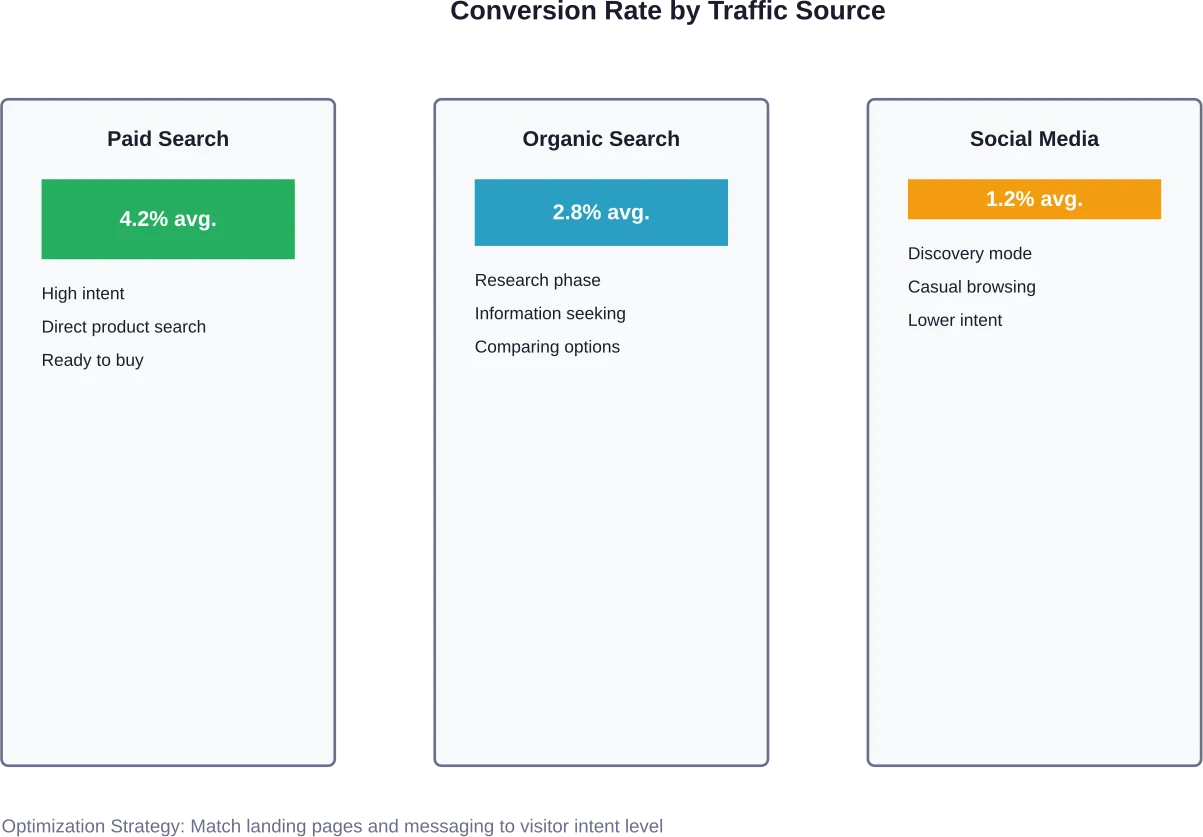
Not all visitors arrive with equal purchase intent. Traffic source significantly impacts conversion probability.
Paid search traffic typically converts at higher rates than social media traffic. Someone actively searching for “buy wireless headphones” demonstrates stronger purchase intent than someone scrolling through social feeds.
Landing page optimization means matching content to traffic source expectations. An ad promoting 20% off should lead to a page highlighting that discount prominently, not a generic homepage.
Retargeting for Conversion Recovery
Most visitors don’t purchase on first visit. Retargeting brings them back.
Display ads following previous visitors around the web serve as reminders. These work particularly well when showcasing specific products customers previously viewed.
Email retargeting captures visitors who provided addresses but didn’t complete purchases. Newsletter signups, account creations, and abandoned carts all represent retargeting opportunities.
Monitor and Analyze Performance Data
Improving conversion rates requires measuring them first. Analytics platforms reveal where customers drop off and which changes produce results.
Conversion funnel analysis identifies specific bottlenecks. High traffic to product pages but low add-to-cart rates suggests product page problems. Many cart additions but few completed purchases points to checkout issues.
Heat mapping tools show where customers click, scroll, and focus attention. This visual data reveals whether important elements receive notice or get overlooked.
Session recordings provide qualitative insights that complement quantitative data. Watching how real users navigate reveals friction points that numbers alone might miss.
Conclusion
Improving conversion rates combines psychology, technology, and continuous testing. The strategies covered here—simplified checkout, optimized product pages, A/B testing, AI personalization, technical performance, trust building, and traffic-specific optimization—work together to move visitors toward purchase decisions.
Start with the highest-impact changes: streamline checkout flows, improve product page clarity, and implement basic personalization. Measure results rigorously, then iterate based on data rather than assumptions.
The e-commerce landscape continues evolving. According to recent digital marketing research, AI-assisted approaches and data-driven personalization have become standard practice for competitive retailers. Staying current with these developments while maintaining focus on fundamental conversion principles positions online stores for sustained growth.
What will be tested first? Pick one element, create variations, measure results, and build from there. Conversion rate optimization is not a one-time project but an ongoing process of incremental improvements that compound over time.
Frequently Asked Questions
What is a good conversion rate for e-commerce?
Conversion rates vary significantly by industry, product type, and price point. Generally speaking, e-commerce conversion rates between 2-3% are common, though some niches perform better or worse. Rather than fixating on industry benchmarks, focus on improving from the current baseline. A store moving from 1.5% to 2.5% conversion achieves meaningful growth regardless of industry averages.
How long does it take to see conversion rate improvements?
Timeline depends on traffic volume and change magnitude. High-traffic sites may see results within days, while smaller operations need weeks for statistical significance. Most A/B tests require 1-2 weeks minimum and at least 100 conversions per variation to produce reliable results. Fundamental changes like checkout redesigns may show immediate impact, while subtle optimizations require longer measurement periods.
Should I focus on increasing traffic or improving conversion rates first?
Improving conversion rates typically delivers faster ROI than traffic acquisition. Optimizing for existing visitors costs less than paying for new ones. Once conversion rates reach competitive levels, traffic growth becomes more cost-effective. Start with conversion optimization when rates sit below 2%, then balance both strategies for sustainable growth.
Do AI-powered tools really improve conversion rates?
According to UC Berkeley research, Amazon’s AI assistant drove 60% higher purchase completion rates for engaged users, demonstrating substantial impact. AI-powered personalization, product recommendations, and automated targeting consistently outperform manual approaches at scale. However, implementation quality matters—poorly configured AI tools can confuse customers rather than help them.
What’s the biggest mistake that hurts conversion rates?
Complicated checkout processes represent the most common conversion killer. Each additional form field, extra page, or unexpected requirement increases abandonment probability. Hidden costs revealed at checkout also destroy conversion rates immediately. Customers who discover surprise shipping fees or service charges frequently abandon carts and don’t return.
How do mobile conversion rates compare to desktop?
Mobile conversion rates traditionally lag behind desktop, though the gap continues narrowing. Mobile shopping has grown substantially according to U.S. Census Bureau data on e-commerce trends. Sites optimized specifically for mobile performance—fast loading, touch-friendly interfaces, simplified forms—can achieve mobile conversion rates approaching desktop levels.
Are customer reviews really necessary for conversions?
Reviews provide essential social proof that reduces purchase anxiety. Products without reviews face higher abandonment rates as customers seek reassurance elsewhere. According to Federal Trade Commission guidelines, reviews must be authentic and not fabricated. Genuine customer feedback builds trust far more effectively than marketing claims alone, making review collection a high-priority conversion optimization tactic.
Join the WisePPC Beta and Get Exclusive Access Benefits
WisePPC is now in beta — and we’re inviting a limited number of early users to join. As a beta tester, you'll get free access, lifetime perks, and a chance to help shape the product — from an Amazon Ads Verified Partner you can trust.
 No credit card required
Free in beta and free extra month free after release
25% off for life — limited beta offer
Access metrics Amazon Ads won’t show you
Be part of shaping the product with your feedback
No credit card required
Free in beta and free extra month free after release
25% off for life — limited beta offer
Access metrics Amazon Ads won’t show you
Be part of shaping the product with your feedback