EN
EN  ES
ES  FR
FR  DE
DE  IT
IT  KO
KO  JA
JA  ZH
ZH  AR
AR  PT
PT  TR
TR  PL
PL What Ecommerce Conversion Rates Are and How to Improve Yours

Most ecommerce stores don’t have a traffic problem – they have a conversion problem. You can have thousands of visitors a day, but if only a few end up buying, that traffic isn’t doing much for your business. That’s where the ecommerce conversion rate comes in. It tells you how many visitors are turning into customers, why that number matters more than most metrics, and what you can do to make it better.
This guide breaks it all down, minus the fluff – just clear, useful answers you can actually use.
Understanding Ecommerce Conversion Rates Without the Jargon
In plain terms, your ecommerce conversion rate is the percentage of people who come to your site and complete a desired action. Most often, that’s making a purchase. But it could also be adding a product to cart, signing up for your newsletter, or requesting a quote – whatever counts as a win in your book.
Here’s the basic formula:
(Number of conversions ÷ Number of visitors) × 100
So if 1,000 people visit your site this week and 30 of them place an order, your conversion rate is 3%.
It sounds simple, and it is. But this number is loaded with context. It connects your marketing, user experience, and product offering into a single performance snapshot.
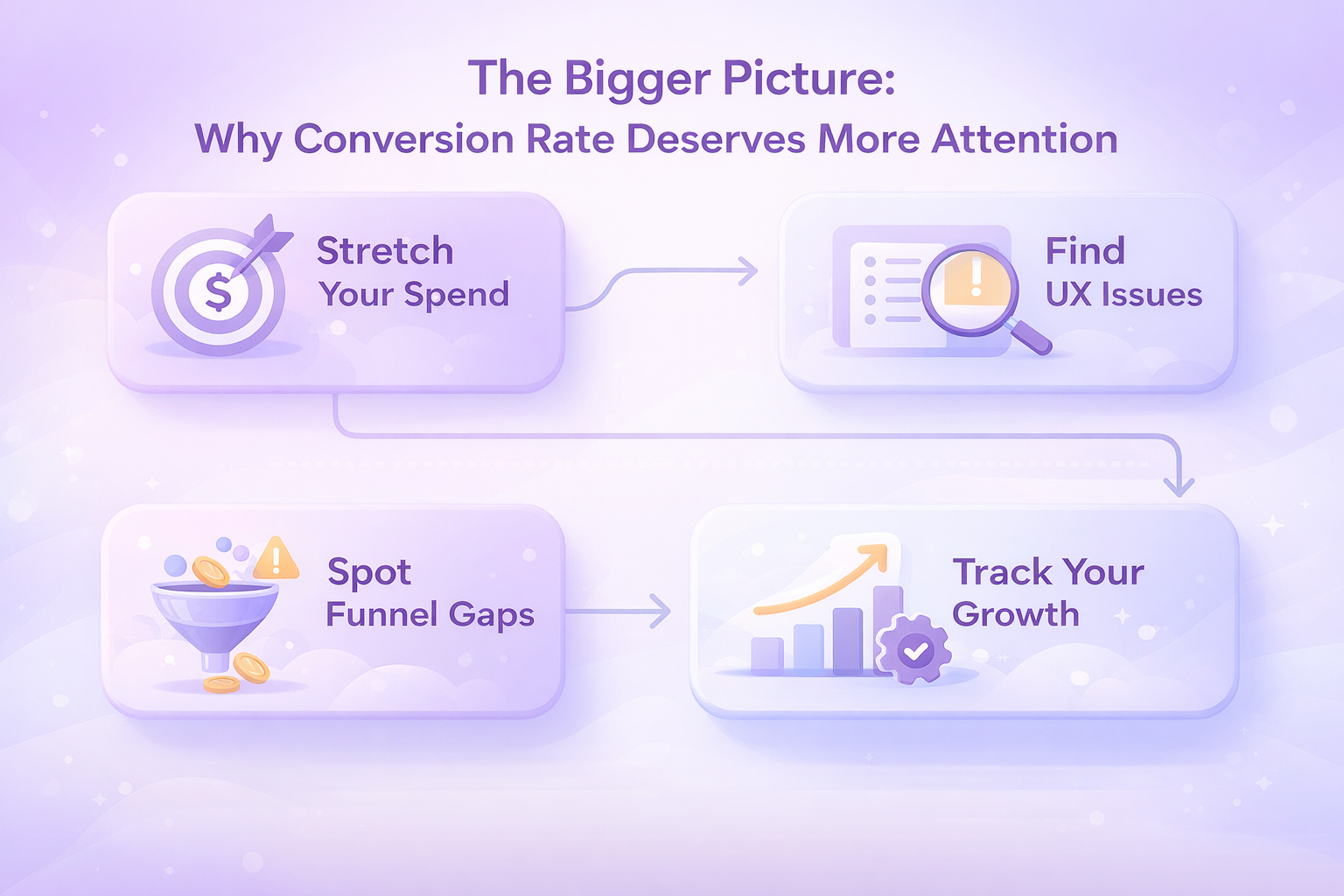
The Bigger Picture: Why Conversion Rate Deserves More Attention
A lot of store owners get caught up chasing traffic. More visitors means more sales, right? Not always.
If your conversion rate is low, doubling your traffic just means twice as many people walk in and leave without buying. On the other hand, if you improve your conversion rate, you can grow revenue without increasing your ad budget.
Here’s what a healthy conversion rate helps you do:
- Stretch your marketing spend further by getting more from existing traffic.
- Identify UX issues or product page weaknesses.
- Spot gaps in your funnel (like cart abandonment or slow checkout).
- Set benchmarks to track growth over time.
And perhaps most importantly, it shows whether your store is actually doing its job – convincing people to buy.
There’s No One-Size-Fits-All “Good” Conversion Rate
Let’s clear something up early: there’s no magic number for a “good” ecommerce conversion rate. It all depends on what you sell, who you’re selling it to, and how much thought goes into the purchase. A $20 hoodie and a $900 treadmill don’t follow the same rules.
That said, some patterns do emerge when you look across industries. Here’s a rough idea of what typical conversion rates look like by category:
- Food and beverages: 3.7%
- Beauty and skincare: 3.3%
- General apparel: 2.6%
- Home, dining, art, and decor: 2.4%
- Footwear: 2.4%
- Sporting goods: 2.3%
- Toys and learning: 2%
- Electronics and accessories: 1.9%
- Home appliances: 1.6%
Some categories naturally perform better – think everyday items with low price points and fast decisions. Others, like appliances or electronics, take more time and trust to convert.
But instead of chasing industry averages, it’s usually smarter to focus on your own numbers. If you’re sitting at 1.9% today and reach 2.6% next quarter, that’s progress. And progress beats a comparison chart every time.
What Impacts Conversion Rates (It’s More Than Just Pricing)
It’s easy to assume that offering lower prices will instantly drive more sales. But pricing alone has limited influence compared to other factors like trust, usability, and perceived value.
Here are some things that have a much stronger impact:
- User experience: If your site is slow, clunky, or hard to navigate, people will leave before even seeing your product.
- Product presentation: High-quality images, videos, and clear descriptions reduce uncertainty and build confidence.
- Payment flexibility: Limited payment options or unclear shipping costs are major reasons people abandon carts.
- Trust signals: Verified reviews, security badges, and transparent policies all help people feel safe spending money with you.
- Device performance: Mobile shoppers often convert at lower rates than desktop users unless your mobile UX is rock solid.
- Traffic source: Referral and email traffic tend to convert better than cold search or social clicks, because there’s more built-in trust.

How to Improve Your Ecommerce Conversion Rate (Without Guessing)
You don’t need to redesign your whole store or throw more money at ads to get better results. In fact, the biggest improvements usually come from solving small, obvious friction points that slow people down.
Here’s a breakdown of conversion-focused improvements that actually work:
1. Speed Up Your Site
Online shoppers have little patience for slow websites. If your page takes longer than a few seconds to load, a good chunk of your visitors will leave before they even see what you’re selling. Speed affects more than user experience – it directly impacts conversions, especially on mobile.
Start by reducing the size of large image files and removing anything on your site that doesn’t serve a real purpose. Keep your design lean, limit the number of pop-ups or heavy effects, and make sure your site performs well on both desktop and mobile. Every second you shave off counts.
2. Fix the Checkout Bottlenecks
Getting someone to click “Buy Now” is the final hurdle, and it’s where a lot of sales quietly fall apart. Complicated forms, hidden fees, and forced account creation are all reasons customers drop off at the last moment.
Keep your checkout process short and distraction-free. Allow people to buy without signing up. Offer a range of payment options, and make sure your shipping policies, return terms, and total costs are easy to understand before the final click. Remove anything that slows people down or makes them second-guess the purchase.
3. Use Better Product Content
Your product page has to do the work of a salesperson. If your photos are fuzzy or your descriptions are vague, customers won’t stick around to guess what they’re buying.
Use sharp, detailed images that show the product from multiple angles. If possible, include context – show the product in use or in a real-life setting. Descriptions should be clear and honest, answering common questions without fluff. Videos or interactive views can be helpful, but at the very least, make sure everything on the page builds confidence instead of raising doubts.
4. Show Real Reviews and Ratings
When shoppers see that others have had a good experience, they’re more likely to buy. Reviews aren’t just a nice-to-have – they’re one of the strongest trust signals on your site.
Display full reviews, not just star ratings. If customers mention helpful details like fit, durability, or ease of use, highlight those. Let people filter reviews based on what matters to themб like product size or style. And if someone leaves negative feedback, respond with care. It shows you’re paying attention and willing to improve.
5. Personalize the Experience
Not every shopper is looking for the same thing. When your site reflects that – by showing products or recommendations that feel relevant – it creates a more engaging experience.
Pay attention to what visitors browse, where they’re located, or what they’ve purchased before. Use that information to show content that makes sense for them. The goal isn’t to overwhelm people, but to guide them toward something they’re already likely to want. Done right, it builds connection and trust.
6. Add Urgency and Scarcity (Responsibly)
Sometimes people just need a small nudge. Telling them that a sale ends soon or that an item is almost out of stock can help them decide to act now instead of later.
But it only works if it’s real. Don’t invent deadlines or fake scarcity – it only damages your credibility. Instead, use urgency where it naturally fits. A limited-time offer, seasonal promotion, or genuinely low stock are all valid ways to create momentum without feeling pushy.
7. Test Everything
What works for one store might flop for another. That’s why testing is so important. Don’t guess – observe.
Try different headlines on your product pages. Move elements around to see if people engage differently. Adjust your call-to-action buttons, experiment with how and when you display discounts, and change up your layout in small ways. Then watch how those changes affect behavior. Small tweaks often lead to meaningful gains, but you won’t know until you see the results in action.
How to Track the Right Metrics And Ignore the Vanity Ones
Your conversion rate is a powerful metric, but it doesn’t live in a vacuum. Pair it with these other data points for a more complete picture:
- Average order value (AOV): Helps track revenue efficiency.
- Customer acquisition cost (CAC): Shows how much you spend to get a customer.
- Return on ad spend (ROAS): Especially important for paid campaigns.
- TACOS and ACOS: For Amazon sellers, these help assess the real impact of ad spend.
Tracking these alongside your conversion rate lets you make smarter budget and pricing decisions.
The Role of Channel and Device (Where Visitors Come From Matters)
Not all traffic is equal. Knowing where your visitors come from helps you understand intent and tailor your approach.
Here’s what the data shows:
- Referral traffic: Converts best. People trust recommendations from friends or partners.
- Email: Strong conversion rates, especially for returning visitors.
- Search ads: Mid-tier. Intent is high, but trust takes work.
- Social media: Typically lower conversion unless paired with strong content or influencer validation.
By device:
- Desktop: Still converts best due to easier navigation and checkout.
- Tablet: Close second.
- Mobile: Often has the most traffic, but the lowest conversion unless your UX is dialed in.
Takeaway: Optimize per channel, not just across the board.

How We Help Sellers Improve Conversion Rates at WisePPC
We are WisePPC and we believe that better data leads to better decisions. Ecommerce conversion rates don’t just improve because you add a shiny new banner or run a discount. They improve when you understand what’s working, what’s leaking revenue, and where your buyers are actually coming from. That’s exactly what we help you do.
Our platform gives you a full picture of both your advertising and your organic performance. You can track multiple core metrics in real time, dive into granular trends, and quickly spot which campaigns, keywords, or products are pulling their weight, and which ones are dragging you down. From there, you can take action right away: bulk-edit bids, adjust budgets, or pause underperforming targets. No spreadsheets, no second-guessing.
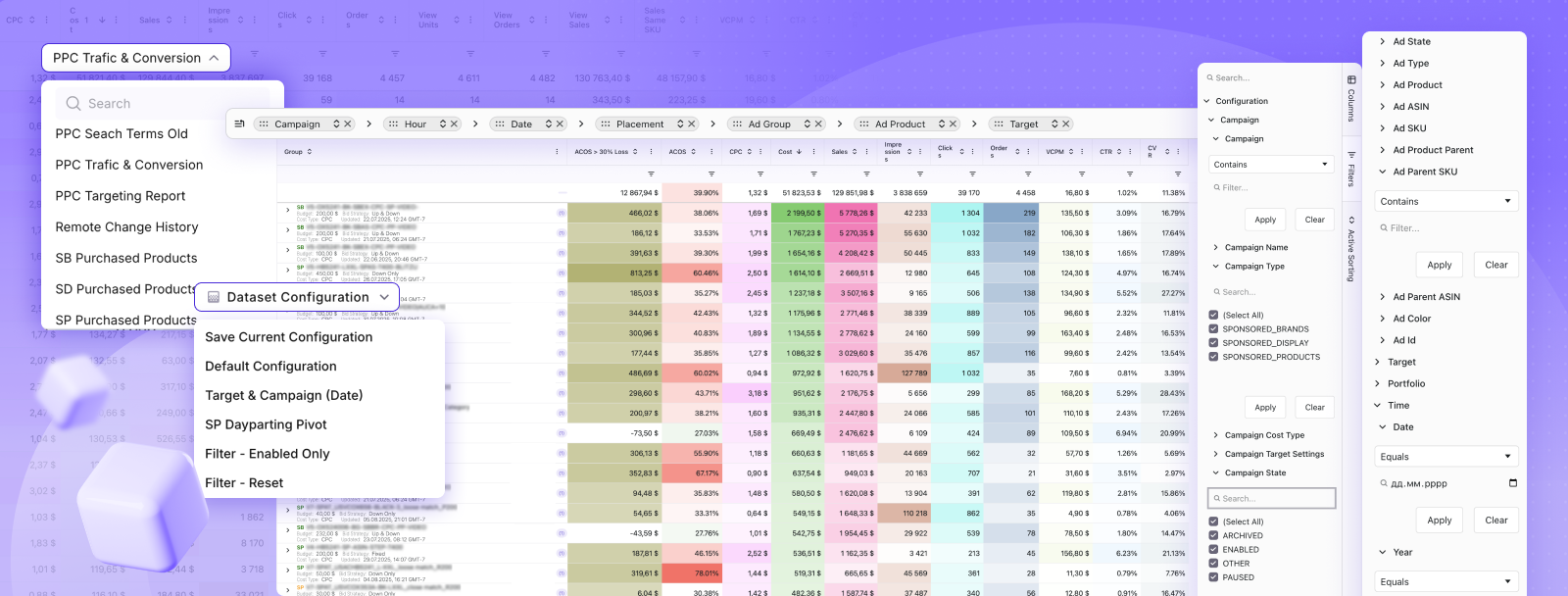
Conversion optimization is all about clarity. We separate your ad-driven sales from your organic revenue, highlight waste, and show you where every dollar goes. Whether you’re selling on Amazon, Shopify, or managing multiple channels at once, we give you the visibility and control to focus on growth – not guesswork. If you’re ready to start making decisions backed by real performance data, we’d love to help.

Closing Thoughts: Stop Guessing, Start Optimizing
A lot of ecommerce brands spend too much time on traffic and not enough on conversion. But improving your conversion rate is one of the most reliable ways to boost revenue without increasing your marketing budget.
You don’t need a massive redesign or a new tech stack. You just need to pay attention to what’s already happening, fix the friction, and test your way to better results.
Start with the basics: speed, clarity, trust, and ease of purchase. Layer in personalization, better visuals, and smart testing. Track your metrics closely. Then let the data show you where to go next.
FAQ
1. What counts as a conversion in ecommerce?
It depends on your business goals, but most of the time, it means a sale. That said, signing up for a newsletter, creating an account, or even adding a product to the cart can all be counted as conversions. It really comes down to what action you’re trying to get from a visitor. Just make sure you’re measuring something meaningful, not just clicks for the sake of it.
2. Is 2% a good conversion rate or a bad one?
It’s not bad. It’s also not great. It’s somewhere in the middle, and that’s okay. A “good” conversion rate is relative to your industry, your price point, and your audience. What matters more is whether that 2% turns into 2.5% or 3% over time. That’s where growth lives. Don’t chase someone else’s benchmark if you’re not even sure it applies to your space.
3. Do I need expensive tools to improve my conversion rate?
Not really. A fast site, clear messaging, solid product photos, and honest reviews go a long way. Fancy tech helps, but it’s not a replacement for understanding your customer and fixing obvious friction. Start with what you’ve got, then add smarter tools (like WisePPC, if you’re running ads) when you’re ready to scale.
4. What’s the fastest way to get a conversion boost?
There’s no magic switch, but simplifying your checkout process is usually the low-hanging fruit. Fewer clicks. Guest checkout. No surprise fees. Also, showing real customer reviews, especially with photos, can make a bigger difference than another 10% off coupon.
Join the WisePPC Beta and Get Exclusive Access Benefits
WisePPC is now in beta — and we’re inviting a limited number of early users to join. As a beta tester, you'll get free access, lifetime perks, and a chance to help shape the product — from an Amazon Ads Verified Partner you can trust.
 No credit card required
Free in beta and free extra month free after release
25% off for life — limited beta offer
Access metrics Amazon Ads won’t show you
Be part of shaping the product with your feedback
No credit card required
Free in beta and free extra month free after release
25% off for life — limited beta offer
Access metrics Amazon Ads won’t show you
Be part of shaping the product with your feedback