EN
EN  ES
ES  FR
FR  DE
DE  IT
IT  KO
KO  JA
JA  ZH
ZH  AR
AR  PT
PT  TR
TR  PL
PL GTINs, Product IDs, and Barcodes: What They Really Mean

You’ve probably scanned a barcode without thinking twice but behind that simple action is a product ID doing some heavy lifting. In ecommerce and retail, product identifiers like GTINs are what keep the system from falling apart. They’re how platforms know a red cotton T-shirt in size medium is not the same thing as a blue one in large. Whether you’re selling online, managing inventory, or syncing with a global supply chain, understanding GTINs (and how they differ from SKUs, UPCs, and barcodes) helps you avoid confusion, stay compliant, and work smarter – not harder.
In this article, we’re going to break down what product IDs actually are, with a deep focus on GTINs. We’ll look at how they compare to other identifiers like SKUs, UPCs, and ASINs, where they’re used, why marketplaces like Amazon depend on them, and what to watch out for when listing or managing products.
What Is a Product ID?
A product ID is any number or code that helps identify a product. That sounds simple, but there’s a lot riding on this little string of digits. From the moment something is manufactured to the time it gets scanned at checkout or shipped to a customer, product IDs help systems keep track of what’s what.
The most important type of product ID used across the globe is the GTIN, short for Global Trade Item Number.
So, What Is a GTIN?
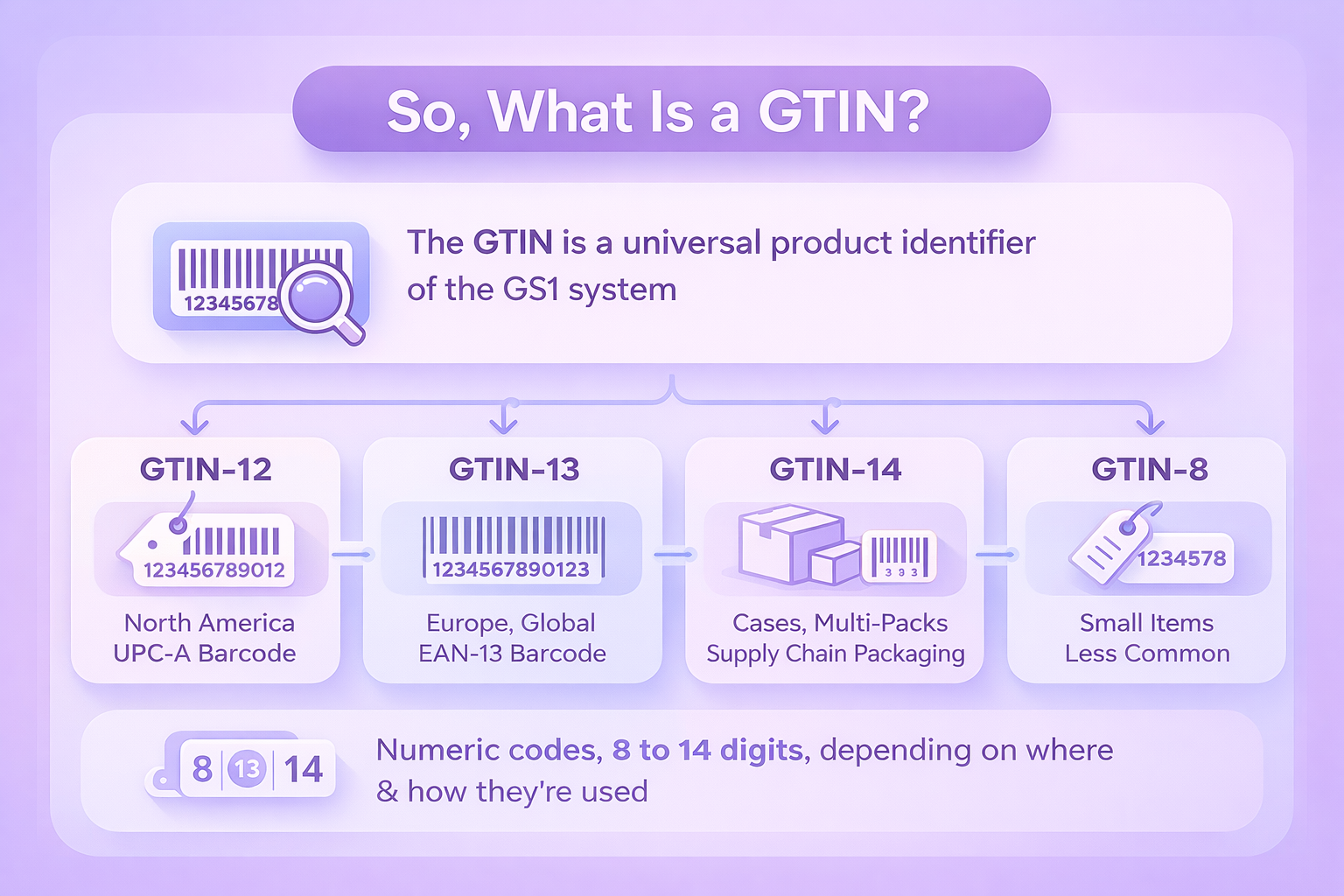
The GTIN is a universal identifier assigned to trade items. It’s part of the GS1 system, a global standard used by companies, retailers, suppliers, and marketplaces to make sure everyone’s speaking the same language when it comes to product data.
GTINs are numeric and can be 8, 12, 13, or 14 digits long, depending on where and how they’re used. They’re not just random numbers either – there’s a specific structure to them, including a company prefix, an item reference, and a check digit to help prevent errors.
Common GTIN formats:
- GTIN-12: Used primarily in North America. This is what you see in a UPC-A barcode.
- GTIN-13: Common in Europe and internationally. Often encoded in an EAN-13 barcode.
- GTIN-14: Used for cases or multi-pack items. Not scanned at checkout but used in supply chain packaging.
- GTIN-8: For very small items. Less common, but still part of the standard.
If you’ve ever scanned a product at a grocery store, you’re almost certainly dealing with a GTIN, even if you didn’t know it.
GTIN vs UPC vs Barcode: What’s the Actual Difference?
A lot of people mix up the terms GTIN, UPC, and barcode, and honestly, it’s easy to see why. They’re often used as if they’re interchangeable, but they each mean something different.
The GTIN is the actual number that uniquely identifies a product. It’s the data point sitting underneath everything else.
UPC, on the other hand, is a specific format of that number – specifically a 12-digit version called GTIN-12, which was developed for the North American retail system.
Then there’s the barcode, which is simply the visual, scannable image that holds the GTIN (or sometimes other types of data). You’ll usually see it printed on packaging, ready to be scanned at checkout or in a warehouse.
So when someone asks, “What’s the barcode for this item?” they might be talking about the physical image or the number behind it. Technically, they’re two separate things, but in practice, people often use one term when they mean the other.

What About SKUs, ASINs, and Other Codes?
There are other product identifiers you’ll see floating around. Here’s how they compare:
- SKU (Stock Keeping Unit): Internal to your company. It’s whatever you decide to use to manage inventory. Not universal. You could use “SHIRT-BLUE-L” and someone else could use “XYZ123.”
- ASIN (Amazon Standard Identification Number): Amazon’s own system. Every product listed on Amazon gets one. Not usable outside Amazon.
- GTIN: Universal. Recognized globally. Required by most major marketplaces.
Think of it like this: GTIN is the passport. SKU is your nickname. ASIN is your Amazon ID badge.
Why GTINs Matter in Ecommerce and Retail
Let’s say you’re launching a product line on Amazon. You upload your listings, but you skip the GTIN. You might run into errors, listing restrictions, or worse – your listing gets removed entirely.
Here’s why GTINs are critical in practice:
1. They Prevent Confusion
GTINs make sure one product doesn’t get mistaken for another. This might sound basic, but it becomes a big deal when you’re managing multiple variations of the same item. A pink dress in size small isn’t the same as the green jacket in size extra large, and platforms need a way to tell them apart instantly. With GTINs, every variant gets a unique ID, which helps keep things clear for both the seller and the buyer.
2. They Support Clear Data
On marketplaces like Amazon, GTINs help systems understand exactly what you’re listing. If a product with your GTIN already exists, Amazon will link you to it. If it doesn’t, you’re prompted to create a new product detail page. This structure prevents messy duplicates and mismatched listings. It’s one of the reasons why search results stay (mostly) organized and product reviews aren’t scattered across unrelated items.
3. They Improve Inventory Accuracy
When each item in your catalog has its own GTIN, it’s far easier to track what’s in stock, what’s selling, and what needs to be reordered. It also helps avoid mix-ups in fulfillment centers where dozens of similar-looking products might be moving at once. From purchase orders to restocks, having precise identifiers keeps your inventory aligned.
4. They Are Often Required
Most major platforms won’t just recommend GTINs – they expect them. Amazon, Shopify, and others use GTINs as part of their core infrastructure for product listings. Without a valid GTIN, your product may be blocked from being listed or advertised, or flagged for missing data. Getting it right from the start means fewer headaches later.

How Do You Get a GTIN?
If you’re sourcing a product from a manufacturer, ask them for the GTIN or UPC. If you’re the manufacturer or creating private-label products, you’ll need to get GTINs yourself.
GTINs are issued by GS1, the only globally recognized provider. You can either:
- Buy a single GTIN (good for small sellers or one-off items).
- License a GS1 Company Prefix, which allows you to create multiple GTINs using a block of numbers.
Avoid buying cheap barcodes from third-party sellers. If your GTIN doesn’t come from GS1, Amazon and other marketplaces might reject it, or worse, flag your listings for policy violations.
Can You List a Product Without a GTIN?
In some cases, yes. If your product doesn’t have a GTIN and isn’t already in the Amazon catalog, you can apply for a GTIN exemption.
To do that, you’ll typically need:
- Product title;
- Brand name (if applicable);
- Images showing all sides of the product and packaging.
If approved, Amazon will let you list the product without a GTIN. But these exemptions are the exception, not the rule. Most sellers will benefit from using standard GTINs.
Real-World Use Cases for GTINs
Here’s where GTINs show up in real operations:
In retail stores
At checkout, the POS system scans the barcode, reads the GTIN, and pulls up the product name, price, and inventory data. It deducts one unit from stock, tracks the sale, and feeds the data into backend analytics.
In warehouses
GTINs help track inbound and outbound shipments. When receiving inventory, systems can confirm that the right items arrived in the right quantity. They also support automated scanning and reduce the risk of human error when handling high volumes of similar products.
In ecommerce
Platforms use GTINs to categorize listings, suggest related products, and even detect counterfeits or duplicates. GTINs can impact product discoverability in search, and they’re often used in algorithms that decide what shows up in filters, ads, and recommendations. Clean, valid GTINs help your products get found and trusted faster.

Beyond the Basics: GPC and GLN
GTINs aren’t the only codes in the GS1 universe.
GPC (Global Product Classification) is used to group products into categories like “Milk > Whole Milk.” It helps standardize product taxonomy across platforms.
GLN (Global Location Number) identifies locations – warehouses, stores, offices. It’s useful in logistics and order fulfillment.
While you may not need these unless you’re managing large operations, it’s good to know they exist. They’re often used in conjunction with GTINs for broader supply chain coordination.
What Happens Without GTINs?
Without GTINs, you’re essentially creating friction in your operations. You’ll end up:
- Manually matching product listings to SKUs.
- Risking listing errors or duplicate content.
- Losing visibility into which items are performing well across platforms.
- Running into listing rejections or compliance issues on Amazon or Google Shopping.
Worse, if you use a fake or duplicated GTIN, you could get banned from selling entirely.
Key Benefits of Using GTINs Properly
Let’s wrap this up with a quick summary of why it’s worth taking GTINs seriously:
- Universal recognition: The same product is identified the same way, everywhere.
- Cleaner catalog management: No duplicate or mismatched listings.
- Faster checkout and fulfillment: Barcodes streamline everything from sales to shipping.
- Platform compliance: You’ll meet listing requirements for Amazon, Google, and others.
- Better analytics: You’ll know exactly what’s selling, where, and why.

How We Use GTINs at WisePPC to Drive Smarter Marketplace Growth
At WisePPC, GTINs play a bigger role than just barcodes or catalog identifiers. For us, they’re the connective tissue between clean data and real results. Every product you sell on Amazon, Shopify, or other marketplaces is tied to a GTIN, and that’s what allows our platform to unify advertising, sales, and inventory analytics into one clear dashboard.
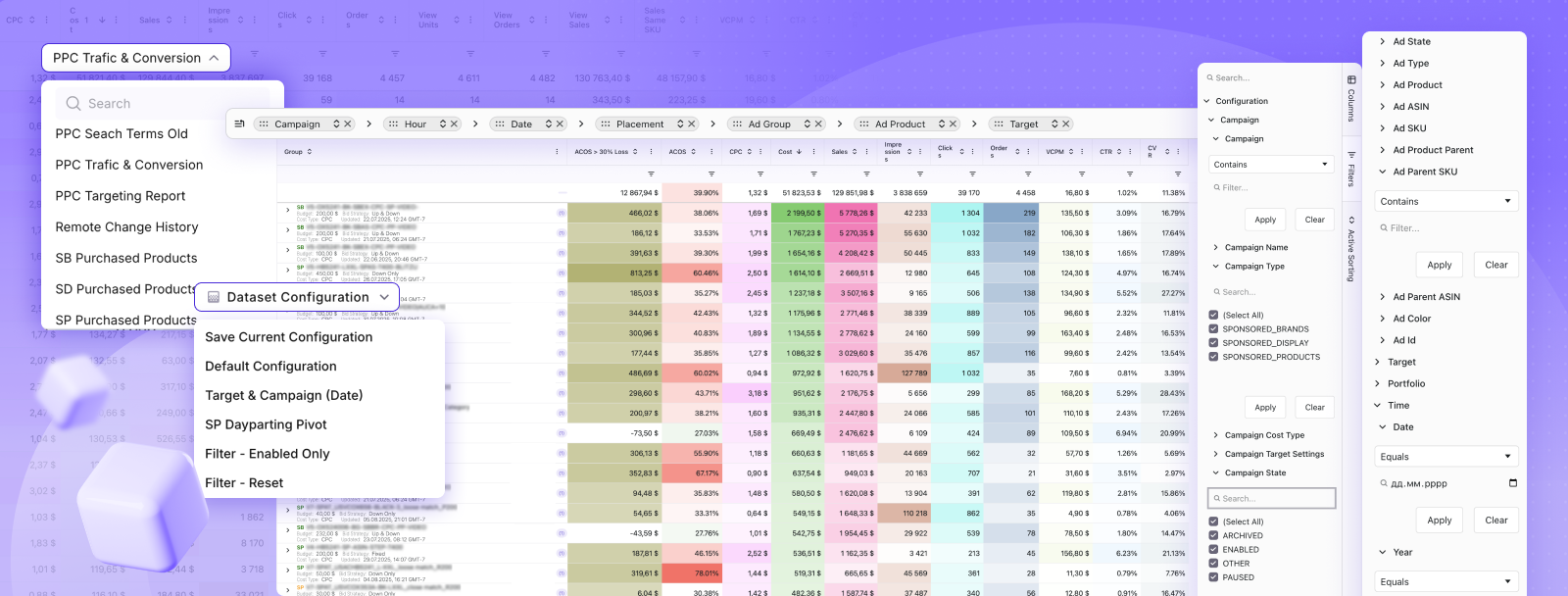
We rely on GTINs to accurately track performance across thousands of products and targets. Whether you’re optimizing bids, comparing ad impact on sales, or identifying product trends over time, it all starts with the right product identifiers. Without them, we couldn’t offer the kind of granular insights our users expect – things like real-time TACOS tracking, placement-level performance, or automated bid suggestions based on historical sales data.
If your product catalog is missing GTINs or using incorrect ones, you’re not just risking listing errors – you’re cutting off access to analytics that could be saving you time and budget. That’s why we always recommend sellers start by getting their product identifiers in order. Once that’s done, our tools can do the rest, whether it’s managing campaigns in bulk, filtering down to the most profitable targets, or helping you scale without drowning in manual work.
Final Thoughts
If you’re serious about selling products, whether it’s through Amazon, a Shopify store, or a brick-and-mortar operation, GTINs aren’t optional. They’re the invisible framework that keeps inventory, listings, logistics, and reporting from spiraling into chaos.
Sure, it’s just a string of numbers on paper. But that number might be the difference between a smooth operation and a headache-inducing mess.
Get your GTINs right, and the rest of your stack gets a whole lot easier to manage.
FAQ
1. Is a GTIN the same as a barcode?
Not exactly. The GTIN is the number that identifies the product. The barcode is just the scannable image that holds that number. Think of the barcode as the packaging, and the GTIN as the info inside it.
2. Do I need a new GTIN for every product variant?
Yes. Each variation of a product, like size, color, or pack quantity, should have its own GTIN. If you sell the same T-shirt in three colors and two sizes, that’s six unique GTINs.
3. What happens if I list a product on Amazon without a GTIN?
You might be able to apply for a GTIN exemption, but it’s not guaranteed. In most cases, Amazon expects a valid GTIN for new listings. Skipping it can slow you down or block your listing entirely.
4. Can I reuse GTINs for new products?
Nope. Once a GTIN is assigned to a product, it stays with that product forever. Reusing GTINs can mess up inventory, confuse marketplaces, and lead to policy violations.
5. What’s the difference between GTIN and SKU?
SKUs are internal. You create them, and they’re just for your own inventory tracking. GTINs are external and standardized – they’re recognized by retailers, marketplaces, and supply chain systems around the world.
6. How do I know if a GTIN is valid?
The safest way is to get it directly from GS1, the official source. If you already have a number, you can also check it using online GTIN validation tools to make sure the format and check digit are correct.
Join the WisePPC Beta and Get Exclusive Access Benefits
WisePPC is now in beta — and we’re inviting a limited number of early users to join. As a beta tester, you'll get free access, lifetime perks, and a chance to help shape the product — from an Amazon Ads Verified Partner you can trust.
 No credit card required
Free in beta and free extra month free after release
25% off for life — limited beta offer
Access metrics Amazon Ads won’t show you
Be part of shaping the product with your feedback
No credit card required
Free in beta and free extra month free after release
25% off for life — limited beta offer
Access metrics Amazon Ads won’t show you
Be part of shaping the product with your feedback