EN
EN  ES
ES  FR
FR  DE
DE  IT
IT  KO
KO  JA
JA  ZH
ZH  AR
AR  PT
PT Use Business Certifications to Stand Out as a Seller

Quick Summary: Business certifications help sellers differentiate themselves by demonstrating verified expertise, building customer trust, and signaling commitment to quality. Key certifications include ISO 9001 for quality management, BBB Accreditation for business ethics, and industry-specific credentials like Certified Professional Sales Person (CPSP) that validate specialized knowledge and professionalism.
The marketplace is more crowded than it’s ever been. Sellers face constant pressure to prove they’re different, better, trustworthy. One effective way to cut through the noise? Business certifications.
These credentials aren’t just fancy letters after your name. They’re signals. Signals that you’ve met rigorous standards, invested in your professional development, and committed to operating at a higher level than the competition.
According to the U.S. Small Business Administration, your business structure and operational choices affect everything from taxes to personal liability. But here’s what many sellers miss: certifications influence customer perception just as profoundly. They provide third-party validation that marketing claims alone can’t deliver.
ISO, the International Organization for Standardization, frames it perfectly: International Standards mean consumers can have confidence that products and services are safe, reliable, and of good quality. That confidence translates directly into competitive advantage.
Why Business Certifications Actually Matter for Sellers
Real talk: certifications aren’t magic bullets. But they do solve specific, measurable problems that sellers face daily.
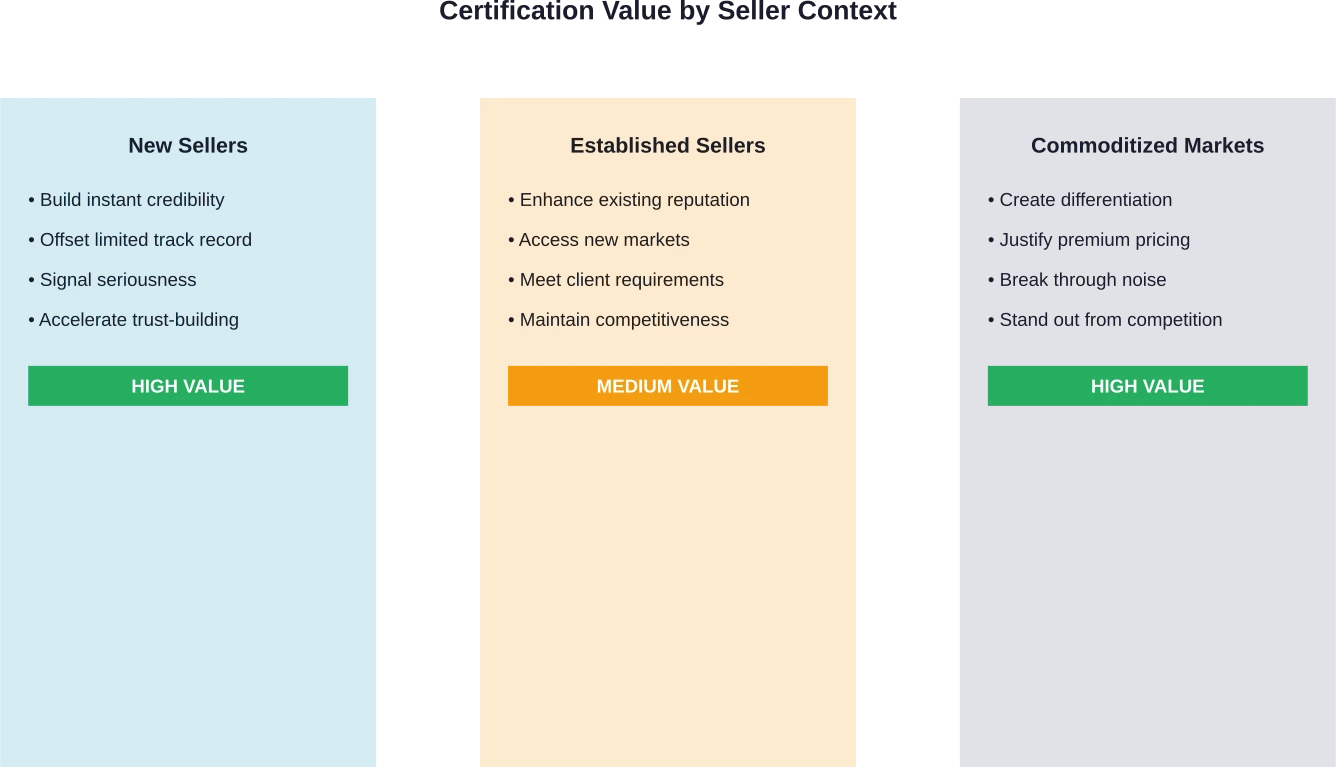
First, they build instant credibility. When potential customers see recognized certifications, they make assumptions about your competence, reliability, and professionalism. Fair or not, those assumptions shape buying decisions.
Second, certifications create differentiation in commoditized markets. When products or services appear similar, credentials become tiebreakers. The seller with verified expertise wins.
Third, many certifications come with ongoing requirements that actually improve operations. ISO 9001, for example, isn’t just about getting a certificate. It’s about implementing quality management systems that reduce errors, improve consistency, and enhance customer satisfaction.
Community discussions on platforms like Reddit frequently debate whether certifications matter in sales. The consensus? For established professionals with proven track records, certifications might be nice-to-haves. For newer sellers or those entering competitive markets, they’re closer to must-haves.
The Trust Factor
Trust is currency in selling. Certifications function as trust accelerators.
Better Business Bureau Accreditation Standards represent standards for business accreditation based on BBB’s determination of the attributes of a better business. These incorporate not only lawful business practices but also BBB’s experience with ethical advertising, selling, and customer experiences.
When buyers see BBB Accreditation or similar credentials, they shortcut the trust-building process. Instead of slowly establishing credibility through repeated positive interactions, certified sellers start with a baseline of assumed competence.
That matters enormously in high-stakes sales, considered purchases, or situations where buyers lack the expertise to evaluate quality independently.
Top Business Certifications That Help Sellers Stand Out
Not all certifications deliver equal value. Some are industry-standard requirements. Others are expensive distractions. Here’s what actually moves the needle for sellers in 2026.
ISO 9001: Quality Management Systems
ISO 9001 sets requirements for quality management systems. It’s one of the most recognized business certifications globally, applicable across industries and company sizes.
The ISO 9001:2015 SME success package specifically targets small and medium enterprises, offering practical guidance for implementation. The standard outlines requirements for a quality management system that organizations can use to demonstrate their ability to consistently provide products and services that meet customer and regulatory requirements.
For sellers, ISO 9001 certification signals process discipline, consistency, and commitment to continuous improvement. It’s particularly valuable in B2B contexts, government contracting, and industries where quality documentation is expected or required.
According to ISO, quality management is essential for healthy long-term success in our age of innovation and rapidly shifting expectations. That perspective resonates with buyers who want partners capable of sustaining performance over time.
BBB Accreditation
BBB Accreditation might seem old-fashioned, but it carries weight with consumers who research businesses before purchasing.
To qualify for BBB Accreditation, businesses must continually meet standards based on ethical advertising, selling, and customer experiences. Not all businesses qualify, which makes accreditation meaningful as a differentiator.
The accreditation appears in search results, social proof contexts, and decision-making moments. For sellers in retail, services, and consumer-facing industries, it’s a relatively accessible certification with immediate credibility benefits.
Certified Professional Sales Person (CPSP)
The National Association of Sales Professionals offers the Certified Professional Sales Person program, which uses modern behavior-based methodologies to transform learners into top-performing sales professionals.
At its core, the program focuses on accountability systems, coaching frameworks, and leadership development. Less than one percent of universities in the United States have a sales program, making specialized certifications like CPSP particularly valuable for career differentiation.
The Certified Professional Sales Person (CPSP) program is typically offered as a comprehensive 6-week online course with an all-inclusive enrollment fee (regularly $695). The program includes all modules, digital materials, and the certification exam within this single price. That investment signals commitment to professional standards that many competitors haven’t matched.
For sellers who want to distinguish themselves based on verified methodology rather than just experience, CPSP provides recognized validation.
Industry-Specific Certifications
Beyond general business certifications, industry-specific credentials often deliver the highest ROI for sellers operating in specialized markets.
E-commerce sellers might pursue certifications covering digital marketing, platform expertise, or international selling. With global online sales expected to hit $8.1 trillion by 2026 according to CertLibrary, e-commerce certification programs help professionals navigate complex digital selling environments.
Professional services providers benefit from credentials recognized within their specific fields. A financial advisor’s certifications differ dramatically from a marketing consultant’s, but both serve the same function: demonstrating verified expertise to potential clients.
The key is matching certification investment to market expectations. In some industries, certain certifications aren’t advantages—they’re table stakes.
Choosing the Right Certifications for Your Selling Context
Here’s the thing though—piling up certifications doesn’t automatically translate to results. Strategic selection matters more than quantity.
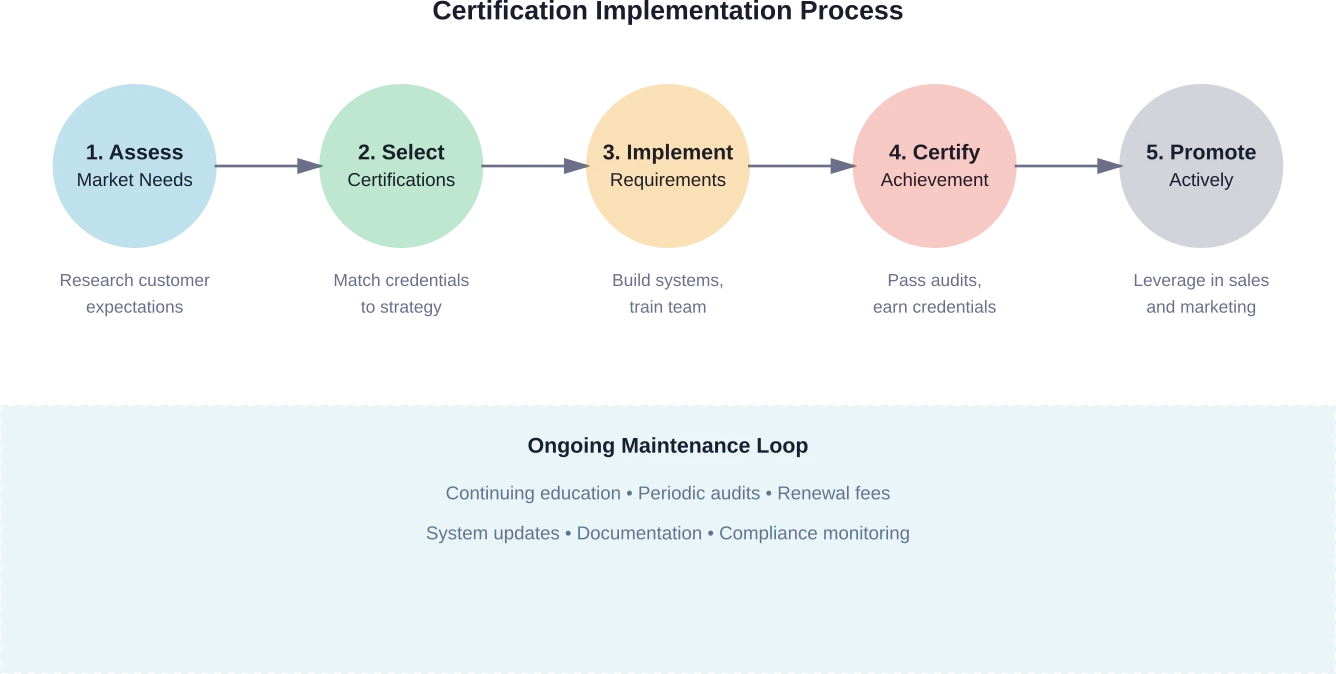
Start by identifying what customers in your market actually value. Some credentials impress peers but leave buyers indifferent. Others directly address buyer concerns and accelerate purchasing decisions.
Research competitors. What certifications do leading sellers in your space hold? If most top performers have specific credentials, those might be prerequisites rather than differentiators.
Consider the investment required. Certification costs include not just fees but also time for study, implementation, and maintenance. The National Association of Sales Professionals’ CPSP program, for instance, involves module fees, exam costs, and annual renewal expenses that add up quickly.
Evaluate ongoing requirements. Some certifications are one-and-done. Others require continuing education, periodic audits, or regular renewals. ISO 9001 certification, for example, involves maintaining quality management systems that require sustained organizational commitment.
ROI Calculation Framework
Smart sellers treat certifications as investments requiring ROI analysis.
Estimate the customer lifetime value increase from improved conversion rates. If certification helps close 10% more deals or attracts slightly higher-value clients, calculate the annual revenue impact.
Factor in time savings. Certifications that streamline operations or reduce errors might pay for themselves through efficiency gains rather than direct sales impact.
Consider opportunity cost. Time spent pursuing certification A is time not spent on certification B, product development, or direct selling activities. Choose accordingly.
| Certification Type | Best For | Investment Level | Time to Value |
|---|---|---|---|
| ISO 9001 | B2B sellers, manufacturers, services requiring process documentation | High (implementation + certification) | 6-12 months |
| BBB Accreditation | Consumer-facing businesses, local services, retail | Low to Medium | Immediate |
| CPSP | Sales professionals seeking methodology validation | Medium ($500-700 initial) | 3-6 months |
| Industry-Specific | Specialized markets with recognized credentials | Varies widely | Varies by market recognition |
Maximizing Certification Impact
Earning certifications is step one. Leveraging them effectively is where many sellers fall short.
Display credentials prominently. Add certification logos to websites, email signatures, proposals, and marketing materials. According to the U.S. Small Business Administration, how businesses present themselves affects customer perception and trust from first contact.
But don’t just slap logos everywhere. Explain what certifications mean in customer-relevant terms. Instead of “ISO 9001 Certified,” try “Independently verified quality systems ensuring consistent service delivery.”
Use certifications in sales conversations. When addressing objections about reliability, experience, or process rigor, reference relevant certifications as third-party validation.
Leverage certifications in content marketing. Blog posts, case studies, and thought leadership pieces that reference your certified expertise build authority while naturally incorporating trust signals.
Common Mistakes to Avoid
Pursuing irrelevant certifications wastes resources and confuses positioning. A B2B software seller probably doesn’t need retail-focused credentials, no matter how impressive they sound.
Letting certifications lapse signals inconsistency. If you promote a certification, maintain it. Expired credentials damage credibility more than never having them.
Overstating certification scope misleads customers and creates legal risks. Certifications apply to specific operations, locations, or product lines. Don’t claim broader coverage than actually exists.
Ignoring certification maintenance requirements creates compliance gaps. ISO certifications require ongoing audits. Professional credentials need continuing education. Budget for long-term commitment, not just initial achievement.
Business Structure Considerations
According to the U.S. Small Business Administration, business structure affects everything from day-to-day operations to taxes and personal liability. It also influences which certifications make sense and how easily they’re obtained.
Sole proprietors face different certification pathways than corporations. Some credentials require specific organizational structures, liability coverage, or operational documentation that certain business types can’t easily provide.
Small business owners should consider certifications that accelerate professional development in multiple relevant areas. Getting certified in management, marketing, and operational areas broadens knowledge of best practices while gaining credentials that build customer trust.
The choice of business structure should happen before pursuing major certifications, since restructuring mid-process can complicate compliance and documentation requirements.
Standing Out on Amazon Also Means Managing Your Ads Well
Business certifications can help sellers stand out in Amazon’s marketplace, especially when buyers are comparing similar products. But visibility on Amazon still depends heavily on advertising performance and how campaigns are managed.
WisePPC helps sellers track and manage Amazon PPC campaigns with clearer data. The platform connects advertising and sales metrics in one dashboard so sellers can monitor performance, review historical campaign data, and adjust campaigns more efficiently.
If you want your certified products to reach more shoppers, WisePPC can help you:
- track Amazon advertising performance across campaigns
- analyze which keywords and ads drive sales
- manage and update campaigns from a single interface
Certifications vs. Experience: Finding the Balance
Look, certifications don’t replace experience. They complement it.
A newly certified seller with no track record still faces credibility challenges. But an experienced seller without credentials might lose opportunities to less-experienced competitors who’ve invested in validation.
The sweet spot? Combining real-world results with recognized certifications that verify methodology and commitment.
Community discussions on platforms like Reddit frequently debate whether certifications matter in sales. The consensus leans toward context-dependency. In technical sales, specialized certifications carry weight. In relationship-driven industries, they matter less than proven results and references.
For sales professionals specifically, certifications like CPSP provide frameworks that systematize what top performers do instinctively. That benefits both the individual seller and the teams they eventually lead or train.
Industry-Specific Certification Opportunities
Every industry has its own certification ecosystem. Understanding which credentials carry weight in your specific market is crucial.
E-Commerce and Digital Selling
E-commerce certifications cover platform-specific expertise, digital marketing, international selling, and customer engagement strategies. With global online sales expected to hit $8.1 trillion by 2026 according to CertLibrary, e-commerce certification programs help professionals navigate complex digital selling environments.
Platform certifications from Shopify, Amazon, or eBay demonstrate technical proficiency. Marketing certifications from Google or Facebook validate advertising expertise. Combined, they position sellers as knowledgeable partners rather than just vendors.
Professional Services
Consultants, advisors, and service providers benefit enormously from industry-recognized certifications. These credentials often function as minimum qualifications rather than differentiators—clients expect them.
Financial services, healthcare, legal, and technical consulting all have established certification bodies whose credentials carry immediate recognition and weight with prospective clients.
Manufacturing and B2B Sales
ISO certifications dominate manufacturing and B2B contexts. ISO 9001 quality management certification is frequently required by large buyers, government agencies, and international customers.
Other relevant certifications include industry-specific safety standards, environmental management systems, and technical proficiency credentials tied to specific technologies or processes.
| Industry | Key Certifications | Primary Benefit |
|---|---|---|
| E-Commerce | Platform-specific, digital marketing | Technical credibility, marketing expertise |
| Professional Services | Industry associations, specialization credentials | Minimum qualification, expertise validation |
| Manufacturing | ISO 9001, safety standards | Quality assurance, compliance |
| Retail | BBB Accreditation, customer service certifications | Consumer trust, ethical business practices |
| Technology Sales | Vendor certifications, technical credentials | Product expertise, solution capabilities |
Measuring Certification Impact
How do sellers know if certifications are working? Track specific metrics before and after implementation.
Monitor conversion rates. Do more prospects convert after seeing certifications in proposals or presentations? Even small improvements in close rates can justify certification investments.
Track average deal size. Certifications that position sellers as premium providers might not increase volume but could attract higher-value clients willing to pay for verified expertise.
Measure sales cycle length. If certifications address common objections or speed trust-building, deals might close faster even if conversion rates stay constant.
Survey customers. Direct feedback reveals whether certifications influenced purchasing decisions. Many buyers won’t volunteer this information, but they’ll share it when asked.
Compare win rates against certified versus non-certified competitors. If your certification status correlates with competitive wins, that’s strong ROI validation.
Moving Forward with Certification Strategy
Business certifications aren’t magic credentials that automatically generate sales. They’re tools—effective when used strategically, wasteful when pursued randomly.
The sellers who benefit most are those who match certifications to genuine market needs, implement them thoroughly, and leverage them consistently in sales and marketing contexts.
Start by assessing what customers in your market actually value. Research competitor certifications. Calculate potential ROI based on realistic conversion improvements or deal size increases.
Choose one or two high-impact certifications rather than collecting credentials indiscriminately. Implement them properly. Promote them intelligently. Measure results.
According to ISO, successful businesses share one essential ingredient: quality. Certifications provide verifiable proof of quality commitment that marketing claims alone can’t deliver.
In competitive markets where buyers struggle to differentiate between similar offerings, that proof makes the difference between being selected and being passed over.
The question isn’t whether certifications matter. It’s whether you’re using the right ones, in the right way, to stand out where it counts.
Ready to differentiate your business through strategic certification? Start by identifying which credentials your ideal customers recognize and value, then build a implementation roadmap that balances investment against expected returns. The sellers who win in 2026 won’t just have credentials—they’ll have the right credentials, properly leveraged.
Frequently Asked Questions
Are business certifications worth the investment for small sellers?
For small sellers, certifications offer disproportionate value by offsetting limited track records and competing against larger, established competitors. BBB Accreditation and industry-specific certifications typically provide the highest ROI for small businesses, as they’re relatively affordable while delivering immediate credibility benefits. The key is choosing certifications that customers in your specific market recognize and value.
How long does it take to earn major business certifications?
Timeline varies significantly by certification type. BBB Accreditation can be obtained relatively quickly once business meets requirements. ISO 9001 typically requires 6-12 months for implementation and certification. Professional sales certifications like CPSP take 3-6 months depending on study pace. Complex industry-specific certifications might require a year or more of preparation, training, and assessment.
Do certifications actually help close more sales?
Certifications influence sales outcomes indirectly by building trust, reducing buyer risk perception, and differentiating sellers in competitive situations. They work best as tiebreakers when buyers compare similar options, or as trust accelerators with new customers who lack references or experience with the seller. Certifications alone don’t close deals, but they remove obstacles and objections that might otherwise prevent closes.
Which certification should I pursue first?
Start with certifications that address your biggest credibility gaps or market requirements. New sellers benefit most from broad credibility builders like BBB Accreditation. Sellers in quality-sensitive industries should prioritize ISO 9001. Those in specialized fields should pursue industry-standard credentials that customers expect. Research what leading competitors hold and what customers mention during sales conversations.
How do I promote certifications without seeming arrogant?
Frame certifications as customer benefits rather than seller achievements. Instead of “We’re ISO 9001 certified,” try “Our independently verified quality systems ensure consistent delivery.” Use certification logos in marketing materials and website footers as visual signals without heavy-handed promotion. Reference certifications when directly relevant to addressing customer concerns about quality, reliability, or expertise.
Can certifications replace a proven track record?
No. Certifications validate methodology and commitment but don’t substitute for demonstrated results. They work best combined with case studies, testimonials, and verifiable outcomes. For new sellers, certifications help compensate for limited track records by providing third-party validation of capabilities. For established sellers, certifications enhance rather than replace reputation.
What’s the difference between certifications and accreditations?
Certifications typically validate individual or organizational competence in specific skills or knowledge areas. Accreditations verify that organizations meet broader operational, ethical, or quality standards established by recognized bodies. BBB Accreditation, for example, assesses overall business practices, while sales certifications verify specific professional capabilities. Both provide third-party validation but at different scopes.
Join the WisePPC Beta and Get Exclusive Access Benefits
WisePPC is now in beta — and we’re inviting a limited number of early users to join. As a beta tester, you'll get free access, lifetime perks, and a chance to help shape the product — from an Amazon Ads Verified Partner you can trust.
 No credit card required
Free in beta and free extra month free after release
25% off for life — limited beta offer
Access metrics Amazon Ads won’t show you
Be part of shaping the product with your feedback
No credit card required
Free in beta and free extra month free after release
25% off for life — limited beta offer
Access metrics Amazon Ads won’t show you
Be part of shaping the product with your feedback