EN
EN  ES
ES  FR
FR  DE
DE  IT
IT  KO
KO  JA
JA  ZH
ZH  AR
AR  PT
PT What Makes a New Product Launch Good in 2026

Quick Summary: A good product launch combines strategic planning, cross-functional team alignment, quality management oversight, and clear quantifiable benefits that resonate with target audiences. Recent Harvard research shows high-quality managers can increase new product revenue by nearly 20% within six months, while BCG reports that three-quarters of yearly product launches fail without proper innovation cycles and consumer insight integration.
Product launches fail at alarming rates. According to BCG, three-quarters of yearly product launches fail. That’s a staggering failure rate for something companies invest millions developing.
But here’s what separates the winners from the rest: it’s not just about having a great product. Launch success depends on strategic execution, team quality, and how well the offering connects with actual market needs.
So what actually makes a product launch good? Research from Harvard Business School, MIT Sloan, and leading consulting firms reveals specific factors that drive launch success. This analysis cuts through the noise to identify what works.
The Critical Role of Management Quality
Recent research from Harvard Business School reveals something most launch frameworks ignore: the quality of managers executing the rollout matters enormously.
Professors Tomomichi Amano and Jorge Tamayo studied product launches across retail environments. Their findings? High-quality managers significantly boost new product revenue and expand market reach compared to lower-quality counterparts.
The impact is quantifiable. Within six months of a high-quality manager’s arrival, revenue per new product increased by nearly 20%. That’s substantial growth from management effectiveness alone.
This research challenges the traditional focus on the four Ps (product, price, place, promotion). While those elements remain important, the people managing the rollout can make or break execution. A mediocre product with excellent management outperforms an excellent product with poor execution.
What defines a high-quality manager in launch contexts?
The research points to several characteristics:
- Strategic coordination across multiple teams
- Data-driven decision making during rollout phases
- Rapid problem identification and course correction
- Clear communication of launch objectives to frontline teams
Organizations often overlook this human element when planning launches. They focus resources on product development and marketing campaigns but underinvest in management capability for the launch phase itself.
Cross-Functional Team Alignment
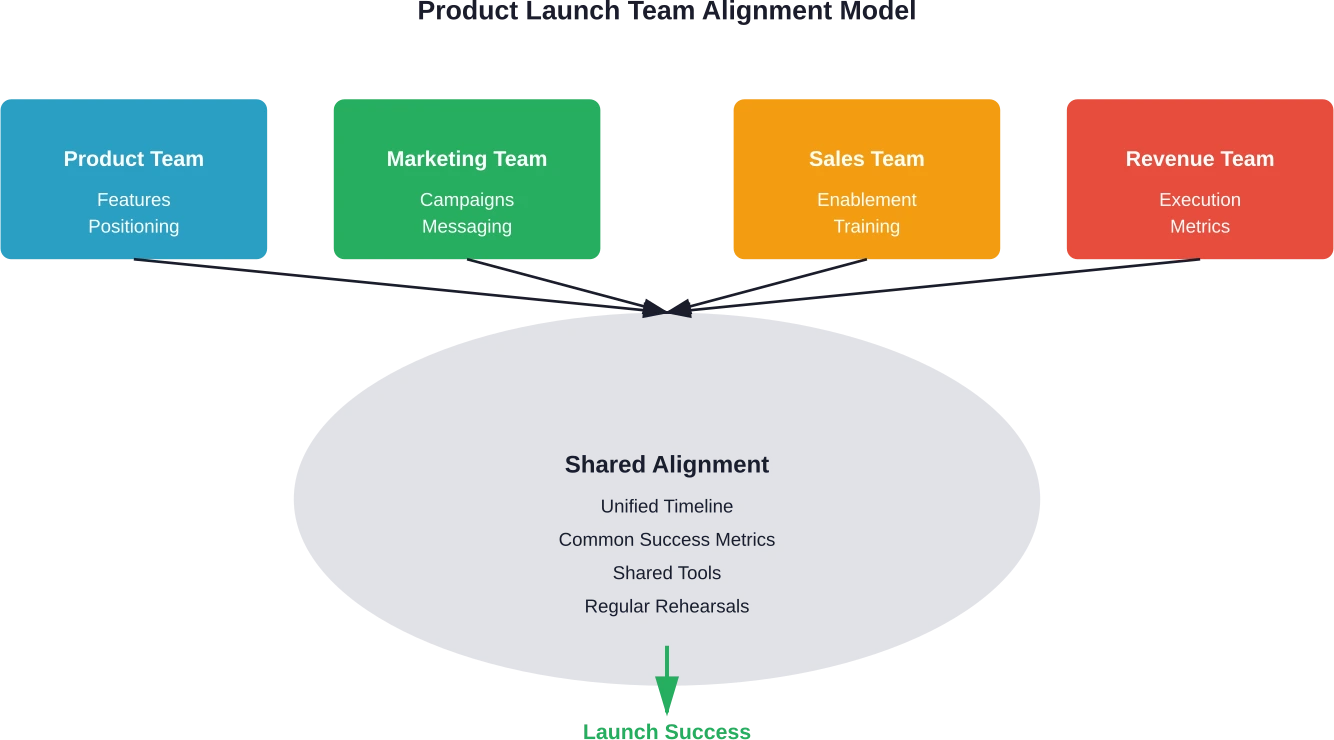
The most successful product launch strategies connect product, marketing, enablement, and revenue teams around shared timing, tools, and ownership. This isn’t just theory—it’s what separates launches that accelerate company growth from ones that fizzle.
Harvard Business Review’s 2026 research on digital product management emphasizes permanent, cross-functional teams over temporary project-based approaches. Traditional project structures have high failure rates because teams disband once the system launches, limiting opportunities for learning and improvement.
Successful launches require each go-to-market team to own their piece of the rollout process. Product teams define features and positioning. Marketing creates campaigns and messaging. Sales enablement prepares customer-facing teams. Revenue teams execute in market.
But ownership alone isn’t enough.
These teams must synchronize around critical milestones:
- Unified launch timeline with dependencies mapped
- Shared definitions of success metrics
- Common tools for tracking launch progress
- Regular rehearsal of key launch moments
By launch week, well-aligned teams are dialing in the final 10%, not scrambling at 110%. They’ve collectively rehearsed key moments and shaken loose potential challenges before they manifest in market.
Quantifiable Benefits Over Feature Lists
Here’s where most product launches go wrong: teams focus on what the product does instead of what problem it solves and how well it solves it.
Community discussions consistently highlight this gap. Launch posts often list features without explaining why they matter. After shipping something significant, tired teams write quick notes and move on. But that approach wastes the launch opportunity.
Effective launches demonstrate measurable outcomes. Instead of saying a product solves a problem, prove it with data, testimonials, and case studies. Quantifiable claims like “reduces time spent on X by 40%” or “saves users an average of Y dollars per month” resonate far more than generic benefit statements.
This principle extends beyond marketing copy.
The entire launch narrative should center on customer outcomes:
- What specific pain point does this address?
- How much better is the customer’s situation after adoption?
- What metrics demonstrate this improvement?
- Can early users validate these benefits?
Testing different messages matters too. Small ad or landing-page experiments before launch reveal which value propositions connect. Instead of “an efficient meal-planning app,” try “helps busy parents save 30 minutes every evening by turning what’s in the fridge into a ready plan.” That’s concrete, human, and instantly meaningful.
The shift from feature-centric to outcome-centric communication isn’t just about marketing effectiveness. It forces product teams to validate that their solution genuinely delivers measurable value. If quantifiable benefits are hard to articulate, that’s a red flag about product-market fit.
Strategic Foresight and Market Timing
Timing isn’t everything, but it’s close. Companies that excel at strategic foresight systematically track both predictable future events and true unknowns across short and long-term horizons.
Companies that excel at strategic foresight demonstrate performance advantages. This advantage comes from data-forward methods, continuous signal detection, and explicit focus on potential upsides to risks, not just downsides.
For product launches, foresight capability translates to:
- Launching when market conditions favor adoption
- Anticipating competitive responses and planning accordingly
- Identifying emerging customer needs before they become obvious
- Avoiding launches during market disruptions or saturation periods
The path to foresight leadership lies in building it as an organizational capability embedded in strategy, not a set of one-off exercises. That means continuous environmental scanning, not just quarterly planning sessions.
MIT Sloan research on learning from outcomes emphasizes that understanding why initiatives succeed or fail helps leaders make better decisions about future strategies. Launches should feed into this learning cycle. Post-launch retrospectives that honestly assess what worked and what didn’t create institutional knowledge that improves subsequent launches.
The Five Key Stages Framework
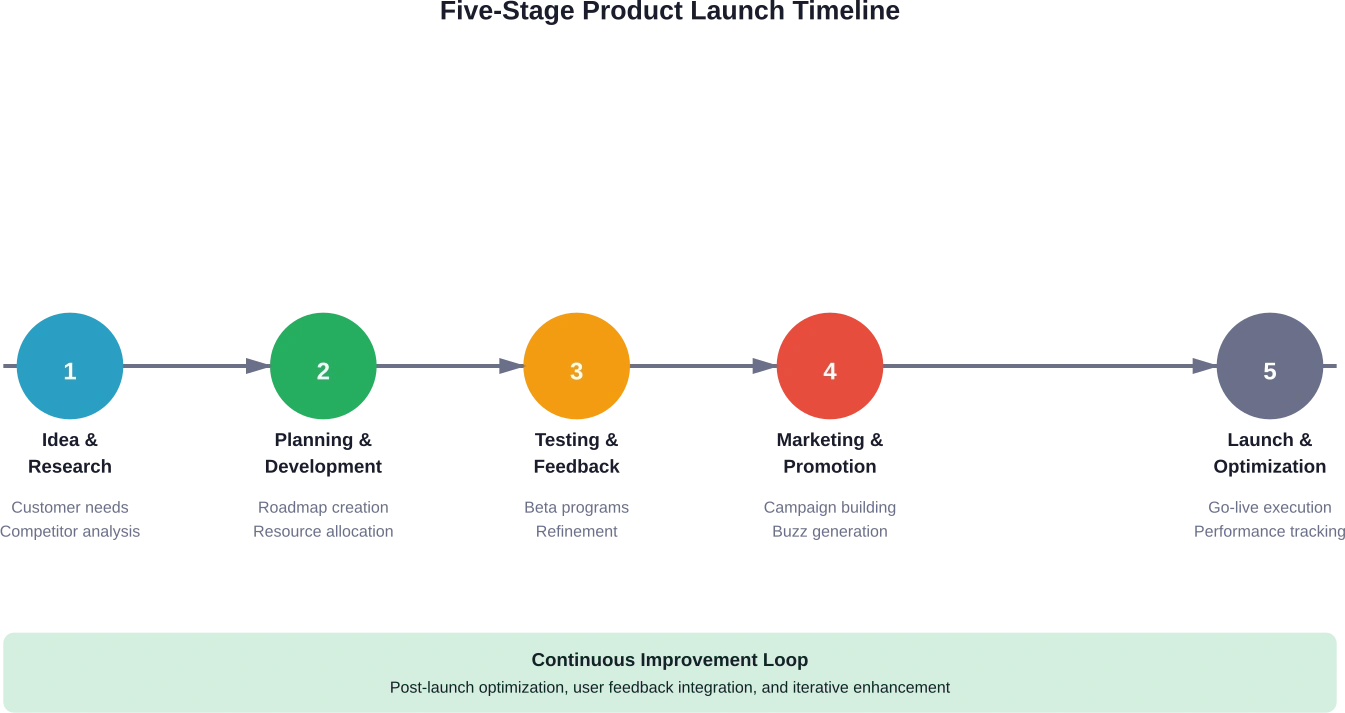
Despite the complexity of modern launches, the fundamental structure remains consistent. Successful launches typically follow five key stages, each with distinct objectives and success criteria.
Stage 1: Idea and Research
This foundation stage involves brainstorming, studying competitors, and understanding customer needs. The research phase shouldn’t be rushed—inadequate understanding of market dynamics causes many launch failures.
Effective research goes beyond surface-level competitor analysis.
It includes:
- Deep customer interviews to uncover unmet needs
- Analysis of competitor positioning and messaging
- Market size and growth trajectory assessment
- Regulatory or compliance considerations
- Technology trends that might accelerate or hinder adoption
Stage 2: Planning and Development
With research complete, teams build roadmaps, create prototypes, and allocate resources. This stage establishes the foundation for cross-functional alignment discussed earlier.
Planning encompasses both product development and go-to-market strategy. The two must evolve in parallel, not sequentially. Waiting until development finishes to begin launch planning creates time pressure that compromises execution quality.
Stage 3: Testing and Feedback
Testing with select users, gathering insights, and refining based on feedback prevents launching with critical flaws. This stage validates assumptions from earlier phases.
The testing approach should match product type and market. B2B products might involve pilot programs with key accounts. Consumer products might use beta programs or soft launches in specific geographies.
Stage 4: Marketing and Promotion
Generating buzz through campaigns, teasers, and partnerships builds anticipation before launch day. The marketing phase shouldn’t start on launch day—it should create momentum leading into it.
Different launch strategies fit different contexts. Influencer-led launches work for consumer products with visual appeal. Partnership launches leverage complementary brands or platforms. Content marketing launches educate audiences about new problem-solution paradigms.
Stage 5: Launch Day and Beyond
Going live, promoting strategically, and tracking performance marks the transition from preparation to execution. But launch day isn’t the finish line—it’s the starting line for ongoing optimization.
Digital product management principles emphasize permanent teams that continue improving products post-launch. Success is judged by adoption, user retention, and revenue over time, not just initial launch metrics.
Measuring Launch Success with Modern Metrics
Traditional operational KPIs like utilization, throughput, and quarterly margins served organizations well in stable environments. But in the transformation age, these legacy metrics often derail product launches by focusing attention on the wrong outcomes.
Harvard Business Review’s research on transformation metrics reveals that organizations should measure what will make them successful in the future, not what worked in the past. For product launches, this means shifting from output metrics to value-creation metrics.
Modern launch measurement focuses on:
- Value: Revenue impact, customer lifetime value increases, or cost savings generated
- Alignment: How well the launch advances strategic objectives versus tactical wins
- Velocity: Speed of adoption, time to revenue, or market penetration rate
- Team Health: Cross-functional collaboration quality and sustainable execution pace
These metrics can be tracked in a live operating system that monitors real-time health, velocity, and strategic alignment of the launch. When performance is measured through these project-driven KPIs, leaders gain confidence, trust in the launch grows, and results follow.
BCG research emphasizes that top-line growth is the most important driver of value creation. Over the longer term, it accounts for about half of ten-year total shareholder return. Margins, free cash flow, and multiples remain important, but they take a back seat to top-line improvement.
This has direct implications for launch measurement. Early fixation on profitability or efficiency might optimize the wrong things. The primary question should be: Is this launch driving growth? Secondary questions about margin and efficiency come later.
| Metric Category | Traditional Approach | Modern Approach | Why It Matters |
|---|---|---|---|
| Success Definition | Launch completed on time | Customer adoption and value creation | Launches are starting points, not endpoints |
| Timeline Focus | Pre-launch execution | Post-launch performance trajectory | Long-term outcomes matter more than launch day |
| Team Measurement | Individual function performance | Cross-functional collaboration quality | Alignment drives better outcomes than siloed excellence |
| Financial Metrics | Cost management and margins | Top-line growth and market expansion | Growth drives long-term value creation |
| Customer Metrics | Initial sales or signups | Retention, engagement, and satisfaction | Sustainable adoption matters more than launch spike |

Track Ad Performance With WisePPC
Launching a new product on Amazon involves more than listing optimization. Advertising performance, keyword visibility, and early sales signals all influence how a product gains traction. WisePPC helps sellers analyze campaign data, keyword performance, and product metrics in one dashboard. This makes it easier to understand which campaigns support a launch and which ones need adjustment.
Running Amazon Ads for a Product Launch?
Use WisePPC to:
- analyze keyword and campaign performance
- track early product sales signals
- adjust PPC campaigns during launch
👉 Explore WisePPC to better understand your Amazon advertising data.
The Role of AI in Modern Product Launches
Artificial intelligence and generative AI are reshaping how organizations approach product innovation and launches. Right now, many consumer packaged goods firms struggle with innovation, and three-quarters of yearly product launches fail.
AI provides a path forward by accelerating the innovation cycle, expanding the range of ideas explored, and surfacing concepts that resonate with customers. These capabilities apply across multiple launch stages.
During the research phase, AI tools analyze market trends, competitor positioning, and customer sentiment at scale. Pattern recognition capabilities identify opportunities human analysts might miss.
In planning and development, AI accelerates prototyping and testing cycles. Generative AI can produce multiple positioning variations, messaging frameworks, or campaign concepts rapidly, enabling broader exploration of strategic options.
For testing and feedback, AI analyzes user responses and behavioral data to identify what’s working and what isn’t. Sentiment analysis across customer conversations reveals issues early, when they’re still easy to fix.
The marketing phase benefits from AI’s ability to optimize messaging for different audience segments and channels. Personalization at scale becomes feasible, improving campaign effectiveness.
Post-launch, AI continuously monitors performance metrics and flags anomalies or opportunities. Predictive analytics help anticipate when momentum might stall, enabling proactive intervention.
That said, AI tools are enablers, not replacements for strategic thinking. The research emphasizes that high-quality management still matters enormously. AI amplifies management capability but doesn’t substitute for it.
Common Launch Strategy Approaches
Different product types and market contexts call for different launch strategies. No single approach works universally, but several proven patterns emerge across successful launches.
Teaser Campaign Strategy
Building anticipation before revealing the full product creates buzz and primes the market. This approach works well for consumer products with visual appeal or innovative features that generate excitement.
Teaser campaigns release information gradually, often through social media, email sequences, or strategic media placements. The key is maintaining interest without frustrating potential customers through excessive secrecy.
Soft Launch Strategy
Releasing to a limited audience or geography before full rollout reduces risk and enables learning. Soft launches identify issues in controlled environments where damage is contained.
This approach suits complex products where unexpected interactions might occur, or markets where local customization might be needed. Geographic soft launches are common for global products.
Partnership Launch Strategy
Leveraging complementary brands or platforms accelerates market access and credibility. Partnership launches work when the partner’s audience aligns with target customers.
Successful partnerships require clear value exchange. Both parties should gain something meaningful—market access, revenue share, or strategic positioning benefits.
Influencer-Led Launch Strategy
Engaging influencers to introduce and validate the product to their audiences provides social proof and reach. This strategy is particularly effective for consumer products targeting demographics that trust influencer recommendations.
The challenge lies in authenticity. Audiences detect inauthentic endorsements quickly, which can backfire. Influencers should genuinely believe in the product, not just accept payment for promotion.
Content Marketing Launch Strategy
Creating valuable content that educates audiences about the problem space positions the product as a solution within a broader context. This approach works well for products that address problems audiences don’t fully understand yet.
Content marketing launches take longer to generate results but often create more sustainable adoption. Educated customers who understand why they need a solution become stronger advocates than those responding to promotional campaigns.
| Launch Strategy | Best For | Timeline | Key Success Factor |
|---|---|---|---|
| Teaser Campaign | Consumer products with visual appeal | 4-8 weeks pre-launch | Maintaining excitement without frustration |
| Soft Launch | Complex products or new markets | 2-6 months before full launch | Learning quickly and adapting |
| Partnership Launch | Products with clear complementary fit | 3-6 months for partnership development | Mutual value creation |
| Influencer-Led | Consumer products for specific demographics | 6-12 weeks including relationship building | Authentic influencer belief in product |
| Content Marketing | Products addressing poorly understood problems | 3-6 months of content before launch | Educational value beyond product promotion |
Learning From Launch Outcomes
Post-launch retrospectives separate organizations that improve over time from those that repeat mistakes. MIT Sloan research emphasizes that understanding why initiatives succeed or fail helps leaders make better decisions about future strategies.
Effective post-launch analysis examines multiple dimensions:
- Market response: Did target customers adopt as expected? If not, why?
- Execution quality: Did teams execute the plan effectively? Where did breakdowns occur?
- Assumption validation: Which assumptions about customers, competition, or market conditions proved correct or incorrect?
- Metric performance: How did actual performance compare to projections across different metrics?
The key is honest assessment. Organizations that only celebrate successes without examining failures miss valuable learning opportunities. Conversely, those that conduct witch hunts after disappointing launches create cultures where teams hide problems rather than surfacing them.
Structured learning processes capture insights systematically. Launch playbooks that document what worked and what didn’t become institutional knowledge that improves subsequent launches.
This learning orientation connects to the digital product management principle of permanent teams. When teams stay together across multiple product cycles, they compound learning. Each launch informs the next, creating continuous improvement.
Avoiding Common Launch Pitfalls
Even well-planned launches encounter predictable problems. Awareness of common pitfalls enables proactive mitigation.
Insufficient Product-Market Fit Validation
The hidden reason behind many launch failures is inadequate consumer insight integration. Organizations assume they understand customer needs without rigorous validation. Despite bigger R&D budgets and better data, many launches still fall short. PDMA’s global study found that just 61% of new products meet their business goals, and that, on average, it takes nearly nine ideas to produce one success.
Inside many organizations, product teams work in isolation from real customer input until late in development. By then, course correction becomes expensive or impossible.
Feature-Centric Communication
As discussed earlier, focusing on what the product does rather than what problems it solves disconnects launches from customer motivations. This mistake appears in launch materials, sales enablement, and customer-facing messaging.
The fix requires discipline. Every feature description should connect to a specific customer outcome. If that connection isn’t clear, either the feature isn’t important enough to highlight, or the team doesn’t understand its value.
Inadequate Cross-Functional Coordination
Siloed execution creates gaps where critical tasks fall through or conflicting messages confuse customers. Marketing launches a campaign while sales remains untrained. Product releases features that support teams don’t understand. Enablement creates materials that don’t align with actual positioning.
The solution is the cross-functional alignment framework described earlier. But alignment requires deliberate effort—it doesn’t happen automatically just because teams report to the same executive.
Poor Timing Decisions
Launching during market disruptions, immediately before major industry events, or when internal capabilities are stretched creates unnecessary headwinds. Some timing factors are controllable, others aren’t, but strategic foresight capability helps navigate both.
Neglecting Post-Launch Optimization
Treating launch day as the finish line abandons momentum when it matters most. The weeks immediately following launch represent the highest-leverage period for optimization. Customer feedback is fresh, team attention is focused, and course correction is easiest.
Organizations that transition immediately to the next project waste this opportunity. Building post-launch optimization into plans ensures teams capture early learnings while they’re most actionable.
Conclusion
Good product launches don’t happen by accident. They result from strategic planning, cross-functional coordination, quantifiable value demonstration, and continuous learning.
The research is clear: management quality matters enormously, alignment across teams separates success from failure, and outcome-focused communication resonates better than feature lists. Modern metrics that emphasize growth and value creation guide better decisions than traditional operational KPIs.
But perhaps most important is this: launches aren’t endpoints. They’re starting points for ongoing optimization and value creation. Teams that treat them as such, maintaining focus through the critical post-launch period, see substantially better results.
The framework exists. The research validates it. What separates organizations that consistently launch successfully from those that struggle is disciplined execution of these principles, adapted to specific product and market contexts.
For teams planning launches now, the path forward is clear: align teams early, validate customer outcomes rigorously, communicate benefits quantitatively, measure what actually drives value, and learn systematically from each launch to improve the next.
Frequently Asked Questions
What is the most important factor in a successful product launch?
Cross-functional team alignment around shared objectives, timing, and success metrics is the most critical factor. Harvard research shows that high-quality management executing coordinated launches can increase new product revenue by nearly 20% within six months. No single element—product quality, marketing budget, or timing—matters as much as how well teams synchronize execution.
How long should product launch planning take?
Planning timelines vary by product complexity and market, but generally range from three to six months for B2B products and two to four months for consumer products. The key is starting go-to-market planning in parallel with product development, not sequentially after it. Teams that wait until development finishes to begin launch planning face time pressure that compromises execution quality.
Should launches focus on features or benefits?
Launches should focus on quantifiable customer outcomes rather than features. Effective messaging demonstrates measurable results like “reduces time spent on X by 40%” rather than listing capabilities. Features only matter when connected to specific problems they solve. Testing different message frames before launch reveals which value propositions resonate most strongly with target audiences.
What metrics best measure launch success?
Modern launch measurement emphasizes value creation metrics over traditional operational KPIs. The most important metrics are revenue impact or customer value generated, speed of adoption, strategic alignment with business objectives, and cross-functional team health. Focusing on completion milestones or launch-day metrics misses the point—launches are starting points for ongoing value creation, not endpoints.
How do soft launches differ from full launches?
Soft launches release products to limited audiences or geographies before full rollout, enabling controlled learning and risk reduction. They work well for complex products where unexpected issues might arise, or markets requiring local customization. Full launches skip this phase and go directly to broad market availability. The choice depends on product complexity, market uncertainty, and organizational risk tolerance.
What role does AI play in modern product launches?
AI accelerates multiple launch phases by analyzing market trends and customer sentiment at scale during research, generating positioning and messaging variations during planning, analyzing user responses during testing, optimizing campaigns during marketing, and monitoring performance post-launch. BCG research indicates AI helps address the problem that three-quarters of yearly product launches fail by expanding ideation, accelerating cycles, and surfacing concepts that resonate with customers.
How can teams learn from previous launches?
Structured post-launch retrospectives that honestly examine market response, execution quality, assumption validation, and metric performance create institutional knowledge. Organizations should document what worked and what didn’t in accessible launch playbooks. MIT Sloan research shows that understanding why initiatives succeed or fail helps leaders make better decisions about future strategies. Permanent product teams compound this learning across multiple cycles better than temporary project teams.
Join the WisePPC Beta and Get Exclusive Access Benefits
WisePPC is now in beta — and we’re inviting a limited number of early users to join. As a beta tester, you'll get free access, lifetime perks, and a chance to help shape the product — from an Amazon Ads Verified Partner you can trust.
 No credit card required
Free in beta and free extra month free after release
25% off for life — limited beta offer
Access metrics Amazon Ads won’t show you
Be part of shaping the product with your feedback
No credit card required
Free in beta and free extra month free after release
25% off for life — limited beta offer
Access metrics Amazon Ads won’t show you
Be part of shaping the product with your feedback