EN
EN  ES
ES  FR
FR  DE
DE  IT
IT  KO
KO  JA
JA  ZH
ZH  AR
AR  PT
PT Amazon Selling Fees Explained: Complete 2026 Cost Guide

Quick Summary: Amazon sellers pay multiple fees including a selling plan fee ($39.99/month for Professional or $0.99 per item for Individual), referral fees (typically 8-15% per sale depending on category), and optional FBA fulfillment fees for storage and shipping. Additional costs may include storage fees, advertising, and various service charges.
Understanding Amazon’s fee structure can feel like decoding a puzzle. And honestly? The platform doesn’t make it simple.
But here’s the thing: knowing exactly what Amazon charges is the difference between running a profitable business and wondering where all the money went. Every seller, from someone moving five items a month to established brands shipping thousands, encounters the same fee categories.
The cost structure breaks into two buckets: mandatory fees that every seller pays, and optional fees for services like Fulfillment by Amazon or advertising. Some fees changed recently, others stayed flat, and new programs launched that affect what sellers actually pay in 2026.
So what does it really cost to sell on Amazon?
The Two Core Fees Every Amazon Seller Pays
Before diving into optional services and specialized programs, two fee types apply to absolutely every seller on the platform.
Selling Plan Fees: Individual vs Professional
Amazon offers two selling plans, and the choice impacts both monthly costs and available features.
The Individual plan costs $0.99 per item sold with no monthly subscription. Someone selling 20 items pays $19.80 that month. Selling 100 items? That’s $99 in per-item fees.
The Professional plan charges $39.99 monthly regardless of sales volume. No per-item fee exists. Sellers moving more than 40 items monthly typically save money with this plan.
But cost isn’t the only difference. Professional sellers get bulk listing tools, advertising options, and access to advanced selling features. Individual sellers can’t run Amazon Ads campaigns or use bulk inventory management.
According to Amazon’s Seller Central documentation, the Professional plan provides access to advanced tools and programs unavailable to Individual sellers. That monthly subscription unlocks the full platform.
Referral Fees: Amazon’s Commission on Every Sale
Every single sale triggers a referral fee. Think of it as Amazon’s commission for connecting sellers with buyers.
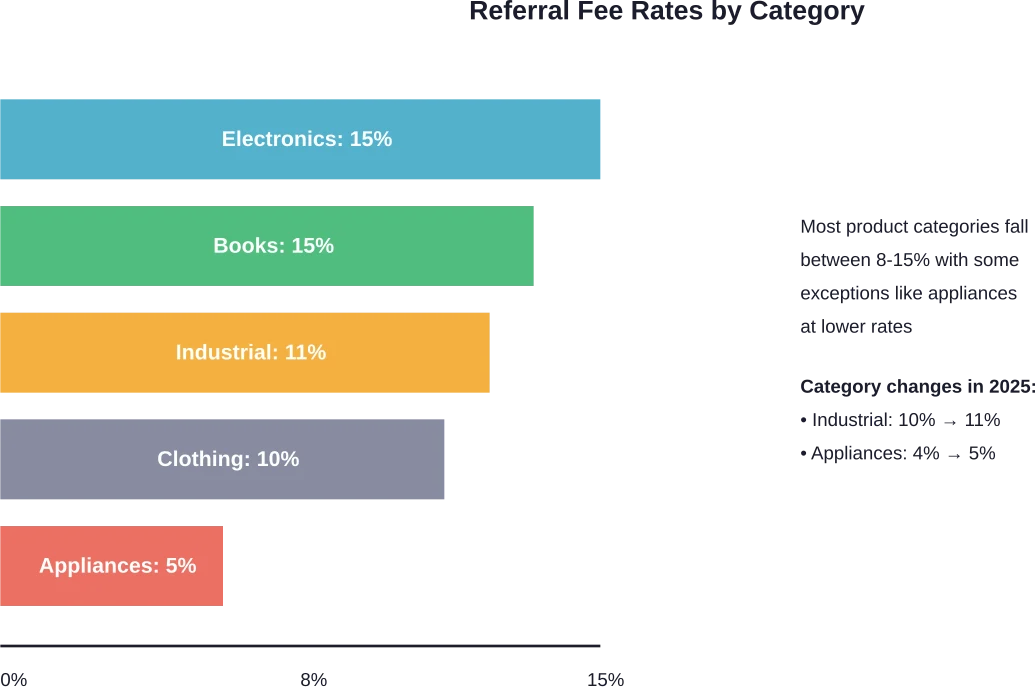
The percentage varies by product category. Most categories fall between 8% and 15% of the total sale price (including the item price plus shipping charges in most cases).
Here’s where it gets specific. Electronics accessories carry a 15% referral fee. Business and industrial supplies increased to 11% from 10% in recent updates. The referral fee for Major Appliances is 8% for the portion of the total sales price greater than $300, and 15% for the portion up to $300. For Televisions, the referral fee is a flat 8%.
Amazon calculates referral fees on the total amount the customer pays, not just the item’s list price. So a $25 product with $5 shipping generates a referral fee on the full $30.
Some categories have minimum referral fees too. Even if 15% of a sale equals $0.20, Amazon might charge a $0.30 minimum for that category.
Fulfillment by Amazon (FBA) Fees: What Storage and Shipping Cost
FBA is optional. But it’s also what most serious sellers use.
Amazon stores inventory in their warehouses, picks and packs orders, ships products to customers, and handles returns. Convenient, yes. Free? Absolutely not.
FBA Fulfillment Fees: Pick, Pack, and Ship
Every time Amazon ships a product for a seller, a fulfillment fee applies. The fee depends on size tier and weight.
Small standard-size items under 10 ounces might cost $3.07 to fulfill. Large standard-size items between one and two pounds could run $4.90. Large bulky items get expensive fast—some oversized products cost $25+ per fulfillment.
Amazon adjusts these fees periodically. Recent updates lowered inbound placement service fees for large bulky products by an average of $0.58 per unit for minimal shipment splits, effective January 2025.
The fee structure rewards smaller, lighter products. A book that weighs 12 ounces and sells for $20 costs far less to fulfill than a 15-pound kitchen appliance selling for the same price.
Monthly Storage Fees: Rent for Warehouse Space
Inventory sitting in Amazon’s warehouses incurs monthly storage fees based on cubic footage.
Standard-size items stored from January through September cost less per cubic foot than during October through December peak season. The rates increase substantially in Q4 when warehouse space becomes premium real estate.
Long-term storage fees hit products that sit unsold for extended periods. Amazon wants fast-moving inventory, not dead stock taking up space.
According to recent Amazon announcements, sellers should monitor inventory age carefully. Slow-moving stock doesn’t just gather dust—it generates escalating storage charges.
The New FBA Liquidations Program
Amazon launched a liquidations program in 2026 to help sellers recover value from excess and returned inventory.
The program charges a 15% referral fee plus per-item processing fees based on size and weight. For items 0-5 kg, processing fees range from CAD $0.25 to CAD $1.90 (Canada-specific rates) (in Canada; US fees differ slightly).
This provides an exit strategy for inventory that won’t sell at regular prices. Better to recover something than pay mounting long-term storage fees.

Want to See Where Your Amazon Ad Spend Actually Goes?
Selling on Amazon involves multiple costs – referral fees, FBA fees, storage, and advertising. For many sellers, Amazon PPC becomes one of the largest ongoing expenses, but it is often the hardest to track clearly inside the standard dashboards.
WisePPC helps sellers understand how advertising spend fits into the overall cost of selling on Amazon. The platform connects Amazon Ads and Seller Central data, allowing you to analyze campaign performance, review historical metrics, and manage campaigns from one interface.
If you want better visibility into your Amazon advertising costs, WisePPC can help you:
- track PPC spend alongside sales performance
- identify campaigns that waste budget
- manage and optimize Amazon ads more efficiently
See how your advertising costs impact profitability. Try WisePPC.
Optional Fees and Additional Services
Beyond the core costs, Amazon offers services that carry their own fee structures.
Inbound Placement Service Fees
When shipping inventory to Amazon, sellers can either split shipments across multiple warehouses (cheaper) or pay for Amazon to distribute inventory from a single shipment (more convenient).
The inbound placement service fee covers Amazon’s work redistributing products across their fulfillment network. Fees vary by size and shipment split level.
Recent changes lowered these fees for large bulky items, making it more affordable to use minimal shipment splits rather than sending products to multiple locations.
Removal and Disposal Fees
Need to get inventory out of FBA? Removal fees apply.
Amazon charges per item to return unsold products to sellers. Disposal fees apply if products are destroyed instead of returned. The fees scale with item size.
Many sellers forget these exist until they need to clear out seasonal inventory or discontinued products. Planning for these costs matters.
Advertising Costs: Sponsored Products and Beyond
Amazon Ads are entirely optional but increasingly necessary for visibility.
Sponsored Products, Sponsored Brands, and Sponsored Display ads all operate on pay-per-click models. Sellers set budgets and bid on keywords. Costs vary wildly by competition—some clicks cost $0.25, others $5+.
Only Professional plan sellers can access advertising tools. Individual sellers don’t get this option at all.
Coupon and Promotion Fees
Running a coupon promotion? Amazon charges a $0.60 fee per redeemed coupon.
Percentage-off promotions, buy-one-get-one deals, and other promotional tools might carry fees too. The costs add up if promotional redemptions run high.
According to Amazon’s official documentation on coupon fees, these charges cover the cost of promoting products through Amazon’s coupon programs.
Refund Administration Fees
When customers return items, Amazon refunds most of the referral fee to sellers. But not all of it.
A small refund administration fee gets retained. It’s not huge per transaction, but in categories with high return rates, these fees accumulate.
High-return categories like apparel see this more than others. Someone selling shoes might deal with 15-20% return rates. Those administration fees become part of the cost model.
| Fee Type | Who Pays | Typical Cost | When It Applies |
|---|---|---|---|
| Individual Plan Fee | Individual sellers | $0.99 per item sold | Every sale |
| Professional Plan Fee | Professional sellers | $39.99/month | Monthly subscription |
| Referral Fee | All sellers | 8-15% of sale price | Every sale |
| FBA Fulfillment Fee | FBA sellers only | $3-$25+ per item | Per fulfillment |
| Monthly Storage Fee | FBA sellers only | Varies by cubic foot | Monthly for stored inventory |
| Removal/Disposal Fee | FBA sellers | Varies by size | When removing inventory |
| Coupon Fee | Sellers using coupons | $0.60 per redemption | Per coupon redeemed |
Calculating Your True Amazon Selling Costs
Understanding individual fees matters. But what do they look like combined?
Real talk: most sellers find total fees consume 30-50% of revenue depending on product type, fulfillment method, and business model.
Example Cost Breakdown for a $25 Product
Consider a seller using FBA for a standard-size product priced at $25:
- Item price: $25.00
- Referral fee (15%): -$3.75
- FBA fulfillment fee: -$3.07
- Monthly storage (averaged per unit): -$0.01
- Shipping to Amazon: -$0.30
- Net before product cost: $17.87
If the product costs $10 to source or manufacture, the actual profit drops to $7.87 per unit—just 31.5% margin.
And that’s before advertising spend, which many sellers need to maintain visibility.
FBA vs FBM: The Cost Difference
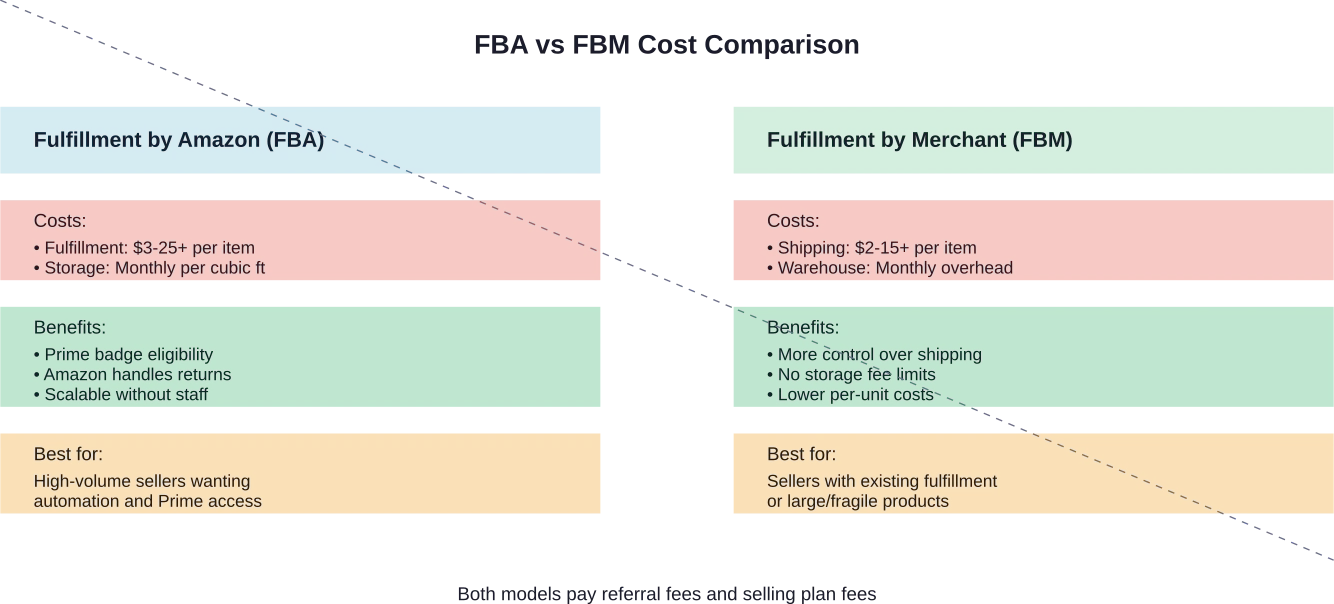
Fulfillment by Merchant (FBM) sellers handle shipping themselves. They avoid FBA fulfillment and storage fees.
But they also handle customer service, manage returns, and don’t get automatic Prime badge eligibility. Plus they need their own shipping infrastructure.
The calculation isn’t just about Amazon’s fees. It’s about total operational costs. Someone paying $4 in FBA fees might spend $2 shipping themselves—but also invest in warehouse space, staff, and packing materials.
Many sellers find FBA more cost-effective despite higher per-unit fees because it scales without proportional labor increases.
Recent Fee Changes and What They Mean
Amazon adjusts fees regularly. Staying current matters.
2025 and 2026 Updates
For 2025 and 2026, Amazon announced no increases to Canada referral and FBA fees, and for 2025 in the US, no increases to referral and FBA fees. This marked a departure from annual increases sellers had come to expect.
Some specific changes did occur:
- Business, industrial, and scientific supplies category referral fees increased to 11% from 10% in August 2025
- Major appliances and televisions saw referral fees rise to 8%
- Inbound placement service fees for large bulky-size products were lowered an average of $0.58 per unit for minimal shipment splits, effective January 15, 2025
- The new FBA Liquidations program launched with specific fee structures
According to official Amazon Seller Central announcements from late 2024, the company emphasized investments in fulfillment infrastructure, faster delivery capabilities, and improved inventory management tools rather than broad fee increases.
Low-Price Product Fee Adjustments
Amazon maintained lower fulfillment fees for low-priced products and reduced referral fees for low-priced apparel items.
These adjustments help sellers compete in price-sensitive categories where margins run thin. Selling a $10 t-shirt becomes viable when fees stay proportional.
Strategies to Minimize Amazon Selling Costs
Understanding fees is step one. Optimizing around them is step two.
Choose the Right Selling Plan
The math is straightforward. Selling more than 40 items monthly? Professional plan saves money and unlocks features.
But don’t upgrade prematurely. New sellers testing products might sell 15 items in month one. That $39.99 subscription plus referral fees hurts when sales haven’t ramped yet.
Optimize Product Size and Weight
FBA fees reward compact, lightweight products.
Two products with identical $30 sale prices might have wildly different profitability. The one weighing 8 ounces costs $3 to fulfill. The one weighing 3 pounds costs $6. That’s $3 extra per unit straight off the bottom line.
Product selection matters. Experienced sellers factor fulfillment costs into sourcing decisions, not as an afterthought.
Manage Inventory Age
Long-term storage fees punish slow-moving inventory.
Smart sellers monitor inventory age reports and make decisions before fees escalate. Running a promotion to move 90-day-old stock costs less than paying months of increasing storage charges.
The new liquidations program provides another option for clearing aged inventory with some value recovery.
Use Fee Calculators Before Launching Products
Amazon provides revenue calculators that preview fees for specific products.
Testing profitability before buying inventory prevents expensive mistakes. Enter the product ASIN, estimated sales price, and costs. The calculator shows expected fees and net profit.
This tool exists in Seller Central and should be mandatory for every product evaluation.
Consider FBM for Specific Products
Not everything belongs in FBA.
Large items, fragile products with high damage rates, or slow-moving specialty goods might work better with merchant fulfillment. Avoiding storage fees and fulfillment costs for a $200 item that sells twice monthly could save substantial money annually.
The trade-off is handling logistics. But for some products and sellers, it makes financial sense.
Hidden Costs Sellers Often Overlook
The published fee schedule doesn’t tell the whole story.
Returns and Refunds
High return rates effectively increase all costs. A product with 20% returns needs 20% higher margins to maintain profitability.
Amazon keeps refund administration fees. Sellers also potentially lose the product if it comes back damaged. Some categories see return rates above 30%.
Stranded Inventory Costs
Inventory that becomes unsellable due to listing errors, compliance issues, or quality problems still incurs storage fees.
Resolving these issues takes time. Meanwhile, storage fees keep accruing for products generating zero sales.
Advertising as a Practical Necessity
Technically optional, advertising often becomes necessary for visibility.
Organic ranking requires sales velocity. Getting initial sales often requires advertising. The cost isn’t listed as mandatory, but many sellers find it functionally required.
Advertising costs vary enormously by category and competition. Some sellers spend 5% of revenue on ads. Others spend 30%+.
Amazon Fees Compared to Other Marketplaces
How do Amazon’s costs stack up?
eBay charges final value fees typically between 10-15% plus payment processing around 2.9%. No monthly subscription for basic selling, but promoted listings cost extra.
Walmart Marketplace charges referral fees between 6-20% depending on category. No monthly fee, but approval requirements are stricter.
Shopify costs $29-299 monthly for the platform plus payment processing (2.4-2.9% + $0.30 per transaction for Shopify Payments). No referral fees, but sellers handle all marketing and customer acquisition.
Amazon’s total costs might run higher per transaction, but the platform delivers traffic other channels don’t. That traffic has value sellers need to factor into comparisons.
Regulatory Considerations and Transparency
Selling online involves more than just marketplace fees.
The INFORM Consumers Act, effective as of June 27, 2023, requires online marketplaces to collect and verify information from high-volume third-party sellers. Sellers meeting specific thresholds in any continuous 12-month period must provide tax identification, contact information, and bank account details.
According to FTC guidance, the law aims to prevent stolen goods and counterfeit products from being sold through online marketplaces. While this doesn’t directly create fees, non-compliance can result in account suspension.
The FTC’s Rule on Unfair or Deceptive Fees also impacts how sellers can display prices. Total prices must include all mandatory fees and charges. This applies more to end-customer pricing than Amazon’s seller fees, but sellers should understand transparency requirements.
Making Sense of Amazon’s Fee Structure
Here’s what it comes down to: Amazon’s fees are substantial, but predictable once understood.
The platform charges for access to its customer base, fulfillment infrastructure, and marketplace tools. For many sellers, these costs deliver value that exceeds alternatives—but only when managed strategically.
Successful sellers treat fees as controllable variables, not fixed costs. Product selection, inventory management, pricing strategy, and fulfillment choices all impact total fees paid. Small optimizations compound over thousands of transactions.
Start with the basics: understand referral fees for target categories, calculate break-even pricing including all applicable fees, and choose the selling plan that matches sales volume. Then layer in FBA decisions based on product characteristics and business model.
The sellers who profit on Amazon aren’t necessarily those with the lowest fees. They’re the ones who understand exactly what they’re paying, why, and how each fee impacts unit economics. Build that understanding, and Amazon becomes a powerful sales channel rather than a confusing fee maze.
Ready to start selling on Amazon? Calculate your specific costs using Amazon’s fee calculators before listing the first product. Know the numbers, plan for them, and build sustainable margins that account for every fee the platform charges.
Frequently Asked Questions
What is the minimum cost to start selling on Amazon?
The absolute minimum is $0 upfront with the Individual selling plan—no monthly fee required. However, sellers pay $0.99 per item sold plus referral fees on each sale. For someone testing the platform with minimal investment, this structure allows starting with essentially no fixed costs beyond product inventory.
Are Amazon FBA fees tax deductible?
Generally yes. FBA fees, referral fees, subscription costs, and other Amazon selling expenses typically qualify as business expenses for tax purposes. Sellers should consult tax professionals about their specific situations, but these costs normally reduce taxable income just like other cost-of-goods-sold and operational expenses.
How do I calculate if a product will be profitable on Amazon?
Use Amazon’s FBA Revenue Calculator in Seller Central. Enter the product ASIN or dimensions/weight, set the selling price, and input product costs. The calculator shows estimated fees, net proceeds, and margin. For accuracy, include all costs: product cost, shipping to Amazon, prep fees, and estimated advertising spend. Many sellers aim for 30%+ net margins after all fees.
Can I switch from Individual to Professional selling plan mid-month?
Yes, sellers can upgrade from Individual to Professional at any time. Amazon prorates the subscription fee based on when the upgrade occurs. Downgrading from Professional to Individual is also possible, but the monthly fee isn’t refunded for the current billing period. The change takes effect at the start of the next billing cycle.
Do I pay FBA fees if I fulfill orders myself?
No. FBA fees only apply to inventory stored in Amazon’s warehouses and fulfilled by Amazon. Sellers using Fulfillment by Merchant (FBM) avoid FBA fulfillment fees, storage fees, and related FBA charges. They still pay referral fees and selling plan fees, but handle shipping, storage, and returns themselves.
What happens to fees when customers return products?
Amazon refunds most of the referral fee when an order is returned, but keeps a small refund administration fee. FBA fees aren’t refunded. If the returned product is damaged or unsellable, sellers may lose both the product and the fees paid. Return rates vary by category—apparel often sees 15-30% returns while electronics might see 5-10%.
Are there any categories with no referral fees?
No. All product categories on Amazon carry referral fees, though the percentages vary. The lowest rates start around 5% for categories like major appliances and televisions. Most categories fall between 8-15%. Some specialized categories may have unique fee structures, but Amazon charges a commission on every sale regardless of category.
Join the WisePPC Beta and Get Exclusive Access Benefits
WisePPC is now in beta — and we’re inviting a limited number of early users to join. As a beta tester, you'll get free access, lifetime perks, and a chance to help shape the product — from an Amazon Ads Verified Partner you can trust.
 No credit card required
Free in beta and free extra month free after release
25% off for life — limited beta offer
Access metrics Amazon Ads won’t show you
Be part of shaping the product with your feedback
No credit card required
Free in beta and free extra month free after release
25% off for life — limited beta offer
Access metrics Amazon Ads won’t show you
Be part of shaping the product with your feedback