EN
EN  ES
ES  FR
FR  DE
DE  IT
IT  KO
KO  JA
JA  ZH
ZH  AR
AR  PT
PT  TR
TR  PL
PL B2B Ecommerce: What It Is, Why It Matters, and How to Build Your Strategy in 2026

B2B ecommerce has grown into a core channel for companies that sell products or services to other businesses. What used to rely heavily on calls, catalogs, and in-person orders has shifted toward online stores, self-service portals, and automated systems. The change hasn’t been overnight, but it’s reshaped how many organizations buy, plan, and restock.
This guide breaks down the main concepts, different models, and the practical steps companies take when they start selling B2B online. You’ll also find strategies you can use to attract business buyers and improve the entire purchasing experience.
What B2B Ecommerce Means Today
At its simplest, B2B ecommerce refers to selling goods or services from one business to another through digital channels. Instead of placing orders by phone or email, buyers use online catalogs, pricing pages, or custom portals to browse, compare, and buy.
The idea is the same as traditional B2B sales, but the tools and expectations have changed. Businesses want faster ordering, clearer information, and the ability to purchase anytime – not only during office hours.
Types of B2B Ecommerce
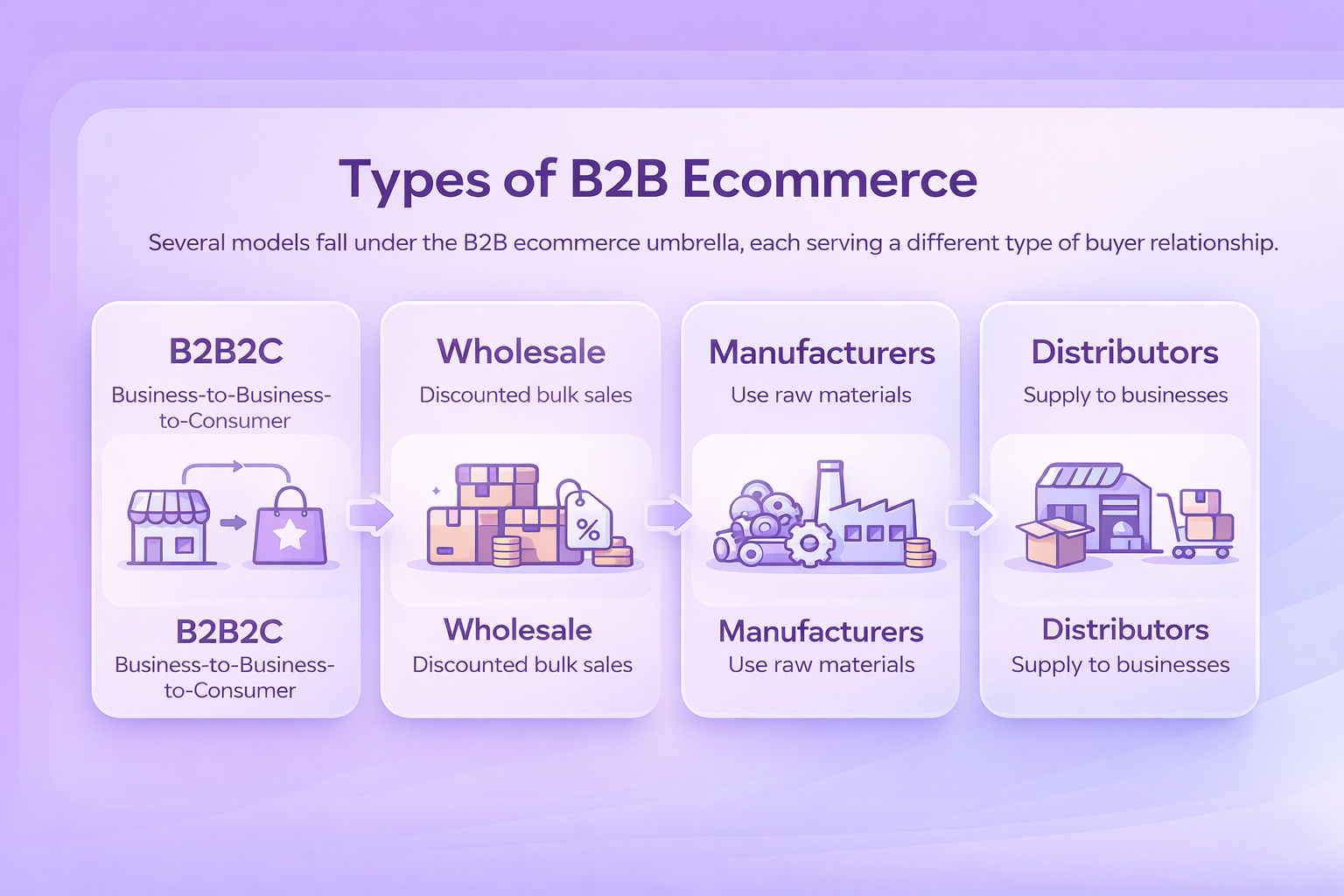
Several models fall under the B2B ecommerce umbrella, each serving a different type of buyer relationship.
- Business-to-Business-to-Consumer (B2B2C): A hybrid model where two companies work together to deliver goods or services to the end consumer. One might produce the item while the other handles fulfillment or customer-facing operations.
- Wholesale: A wholesaler buys or produces items in bulk and sells them to retailers at discounted rates. The retailer then sells those same products to consumers at standard retail pricing.
- Manufacturers: Manufacturers use raw materials and machinery to create products that are sold in large quantities to wholesalers, distributors, or other manufacturers.
- Distributors: Distributors serve as the link between product makers and the businesses that need those products for resale or operations.
Common Examples of B2B Ecommerce
Many industries use online storefronts or purchasing systems to simplify how businesses place orders. A few everyday examples include:
- An office supply company offering corporate accounts so teams can reorder essentials whenever needed
- An equipment manufacturer with an online portal where maintenance departments schedule part replacements
- A furniture wholesaler giving design studios access to product customization and volume ordering
- A software provider offering self-service licensing and subscription management for business clients
- A commercial cleaning supplier selling directly to hotels, clinics, and gyms through a simple online catalog
The common thread is convenience. These companies use digital tools to make ordering faster, information easier to find, and repeat purchasing nearly effortless.

Where WisePPC Helps B2B Teams Work Smarter
When we talk to teams exploring B2B ecommerce, one theme comes up again and again – the data behind their decisions is often scattered, delayed, or difficult to translate into clear next steps. At WisePPC, we built our toolkit to take some of that weight off their shoulders. Instead of juggling spreadsheets, ad dashboards, and marketplace reports, sellers get one place where their performance actually makes sense. It lets them see how their products move, where demand is shifting, and which campaigns are quietly shaping their B2B sales pipeline.
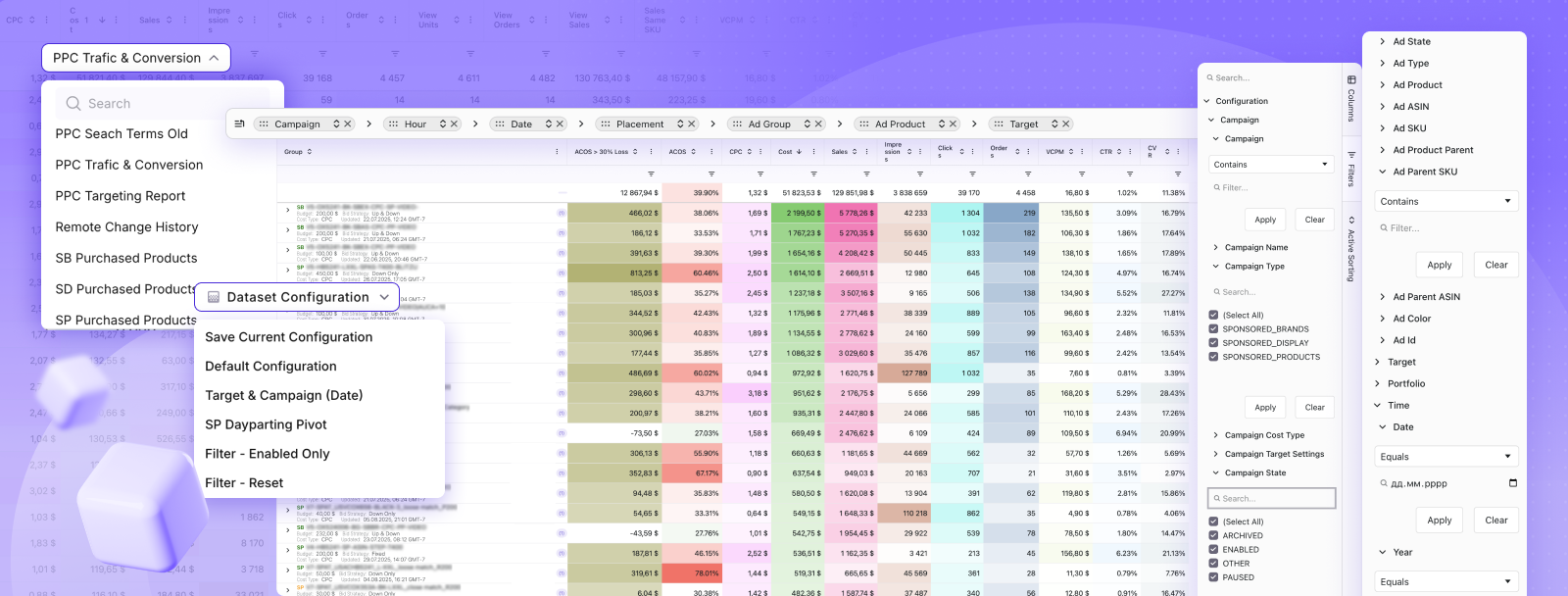
We also try to simplify the routine work that eats up hours each week. Bulk updates, real-time filtering, historical trend charts, and on-the-spot editing were added because teams kept telling us how much time disappears into the small tasks. Our goal isn’t to replace anyone’s workflow – it’s to make the everyday steps quicker, clearer, and less frustrating. When sellers can track what’s happening across marketplaces and react without digging through multiple tools, their B2B strategies usually start falling into place on their own.

6 Benefits of B2B Ecommerce
Whether you already serve business buyers or you’re shifting from consumer-focused sales, moving B2B transactions online brings noticeable advantages.
1. Access to New Business Customers
Traditional B2B selling tends to rely on existing relationships, trade shows, and outreach. Ecommerce widens that circle. Buyers searching online can discover your products even if they’re across the country – or across the world. If you already sell B2C, your infrastructure may only need a few adjustments to support business orders as well.
2. Smoother and More Efficient Operations
Digitizing B2B sales often removes the most time-consuming parts of the process:
- Orders enter automatically instead of through calls or emails
- Inventory updates in real time, reducing manual adjustments
- Billing and invoicing run on their own, especially when connected to accounting tools
- Buyers manage their accounts, reorders, and documentation without waiting on a representative
The result is a shorter sales cycle and fewer administrative bottlenecks.
3. A More Convenient Purchasing Experience
Business buyers want the same ease they experience when shopping personally: quick search, clear details, easy checkout, and reliable delivery.
A B2B ecommerce store lets them:
- Search for exact items
- View specifications, pricing, and availability
- Place orders anytime
- Reorder in one click or set subscription deliveries
- Track shipments and download invoices as needed
You can also offer features tailored for business needs, like custom pricing, quantity breaks, credit-based payments, and procurement approvals.
4. More Insight into Buying Behavior
Selling online gives you visibility into what your customers browse, how often they order, and which items generate the most interest. These insights help refine product planning, marketing efforts, inventory management, and even pricing.
5. Lower Costs Across the Business
Moving B2B sales online can reduce expenses in several ways:
- Less manual order entry
- Fewer errors and returns
- Less time spent on repetitive customer service tasks
- Lower printing and mailing costs
- Better inventory control that reduces stockouts and excess storage
- Sales teams free to focus on large accounts rather than routine ordering
6. Better Collaboration Between Teams
When your sales happen online, different teams inside your company gain access to the same real-time information. Sales, operations, finance, and customer support all see the same order history, stock levels, and delivery updates. It cuts down on miscommunication and makes it easier to resolve issues quickly.
A shared system also helps everyone understand customer patterns. Sales can spot opportunities, marketing can refine messaging, and operations can prepare for demand. Instead of running separate spreadsheets or chasing answers through email threads, everyone works from one reliable source of truth.
Before You Get Started: A Quick Self-Check
Before stepping into B2B ecommerce, it’s worth taking a moment to look at how your business currently operates. Think about your catalog, how complex your pricing is, and how often customers come back with the same types of orders. If you’re already spending a lot of time answering repeat questions, sending quotes, or processing manual purchases, that’s usually a sign your buyers would appreciate a more streamlined way to order.
A quick readiness check doesn’t need to be formal. It simply helps you understand what your B2B setup should actually support and where you might need small adjustments before launching. Going in with a clear picture of your starting point makes the rest of the process easier and prevents issues later on.
Three Steps to Start Selling B2B Online
Ready to build a B2B ecommerce presence? The process is usually more straightforward than it seems.
Step 1: Shape Your B2B Ecommerce Approach
Start by clarifying:
- Who your business buyers are: Understand their industries, order sizes, needs, and decision processes.
- How you plan to sell: You can use your own website, join a marketplace, or combine both. Each option has different strengths – your audience and product type usually guide the decision.
Step 2: Build Your Online Store or Portal
A simple setup checklist might look like this:
- Choose an ecommerce platform that supports B2B features such as custom pricing, bulk discounts, and invoicing.
- Prepare your product catalog with strong descriptions, clear images, and accurate data.
- Design the storefront in a way that feels intuitive and aligns with your brand.
- Set up payments, tax settings, and shipping rules.
- Run test orders to make sure everything works the way customers expect.
Launching is just the beginning – most businesses refine their store continuously as they learn how buyers interact with it.
Quick Tip: Detailed product specs and volume pricing make a big difference for business buyers who need clarity before placing bulk orders.
Step 3: Promote Your B2B Offering
Once your store is live, focus on visibility.
- Share industry-specific tips and content on social platforms
- Build segmented email lists for targeted outreach
- Use paid ads to reach specific business audiences
- Publish useful resources that draw the right customers to your store
The goal is not only to attract new buyers, but also to remind existing ones that ordering from you is now easier and faster.

B2B Ecommerce Strategies for Sustainable Growth
A strong B2B operation doesn’t run on a store alone. Even with a solid platform in place, you still need habits and processes that keep your momentum going. These strategies help you stay focused on what actually moves the needle.
Identify Trends and Opportunities
Spend some time with your long-term data instead of only reacting to what happened this week. Patterns usually don’t show up overnight, but when they do, they reveal which products are picking up interest and which customer groups might be worth nurturing. It’s a simple way to spot opportunities before they turn into crowded markets.
Understand Your Audience
Getting to know your buyers isn’t a one-time task. Their goals shift, their workloads change, and the problems they’re trying to solve evolve over time. The clearer you are about what they’re dealing with, the easier it becomes to shape your messaging, choose the right features to highlight, and avoid offering things they don’t actually need.
Offer Incentives
Business buyers appreciate a good deal just as much as consumers, especially when the purchase involves volume or frequent reorders. Small nudges like bulk discounts, first-order perks, or free shipping above a certain amount can help hesitant buyers commit. It’s not about running constant promotions – just giving people a little extra reason to try you out.
Refine Your Marketing
Your campaigns will rarely be perfect on the first try. Look at what’s working, what’s costing too much, and what’s getting ignored altogether. Performance data helps you shift budget to the channels that actually bring in steady business buyers. Over time, this makes your marketing feel less like guesswork and more like a well-tuned system.
Optimize for Search Engines
When businesses search for products in your category, you want to show up where they’ll actually see you. Clear descriptions, relevant keywords, and useful content help search engines understand who you serve. SEO takes some patience, but it’s one of the most reliable ways to attract steady B2B traffic without paying for every click.
Building a Smooth Post-Purchase Experience
A lot of attention goes into attracting business buyers and helping them place that first order, but what happens afterward often matters just as much. The post-purchase stage is where buyers decide whether your store is a one-time stop or a dependable partner they can rely on. When this part feels simple and predictable, it builds trust without you having to push for it.
Clear communication makes the biggest difference. Buyers want to know where their order stands, when it will arrive, and what to expect if anything changes. Straightforward tracking updates, easy access to order history, and well-organized invoices can save everyone from unnecessary back-and-forth emails. The same goes for returns and replacements – the smoother you make those moments, the more confident buyers feel ordering from you again.
Repeat purchases are another part of the equation. Many B2B orders follow patterns, so giving buyers quick reorder tools or letting them save their preferred items helps them move through the process without thinking twice. When routine tasks feel effortless, the relationship grows naturally. The goal isn’t to impress buyers with big gestures, it’s to make the everyday steps so simple that they barely notice the work happening behind the scenes.
Wrapping It Up
B2B ecommerce has become one of the most reliable ways for companies to reach business buyers, simplify operations, and build a more predictable sales engine. What used to require long email chains or repeated phone calls now happens through clear product pages, real-time inventory, and ordering systems that run day and night. The shift isn’t just about convenience – it changes how teams work, how relationships grow, and how businesses plan for the future.
If you’re exploring B2B ecommerce in 2026, the path forward doesn’t have to feel overwhelming. Start by understanding what your buyers expect, build a store that supports how they already prefer to purchase, and adjust as you learn. With the right pieces in place, online buying becomes more than a channel, it becomes the dependable backbone of your business. Most companies discover that once the system is up and running, the real work is simply fine-tuning it and letting it scale.
FAQs
What exactly counts as B2B ecommerce?
B2B ecommerce refers to businesses selling goods or services to other businesses through online stores, portals, or digital marketplaces. Buyers can browse, compare, and purchase without relying on manual order-taking.
Is B2B ecommerce only for large companies?
Not at all. Small and mid-sized businesses are often the ones who benefit most, since ecommerce reduces time spent on manual tasks and makes it easier to reach new customers without expanding a full sales team.
Do I need a complex website to sell B2B online?
No. You can start with a straightforward store that includes clear product information, accurate pricing, and reliable ordering. You can always add advanced features, like custom catalogs or approval workflows, as you grow.
How is B2B ecommerce different from B2C ecommerce?
The buying process is more structured. Business customers often need quotes, bulk pricing, account-level history, or payment terms. The experience is more functional than emotional, and consistency matters more than impulse.
What features do business buyers expect?
They typically look for real-time availability, transparent pricing, simple reordering, clear delivery timelines, and the ability to manage their account without waiting for someone to respond manually.
Join the WisePPC Beta and Get Exclusive Access Benefits
WisePPC is now in beta — and we’re inviting a limited number of early users to join. As a beta tester, you'll get free access, lifetime perks, and a chance to help shape the product — from an Amazon Ads Verified Partner you can trust.
 No credit card required
Free in beta and free extra month free after release
25% off for life — limited beta offer
Access metrics Amazon Ads won’t show you
Be part of shaping the product with your feedback
No credit card required
Free in beta and free extra month free after release
25% off for life — limited beta offer
Access metrics Amazon Ads won’t show you
Be part of shaping the product with your feedback