EN
EN  ES
ES  FR
FR  DE
DE  IT
IT  KO
KO  JA
JA  ZH
ZH  AR
AR  PT
PT  TR
TR  PL
PL Amazon Accelerate 2026: The Seller Conference That Sets the Tone

Amazon Accelerate isn’t just another ecommerce event. It’s the conference where Amazon lays out what’s changing, what’s coming next, and where sellers should be paying attention.
Held annually in Seattle, Accelerate brings together brand owners, operators, agencies, and Amazon teams for a few focused days of strategy and straight answers. If you’re serious about selling on Amazon in 2026, this is where many of the important conversations start.
Amazon Accelerate 2026: The Flagship Seller Conference
One of the most anticipated events on the calendar is Amazon Accelerate 2026, happening September 22–24, 2026, at the Seattle Convention Center.
Accelerate is Amazon’s annual conference for selling partners. It brings together brand owners, private label sellers, agencies, service providers, and Amazon teams under one roof for three days of sessions, workshops, and networking.
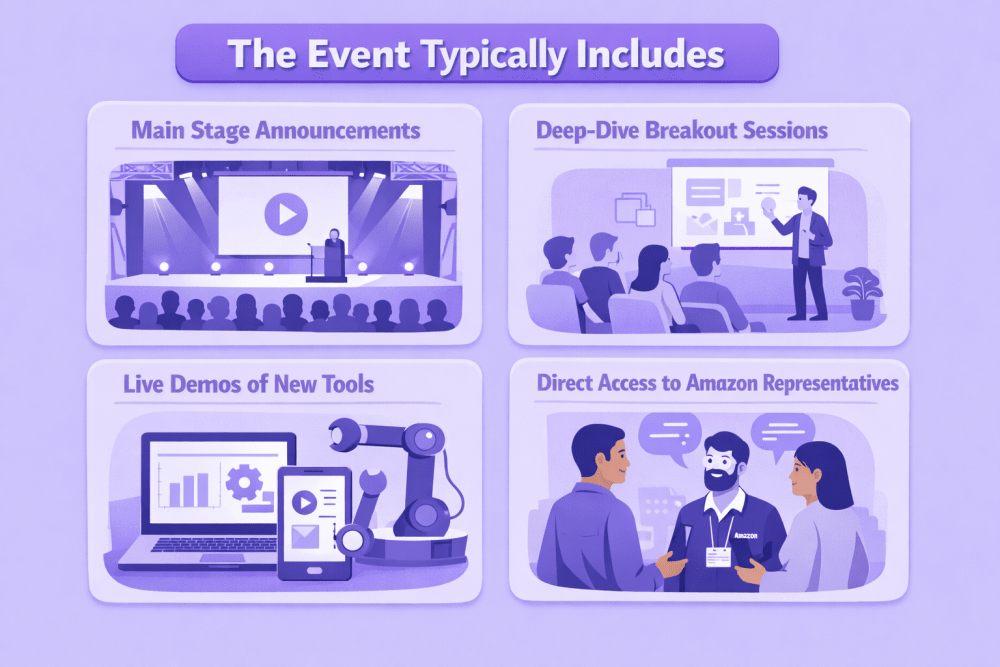
The Event Typically Includes
- Main stage announcements from Amazon leadership
- Deep-dive breakout sessions on advertising, logistics, and product strategy
- Live demos of new tools and features
- Direct access to Amazon representatives at Seller Café and Partner Connect
For sellers trying to stay ahead of platform changes, this is where many updates are first explained in detail.
What Sellers Actually Get From These Events
It’s easy to think conferences are just about announcements. In reality, the biggest value often comes from clarity.
You hear how Amazon’s roadmap is evolving. You see which tools are getting prioritized. And you start to understand how updates connect across advertising, fulfillment, AI, and global expansion.
At recent Accelerate events, major themes have included:
- AI-powered listing and creative tools
- Expanded analytics and profitability tracking
- Smarter FBA inventory optimization
- Global warehousing and cross-border logistics improvements
- Multi-channel fulfillment integration
For many sellers, that context alone helps shape their strategy for the next 12 months.
Beyond Accelerate: Local Amazon Seller Meetups
Not every seller can travel to Seattle. That’s where local meetups and regional summits come in.
Across the United States and internationally, Amazon-focused communities host smaller gatherings. These range from casual networking dinners to structured workshop-style events with speakers and panel discussions.
Local meetups are often more tactical. Sellers share what’s working right now. PPC experiments. Inventory mistakes. Listing tests. Funding strategies. Real numbers, not theory.
And because the groups are smaller, conversations tend to be more direct and practical.
Who Attends These Events?
Seller summits draw a mix of participants:
- Founders and brand owners
- Professional sellers scaling multiple SKUs
- Agencies and Amazon consultants
- Software companies focused on analytics and automation
- Logistics providers and sourcing partners
At larger events like Accelerate, attendance includes professionals from software, retail, marketing, finance, and operations roles. Senior leadership is typically well represented, including founders, directors, and C-suite executives.
The networking opportunities reflect that diversity. You might walk in looking for ad insights and leave with a new 3PL contact.
In-Person vs Virtual: What to Expect in 2026
Most major Amazon conferences now offer both in-person attendance and virtual access. The format you choose depends on what you need right now: relationships, hands-on learning, or flexible access to content.
In-Person Experience
Attending live gives you something screens can’t replicate. Conversations happen naturally. Questions get answered in real time. You feel the pace of where the ecosystem is heading.
In-Person Events Typically Include:
- Direct networking with sellers, partners, and Amazon teams
- Live Q&A sessions with product leaders and specialists
- Hands-on workshops with practical walkthroughs
- On-site coaching and structured partner meetings
For sellers focused on expansion, partnerships, or deeper operational clarity, being there physically often makes a difference.
Virtual Access
Virtual options have become far more robust over the past few years. They’re no longer just a camera pointed at a stage.
Virtual Access Usually Offers
- Full session recordings
- Flexible viewing on your own schedule
- Broader accessibility for international sellers
- Easier content replay for note-taking and team sharing
If travel isn’t practical, virtual attendance still delivers strong strategic insight.
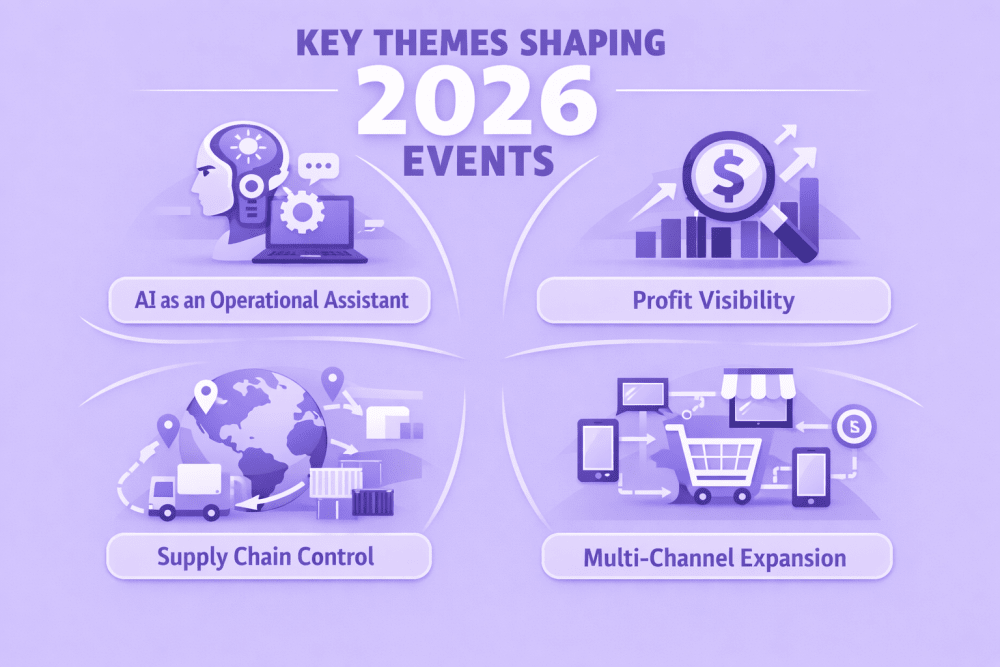
Key Themes Shaping 2026 Events
If you look at recent product releases, roadmap discussions, and what’s being highlighted at major conferences, a few clear themes are shaping seller conversations in 2026.
These aren’t surface-level trends. They directly affect how you run your account day to day — especially heading into Q4.
1. AI as an Operational Assistant
AI is no longer just a tool for writing product descriptions.
In 2026, the focus has shifted toward AI acting as a behind-the-scenes operator. That includes automated listing improvements, proactive compliance checks, performance alerts, and smart recommendations based on live data.
Instead of reacting to problems, sellers are being pushed toward predictive workflows. Low inventory warnings. Margin alerts. Policy risk detection. The goal is fewer surprises and faster decisions.
Events are diving deeper into how to actually use these systems, not just what they’re called.
2. Profit Visibility, Not Just Revenue
Revenue screenshots don’t tell the whole story anymore.
Conferences are emphasizing SKU-level profitability tracking, blended ad impact, storage costs, returns, and hidden fees that quietly eat into margins. Sellers are being encouraged to understand true contribution profit, not just top-line sales.
More sessions now focus on connecting ads, fees, logistics, and pricing into one financial picture. Because scaling without margin clarity is risky, especially during peak seasons.
3. Supply Chain Control
Logistics has become strategic.
From the end of inventory commingling to smarter FBA placement optimization and regional launches, supply chain structure is evolving. Global inventory pooling and cross-border fulfillment options are also changing how sellers think about expansion.
Event sessions increasingly focus on inventory forecasting, reducing long-term storage fees, and preparing for demand spikes without overstocking.
It’s less about just sending products in. It’s about sending them intelligently.
4. Multi-Channel Expansion
Amazon is no longer operating in isolation.
With centralized order management, Multi-Channel Fulfillment improvements, and integrations across platforms like Walmart and Shopify, sellers are building more diversified ecosystems.
Events are addressing how to manage inventory across channels without overselling, how to unify reporting, and how to protect margins while expanding reach.
For many brands, 2026 isn’t about choosing one platform. It’s about managing several without creating operational chaos.
These themes aren’t theoretical. They reflect real structural changes happening inside Seller Central, advertising systems, and fulfillment networks.
Understanding them before Q4 isn’t optional. It’s preparation.
Why Networking Still Wins
Data is important. Dashboards are important. But real conversations still move businesses forward faster. At seller summits and meetups, people talk differently than they do online. The tone is less polished. The answers are more direct. Sellers openly share what’s actually working, what failed quietly, and what they wish they had done sooner.
You’ll hear honest discussions about ad spend efficiency, supplier negotiations, unexpected fee increases, inventory mistakes, and what truly shifted margins this year. That kind of transparency rarely makes it into blog posts or LinkedIn threads.
There’s also something valuable about context. When someone explains how they scaled from 50 to 500 SKUs, you can ask follow-up questions. You can understand their category, their price point, their ad structure. That nuance matters.
A 20-minute hallway conversation can save months of trial and error. Sometimes it changes your entire approach to launches, pricing, or expansion. Tools evolve every year. Algorithms shift. Policies update.But relationships still compound.
How to Find the Right Event
If you’re considering attending:
- Decide whether you want strategic direction or tactical skill-building.
- Check whether the event focuses on beginners, advanced sellers, or mixed levels.
- Review session tracks in advance to match your current challenges.
- Consider whether virtual access is enough or if networking matters for your stage.
Large conferences like Amazon Accelerate are ideal for big-picture updates. Local meetups are better for practical peer learning.

Turn Event Insights Into Measurable Growth – WisePPC
Seller events give you strategy. WisePPC helps you execute it.
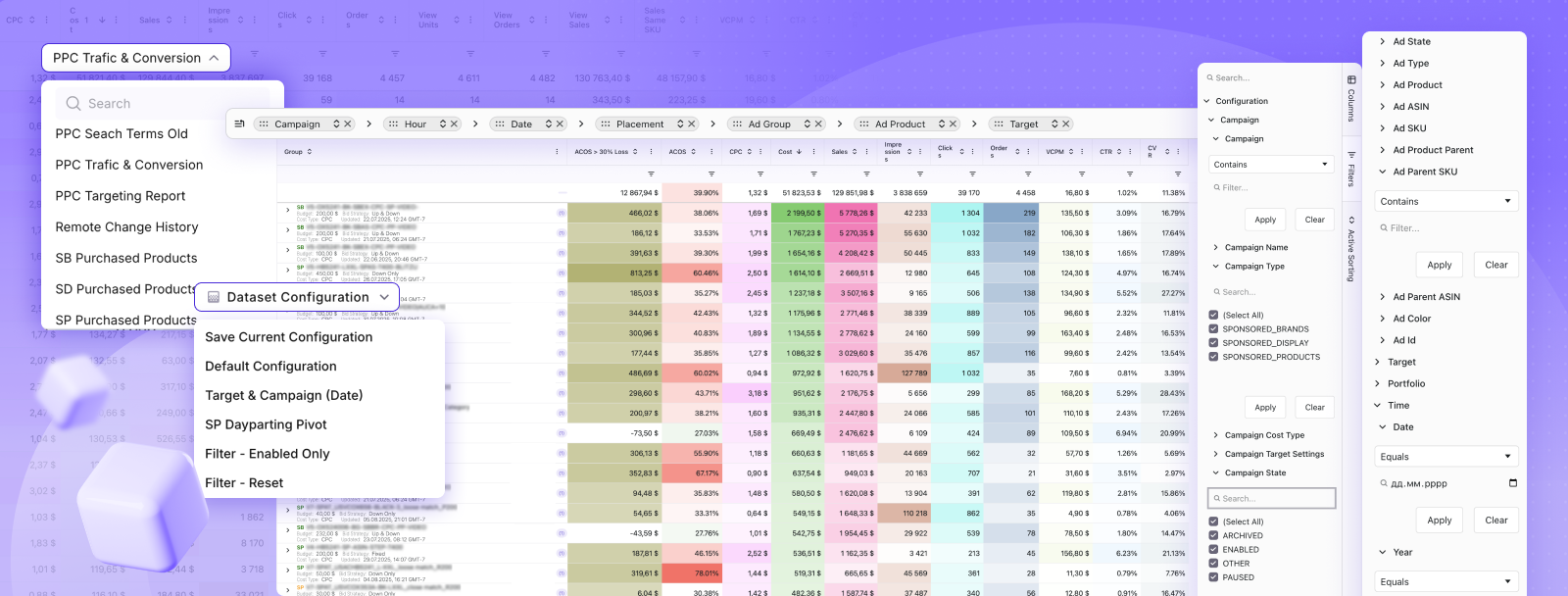
As an Amazon Ads Verified Partner, WisePPC works through official integrations and focuses on performance clarity. The platform tracks 30+ key metrics, stores long-term historical data far beyond Amazon’s 60–90 day window, and clearly separates ad-driven revenue from organic sales so budget decisions are grounded in reality.
Bulk actions allow thousands of campaigns or targets to be edited in seconds. Advanced filtering, placement-level analysis, and multi-metric charts make it easy to connect ACOS, TACOS, profit, and trends in one view. Gradient highlights surface wasted spend and underperforming keywords instantly, without digging through spreadsheets.
We built it for sellers who want control at scale. When insights are centralized and actionable, growth stops feeling chaotic and starts feeling structured.
Final Thoughts
Amazon Seller Summits and Meetups aren’t just industry events. They’re checkpoints.
They help you pause, reassess, and see where the platform is heading before you commit budget and inventory for the next cycle.
In 2026, with AI, logistics restructuring, and global expansion accelerating at once, staying informed is less optional than it used to be.
Whether you attend Amazon Accelerate in Seattle or join a smaller local meetup, the goal is the same: clarity, connection, and smarter decisions for the year ahead.
Frequently Asked Questions
What are Amazon Seller Summits and Meetups?
Amazon Seller Summits and Meetups are events designed for sellers who operate on Amazon and other ecommerce platforms. Some are large-scale conferences like Amazon Accelerate, while others are smaller, community-led gatherings. They focus on education, networking, and sharing practical strategies for growth.
What is Amazon Accelerate?
Amazon Accelerate is Amazon’s official annual conference for selling partners. It typically takes place in Seattle and includes keynote sessions, breakout workshops, networking opportunities, and direct access to Amazon teams. The event covers advertising, logistics, AI tools, global expansion, and marketplace updates.
Are these events only for large sellers?
No. While larger brands attend, many sessions are designed for sellers at different stages. Some tracks focus on fundamentals, while others go deeper into advanced advertising, analytics, or international expansion. Local meetups, in particular, tend to be accessible and practical for smaller or mid-sized sellers.
Is it better to attend in person or virtually?
It depends on your goals. In-person attendance is stronger for networking, direct conversations, and live interaction. Virtual access is more flexible and allows you to watch sessions on your own schedule. Many sellers alternate between formats depending on the year and their priorities.
Join the WisePPC Beta and Get Exclusive Access Benefits
WisePPC is now in beta — and we’re inviting a limited number of early users to join. As a beta tester, you'll get free access, lifetime perks, and a chance to help shape the product — from an Amazon Ads Verified Partner you can trust.
 No credit card required
Free in beta and free extra month free after release
25% off for life — limited beta offer
Access metrics Amazon Ads won’t show you
Be part of shaping the product with your feedback
No credit card required
Free in beta and free extra month free after release
25% off for life — limited beta offer
Access metrics Amazon Ads won’t show you
Be part of shaping the product with your feedback