EN
EN  ES
ES  FR
FR  DE
DE  IT
IT  KO
KO  JA
JA  ZH
ZH  AR
AR  PT
PT Amazon Global Selling: Market Demand Guide 2026

Quick Summary: Amazon Global Selling enables businesses to tap into international markets by listing products across Amazon’s 20+ global marketplaces. With access to hundreds of millions of international customers and built-in logistics support, sellers can expand their reach beyond domestic borders while leveraging Amazon’s infrastructure for payments, shipping, and localization.
The ecommerce landscape has transformed dramatically. What started as domestic online retail has evolved into a genuinely global marketplace where borders matter less than customer demand.
Amazon’s global reach generated $638 billion in net sales worldwide recently, marking an 11% year-over-year increase. That’s not just impressive—it represents millions of daily transactions across continents.
But here’s the thing: most sellers only scratch the surface of what’s possible. They focus on their home market while international customers actively search for their products.
Understanding Global Market Demand
Market demand represents the total quantity of products consumers are willing and able to purchase in a specific region. It’s shaped by search patterns, purchasing power, seasonal trends, and local preferences.
Amazon’s marketplace infrastructure spans North America, Europe, Asia-Pacific (including Australia, India, Japan, and Singapore), and emerging markets. Each region brings distinct opportunities and challenges.
According to the U.S. International Trade Administration, the global B2B ecommerce market will reach approximately $36 trillion by 2026, growing at a 14.5% compound annual growth rate. While B2C represents a smaller slice, it’s growing rapidly in specific sectors.
The Asia-Pacific marketplaces offer particularly strong growth potential. Canada’s ecommerce retail trade sales hit an all-time high of US$3.82 billion in December 2020, demonstrating sustained consumer appetite for online shopping.
Why International Demand Matters Now
The COVID pandemic permanently shifted consumer behavior worldwide. Physical store limitations forced millions of first-time buyers online, and many never went back.
Based on trade data, ecommerce’s share of total global retail sales continues climbing year after year. Fashion and consumer electronics dominate by volume, but biohealth pharmaceuticals represent the fastest-growing product segment internationally.
Social commerce in Canada was valued at USD $6.47 billion in 2024, projected to reach USD $10.99 billion by 2029 as platforms like Instagram, TikTok, and Facebook integrate shopping features more deeply.
How Amazon Global Selling Works
The program allows established sellers to list products on international Amazon marketplaces. Whether you’re based in the US selling to Europe, or outside the US targeting American customers, the infrastructure supports bidirectional trade.
Amazon provides a unified seller account that can manage multiple international storefronts. This streamlines operations compared to managing separate platforms in each country.
The Professional selling plan costs $39.99 monthly plus applicable selling fees, giving access to advanced tools for international expansion.
Key Components of the Program
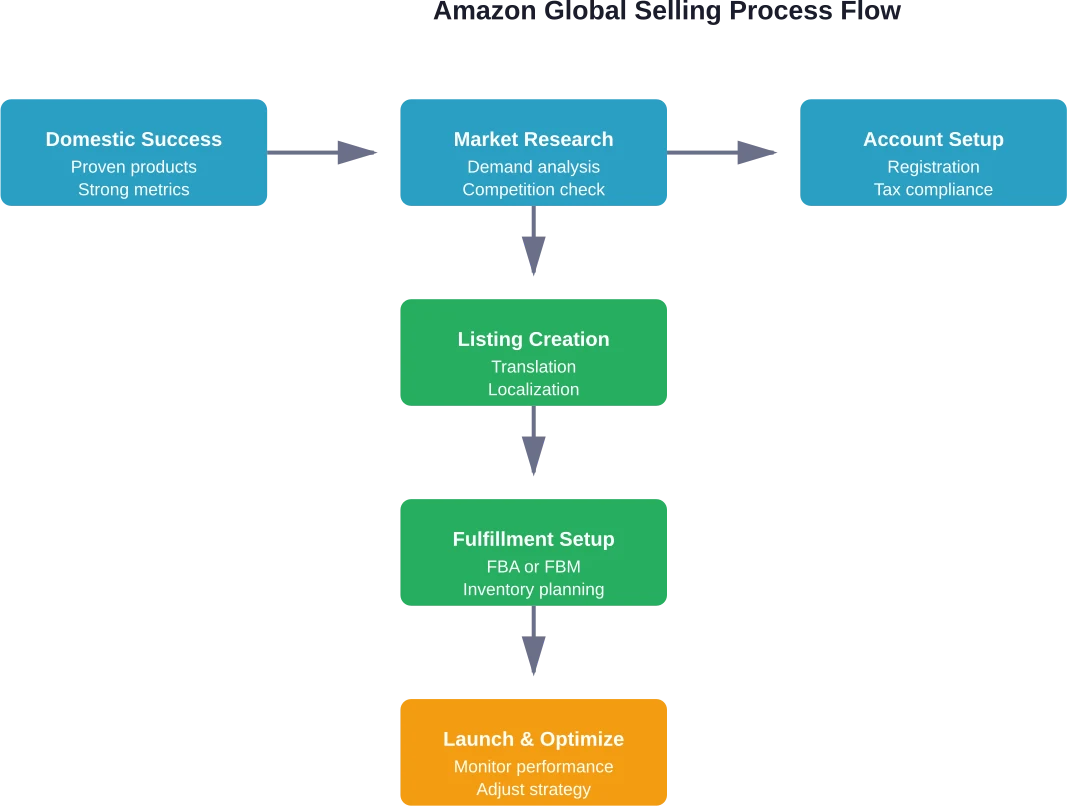
Cross-listing tools enable sellers to replicate successful domestic listings to international marketplaces with localized adjustments. Product titles, descriptions, and keywords need translation and cultural adaptation, but the core listing structure transfers.
Amazon’s global logistics network includes Fulfillment by Amazon (FBA) options in most major markets. Products can ship from local fulfillment centers, reducing delivery times and improving customer satisfaction.
Payment processing handles currency conversion automatically. Sellers receive payments in their local currency while customers pay in theirs. Amazon Currency Converter for Sellers (ACCS) fees typically range from 0.75% to 1.5% for high-volume sellers, with a standard top tier often around 1.5%.
Vetted shipping providers offer international logistics for merchants using Fulfillment by Merchant (FBM). This matters for oversized items, custom products, or sellers preferring direct inventory control.
Tools for Identifying International Demand
Amazon offers several built-in resources for evaluating global opportunities. These tools transform guesswork into data-driven decisions.
Sell Globally Dashboard
This centralized interface shows high-level metrics about international marketplace performance. It highlights which products are generating cross-border interest and where demand clusters exist.
Sellers can view search volume trends, competitive intensity, and estimated sales potential across different regions. The dashboard updates regularly to reflect current market conditions.
Expansion Research Tool
More detailed than the dashboard, this resource provides product-specific analysis. Enter an ASIN, and the tool evaluates its performance potential in various international markets.
The analysis considers factors like existing competition, price positioning, seasonal demand patterns, and regulatory requirements. It ranks marketplaces by opportunity score, helping prioritize expansion efforts.
Marketplace Product Guidance
This feature identifies product categories with strong demand but limited supply in specific countries. It essentially highlights market gaps where competition is lighter.
The guidance updates monthly, reflecting shifting consumer preferences and emerging trends. Categories showing consistent month-over-month growth signal sustainable opportunities rather than temporary spikes.
| Tool | Best For | Data Provided | Update Frequency |
|---|---|---|---|
| Sell Globally Dashboard | Quick overview | High-level metrics, trends | Weekly |
| Expansion Research | Product-specific analysis | Opportunity scores, competition | Daily |
| Marketplace Product Guidance | Finding gaps | Category demand, supply levels | Monthly |

Track Demand Trends With WisePPC
Selling internationally on Amazon means understanding how products perform across different marketplaces and advertising environments. WisePPC helps sellers analyze advertising performance, product data, and campaign metrics across their Amazon accounts. With detailed reporting on campaigns, keywords, and product performance, sellers can see which products gain traction and where demand is growing.
Managing Ads Across Multiple Amazon Markets?
Use WisePPC to:
- analyze campaign and product performance
- identify products gaining traction in new markets
- manage advertising data across multiple accounts
👉 Explore WisePPC to get clearer insights into your Amazon advertising performance.
Selecting Your Target Markets
Not all international marketplaces offer equal opportunity for every product. Strategic selection matters more than casting the widest possible net.
Start with Geographic Proximity
For US-based sellers, Canada represents the easiest entry point. Language barriers are minimal (outside Quebec), logistics are simpler, and regulatory requirements closely mirror American standards.
Canadian ecommerce continues growing steadily. The market is mature but not oversaturated in most categories.
Mexico offers another nearby option with less competition than more established markets, though Spanish language requirements and different consumer preferences require more adaptation.
European Marketplace Considerations
The European Union operates as a somewhat unified market, but each country maintains distinct characteristics. Germany represents the largest economy, while the UK (post-Brexit) requires separate consideration.
France, Italy, and Spain each offer substantial populations with growing ecommerce adoption. Language localization becomes more critical in these markets—machine translation rarely suffices for product descriptions.
Logistics within Europe benefit from Amazon’s pan-European FBA program, which distributes inventory across multiple fulfillment centers to optimize delivery speeds.
Asia-Pacific Growth Potential
Japan offers a sophisticated, high-value market with strong consumer purchasing power. Cultural attention to quality and presentation means product photography and descriptions need extra polish.
Australia provides English-language advantages with a developed ecommerce infrastructure. The population is smaller but concentrated in major urban centers, simplifying logistics.
India represents massive population scale with rapidly expanding middle-class purchasing power. Competition is intense, but opportunities exist for differentiated products.
Singapore serves as a regional hub with high per-capita income and strong cross-border shopping habits.
Registration and Compliance Requirements
International selling introduces regulatory complexity that doesn’t exist for domestic operations. Each country maintains its own tax structures, product standards, and business registration requirements.
Tax Considerations
Value-added tax (VAT) applies in most countries outside North America. Sellers must register for VAT once they exceed country-specific thresholds, then collect and remit it on sales.
Amazon offers tax calculation services that handle most of this automatically, but sellers remain ultimately responsible for compliance. Working with international tax advisors familiar with ecommerce prevents costly mistakes.
Canada recently introduced simplified tax collection for foreign sellers, reducing administrative burden while ensuring compliance.
Product Standards and Certifications
Electrical products sold in Europe require CE marking, indicating conformity with health, safety, and environmental protection standards. This often necessitates third-party testing and documentation.
Japan maintains strict standards for various product categories, particularly anything related to health, children, or food. Products may require modification to meet local specifications.
Australia enforces clear country-of-origin labeling for many categories. Packaging and product documentation must meet these requirements before listing.
Optimizing Listings for International Markets
Successful international listings go beyond simple translation. They adapt to local search behavior, cultural preferences, and competitive positioning.
Keyword Research Across Languages
Direct translation of keywords rarely captures how native speakers actually search. A product called “sneakers” in American English might be searched as “trainers” in British English or “baskets” in French.
Amazon’s search term report for each marketplace reveals actual customer queries. Analyzing top competitors’ listings in target markets also uncovers effective keyword strategies.
Cultural Adaptation
Product photography preferences vary by region. Japanese consumers often expect more detailed, multiple-angle shots with packaging clearly visible. European markets tend to favor lifestyle imagery showing products in use.
Color associations differ culturally. What signals quality or luxury in one market might convey different meanings elsewhere.
Sizing conventions need conversion and clear communication. Clothing, shoes, and home goods all use different measurement standards across regions.
Pricing Strategy
International pricing can’t just convert domestic prices at current exchange rates. It must account for local competition, purchasing power, shipping costs, taxes, and perceived value.
Some markets support premium pricing for imported products perceived as higher quality. Others are extremely price-sensitive with strong local competition.
Dynamic repricing tools can help maintain competitiveness as exchange rates fluctuate, but they should operate within parameters that protect margins.
Fulfillment and Logistics Options
Getting products to international customers efficiently determines much of the customer experience and overall profitability.
Amazon FBA for International Markets
Fulfillment by Amazon handles storage, packing, shipping, customer service, and returns in local markets. Products ship from in-country fulfillment centers, enabling Prime eligibility and fast delivery.
The pan-European FBA program distributes inventory across EU fulfillment centers based on demand patterns. A single shipment to the network can serve multiple countries.
FBA fees vary by marketplace and are subject to periodic adjustments. As announced in official updates, Canada saw no increases to referral and FBA fees for 2026, though a new FBA Liquidations program launched effective November 5, 2025, with a 15% referral fee plus per-item processing fees (ranging from CAD 0.25 to CAD 1.90 for items 0-5 kg, with additional CAD 0.20 per kg for items over 5 kg).
Merchant-Fulfilled International Shipping
Some sellers prefer maintaining direct control over inventory and fulfillment. This works particularly well for high-value items, custom products, or sellers with existing international logistics capabilities.
Amazon’s Seller Fulfilled Prime program extends Prime benefits to merchant-fulfilled orders in some markets, though requirements are strict regarding delivery speed and reliability.
Working with vetted global shipping providers simplifies customs documentation and tracking integration. Amazon provides access to discounted rates with several international carriers.
Real-World Success: What Works
According to Amazon’s own case studies, companies like Blink have turned global product demand into substantial sales growth by systematically approaching international expansion.
The pattern among successful global sellers involves starting with one or two adjacent markets rather than launching everywhere simultaneously. This allows learning and refinement before broader expansion.
Community discussions among sellers emphasize the importance of maintaining adequate inventory levels across markets. Stockouts damage rankings more severely in newer international listings where algorithms have less historical data.
Testing pricing across markets reveals different optimal price points. What works domestically may be too high or too low internationally, depending on local competition and consumer expectations.
Common Challenges and How to Address Them
International expansion introduces complexity. But awareness of common pitfalls enables proactive solutions.
Currency Fluctuations
Exchange rates shift constantly, affecting profit margins on international sales. Large swings can turn profitable products into money-losers if pricing isn’t adjusted.
Some sellers build currency buffers into pricing. Others use financial instruments to hedge against major moves. At minimum, regular monitoring and willingness to adjust prices maintains healthy margins.
Returns and Customer Service
International returns cost more and take longer than domestic ones. FBA handles this, but the fees impact profitability.
Clear product descriptions, accurate sizing information, and quality photography reduce return rates. The upfront investment in excellent listings pays ongoing dividends.
Customer service in multiple languages presents challenges for smaller operations. Amazon provides basic customer service for FBA orders, but seller messages still require language capability. Translation services or multilingual virtual assistants help bridge gaps.
Inventory Management
Spreading inventory across multiple countries ties up capital and complicates planning. Predicting demand in newer markets is harder than in established ones.
Starting conservatively with smaller inventory shipments limits risk while gathering actual sales data. Gradually scaling based on performance prevents both stockouts and overstock situations.
Measuring International Performance
Expansion decisions should be driven by clear metrics rather than assumptions.
Key performance indicators for international marketplaces include sales velocity, conversion rate, advertising cost of sale (ACoS), return rate, and profit margin after all fees and logistics costs.
Comparing these metrics across marketplaces reveals which are genuinely profitable versus which generate sales without adequate returns. Some markets may show strong revenue but weak profits once all costs are accounted for.
Timeframe for reaching sustainable profitability varies significantly by product category, market maturity, and seller preparation; timeline expectations should be validated against your specific business metrics.
Future Trends in Global Ecommerce
The trajectory points toward continued international ecommerce growth. Trade administration data shows cross-border online shopping becoming increasingly normalized worldwide.
Social commerce integration is accelerating, with platforms like TikTok and Instagram adding shopping features globally. Social commerce in Canada was valued at USD $6.47 billion in 2024, exemplifying this trend.
Regulatory frameworks continue evolving. Tax collection has simplified in many jurisdictions, but product safety and environmental regulations are tightening. Staying ahead of compliance requirements becomes more important as scrutiny increases.
Localization technology improves constantly. AI-powered translation gets more nuanced, and tools for adapting content to cultural contexts become more sophisticated and accessible.
Taking the First Step Toward Global Growth
International expansion through Amazon Global Selling represents one of the most accessible paths to worldwide market access for businesses of all sizes.
The infrastructure exists. Customer demand spans continents. Tools for identifying opportunities and managing complexity continue improving.
Success doesn’t require perfection from day one. It requires starting strategically, learning continuously, and adapting based on real performance data.
The brands that thrive internationally over the coming years will be those that begin testing markets now, building experience while competition in many regions remains lighter than in saturated domestic markets.
Ready to explore what international demand looks like for your products? Start with Amazon’s Sell Globally dashboard to see where opportunity exists, then take the first step into your highest-potential market.
Frequently Asked Questions
What are the costs of selling internationally through Amazon?
The Professional selling plan costs $39.99 monthly and works across all marketplaces you activate. Additional costs include referral fees (typically 8-15% depending on category), FBA fees if used (varying by marketplace and product size), currency conversion fees (4% unless you establish local bank accounts), and international shipping if sending inventory to foreign fulfillment centers. Tax registration and compliance may require professional services in some countries.
Which marketplace should I start with for international expansion?
For US-based sellers, Canada typically offers the easiest entry point due to geographic proximity, minimal language barriers, simpler logistics, and similar regulatory environment. The market is mature with established ecommerce adoption. European sellers often start with neighboring countries where language or cultural similarities exist. The key is choosing a market where demand exists for your products with manageable complexity rather than simply the largest available market.
Do I need to translate my product listings myself?
Amazon provides basic translation tools, but professional translation delivers better results. Machine translation misses cultural nuances and may use awkward phrasing that reduces conversion rates. For competitive categories, investing in native-speaker translation and localization provides meaningful advantage. At minimum, have native speakers review machine translations before publishing. Keywords especially require local market research rather than direct translation.
How does VAT work for international Amazon sales?
Value-added tax applies in most countries outside North America. Once sales in a country exceed specific thresholds, sellers must register for VAT, collect it from customers, and remit it to tax authorities. Amazon can calculate and collect VAT automatically in many jurisdictions, but sellers remain responsible for registration and remittance. Requirements vary significantly by country. Many sellers work with international tax advisors to ensure compliance across multiple markets.
Can I use the same product listings in multiple international markets?
Listings can be duplicated across markets, but they should be adapted rather than used identically. Different markets require different keywords based on local search behavior, pricing adjusted for local competition and purchasing power, images that resonate with cultural preferences, and measurements converted to local standards. Amazon’s cross-listing tools help replicate the structure while allowing necessary customization for each marketplace.
What happens if my international inventory runs out?
Stockouts damage search ranking and sales velocity more severely in international markets where listings have less history and customer reviews. Recovery takes longer than in established domestic listings. Maintaining adequate inventory becomes critical. Amazon’s inventory management tools provide restock alerts, but building buffers for international shipping delays prevents stockouts. Some sellers use more conservative forecasting for international markets until demand patterns stabilize.
Is FBA required for international selling?
Fulfillment by Amazon is not required but provides significant advantages including Prime eligibility, faster delivery from local fulfillment centers, simplified logistics and customer service, and better search placement. Merchant fulfillment works for certain product types like high-value items, custom products, or sellers with existing international logistics capabilities. The Seller Fulfilled Prime program extends some Prime benefits to merchant-fulfilled orders in select markets if delivery standards are met.
Join the WisePPC Beta and Get Exclusive Access Benefits
WisePPC is now in beta — and we’re inviting a limited number of early users to join. As a beta tester, you'll get free access, lifetime perks, and a chance to help shape the product — from an Amazon Ads Verified Partner you can trust.
 No credit card required
Free in beta and free extra month free after release
25% off for life — limited beta offer
Access metrics Amazon Ads won’t show you
Be part of shaping the product with your feedback
No credit card required
Free in beta and free extra month free after release
25% off for life — limited beta offer
Access metrics Amazon Ads won’t show you
Be part of shaping the product with your feedback