EN
EN  ES
ES  FR
FR  DE
DE  IT
IT  KO
KO  JA
JA  ZH
ZH  AR
AR  PT
PT  TR
TR  PL
PL  ID
ID  VI
VI How to Optimize Sponsored Products Campaigns Without Wasting Budget

Running Sponsored Products is easy. Running them profitably is not.
Most campaigns don’t fail because of bad products. They fail because no one is really steering them. Keywords pile up. Bids drift. Budgets get spread thin. And suddenly ACoS climbs without a clear reason.
Optimization is not about constant tinkering. It’s about knowing what to measure, what to cut, and what to scale. When you focus on the right signals, small adjustments can change the direction of an entire account. Let’s break down how to do it properly.
The Core Framework for Efficient Sponsored Products Optimization
Optimizing Sponsored Products is not about chasing every fluctuation in your dashboard. It is about building a system that makes smart decisions predictable.
Most wasted budget does not disappear in one dramatic mistake. It leaks through small gaps – broad keywords left unchecked, bids that were never revisited, budgets spread too thin across too many campaigns. Over time, those gaps compound.
The framework below focuses on control. Not hacks. Not shortcuts. Just the areas that consistently separate profitable accounts from unstable ones. If you work through these methodically, you stop reacting to performance and start steering it.
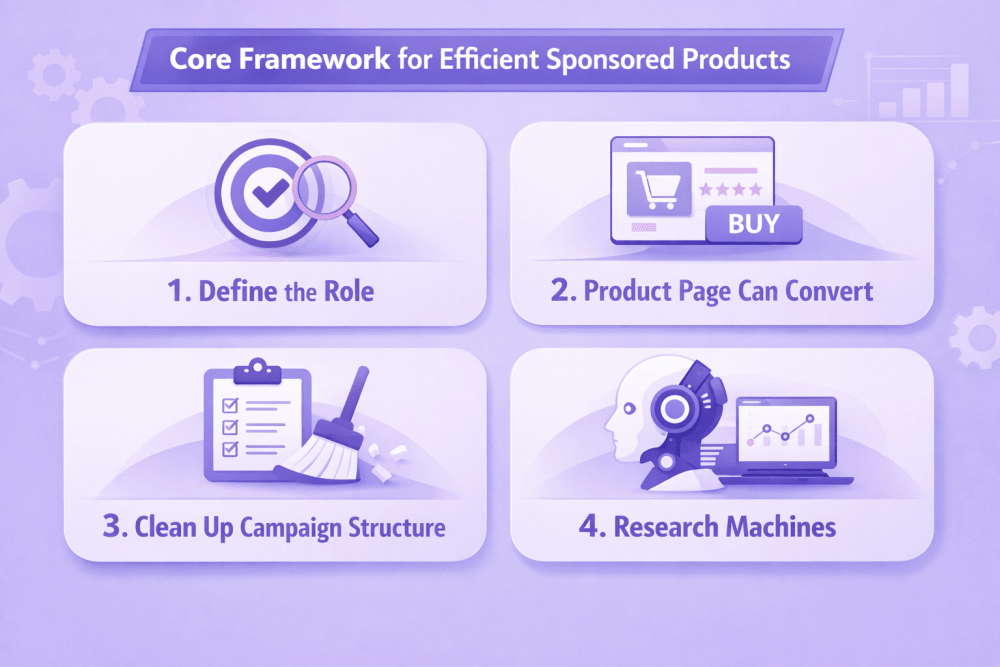
1. Define the Role of Each Campaign Before You Touch Anything
Before adjusting bids or pausing keywords, ask one simple question: what is this campaign meant to achieve?
Sponsored Products Can Serve Different Goals
- Launching new products
- Protecting branded traffic
- Scaling top sellers
- Clearing inventory
- Improving organic ranking
Each goal justifies a different tolerance for ACoS.
A launch campaign might accept aggressive spending. A mature product should operate closer to target profitability. If you optimize everything toward the same metric, you lose strategic control.
Clarity comes first. Adjustments come second.
2. Make Sure the Product Page Can Convert
If your conversion rate is low, the issue is not bidding. It is the product page.
Sponsored Products amplify what already exists. If your listing converts well, ads accelerate growth. If it does not, you are simply paying to send traffic into friction.
Before increasing spend, review:
- Main image clarity. Your main image competes directly on the search results page. If it looks dull, cropped poorly, low contrast, or weaker than competitors, your click-through rate will suffer before the shopper even reaches your listing.
- Title relevance. The title must clearly match the keywords you are targeting. If you are bidding on specific features or variations, those should be visible immediately. Relevance improves both CTR and conversion.
- Bullet point structure. Bullet points should remove hesitation. They need to explain benefits, use cases, and key differentiators. Vague or generic bullets increase bounce rate.
- Review volume and rating. Social proof drives paid performance. Low ratings or very few reviews make ads less efficient because trust is missing.
- Pricing competitiveness. Price must align with positioning. If you are premium, the listing must justify it. If you compete on value, that advantage should be obvious.
- Stock availability. Running ads on unstable inventory leads to wasted budget and ranking volatility. You cannot scale what you cannot consistently ship.
Higher conversion rate lowers effective ACoS without touching your bids. That is the cleanest form of optimization. It happens before the click.
3. Clean Up Your Campaign Structure
Messy structures hide waste.
Avoid Mixing
- Automatic and manual targeting
- Broad, phrase, and exact match
- Branded and non-branded traffic
- Experimental and proven ASINs
Instead, separate them. When match types are isolated, performance becomes visible. You can scale exact without overfeeding broad. You can cut waste without damaging winners.
Structure reduces confusion. Confusion causes overspending.
4. Turn Automatic Campaigns Into Research Machines
Automatic campaigns are not meant to sit untouched.
Their real value is not automation. It is discovery. They reveal how shoppers actually search, which variations convert, and which assumptions were wrong. Let them collect enough search term data before making decisions. Once meaningful data accumulates, review it carefully. Identify search terms that generated real conversions. These are strong candidates to move into manual exact campaigns, where you gain tighter control and better scaling potential.
At the same time, look for terms that consumed spend but produced no sales. Patterns matter here. One click is noise. Repeated wasted spend is a signal. Those terms either need lower bids or should be added as negative keywords.
Also pay attention to ASIN targets inside automatic campaigns. Sometimes product targeting opportunities appear unexpectedly. Strong-performing ASINs can be isolated into dedicated manual campaigns for more strategic control.
Automatic targeting should continuously feed your manual structure. If you let it run without review, wasted budget does not disappear dramatically. It simply drains quietly in the background.
5. Aggressively Remove Irrelevant Traffic
Wasted clicks are rarely dramatic. They accumulate quietly over time.
Search term reports often reveal patterns that explain where budget disappears. Broad keywords may pull in loosely related traffic that looks relevant on the surface but does not match buyer intent. Informational queries can generate impressions and clicks from shoppers who are still researching rather than ready to purchase. And sometimes you will find completely irrelevant variations that simply slipped through automated targeting.
These are not catastrophic mistakes. They are small leaks. But left unchecked, they slowly erode efficiency and inflate ACoS without obvious warning signs.
Add clear mismatches as negative exact or phrase. This improves:
- CTR
- Conversion rate
- Overall ACoS
Be precise, not reckless. Only block what clearly will not convert.
6. Manage Bids With Thresholds, Not Emotion
Do not increase bids because of one good day. Do not pause a keyword after two bad clicks. Short-term fluctuations are normal. Emotional reactions create instability.
Follow Clear Rules
- Reduce bids when spend exceeds your acceptable CPA without conversions. If a keyword consistently burns budget past your target threshold, lower the bid in controlled steps rather than cutting it entirely.
- Increase bids gradually for profitable keywords. When a keyword performs below your target ACoS and drives steady sales, scale it slowly. Small increases protect efficiency while expanding volume.
- Pause only after meaningful data. A few clicks mean nothing. Wait until the keyword has generated enough spend to make a statistically reasonable decision.
Bid decisions should reflect product margin and long-term goals, not frustration from a single data point.
7. Optimize Placements Intentionally
Sponsored Products allow you to adjust placements, including top of search, product pages, and rest of search. Each of these positions behaves differently, and they rarely perform at the same level.
Instead of treating them equally, pull placement reports and analyze the differences. Compare conversion rate, ACoS, and revenue concentration across placements. Sometimes top of search drives higher CPC but significantly stronger conversion. In other cases, product page placements may generate lower volume but better efficiency.
If top of search converts substantially better, increasing its placement multiplier can improve overall campaign performance, even if CPC rises slightly. The key is to evaluate results based on profit impact, not just click cost.
Placement strategy is often underused. Yet it has a direct influence on profitability and deserves the same level of attention as keyword bidding.
8. Control Budget Allocation Strategically
Daily budget is not just a cap. It is a lever.
If profitable campaigns run out of budget early, you miss high-intent traffic. If weak campaigns have unlimited room, they burn spend.
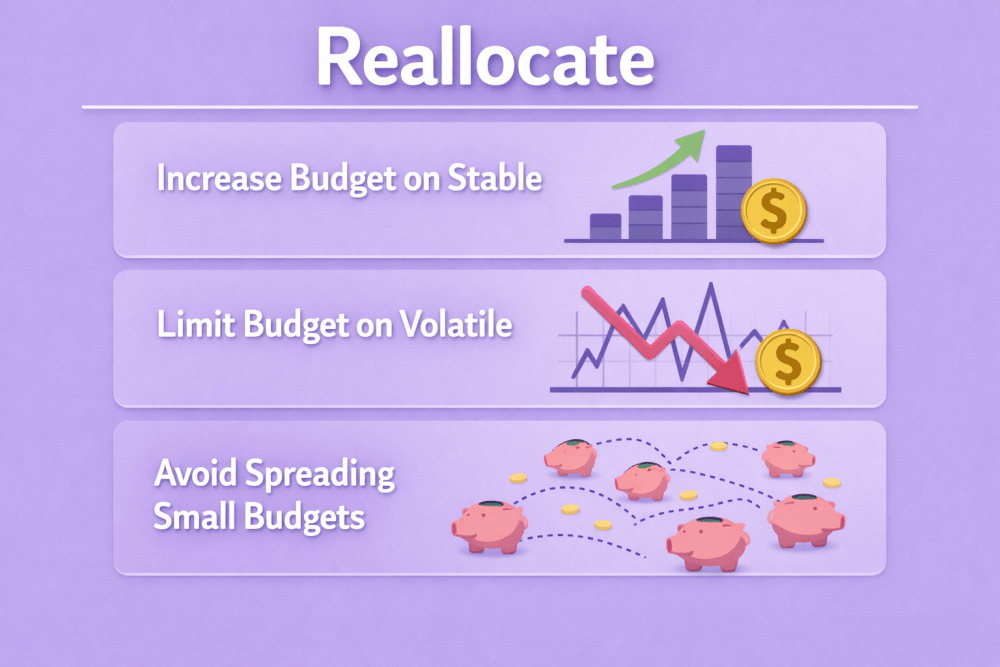
Reallocate
- Increase budget on stable, profitable campaigns
- Limit budget on volatile or testing campaigns
- Avoid spreading small budgets across too many experiments
Concentrated spend often performs better than diluted spend.
9. Separate Top Sellers From Experimental Products
Scale What Already Works
Top sellers convert better. They already have reviews, stronger ranking signals, and buyer trust. They generate momentum naturally, which means paid traffic works more efficiently for them.
Instead of mixing these products with experimental or underperforming ASINs, isolate them.
Create Dedicated Campaigns for Proven Winners
Top sellers deserve their own structure. That typically means:
- Dedicated exact match campaigns focused on high-intent keywords
- Higher budget ceilings so they do not run out of spend early in the day
- More aggressive placement adjustments, especially for top of search
When you isolate strong performers, you can scale them confidently without inflating costs for weaker products.
Do Not Overfeed Weak ASINs
Underperforming or experimental products should not consume the same share of budget as proven winners. Testing is important, but it must be controlled.
Protect and scale what already works first. Let strength dictate growth. When budget follows performance, efficiency improves naturally.
Growth should follow strength, not hope.
10. Monitor Conversion Delay Before Cutting Spend
Not every click turns into a purchase within minutes. In many categories, especially higher-priced or more considered products, shoppers compare options, read reviews, and come back later.
Higher-priced products often convert days after the initial click. This delay is completely normal.
Amazon attributes conversions within a defined window, which means sales may appear several days after the original ad interaction. If you evaluate performance based only on same-day results, you risk misreading the data. A keyword may look unprofitable today but convert tomorrow.
Aggressively reducing bids or pausing keywords too quickly can eliminate traffic that is actually working on a delayed cycle. This creates unnecessary volatility in your campaigns.
Instead, evaluate performance over appropriate time frames. Give campaigns enough data before making structural changes. Look at trends over several days or weeks rather than reacting to daily swings.
Optimization without patience creates instability. Smart optimization balances responsiveness with perspective.
11. Build a Consistent Optimization Routine
Optimization works best as a rhythm, not a reaction.
Constantly changing bids every few hours usually creates instability. Ignoring campaigns for weeks creates waste. The middle ground is structured consistency.
Below is a practical review framework you can follow:
| Frequency | What to Focus On | Why It Matters |
| Daily | Check for anomalies or extreme overspend | Prevents runaway spend and catches sudden performance drops early |
| Weekly | Review search term reports | Identifies new converting terms and wasted spend patterns |
| Adjust bids logically | Keeps performance aligned with target ACoS or ROAS | |
| Expand negative keyword lists | Reduces irrelevant traffic and protects budget | |
| Monthly | Reevaluate campaign structure | Ensures campaigns remain organized and scalable |
| Reallocate budgets | Shifts spend toward profitable campaigns | |
| Analyze placement trends | Optimizes top of search and product page performance strategically |
Consistency prevents budget waste from creeping back in. Small, disciplined reviews are far more effective than large, reactive overhauls.

Turning Strategy Into Action With WisePPC
All the principles above sound simple on paper. In reality, managing them across dozens of campaigns and thousands of keywords can get overwhelming fast.
That is exactly why we built WisePPC.
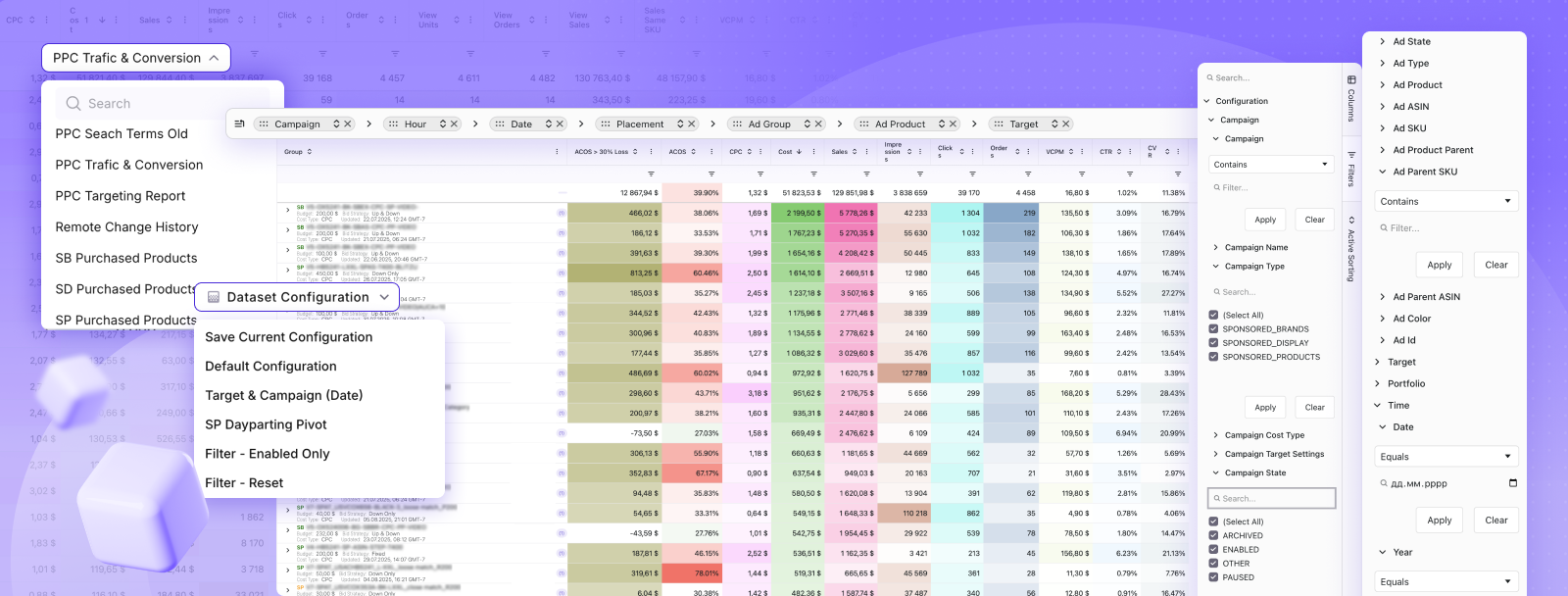
As an Amazon Ads Verified Partner, WisePPC uses official integrations to pull advertising and sales data into one structured environment. Instead of switching between fragmented reports and short data windows, the platform provides long-term historical performance, real-time metrics, and placement-level insights in one clean dashboard.
WisePPC removes guesswork from optimization by turning raw data into actionable clarity. Bulk actions allow bids and budgets to be adjusted in seconds. Advanced filtering isolates high-spend, low-return targets instantly. Visual performance highlights make anomalies easy to spot. And because data is stored for years rather than weeks, seasonality, long-term trends, and structural shifts remain visible.
It is not about adding more data. It is about making decisions clearer.
When revenue drivers, wasted spend, and the relationship between ads and organic sales become transparent, optimization stops being reactive. It becomes intentional.
That is how scaling should feel.
Final Thoughts
Sponsored Products do not need constant dramatic changes. They need structured oversight.
When campaigns have clear goals, clean architecture, controlled bidding, and disciplined review cycles, wasted budget becomes easier to spot. Profitability becomes easier to scale.
Optimization is not about squeezing every cent today. It is about building a system that stays efficient tomorrow.
And once you reach that point, Sponsored Products stop feeling unpredictable. They start feeling intentional.
Frequently Asked Questions
How often should I optimize Sponsored Products campaigns?
Light monitoring should happen daily to catch anomalies or sudden overspend. Structural optimization, such as reviewing search terms and adjusting bids, works best on a weekly basis. Larger decisions like restructuring campaigns or reallocating budgets should be done monthly. Constant tinkering creates instability, while structured reviews create control.
What is the biggest cause of wasted budget in Sponsored Products?
The most common cause is unreviewed search terms. Broad or automatic targeting often pulls in loosely related traffic that consumes spend without converting. Over time, these small leaks compound. Regular negative keyword management and search term analysis prevent most unnecessary spend.
Should I use automatic or manual campaigns for optimization?
Both serve different purposes. Automatic campaigns are valuable for discovery and keyword harvesting. Manual campaigns give you precision and control. The most efficient accounts use automatic campaigns to gather data and manual campaigns to scale proven keywords.
When should I pause a keyword?
Pause a keyword only after it has accumulated meaningful data. A few clicks without conversions do not justify removal. If spend consistently exceeds your acceptable cost per acquisition without results, reduce bids first. Pause only when performance clearly indicates long-term inefficiency.
How long should I wait before making changes to a new campaign?
Allow enough time for data to stabilize. For most products, that means at least several days to a couple of weeks depending on traffic volume. Also consider conversion delay, especially for higher-priced products. Optimizing too early can eliminate keywords that would have converted later.
Join the WisePPC Beta and Get Exclusive Access Benefits
WisePPC is now in beta — and we’re inviting a limited number of early users to join. As a beta tester, you'll get free access, lifetime perks, and a chance to help shape the product — from an Amazon Ads Verified Partner you can trust.
 No credit card required
Free in beta and free extra month free after release
25% off for life — limited beta offer
Access metrics Amazon Ads won’t show you
Be part of shaping the product with your feedback
No credit card required
Free in beta and free extra month free after release
25% off for life — limited beta offer
Access metrics Amazon Ads won’t show you
Be part of shaping the product with your feedback