EN
EN  ES
ES  FR
FR  DE
DE  IT
IT  KO
KO  JA
JA  ZH
ZH  AR
AR  PT
PT  TR
TR  PL
PL Conversion Rate Optimization in 2026: What Actually Works

Getting traffic isn’t the hard part anymore. Between paid ads, SEO, social, and AI-driven content, most brands can attract visitors. The real question is what happens next.
In 2026, conversion rate optimization isn’t about tweaking button colors or copying your competitor’s landing page layout. It’s about removing friction, building trust faster, and aligning your marketing, product, and sales into one smooth experience. The brands that win aren’t necessarily louder. They’re clearer. Smarter. More intentional.
Let’s break down what CRO actually looks like this year and what’s worth your time.
What Conversion Rate Optimization Really Means
Conversion rate optimization, or CRO, is simply the process of increasing the percentage of visitors who take a specific action on your site. That action might be a purchase, a form submission, a demo request, a free trial signup, or a resource download. The calculation itself is straightforward – you divide the number of conversions by the total number of visitors and multiply by one hundred.
The concept sounds simple. The execution is not. CRO is not about random changes or surface-level edits. It is about making your website work better so more people actually do what you want them to do.
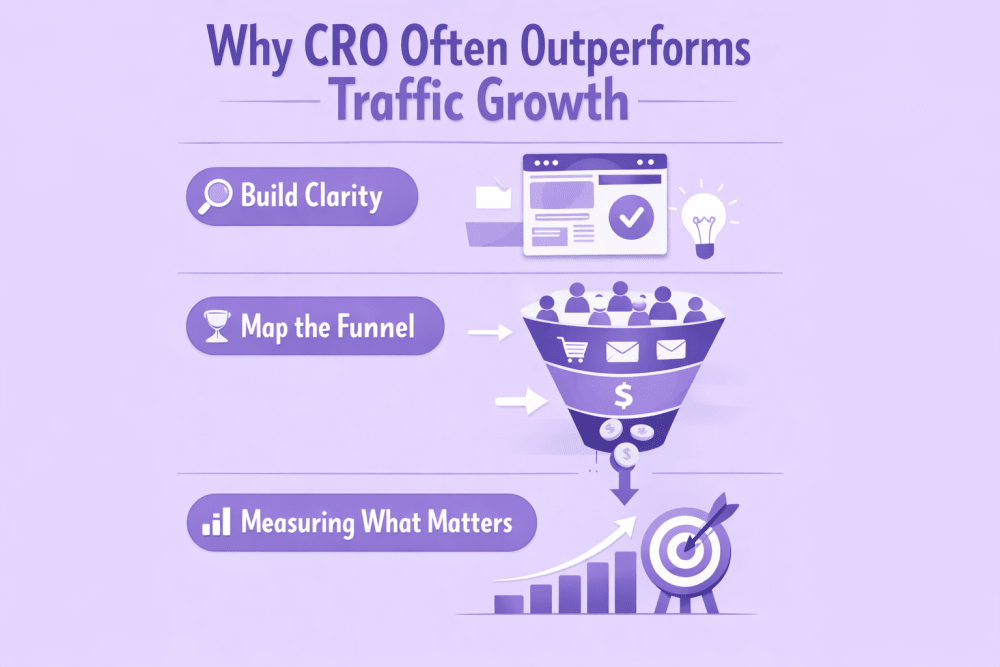
Why CRO Often Outperforms Traffic Growth
Let’s look at the numbers.
Imagine you have 10,000 monthly visitors, a 2 percent conversion rate, and a 100 dollar average order value. That gives you 20,000 dollars in revenue. Now increase the conversion rate to 3 percent. The traffic stays the same. The offer stays the same. Revenue jumps to 30,000 dollars.
One percentage point creates a 50 percent lift.
That is why serious growth-focused teams prioritize optimization before scaling acquisition. Improving conversion rates increases return on ad spend, reduces customer acquisition cost, improves marketing efficiency, and makes scaling far less risky.
Driving more traffic without fixing weak conversion points is like pouring water into a leaking bucket.
Build Clarity Before You Run Tests
It is tempting to jump straight into A-B testing. But testing without direction usually creates noise, not insight.
Before making changes, get clear on what you are optimizing. Define your primary conversion goal. Identify the smaller actions that signal intent. Look at where users are dropping off. Review what your current data actually shows.
This only works if your analytics are reliable. That means accurate event tracking, clear conversion definitions, consistent naming conventions, and alignment between marketing and sales. If tracking is messy, conclusions will be too.
Optimization starts with visibility.
Map the Funnel and Find the Friction
Conversion issues are rarely random. They tend to appear at specific stages of the funnel.
In ecommerce, that might be the move from product view to add to cart, from cart to checkout, or from checkout to purchase. In lead generation, it could be from landing page to form start, from form start to completion, or from lead to qualified opportunity.
Look closely at drop-off between each stage. That is usually where the real opportunity sits.
Use tools to understand behavior, not just numbers. Heatmaps show where attention goes. Scroll tracking reveals engagement depth. Session recordings expose confusion. Form analytics highlight hesitation.
Data shows you where the problem exists. Behavior helps you understand why.
Measuring What Matters
Conversion rate is only part of the picture. On its own, it does not tell you whether growth is healthy or profitable.
You should also track average order value, customer lifetime value, cost per conversion, bounce rate, engagement metrics, and lead quality. These indicators show whether your conversions bring real business value or just inflate numbers.
A higher conversion rate matters only if it supports sustainable revenue and long-term growth.
How Wise PPC Supports Conversion Optimization
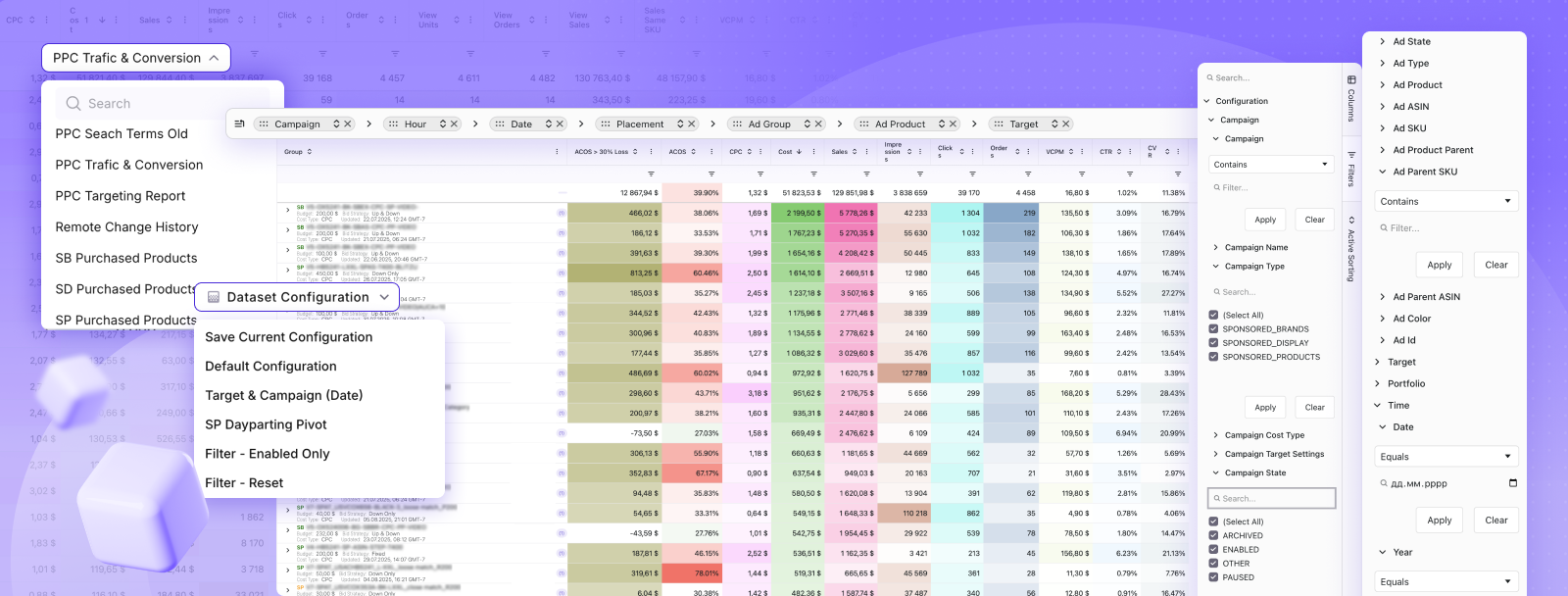
We built Wise PPC on a simple belief – conversions are the outcome of connected systems working together. A click does not turn into revenue because of one isolated change. It is shaped by advertising performance, inventory availability, pricing decisions, and marketplace dynamics. Our platform brings those elements into one environment, allowing brands to see the full operational picture instead of juggling separate tools.
Through our service, teams can automate ad campaigns, track real time sales data, monitor stock levels, and forecast demand from a single dashboard. That level of visibility changes how optimization decisions are made. Instead of reacting to performance drops without context, Wise PPC provides the clarity needed to adjust budgets, prevent stockouts, and scale campaigns with confidence across Amazon, Shopify, and other marketplaces.
Friction Is the Silent Conversion Killer
If there is one principle that consistently drives results, it is friction reduction.
People do not abandon because they are uninterested. They abandon because something feels unclear, slow, or risky.
Here are the highest impact friction areas to review.
Simplify Forms
Long forms drain momentum.
High-Converting Forms:
- Ask only essential questions
- Use autofill when possible
- Provide clear labels
- Show instant error messages
- Avoid unnecessary dropdowns
Every additional field reduces completion probability.
Streamline Checkout
Checkout friction directly impacts revenue.
Where to Focus:
- Guest checkout options
- Clear progress indicators
- Transparent shipping costs
- Multiple payment methods
- Visible security badges
Uncertainty during checkout creates doubt. Doubt kills conversions.
Improve Speed and Mobile Experience
Mobile still underperforms in many industries because the experience is often clunky. Buttons are too small, text requires zooming, pages load slowly, and popups block the screen. These details push users away.
Page speed is not just a technical metric. If a site feels slow or awkward on mobile, people lose confidence and leave.
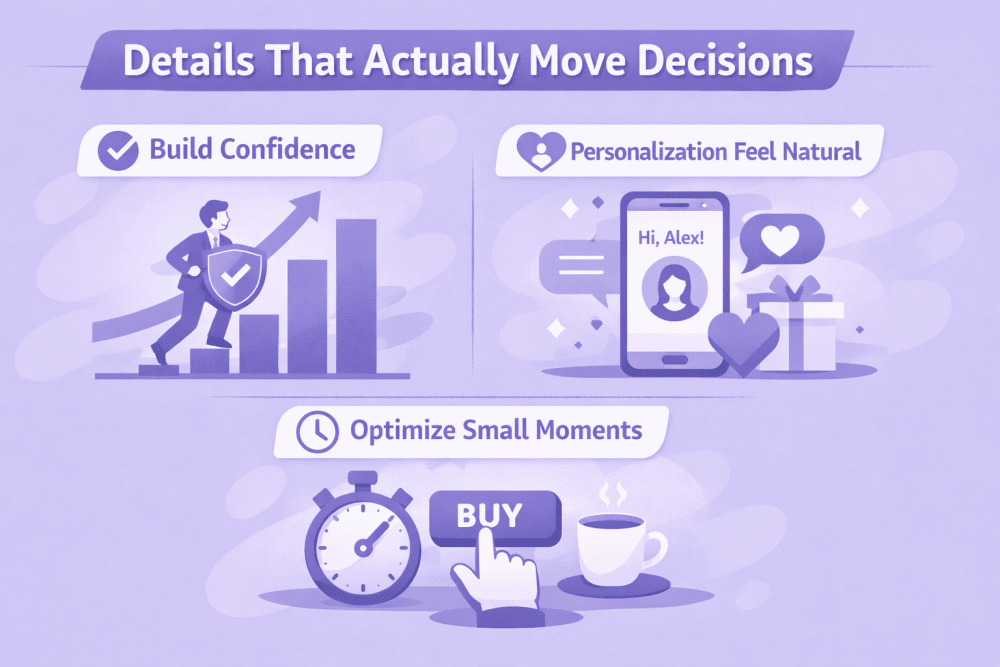
The Details That Actually Move Decisions
Conversions rarely depend on one big moment. More often, they are shaped by a series of small signals – trust, relevance, and tiny interactions that either build confidence or create doubt.
Build Confidence With Real Proof
People compare options fast. They look for evidence before they commit. A clever headline might catch attention, but proof is what closes the gap.
What Builds Trust:
- Customer reviews with real names
- Testimonials that show specific results
- Case studies
- Clear guarantees
- Transparent return policies
- Recognizable certifications
Where you place these matters. Add them near pricing sections and calls to action, because that is where hesitation usually happens. When someone is unsure, a single credible proof point can be enough to push the decision forward.
Make Personalization Feel Natural
Personalization works when it makes things clearer. It fails when it feels like surveillance.
In Action:
- Matching landing page messaging to the ad that brought the user there
- Showing relevant product recommendations
- Displaying local currency and shipping details
- Segmenting emails based on real behavior
The goal is not to impress with technology. It is to reduce effort. When relevance feels logical, users move forward without thinking about it.
Optimize the Small Moments
Conversions rarely depend on one big action. They are often shaped by a series of smaller interactions that either build confidence or create hesitation. Watching a short demo, opening an FAQ section, comparing pricing options, or scrolling through product images all influence how comfortable someone feels about moving forward.
Strengthening these touchpoints does not require dramatic changes. Clear explainer videos, structured comparisons, visible differentiators, and direct answers to common questions can remove uncertainty at the right moment. Individually, these improvements may seem minor. Together, they reduce friction and make the decision feel easier.
Turning Optimization Into a Connected Growth System
Conversion rate optimization does not live in isolation. It works best when tools, content, and teams are aligned around one goal – turning attention into revenue.
Use AI to Support Strategy, Not Replace It
AI is now part of most optimization workflows. It can summarize survey responses, surface patterns in feedback, suggest headline variations, generate test ideas, and assist with segmentation. That makes research faster and experimentation more efficient.
But AI is not a strategy. It cannot replace judgment or deep understanding of your audience. Use it to speed up analysis and idea generation, then apply human insight to refine messaging. If your copy starts to sound generic, tighten it. Specific language and real examples build credibility in ways automated text cannot.
Make Content Move People Forward
Content should not exist just to bring traffic. It should guide users toward action.
Strong content anticipates objections, matches search intent, and leads naturally to the next step. If a blog post covers cart abandonment, the logical continuation might be a downloadable checklist or a consultation offer. Contextual calls to action work better because they feel relevant, not forced.
The goal is simple. Help readers move from information to decision without friction.
Align Marketing and Sales Around Revenue
For many businesses, especially in B2B, a form submission is only the beginning. Real optimization continues through lead qualification, sales conversations, and closed deals.
Improving conversion performance means improving lead quality, shortening sales cycles, aligning messaging across channels, and tracking how experiments affect revenue. If sales teams hear the same objections repeatedly, address them earlier in the funnel. If certain types of leads convert at higher rates, study their behavior and replicate what works.
Optimization is not limited to landing pages. It spans the entire customer journey.
Build a Disciplined Optimization System
Random testing does not create consistent growth. Structure does.
Prioritize What Actually Matters
Testing everything at once creates noise. A smarter approach is to evaluate ideas before you launch them. Score each experiment based on expected impact, implementation effort, and your level of confidence.
High impact and high confidence changes should come first. Simplifying a complicated checkout flow will usually deliver more value than changing a button color. Adding trust signals near pricing tends to outperform minor visual tweaks.
Focus on decisions that influence buying behavior, not cosmetic edits.
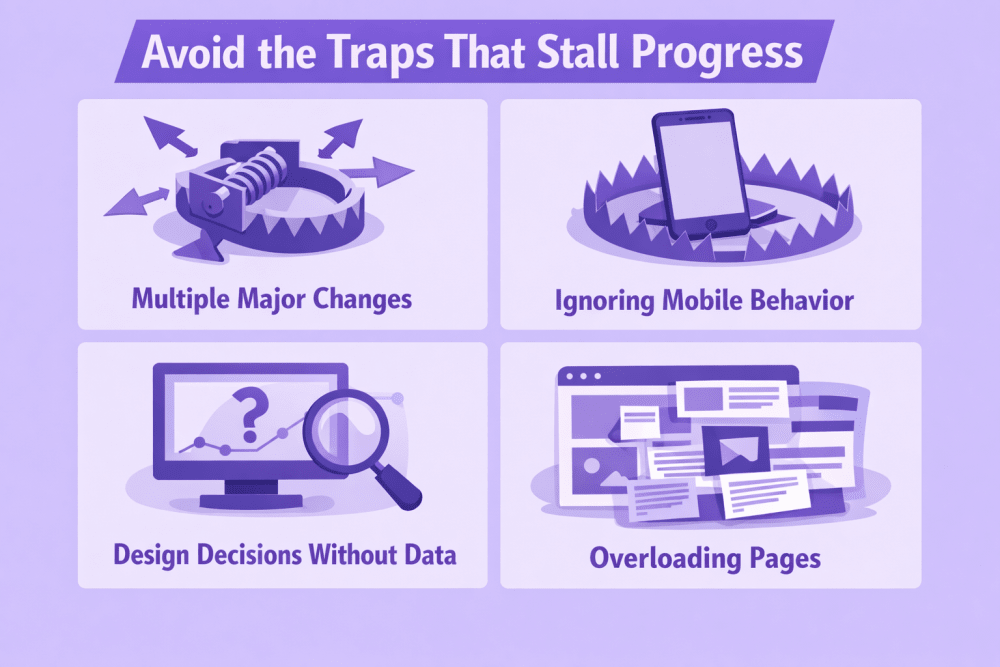
Avoid the Traps That Stall Progress
Even experienced teams fall into predictable mistakes. The most common ones include:
- Running multiple major changes at the same time
- Ignoring mobile behavior
- Making design decisions without data
- Overloading pages with information
- Copying competitors without understanding context
- Stopping after one successful test
Optimization is not a one time win. It is a habit.
Turn Optimization Into a Habit
The strongest teams follow a simple rhythm: analyze data, identify friction, form a clear hypothesis, run a focused test, measure the impact, document insights, and apply what works elsewhere.
One strong result often reveals a broader pattern. If simplifying one form increases conversions, similar simplifications may improve other parts of the journey. When this cycle repeats consistently, improvements compound.
Where Optimization Is Headed
User behavior keeps getting sharper. People research quickly, compare options side by side, and expect a seamless experience on every device. Many visitors now arrive already informed, which means your site has less time to convince and more responsibility to confirm their decision.
That puts more pressure on bottom-of-funnel pages. Pricing must be clear. Value should be obvious. Trust elements need to be visible at the moment of decision. Inconsistent messaging between ads, landing pages, and checkout creates doubt instantly.
The core principles stay the same: clarity, speed, transparency, and structured testing. Tools will change. Human expectations will not.
Final Thoughts
Conversion rate optimization is about making your existing traffic work harder. Not by tricks, but by removing friction, strengthening trust, and guiding users toward clear decisions.
When you understand where people drop off and why, improvements become practical, not theoretical. Small, focused changes often outperform big redesigns. Teams that treat CRO as an ongoing system, not a one time effort, see steady gains over time.
Growth becomes more predictable when the experience is clear, fast, and aligned with user intent.
FAQ
1. What is conversion rate optimization?
Conversion rate optimization is the process of increasing the percentage of visitors who take a specific action on your website, such as making a purchase or submitting a form.
2. Why is CRO important if I already have traffic?
Traffic alone does not guarantee revenue. If visitors are not converting, you are losing potential value. CRO improves performance without increasing acquisition costs.
3. Where should I start with CRO?
Start with your data. Identify where users drop off in the funnel, then focus on the stage with the highest friction.
4. How often should I run tests?
Testing should be continuous but structured. Run focused experiments, measure results properly, and apply what you learn before moving to the next change.
5. Does CRO require advanced tools?
Advanced tools help, but the foundation is clear tracking and disciplined analysis. Even basic analytics can reveal major opportunities if used correctly.
Join the WisePPC Beta and Get Exclusive Access Benefits
WisePPC is now in beta — and we’re inviting a limited number of early users to join. As a beta tester, you'll get free access, lifetime perks, and a chance to help shape the product — from an Amazon Ads Verified Partner you can trust.
 No credit card required
Free in beta and free extra month free after release
25% off for life — limited beta offer
Access metrics Amazon Ads won’t show you
Be part of shaping the product with your feedback
No credit card required
Free in beta and free extra month free after release
25% off for life — limited beta offer
Access metrics Amazon Ads won’t show you
Be part of shaping the product with your feedback