EN
EN  ES
ES  FR
FR  DE
DE  IT
IT  KO
KO  JA
JA  ZH
ZH  AR
AR  PT
PT  TR
TR  PL
PL  ID
ID  VI
VI A Practical Guide to Calculating Percentage Discounts for Online Pricing

Discounts are one of the simplest ways to catch a shopper’s attention. They can increase conversion rates, clear inventory, and help test price sensitivity. But discounts only work when the math is right. A small calculation error can quietly eat into margins or confuse customers.
This guide explains how percentage discounts work, how to calculate them correctly, and how to use them in real selling scenarios without creating pricing problems later.
What a Percentage Discount Really Means
A percentage discount is a reduction based on a portion of the original price. When you offer 20 percent off, you are not subtracting a random amount. You are removing 20 out of every 100 units of the price.
For example, a 20 percent discount equals 0.20 of the original price. Everything that follows in discount pricing builds on this simple idea.
To calculate any percentage-based discount, you only need two numbers:
- The original product price
- The discount percentage you want to apply
Once you have those, the rest is just clean math.
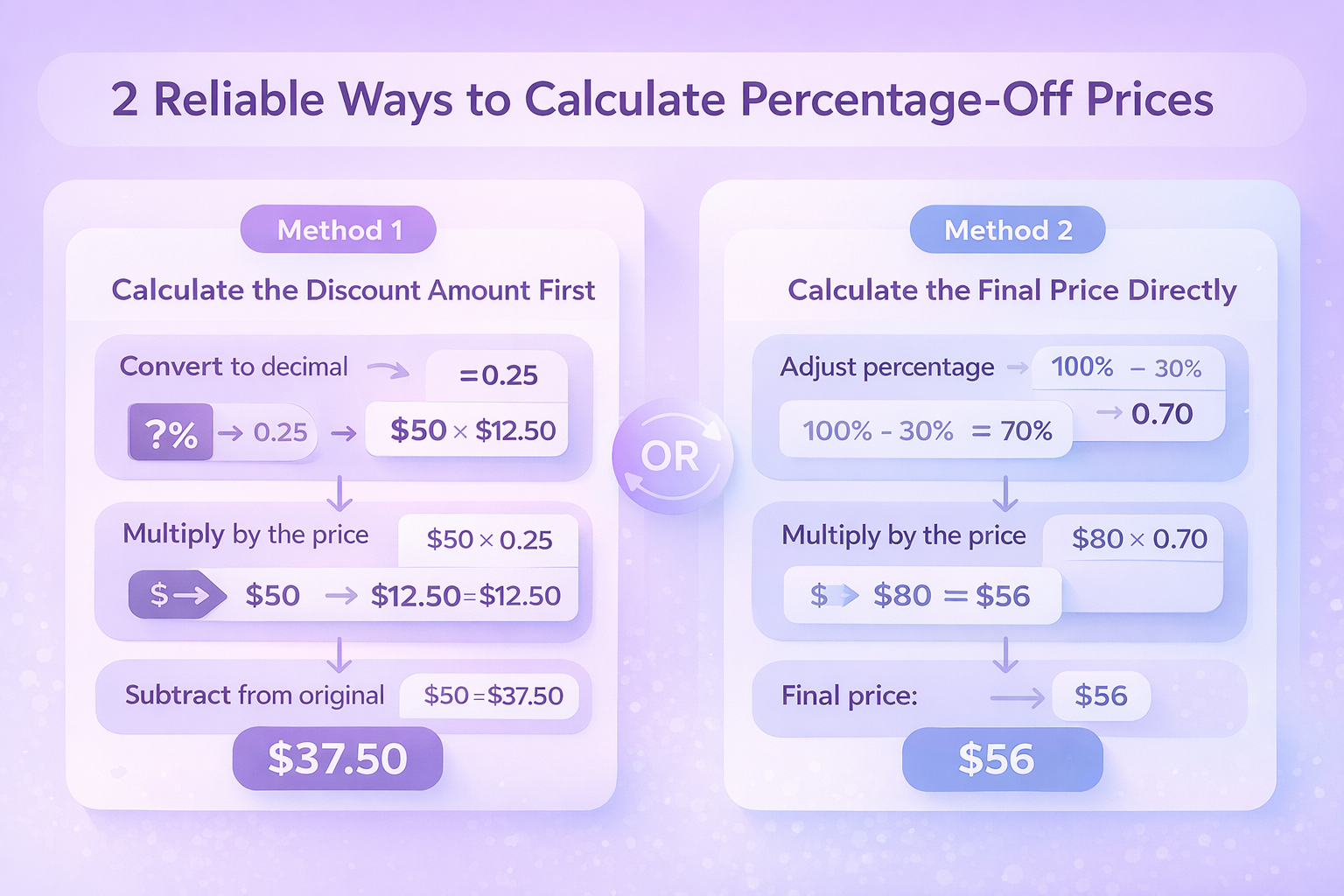
2 Reliable Ways to Calculate Percentage-Off Prices
There are two common methods sellers use. Both are correct. The choice usually comes down to what feels clearer or faster in your workflow.
Method 1: Calculate the Discount Amount First
This approach focuses on figuring out how much you are taking off, then subtracting it from the original price.
Steps:
- Convert the percentage to a decimal by dividing it by 100
- Multiply the original price by that decimal
- Subtract the result from the original price
Example:
- Original price: $50
- Discount: 25 percent
25 divided by 100 equals 0.25
$50 multiplied by 0.25 equals $12.50
$50 minus $12.50 equals $37.50
Final price: $37.50
This method is helpful when you want to see the exact dollar value of the discount.
Method 2: Calculate the Final Price Directly
This method skips the discount amount and goes straight to the final price.
Steps:
- Subtract the discount percentage from 100 percent
- Convert the remaining percentage to a decimal
- Multiply it by the original price
Example:
- Original price: $80
- Discount: 30 percent
100 minus 30 equals 70 percent
70 percent becomes 0.70
$80 multiplied by 0.70 equals $56
Final price: $56
This approach is often faster when setting prices in bulk.
Handling Multiple Discounts the Right Way
Discounts sometimes stack. That is where mistakes often happen.
Sequential Discounts
Sequential discounts are applied one after another. Each discount affects the updated price, not the original.
Example:
- Original price: $100
- First discount: 20 percent
- Second discount: 10 percent
After the first discount: $100 × 0.80 = $80
After the second discount: $80 × 0.90 = $72
Final price: $72
This is common in promotions like “extra 10 percent off already discounted items.”
Combined Discounts
Combined discounts add percentages together and apply them once.
Example:
20 percent plus 10 percent equals 30 percent
$100 × 0.70 = $70
Final price: $70
Important note: sequential and combined discounts are not the same. Mixing them up can lead to larger price cuts than expected.

Tools That Make Discount Calculations Easier
Manual calculations are useful to understand the logic, but most sellers rely on tools to reduce errors.
Spreadsheets
Simple formulas can handle discounts automatically. A common structure looks like:
Original price × (1 − discount percentage)
This works well for bulk pricing and forecasting.
Online Discount Calculators
There are many free calculators designed for retail discounts. They are quick, but always double-check the inputs.
Ecommerce Platform Features
Most ecommerce platforms include built-in promotion tools that calculate discounts for you. For sellers using Amazon, percentage-off promotions and coupon tools can apply discounts automatically while keeping prices consistent across listings.

How We Help Sellers Track and Optimize Discounts at WisePPC
At WisePPC, we focus on what happens after a discount goes live. Calculating a percentage-off price is only the first step. What really matters is how that discount affects sales velocity, ad efficiency, margins, and long-term performance.
We give sellers a clear view of how discounts interact with advertising and organic sales. Instead of relying on short-term snapshots, we store historical data for years, making it possible to compare performance before, during, and after promotions. This helps teams understand whether a discount actually drove incremental sales or simply reduced revenue on purchases that would have happened anyway.
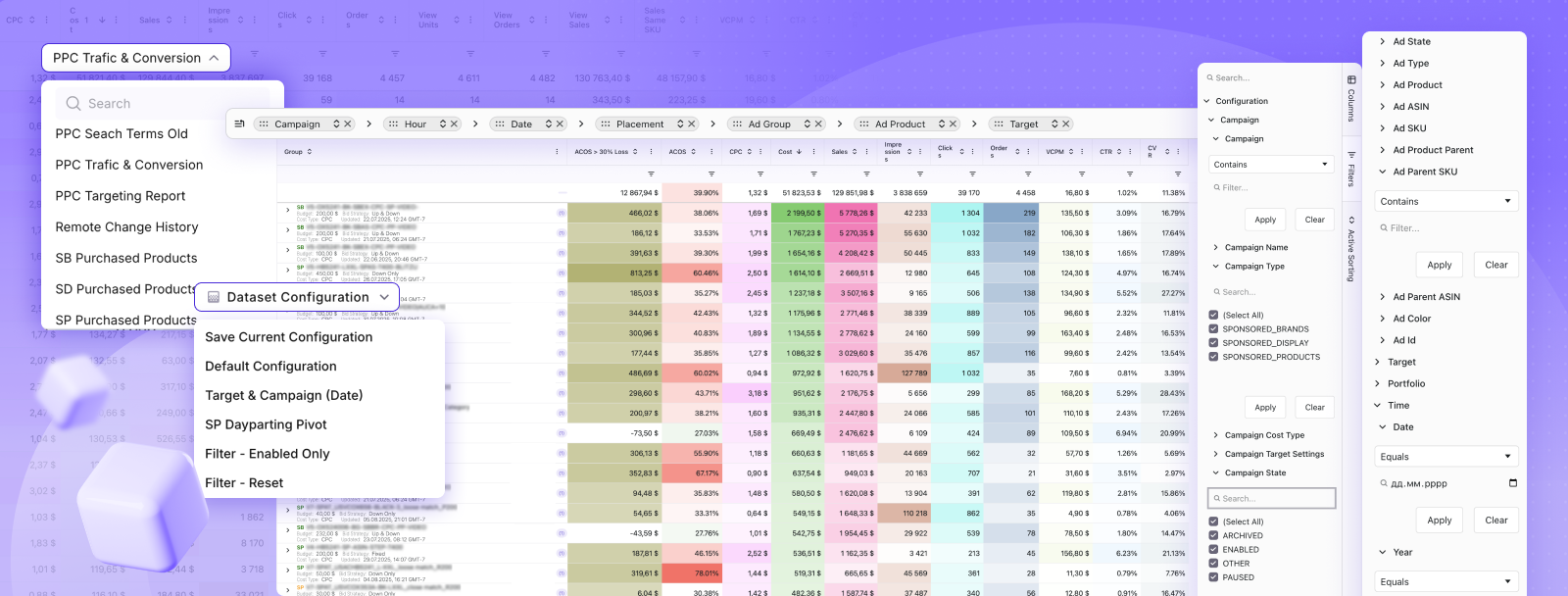
Our platform brings pricing signals, advertising metrics, and sales results into one place. With granular filtering, bulk actions, and visual highlights, sellers can quickly spot when a discounted product starts hurting profitability, inflating ACOS, or pulling spend into low-return campaigns. That visibility makes it easier to adjust bids, pause underperforming targets, or refine promotions while they are still running, not after the damage is done.
When Percentage Discounts Make the Most Sense
Discounts are not just math. Timing and context matter.
Percentage-off pricing tends to work well when:
- Launching a new product and testing demand
- Running short-term promotions or seasonal sales
- Clearing excess inventory
- Competing in price-sensitive categories
For premium or low-margin products, fixed-amount discounts or bundles may work better.
How to Present Discounts Clearly to Customers
Clear pricing builds trust. When customers immediately understand what they are saving and why, they are far less likely to hesitate or question the offer later. On the other hand, confusing or incomplete discount messaging often leads to abandoned carts, returns, or customer support issues.
A few simple practices make a noticeable difference:
- Show both the original price and the discounted price so the savings are obvious at a glance
- Make the percentage discount easy to spot without forcing shoppers to do the math themselves
- Avoid cluttered layouts or overlapping promotions that compete for attention
- Keep discount language straightforward and specific, without fine print hidden behind links
For example, “Save 20 percent when you buy two” sets a clear expectation. Vague phrases like “Special offer” or “Limited deal” do not explain the actual value and often create more confusion than urgency.

Common Pricing Mistakes to Watch For
Math Errors
Even small calculation mistakes can cause real pricing issues. Misplaced decimals, incorrect percentage conversions, or forgetting that stacked discounts compound rather than add up can all lead to deeper discounts than intended. These errors are easy to miss at setup and often only show up later in declining margins or unexpected pricing complaints.
Margin Blind Spots
Discounts are often applied without fully checking how much room the margin actually allows. Using the same percentage across products with very different costs can quickly turn a promotion into a loss leader. This is especially risky when discounts run alongside paid advertising, where reduced prices and ad spend combine.
Technical Oversights
Some of the most expensive mistakes are technical rather than mathematical. Forgetting to set an end date can leave a discount running far longer than planned. Promotions that are not tested before launch may fail silently or apply incorrectly. Inconsistent pricing across sales channels can also confuse customers and weaken trust.
Small errors in any of these areas can undo the benefit of an otherwise well-planned promotion.
Making Discounts Work Long-Term
Discounts should support your business, not train customers to wait for lower prices. The most successful sellers treat discounts as a strategy, not a habit.
Accurate calculations protect margins. Clear communication protects trust. And thoughtful timing turns short-term promotions into long-term growth.
If you understand the math and apply it carefully, percentage-off pricing becomes a reliable tool instead of a risk.
Conclusion
Percentage discounts are simple in theory, but small mistakes in calculation or presentation can quickly create bigger problems. When prices are calculated correctly and communicated clearly, discounts become a controlled tool rather than a risk.
The key is consistency. Use the same logic every time, double-check the math, and make sure discounts fit your margins before they go live. Just as important, track what happens after a promotion starts. Discounts should support growth, not quietly reduce profitability or distort performance data.
When pricing decisions are based on clear calculations and real results, percentage-off promotions can work exactly as intended.
FAQ
What is a percentage discount in online pricing?
A percentage discount reduces the original price by a set portion of its value. For example, a 20 percent discount removes 20 out of every 100 units of the price.
What is the easiest way to calculate a percentage-off price?
The simplest method is multiplying the original price by one minus the discount percentage expressed as a decimal. This gives the final price directly.
Are sequential discounts the same as combined discounts?
No. Sequential discounts apply one after another and usually result in a smaller final price reduction than adding percentages together.
Should discounts be applied before or after advertising costs?
Discounts should be calculated based on product pricing and margins first. Advertising costs should then be evaluated to ensure the promotion remains profitable.
Why do pricing mistakes often happen during promotions?
Most errors come from rushed setup, incorrect percentage conversions, or not testing promotions before launch.
Join the WisePPC Beta and Get Exclusive Access Benefits
WisePPC is now in beta — and we’re inviting a limited number of early users to join. As a beta tester, you'll get free access, lifetime perks, and a chance to help shape the product — from an Amazon Ads Verified Partner you can trust.
 No credit card required
Free in beta and free extra month free after release
25% off for life — limited beta offer
Access metrics Amazon Ads won’t show you
Be part of shaping the product with your feedback
No credit card required
Free in beta and free extra month free after release
25% off for life — limited beta offer
Access metrics Amazon Ads won’t show you
Be part of shaping the product with your feedback